2016 TOYOTA MIRAI traction motor
[x] Cancel search: traction motorPage 8 of 464
8
MIRAI_OM_USA_OM62004UYour Toyota is equipped with several sophisticated computers that will record
certain data, such as:
• Electric motor speed (traction motor speed)
• Accelerator status
• Brake status
• Vehicle speed
• Shift position
• Traction battery status
The recorded data varies according to the vehicle grade level and options
with which it is equipped. Furthermore, these computers do not record con-
versations, sounds or pictures.
●Data usage
Toyota may use the data recorded in these computers to diagnose malfunc-
tions, conduct research and development, and improve quality.
Toyota will not disclose the recorded data to a third party except:
• With the consent of the vehicle owner or with the consent of the lessee if the vehicle is leased
• In response to an official request by the police, a court of law or a govern-
ment agency
• For use by Toyota in a lawsuit
• For research purposes where the data is not tied to a specific vehicle or
vehicle owner
●Usage of data collected through Safety Connect (U.S.mainland only)
If your Toyota has Safety Connect and if you have subscribed to those ser-
vices, please refer to the Safety Connect Telematics Subscription Service
Agreement for information on data collected and its usage.
Vehicle data recordings
Page 78 of 464
782. Fuel cell vehicle
MIRAI_OM_USA_OM62004U
Fuel cell vehicle characteristics
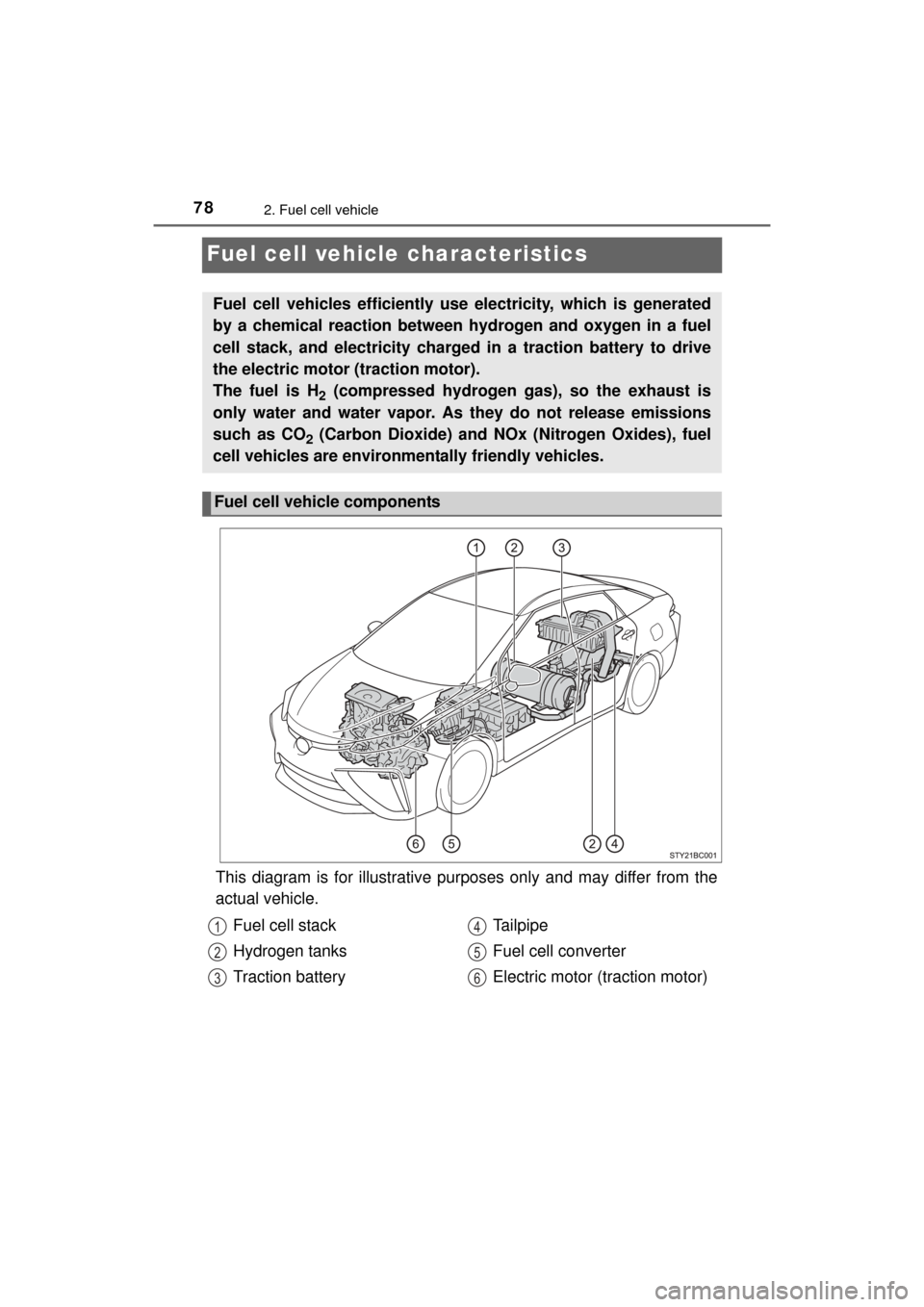
This diagram is for illustrative purposes only and may differ from the
actual vehicle.
Fuel cell vehicles efficiently use electricity, which is generated
by a chemical reaction between hydrogen and oxygen in a fuel
cell stack, and electricity charged in a traction battery to drive
the electric motor (traction motor).
The fuel is H
2 (compressed hydrogen gas), so the exhaust is
only water and water vapor. As they do not release emissions
such as CO
2 (Carbon Dioxide) and NOx (Nitrogen Oxides), fuel
cell vehicles are environm entally friendly vehicles.
Fuel cell vehicle components
Fuel cell stack
Hydrogen tanks
Traction battery Tailpipe
Fuel cell converter
Electric motor (traction motor)1
2
3
4
5
6
Page 79 of 464
792. Fuel cell vehicle
2
Fuel cell system
MIRAI_OM_USA_OM62004U
The electric motor (traction motor) allows smooth, powerful takeoff
and acceleration. This vehicle drives similarly to a gasoline vehicle
without any special actions by the driver. ( P. 158) As there are no
engine sounds and the vehicle is qu iet, operation noises unique to
fuel cell vehicle components may be heard. ( P. 80)
The system may behave differently on cold days. It is performing a
special cold-start process to improve start-up performance. ( P. 175)
Operation noises ( P. 80), purge process ( P. 175), etc., differ from
usual. However, this is not a malfunction.
Compressed hydrogen gas fuel can be filled at hydrogen stations.
Opening the fuel door (P. 198)
Driving the vehicle
Fuel cell system
Fuel filling
Page 80 of 464

802. Fuel cell vehicle
MIRAI_OM_USA_OM62004U
■Sounds unique to the fuel cell vehicle
Due to the design of your fuel cell vehicle, there are various relays, valves
and pumps which under normal driving conditions will produce sounds. This
is a normal characteristic of the vehicle and does not indicate a malfunction.
Furthermore, way of hearing may differ based on usage environment or con-
dition.
Noticeable soundsSource of the sounds
Clunking, clicking and clack-
ingOperation of relays and hydrogen tank
valves
Sounds may come from under the floor or
behind the rear seats.
(Sounds may be heard when starting the
fuel cell system.)
KnockingThe parking lock is engaged
Sounds may come from the motor
compartment.
(Sounds may be heard when press the P
position switch or stopping the fuel cell
system.)
Whooshing, squealingGas is flowing through the nozzle and
valvesSounds may come from behind the rear
seats, or from the dispenser hose/nozzle.
(Sounds may be heard when filling the
fuel.)
• High pitch sound
• Gurgle sound
• Pulsing soundOperation of the pumpsSounds may come from the motor com-
partment or under the front seats.
(In particular, sounds may be heard when
starting the fuel cell system, accelerating
from a stop, or press the H
2O switch. The
sound may be louder when in Br mode or
when the vehicle decelerates during
dynamic radar cruise control.)
Humming soundOperation of the pumps are speeding up
Sounds may come from the motor com-
partment or under the front seats.
(In particular, sounds may be heard when
accelerating or decelerating.)
Whooshing sound Operation of the hydrogen injectorSounds may come from under the front
seats or behind the rear seats.
(In particular, sounds may be heard when
starting the fuel cell system, driving at low
speeds, or charging the traction battery.)
Page 81 of 464
812. Fuel cell vehicle
2
Fuel cell system
MIRAI_OM_USA_OM62004U■
Regenerative braking
In the following situations, the vehicle generates electricity from the decelera-
tion of the vehicle while driving.
●The accelerator pedal is released while driving with the shift position in D.
● The brake pedal is depressed while driving with the shift position in D.
■ Charging the traction battery
Because electricity generated by the fuel cell stack and regenerative braking
charges the traction battery, the battery does not need to be charged from an
outside source. However, if the vehicle is left parked for a long time, the trac-
tion battery will slowly discharge. For this reason, be sure to drive the vehicle
at least once every few months for at least 30 minutes or 10 miles (16 km).
If the traction battery becomes fully discharged and you are unable to start
the fuel cell system, contact your Toyota dealer.
■ Charging the 12-volt battery
P. 403
■ Parking
Because there is no engine sound or vibration, it is easy to mistake the fuel
cell vehicle for being off when it is actually still running, as indicated by the
“READY” indicator being illuminated. For safety, make sure to always shift the
shift position to P and apply the parking brake when parked.
■ Maintenance, repair, recycling, and disposal
Contact your Toyota dealer regarding maintenance, repair, recycling, and dis-
posal. Do not dispose of the vehicle or any of its components yourself.
• Humming sound
• High pitch soundOperation of the motor
Sounds may come from the motor com-
partment.
(In particular, sounds may be heard when
accelerating or decelerating.)
Blowing and draining soundExhaust water or air is being purgedSounds may come from the rear of the
vehicle.
May also occur periodically while parked
when it is cold to prevent freezing.
(Sounds may be heard when vehicle is
stopped, fuel cell system is stopped, park-
ing.)
Noticeable soundsSource of the sounds
Page 83 of 464

832. Fuel cell vehicle
2
Fuel cell system
MIRAI_OM_USA_OM62004U
The fuel cell vehicle has high-voltage components (about 650 V maxi-
mum) such as a fuel cell stack, traction battery, power control unit,
high-voltage cables (which are distinguished from low-voltage cables
by their orange covers), electric motor (traction motor), etc., and high-
temperature parts such as the radiator for cooling. Pay attention to all
warning labels attached to the vehicle.
This diagram is for illustrative purposes only and may differ from the
actual vehicle.
High-voltage and high-temperature components
Warning label
Power control unit
High-voltage cables (orange)
Fuel cell stack
Traction battery
Service plug
Fuel cell converter Electric motor (traction motor)
Air conditioning compressor
Radiator for inverter cooling
Radiator for fuel cell stack
cooling
Auxiliary inverter
Cabin coolant heater1
2
3
4
5
6
7
8
9
10
11
12
13
Page 91 of 464
912. Fuel cell vehicle
2
Fuel cell system
MIRAI_OM_USA_OM62004U
WARNING
■Tailpipe
●Do not directly touch the water or steam coming out of the tailpipe. Doing
so may cause low-temperature burns.
● The fuel cell vehicle generates wate r during power generation. The gener-
ated water discharged from the tailpipe is not suitable for drinking. Never
drink the water coming out of the tailpipe.
● You may notice a strange odor from the tailpipe for a while after the pur-
chase of a new vehicle or after an extended period of non-use, but this is
not a malfunction. Also, the odor is harmless but it may be unpleasant, so
do not breathe in the exhaust.
■ High-voltage and high-temperature precautions
This vehicle is equipped with a high-voltage system. Follow the instructions
below as high-voltages can cause severe burns and electric shock that may
result in death or serious injury.
●Never touch, disassemble, remove, or replace the high-voltage parts,
cables (orange), or connectors.
● The components inside the motor compartment will become hot during
operation. Be careful of both the high-voltage and high-temperature, and
always obey the warning labels on the vehicle.
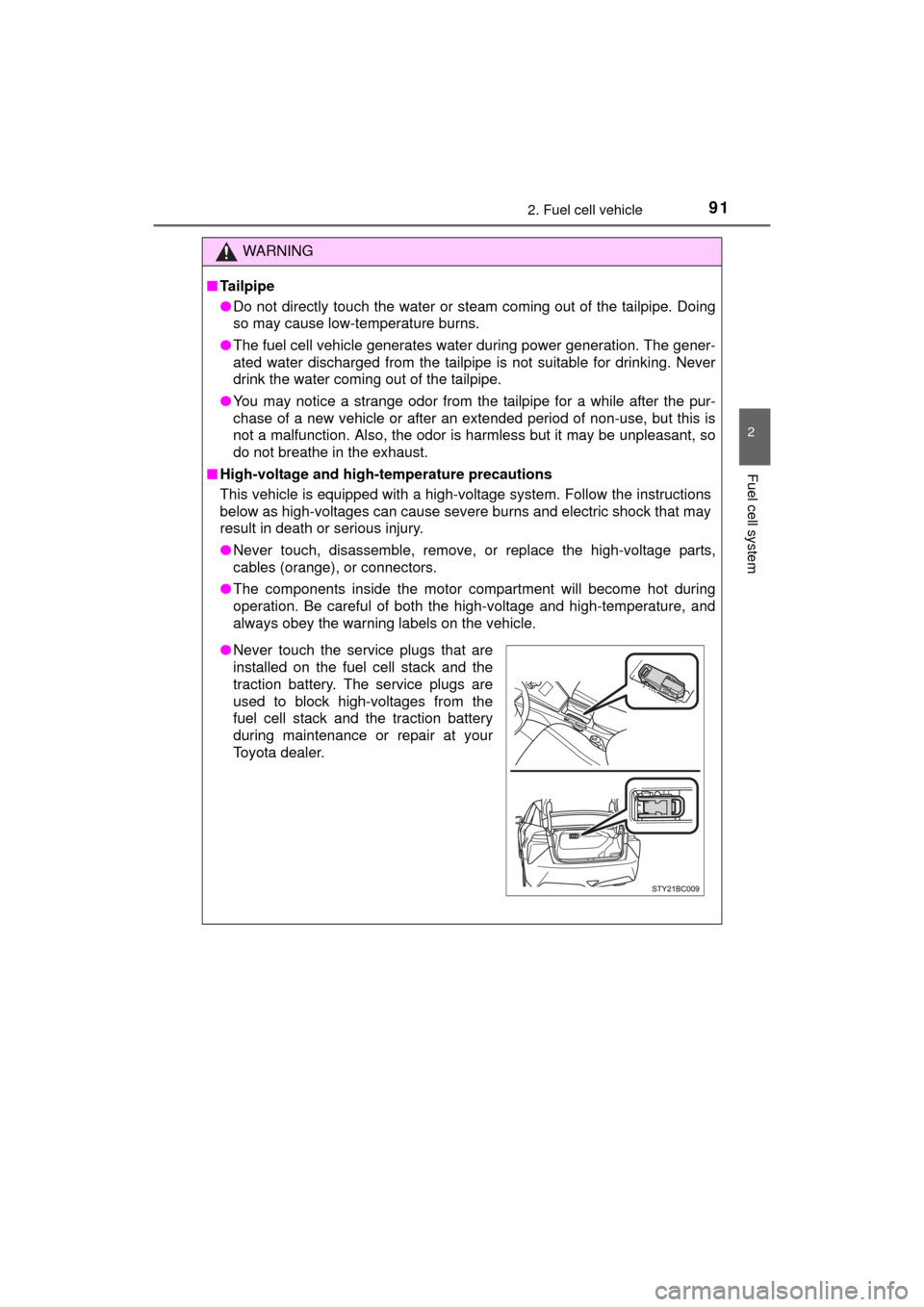
●Never touch the service plugs that are
installed on the fuel cell stack and the
traction battery. The service plugs are
used to block high-voltages from the
fuel cell stack and the traction battery
during maintenance or repair at your
Toyota dealer.
Page 92 of 464
922. Fuel cell vehicle
MIRAI_OM_USA_OM62004U
WARNING
■Precautions in case of an accident
In the event of an accident, observe the following precautions. Failure to do
so can cause fire or electric shocks, resulting in death or serious injury.
●Stop the vehicle in a safe place to prevent subsequent accidents. Shift the
shift position to P and apply the parking brake.
● Check for hydrogen gas leakage.
Hydrogen leaks will cause a warning message to be shown on the multi-
information display. Larger leaks may also be audible.
● If a large amount of hydrogen gas leaking is noticed, turn off the power
switch, exit the vehicle, and stay far away from it. Display warning signs
and keep sources of fire away from the vehicle. If possible, get assistance.
When the above is done, immediately contact your Toyota dealer.
● Do not touch the high-voltage parts, cables (orange), or connectors.
● If electric wires are exposed inside or outside your vehicle, an electric
shock may occur. Never touch exposed electric wires.
● If a fluid leak occurs, do not touch the fluid as it may be the strong alkaline
electrolyte from the traction battery. If it comes into contact with your skin
or eyes, wash it off immediately with a large amount of water, and seek
immediate medical attention.
● If a vehicle fire occurs, extinguish it with a Class A, B, or C fire extin-
guisher. If using water, apply a large amount from a hydrant.
● In case of a vehicle fire, the hydrogen gas in the hydrogen tanks is
released via the hydrogen tank valves toward the rear of the vehicle
angled downward, in order to reduce the damage to the hydrogen tanks.
Keep away from the vehicle.
● If your vehicle needs to be towed, do so with the front wheels lifted. If the
wheels are touching the ground, the electric motor (traction motor) may
continue to generate electricity. This may cause a fire.