Page 485 of 620

4857-3. Do-it-yourself maintenance
7
Maintenance and care
COROLLA_TMMMS_TMMC_U (OM12J84U)n
Replacing the following bulbs
If any of the lights listed below
has burnt out, have it replaced by
your Toyota dealer.
l Headlight low beams/daytime running lights
l High mounted stoplights
l Side turn signal lights (if equipped)
nLED light bulbs
The high mounted stoplights and headlight low beams/daytime running lights
consist of a number of LEDs. If any of the LEDs burns out, take your vehicle
to your Toyota dealer to have the light replaced.
n Condensation build-up on the inside of the lens
Temporary condensation build-up on the inside of the headlight lens does not
indicate a malfunction.
Contact your Toyota dealer for more information in the following situations:
lLarge drops of water have built up on the inside of the lens.
l Water has built up inside the headlight.
CAUTION
n Replacing light bulbs
lTurn off the lights. Do not attempt to replace the bulb immediately after
turning off the lights.
The bulbs become very hot and may cause burns.
l Do not touch the glass portion of the light bulb with bare hands. When it is
unavoidable to hold the glass portion, use and hold with a clean dry cloth
to avoid getting moisture and oils on the bulb.
Also, if the bulb is scratched or dropped, it may blow out or crack.
l Fully install light bulbs and any parts used to secure them. Failure to do so
may result in heat damage, fire, or water entering the headlight unit. This
may damage the headlights or cause condensation to build up on the lens.
n To prevent damage or fire
Make sure bulbs are fully seated and locked.
Page 488 of 620
488
COROLLA_TMMMS_TMMC_U (OM12J84U)
8-1. Essential information
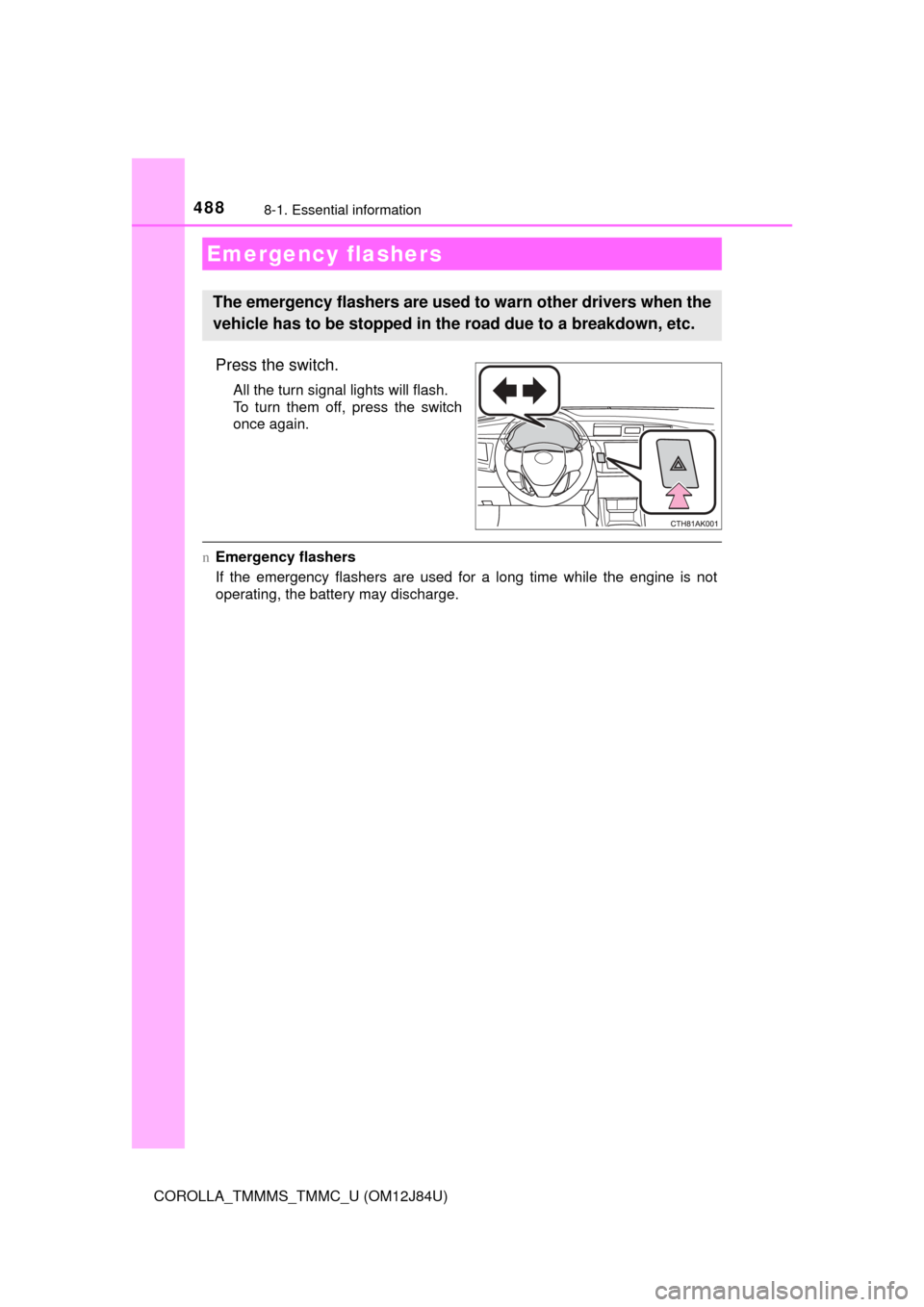
Press the switch.
All the turn signal lights will flash.
To turn them off, press the switch
once again.
nEmergency flashers
If the emergency flashers are used for a long time while the engine is not
operating, the battery may discharge.
Emergency flashers
The emergency flashers are used to warn other drivers when the
vehicle has to be stopped in th e road due to a breakdown, etc.
Page 498 of 620

4988-2. Steps to take in an emergency
COROLLA_TMMMS_TMMC_U (OM12J84U)
If a warning light turns on or a warning
buzzer sounds
Calmly perform the following actions if any of the warning lights
comes on or flashes. If a light comes on or flashes, but then
goes off, this does not necessarily indicate a malfunction in the
system. However, if this continues to occur, have the vehicle
inspected by your Toyota dealer.
Warning light and warning buzzer list
Warning lightWarning light/Details/Actions
(U.S.A.)
(Canada)
Brake system warning light (warning buzzer)*1
Indicates that:
• The brake fluid level is low; or
• The brake system is malfunctioning This light also comes on when the parking brake is not
released. If the light turns off after the parking brake is
fully released the system is operating normally.
Immediately stop the vehicle in a safe place and con-
tact your Toyota dealer. Continuing to drive the vehi-
cle may be dangerous.
Charging system warning light*3
Indicates a malfunction in the vehicle’s charging system
Immediately stop the vehicle in a safe place and con-
tact your Toyota dealer.
Low engine oil pressure warning light*3
Indicates that the engine oil pressure is too low.
Immediately stop the vehicle in a safe place and con-
tact your Toyota dealer.
and
High engine coolant temperature warning light*3
Indicates that the engine is almost overheating. ( P. 543)
Immediately stop the vehicle in a safe place and con-
tact your Toyota dealer.
Page 507 of 620
5078-2. Steps to take in an emergency
8
When trouble arises
COROLLA_TMMMS_TMMC_U (OM12J84U)
CAUTION
nIf both the ABS and the brake system warning lights remain on
Stop your vehicle in a safe place immediately and contact your Toyota
dealer. The vehicle will become extrem ely unstable during braking, and the
ABS system may fail, which could cause an accident resulting in death or
serious injury.
n When the electric power steerin g system warning light comes on
The steering wheel may become extremely heavy.
If the steering wheel becomes heavie r than usual when operating, hold
firmly and operate using more force than usual.
n
If the tire pressure warning light comes on (vehicles with a tire
pressure warning system)
Be sure to observe the following precautions. Failure to do so could
cause a loss of vehicle control and result in death or serious injury.
lStop your vehicle in a safe place as soon as possible. Adjust the tire
inflation pressure immediately.
lIf the tire pressure warning light comes on even after tire inflation pres-
sure adjustment, it is probable that you have a flat tire. Check the tires.
If a tire is flat, change it with th e spare tire and have the flat tire
repaired by the nearest Toyota dealer.
lAvoid abrupt maneuvering and braking. If the vehicle tires deteriorate,
you could lose control of the steering wheel or the brakes.
nIf a blowout or sudden air leakage should occur (vehicles with a tire
pressure warning system)
The tire pressure warning system may not activate immediately.
Page 511 of 620

5118-2. Steps to take in an emergency
8
When trouble arises
COROLLA_TMMMS_TMMC_U (OM12J84U)
Indicates a malfunction in the vehicle’s charging
system.
Immediately stop the vehicle in a safe place
and contact your Toyota dealer. Continuing
to drive the vehicle may be dangerous.
Indicates a malfunction in the smart key system
(if equipped). A buzzer also sounds.
Have the vehicle inspected by your Toyota
dealer.
Indicates a malfunction in the cruise control sys-
tem (if equipped). • Press the “ON-OFF” button once to deacti-
vate the system, and then press the button
again to reactivate the system.
• A buzzer also sounds.
Have the vehicle inspected by your Toyota
dealer.
Indicates abnormal engine oil pressure.
The warning message is shown if the engine oil
pressure is too low.
Immediately stop the vehicle in a safe place
and contact your Toyota dealer. Continuing
to drive the vehicle may be dangerous.
Vehicles without a smart key system:
Indicates that the engine switch is turned off or
turned to the “ACC” position mode and the
driver’s door is opened while the lights are turned
on. A buzzer also sounds.
Turn the lights off.
Vehicles with a smart key system:
Indicates that the engine switch is turned off or
turned to ACCESSORY mode and the driver’s
door is opened while the lights are turned on. A buzzer also sounds.
Turn the lights off.
Warning messageDetails/Actions
(Flashes)
(Flashes)
Page 532 of 620
5328-2. Steps to take in an emergency
COROLLA_TMMMS_TMMC_U (OM12J84U)
One of the following may be the cause of the problem:
lThere may not be sufficient fuel in the vehicle’s tank.
Refuel the vehicle.
l The engine may be flooded.
Try to restart the engine again following correct starting procedures.
( P. 168)
l There may be a malfunction in the engine immobilizer system.
( P. 66)
One of the following may be the cause of the problem:
l The battery may be discharged. ( P. 538)
l The battery terminal connections may be loose or corroded.
The engine starting system may be malfunctioning due to an electrical
problem such as electronic key battery depletion or a blown fuse.
However, an interim measure is available to start the engine.
( P. 533)
If the engine will not start
If the engine will not start even though correct starting proce-
dures are being followed ( P. 165, 168), consider each of the fol-
lowing points:
The engine will not start even though the starter motor operates
normally.
The starter motor turns over slowly, the interior lights and head-
lights are dim, or the horn does not sound or sounds at a low
volume.
The starter motor does not turn over (vehicles with a smart key
system)
Page 533 of 620

5338-2. Steps to take in an emergency
8
When trouble arises
COROLLA_TMMMS_TMMC_U (OM12J84U)
One of the following may be the cause of the problem:
lOne or both of the battery terminals may be disconnected.
l The battery may be discharged. ( P. 538)
l There may be a malfunction in the steering lock system (vehicles
with a smart key system).
Contact your Toyota dealer if the problem cannot be repaired, or if repair
procedures are unknown.
When the engine does not start, the following steps can be used as an
interim measure to start the engine if the engine switch is functioning
normally:
Set the parking brake.
Shift the shift lever to P (continuously variable transmission) or N
(manual transmission).
Turn the engine switch to ACCESSORY mode.
Press and hold the engine switch for about 15 seconds while
depressing the brake pedal and cl utch pedal (manual transmission)
firmly.
Even if the engine can be started using the above steps, the system
may be malfunctioning. Have the v ehicle inspected by your Toyota
dealer.
The starter motor does not turn ov er, the interior lights and head-
lights do not turn on, or the horn does not sound.
Emergency start function (vehicles with a smart key system)
1
2
3
4
Page 541 of 620

5418-2. Steps to take in an emergency
8
When trouble arises
COROLLA_TMMMS_TMMC_U (OM12J84U)
nStarting the engine when the battery is discharged
The engine cannot be started by push-starting.
n To prevent battery discharge
lTurn off the headlights and the audio system while the engine is off.
l Turn off any unnecessary electrical components when the vehicle is running
at a low speed for an extended period, such as in heavy traffic.
n Charging the battery
The electricity stored in the battery will discharge gradually even when the
vehicle is not in use, due to natural discharge and the draining effects of cer-
tain electrical appliances. If the vehicle is left for a long time, the battery may
discharge, and the engine may be unable to start. (The battery recharges
automatically during driving.)
n When recharging or replacing the battery
lVehicles with a smart key system: In some cases, it may not be possible to
unlock the doors using the smart key system when the battery is dis-
charged. Use the wireless remote control or the mechanical key to lock or
unlock the doors.
l The engine may not start on the first attempt after the battery has recharged
but will start normally after the second attempt. This is not a malfunction.
l Vehicles with a smart key system: The engine switch mode is memorized by
the vehicle. When the battery is reconnected, the system will return to the
mode it was in before the battery was discharged. Before disconnecting the
battery, turn the engine switch off.
If you are unsure what mode the engine switch was in before the battery dis-
charged, be especially careful when reconnecting the battery.
l Make sure that the key is not inside the vehicle when recharging or replac-
ing the battery. The key may be locked in the vehicle if the alarm is acti-
vated. ( P. 69)