Page 418 of 572
4187-3. Do-it-yourself maintenance
CAMRY_HV_U (OM33C35U)
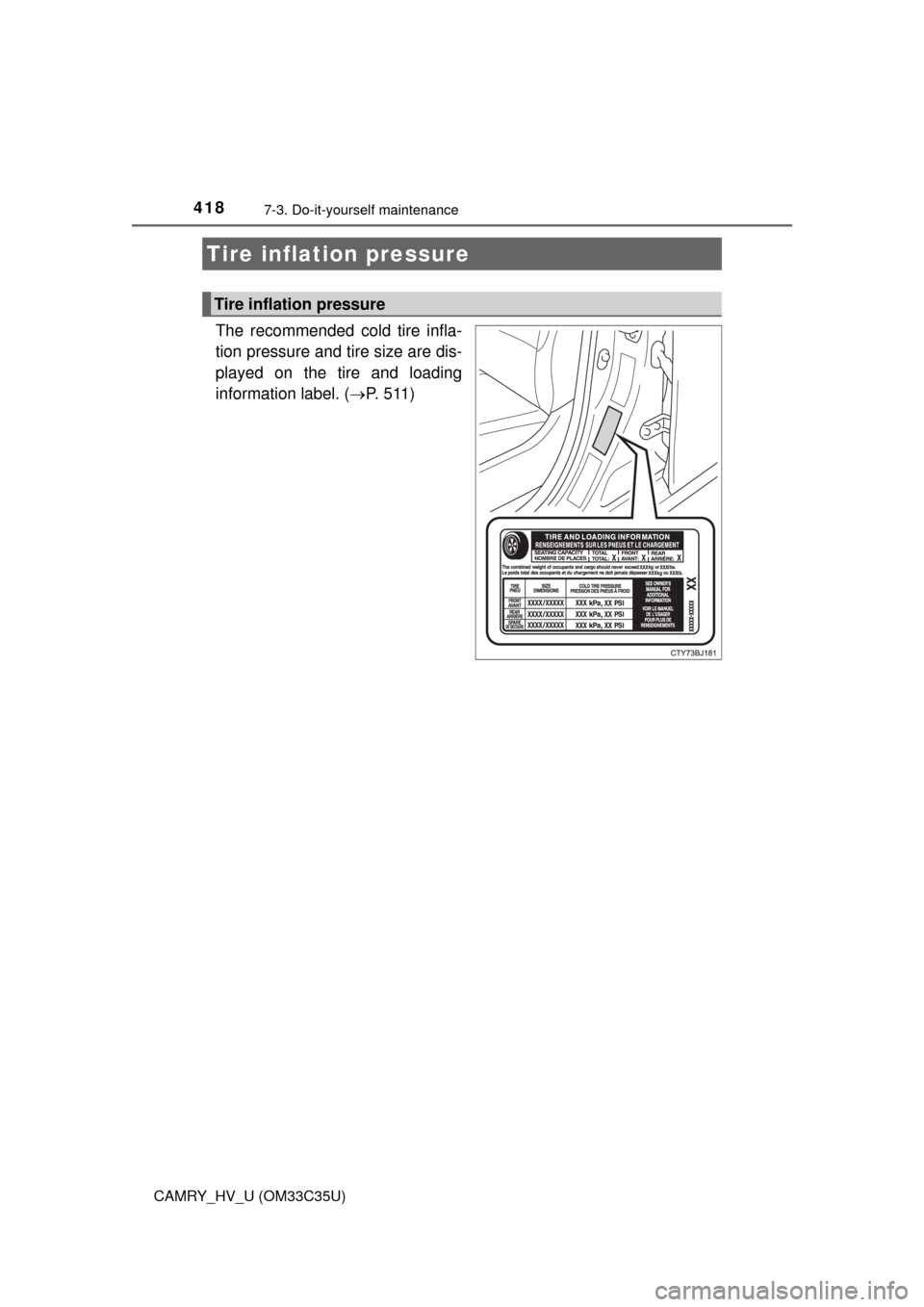
The recommended cold tire infla-
tion pressure and tire size are dis-
played on the tire and loading
information label. (P. 5 1 1 )
Tire inflation pressure
Tire inflation pressure
Page 419 of 572
4197-3. Do-it-yourself maintenance
7
Maintenance and care
CAMRY_HV_U (OM33C35U)
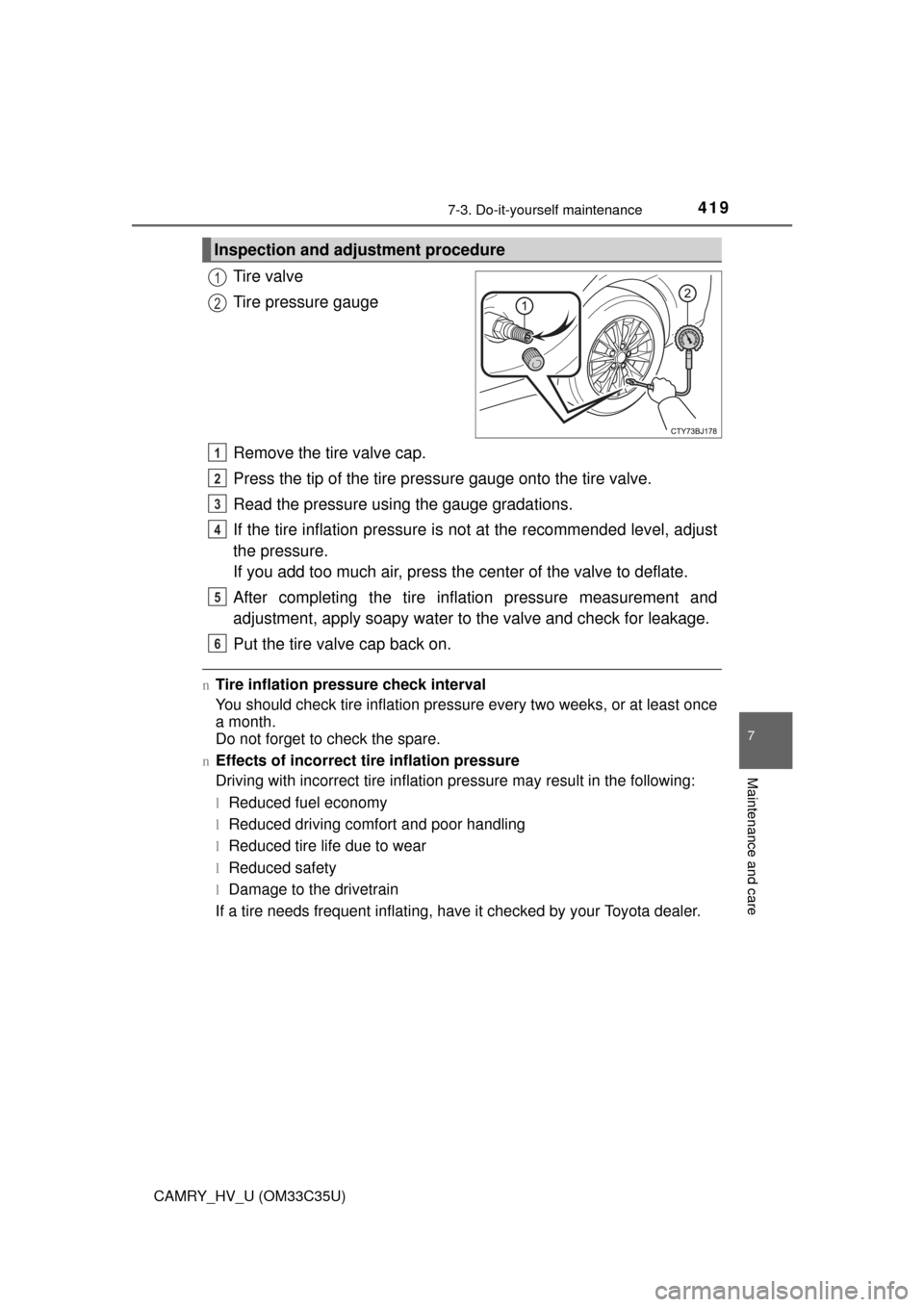
Tire valve
Tire pressure gauge
Remove the tire valve cap.
Press the tip of the tire pressure gauge onto the tire valve.
Read the pressure usi ng the gauge gradations.
If the tire inflation pressure is not at the recommended level, adjust
the pressure.
If you add too much air, press the center of the valve to deflate.
After completing the tire inflation pressure measurement and
adjustment, apply soapy water to the valve and check for leakage.
Put the tire valve cap back on.
nTire inflation pressure check interval
You should check tire inflation pressure every two weeks, or at least once
a month.
Do not forget to check the spare.
nEffects of incorrect tire inflation pressure
Driving with incorrect tire inflation pressure may result in the following:
lReduced fuel economy
lReduced driving comfort and poor handling
lReduced tire life due to wear
lReduced safety
lDamage to the drivetrain
If a tire needs frequent inflating, have it checked by your Toyota dealer.
Inspection and adjustment procedure
1
2
1
2
3
4
5
6
Page 420 of 572

4207-3. Do-it-yourself maintenance
CAMRY_HV_U (OM33C35U)n
Instructions for checking tire inflation pressure
When checking tire inflation pressure, observe the following:
lCheck only when the tires are cold.
If your vehicle has been parked for at least 3 hours or has not been
driven for more than 1 mile or 1.5 km, you will get an accurate cold tire
inflation pressure reading.
lAlways use a tire pressure gauge.
It is difficult to judge if a tire is properly inflated based only on its appear-
ance.
lIt is normal for the tire inflation pressure to be higher after driving as
heat is generated in the tire. Do not
reduce tire inflation pressure after
driving.
lNever exceed the vehicle capacity weight.
Passengers and luggage weight should be placed so that the vehicle is
balanced.
WARNING
nProper inflation is critical to save tire performance
Keep your tires properly inflated.
If the tires are not properly inflated, the following conditions may occur
which could lead to an accident resulting in death or serious injury:
lExcessive wear
lUneven wear
lPoor handling
lPossibility of blowouts result ing from overheated tires
lAir leaking from between tire and wheel
lWheel deformation and/or tire damage
lGreater possibility of tire damage while driving (due to road hazards,
expansion joints, sharp edges in the road, etc.)
NOTICE
nWhen inspecting and adjusting tire inflation pressure
Be sure to put the tire valve caps back on.
If a valve cap is not installed, dirt or moisture may get into the valve and
cause an air leak, resulting in decreased tire inflation pressure.
Page 421 of 572
4217-3. Do-it-yourself maintenance
7
Maintenance and care
CAMRY_HV_U (OM33C35U)
When replacing wheels, care should be taken to ensure that they are
equivalent to those removed in load capacity, diameter, rim width and
inset
*.
Replacement wheels are available at your Toyota dealer.
*: Conventionally referred to as “offset”.
Toyota does not recommend using the following:
l Wheels of different sizes or types
l Used wheels
l Bent wheels that have been straightened
l Use only Toyota wheel nuts and wrenches designed for use with
your aluminum wheels.
l When rotating, repairing or changi ng your tires, check that the
wheel nuts are still tight after driving 1000 miles (1600 km).
l Be careful not to damage the aluminum wheels when using tire
chains.
l Use only Toyota genuine balance weights or equivalent and a plas-
tic or rubber hammer when balancing your wheels.
nWhen replacing wheels (vehicles with a tire pressure warning sys-
tem)
The wheels of your vehicle are equipped with tire pressure warning
valves and transmitters that allow the tire pressure warning system to
provide advance warning in the event of a loss in tire inflation pressure.
Whenever wheels are replaced, tire pressure warning valves and trans-
mitters must be installed. ( P. 409)
Wheels
If a wheel is bent, cracked or heavily corroded, it should be
replaced. Otherwise, the tire may separate from the wheel or
cause a loss of handling control.
Wheel selection
Aluminum wheel precautions (if equipped)
Page 439 of 572
439
8When trouble arises
CAMRY_HV_U (OM33C35U)8-1. Essential information
Emergency flashers .......... 440
If your vehicle has to be stopped in an
emergency ...................... 441
8-2. Steps to take in an emergency
If your vehicle needs to be towed ......................... 442
If you think something is wrong .............................. 445
If a warning light turns on or a warning buzzer
sounds ............................ 446
If a warning message or indicator is displayed ...... 455
If you have a flat tire.......... 473
If the hybrid system will not start ..................... 484
If the shift lever cannot be shifted from P ............. 486
If the electronic key does not operate
properly ........................... 487
If the vehicle 12-volt battery is discharged ....... 490
If your vehicle overheats ........................ 496
If the vehicle becomes stuck ............................... 500
Page 445 of 572
4458-2. Steps to take in an emergency
8
When trouble arises
CAMRY_HV_U (OM33C35U)
lFluid leaks under the vehicle.
(Water dripping from the air co nditioning after use is normal.)
l Flat-looking tires or uneven tire wear
l Engine coolant temperature gauge needle continually points higher
than normal
l Changes in exhaust sound
l Excessive tire squeal when cornering
l Strange noises related to the suspension system
l Pinging or other noises related to the hybrid system
l Engine missing, stumbling or running roughly
l Appreciable loss of power
l Vehicle pulls heavily to one side when braking
l Vehicle pulls heavily to one side when driving on a level road
l Loss of brake effectiveness, spon gy feeling, pedal almost touches
the floor
If you think something is wrong
If you notice any of the follow ing symptoms, your vehicle proba-
bly needs adjustment or repair. Contact your Toyota dealer as
soon as possible.
Visible symptoms
Audible symptoms
Operational symptoms
Page 448 of 572
4488-2. Steps to take in an emergency
CAMRY_HV_U (OM33C35U)
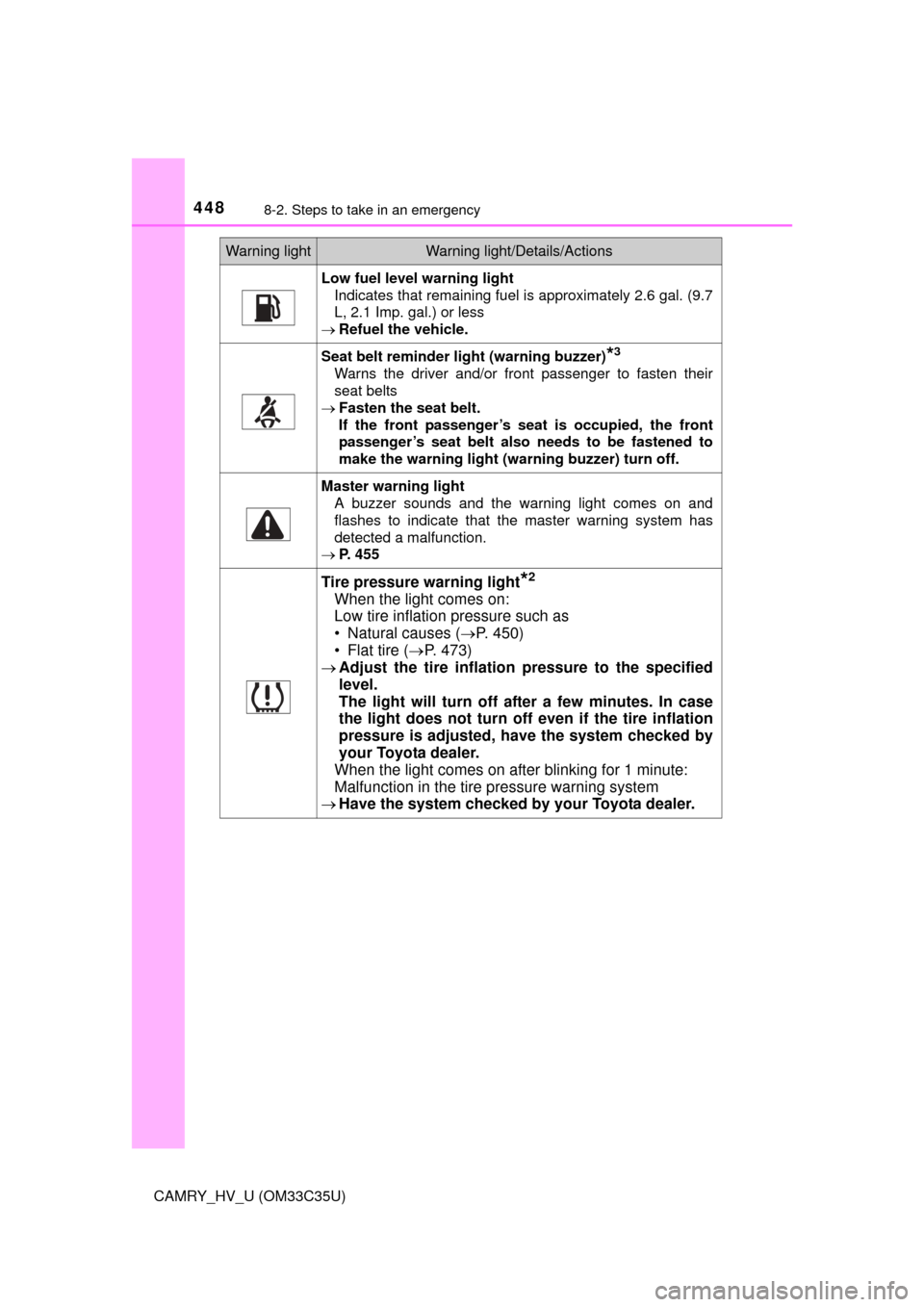
Low fuel level warning lightIndicates that remaining fuel is approximately 2.6 gal. (9.7
L, 2.1 Imp. gal.) or less
Refuel the vehicle.
Seat belt reminder light (warning buzzer)*3
Warns the driver and/or front passenger to fasten their
seat belts
Fasten the seat belt.
If the front passenger’s seat is occupied, the front
passenger’s seat belt also needs to be fastened to
make the warning light (war ning buzzer) turn off.
Master warning light
A buzzer sounds and the warning light comes on and
flashes to indicate that the master warning system has
detected a malfunction.
P. 455
Tire pressure warning light*2
When the light comes on:
Low tire inflation pressure such as
• Natural causes ( P. 450)
• Flat tire ( P. 473)
Adjust the tire inflation pressure to the specified
level.
The light will turn off after a few minutes. In case
the light does not turn off even if the tire inflation
pressure is adjusted, have the system checked by
your Toyota dealer.
When the light comes on after blinking for 1 minute:
Malfunction in the tire pressure warning system
Have the system checked by your Toyota dealer.
Warning lightWarning light/Details/Actions
Page 450 of 572

4508-2. Steps to take in an emergency
CAMRY_HV_U (OM33C35U)
nSRS warning light
This warning light system monitors the airbag sensor assembly, front impact
sensors, side impact sensors (front door), side impact sensors (front), side
impact sensors (rear), driver’s seat belt buckle switch, front passenger occu-
pant classification system, “AIR BAG ON” indicator light, “AIR BAG OFF” indi-
cator light, front passenger’s seat belt buckle switch, seat belt pretensioners
(front), airbags, interconnecting wiring and power sources. ( P. 3 8 )
n Front passenger detection sensor, seat belt reminder and warning
buzzer
l If luggage is placed on the front passenger seat, the front passenger detec-
tion sensor may cause the warning light to flash and the warning buzzer to
sound even if a passenger is not sitting in the seat.
l If a cushion is placed on the seat, the sensor may not detect a passenger,
and the warning light may not operate properly.
n If the malfunction indicator la mp comes on while driving
First check the following:
l Is the fuel tank empty?
If it is, fill the fuel tank immediately.
l Is the fuel tank cap loose?
If it is, tighten it securely.
The light will go off after several driving trips.
If the light does not go off even after several trips, contact your Toyota dealer
as soon as possible.
n
When the tire pressure warning light comes on (vehicles with a tire
pressure warning system)
Check the tire inflation pressure and adjust to the appropriate level. Push-
ing the tire pressure warning reset switch will not turn off the tire pressure
warning light.
nThe tire pressure warning light may come on due to natural causes
(vehicles with a tire pressure warning system)
The tire pressure warning light may come on due to natural causes such
as natural air leaks and tire inflation pressure changes caused by temper-
ature. In this case, adjusting the ti re inflation pressure will turn off the
warning light (after a few minutes).