Page 370 of 528

3706-3. Do-it-yourself maintenance
4RUNNER (U)_(OM35B23U)
NOTICE
■Repairing or replacing tires, wheels, tire pressure warning valves,
transmitters and tire valve caps
●When removing or fitting the wheels, tires or the tire pressure warning
valves and transmitters, contact your Toyota dealer as the tire pres-
sure warning valves and transmitters may be damaged if not handled
correctly.
●When replacing tire valve caps, do not use tire valve caps other than
those specified. The cap may become stuck.
■To avoid damage to the tire pressure warning valves and transmit-
ters
When a tire is repaired with liquid sealants, the tire pressure warning
valve and transmitter may not operate properly. If a liquid sealant is
used, contact your Toyota dealer or other qualified service shop as soon
as possible. Make sure to replace the tire pressure warning valve and
transmitter when replacing the tire. (P. 367)
■Driving on rough roads
Take particular care when driving on roads with loose surfaces or pot-
holes.
These conditions may cause losses in tire inflation pressure, reducing
the cushioning ability of the tires. In addition, driving on rough roads
may cause damage to the tires themselves, as well as the vehicle’s
wheels and body.
■If tire inflation pressure of each tire becomes low while driving
Do not continue driving, or your tires and/or wheels may be ruined.
Page 373 of 528

3736-3. Do-it-yourself maintenance
6
Maintenance and care
4RUNNER (U)_(OM35B23U)■
Instructions for checking tire inflation pressure
When checking tire inflation pressure, observe the following:
●Check only when the tires are cold.
If your vehicle has been parked for at least 3 hours or has not been
driven for more than 1 mile or 1.5 km, you will get an accurate cold tire
inflation pressure reading.
●Always use a tire pressure gauge.
It is difficult to judge if a tire is properly inflated based only on its appear-
ance.
●It is normal for the tire inflation pressure to be higher after driving as
heat is generated in the tire. Do not reduce tire inflation pressure after
driving.
●Never exceed the vehicle capacity weight.
Passengers and luggage weight should be placed so that the vehicle is
balanced.
CAUTION
■Proper inflation is critical to save tire performance
Keep your tires properly inflated.
If the tires are not properly inflated, the following conditions may occur
which could lead to an accident resulting in death or serious injury:
●Excessive wear
●Uneven wear
●Poor handling
●Possibility of blowouts resulting from overheated tires
●Air leaking from between tire and wheel
●Wheel deformation and/or tire damage
●Greater possibility of tire damage while driving (due to road hazards,
expansion joints, sharp edges in the road, etc.)
NOTICE
■When inspecting and adjusting tire inflation pressure
Be sure to put the tire valve caps back on.
If a valve cap is not installed, dirt or moisture may get into the valve and
cause an air leak, resulting in decreased tire inflation pressure.
Page 377 of 528
3776-3. Do-it-yourself maintenance
6
Maintenance and care
4RUNNER (U)_(OM35B23U)
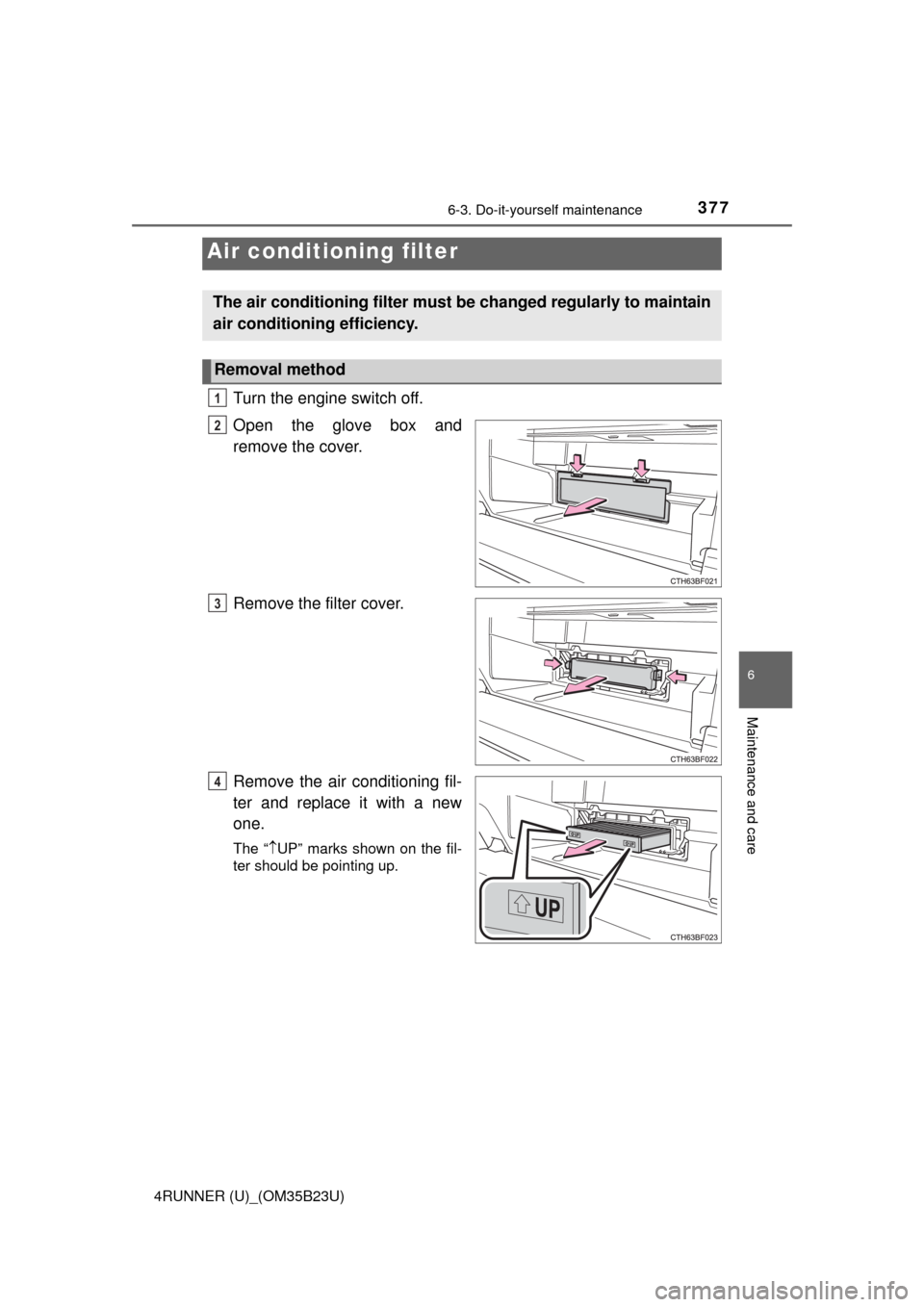
Turn the engine switch off.
Open the glove box and
remove the cover.
Remove the filter cover.
Remove the air conditioning fil-
ter and replace it with a new
one.
The “UP” marks shown on the fil-
ter should be pointing up.
Air conditioning filter
The air conditioning filter must be changed regularly to maintain
air conditioning efficiency.
Removal method
1
2
3
4
Page 378 of 528
3786-3. Do-it-yourself maintenance
4RUNNER (U)_(OM35B23U)
■Checking interval
Inspect and replace the air conditioning filter according to the maintenance
schedule. In dusty areas or areas with heavy traffic flow, early replacement
may be required. (For scheduled maintenance information, please refer to the
“Schedule maintenance guide” or “Owner’s Manual Supplement”.)
■If air flow from the vents decreases dramatically
The filter may be clogged. Check the filter and replace if necessary.
NOTICE
■When using the air conditioning system
Make sure that a filter is always installed.
Using the air conditioning system without a filter may cause damage to the
system.
Page 411 of 528
4117-2. Steps to take in an emergency
7
When trouble arises
4RUNNER (U)_(OM35B23U)
●Fluid leaks under the vehicle.
(Water dripping from the air conditioning after use is normal.)
●Flat-looking tires or uneven tire wear
●Engine coolant temperature gauge needle continually points higher
than normal.
●Changes in exhaust sound
●Excessive tire squeal when cornering
●Strange noises related to the suspension system
●Pinging or other noises related to the engine
●Engine missing, stumbling or running roughly
●Appreciable loss of power
●Vehicle pulls heavily to one side when braking
●Vehicle pulls heavily to one side when driving on a level road
●Loss of brake effectiveness, spongy feeling, pedal almost touches
the floor
If you think something is wrong
If you notice any of the following symptoms, your vehicle proba-
bly needs adjustment or repair. Contact your Toyota dealer as
soon as possible.
Visible symptoms
Audible symptoms
Operational symptoms
Page 452 of 528
4527-2. Steps to take in an emergency
4RUNNER (U)_(OM35B23U)
●The needle of the engine coolant temperature gauge (P. 8 1 )
enters the red zone or a loss of engine power is experienced.
(For example, the vehicle speed does not increase.)
●Steam comes out from under the hood.
Stop the vehicle in a safe place and turn off the air conditioning sys-
tem, and then stop the engine.
If you see steam:
Carefully lift the hood after the steam subsides.
If you do not see steam:
Carefully lift the hood.
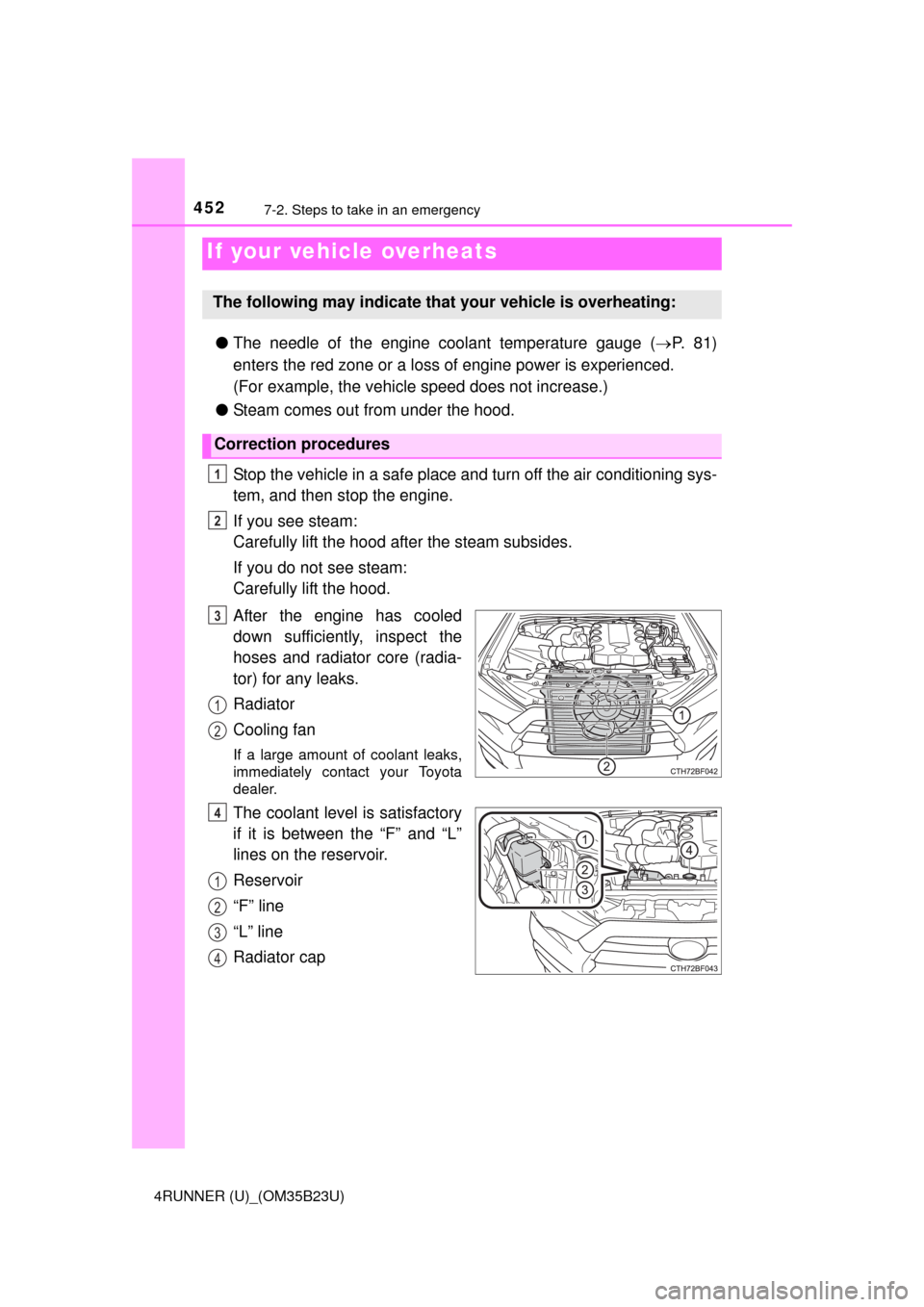
After the engine has cooled
down sufficiently, inspect the
hoses and radiator core (radia-
tor) for any leaks.
Radiator
Cooling fan
If a large amount of coolant leaks,
immediately contact your Toyota
dealer.
The coolant level is satisfactory
if it is between the “F” and “L”
lines on the reservoir.
Reservoir
“F” line
“L” line
Radiator cap
If your vehicle overheats
The following may indicate that your vehicle is overheating:
Correction procedures
1
2
3
1
2
4
1
2
3
4
Page 479 of 528
4798-1. Specifications
8
Vehicle specifications
4RUNNER (U)_(OM35B23U)
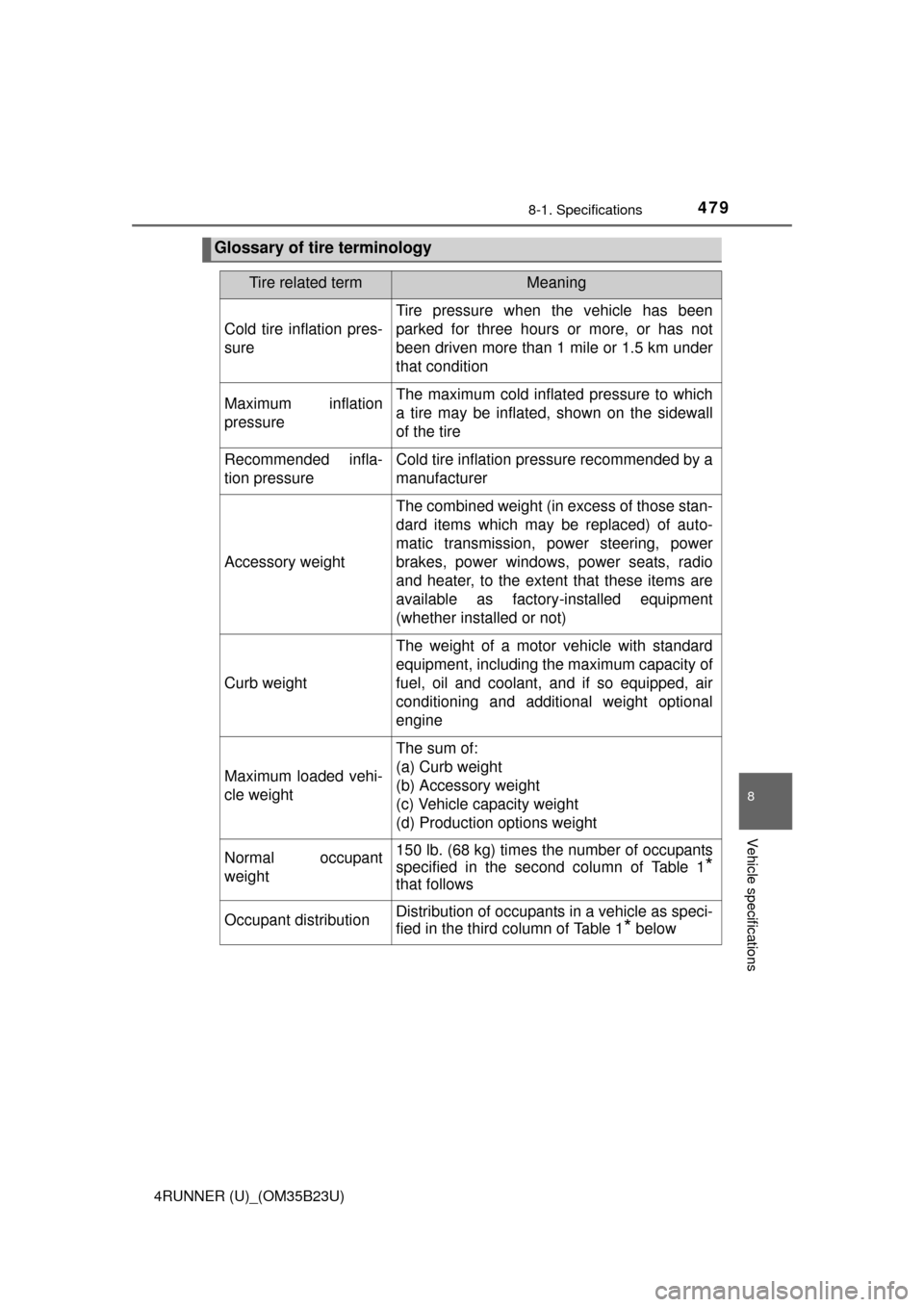
Glossary of tire terminology
Tire related termMeaning
Cold tire inflation pres-
sure
Tire pressure when the vehicle has been
parked for three hours or more, or has not
been driven more than 1 mile or 1.5 km under
that condition
Maximum inflation
pressureThe maximum cold inflated pressure to which
a tire may be inflated, shown on the sidewall
of the tire
Recommended infla-
tion pressureCold tire inflation pressure recommended by a
manufacturer
Accessory weight
The combined weight (in excess of those stan-
dard items which may be replaced) of auto-
matic transmission, power steering, power
brakes, power windows, power seats, radio
and heater, to the extent that these items are
available as factory-installed equipment
(whether installed or not)
Curb weight
The weight of a motor vehicle with standard
equipment, including the maximum capacity of
fuel, oil and coolant, and if so equipped, air
conditioning and additional weight optional
engine
Maximum loaded vehi-
cle weight
The sum of:
(a) Curb weight
(b) Accessory weight
(c) Vehicle capacity weight
(d) Production options weight
Normal occupant
weight150 lb. (68 kg) times the number of occupants
specified in the second column of Table 1
*
that follows
Occupant distributionDistribution of occupants in a vehicle as speci-
fied in the third column of Table 1
* below
Page 514 of 528

514
4RUNNER (U)_(OM35B23U)
Alphabetical index
Alphabetical index
A/C .................................... 278, 284
Air conditioning filter ............. 377
ABS
(Anti-lock Brake System)...... 259
Function ................................ 259
Warning light ......................... 414
Active head restraints ............. 120
Active traction control ............ 239
Air conditioning filter .............. 377
Air conditioning
system ............................ 278, 284
Air conditioning filter ............. 377
Airbags ....................................... 35
Airbag operating conditions .... 42
Airbag precautions
for your child ......................... 37
Airbag warning light .............. 414
Correct driving posture ........... 28
Curtain shield airbag
operating conditions ............. 42
Curtain shield airbag
precautions ........................... 39
Front passenger occupant
classification system............. 46
General airbag precautions .... 37
Locations of airbags................ 35
Modification and disposal
of airbags.............................. 41
Side airbag operating
conditions ............................. 42
Side airbag precautions .......... 37
Side and curtain shield airbags
operating conditions ............. 42
Side and curtain shield
airbags precautions .............. 37
SRS airbags............................ 35Alarm .......................................... 72
Alarm ...................................... 72
Warning buzzer .................... 413
Anchor brackets ........................ 57
Antennas
(smart key system) ............... 103
Anti-lock Brake System
(ABS) ...................................... 259
Function ................................ 259
Warning light......................... 414
Armrest..................................... 318
Assist grip ................................ 319
Audio system
*
AUTO LSD system................... 241
Automatic air conditioning
system.................................... 284
Automatic light control
system.................................... 204
Automatic running boards ..... 111
Automatic transmission ......... 199
If the shift lever
cannot be shifted from P .... 444
S mode ................................. 200
AUX port
*
Auxiliary boxes ........................ 300
A