2016 SUBARU WRX traction control
[x] Cancel search: traction controlPage 412 of 594

– When a temporary spare tire
is installed
– When your vehicle is towed
– When the vehicle is stopped
with the manual mode se-
lected
NOTE . A higher initial LSD torque setting
gives the vehicle greater traction when
driving straight ahead but makes cor-
nering more difficult. Remember this
when adjusting the initial LSD torque.
In general, higher initial LSD torque
settings assist driving on slippery
roads and lower settings for non-slip-
pery roads. When the vehicle is stuck
in snow or mud, setting the initial LSD
torque to the maximum will help to free
the vehicle.
. The setting of the initial LSD torque
will remain even when the auto mode is
selected or the ignition switch is turned
to the “ LOCK ” / “ OFF ” position. How-
ever, the initial LSD torque will be
minimized when the battery is discon-
nected and reconnected.
. During cornering or when making
turns (especially when going into the
garage), the rotational difference be-
tween the front and rear wheels may cause a braking effect accompanied by
vibration and noise. This does not
indicate a problem. The phenomenon
will disappear when setting the initial
LSD torque to the minimum.
In the auto mode, it controls the initial
LSD torque automatically. While in the
auto mode, this phenomenon some-
times occurs depending on the driving
condition, however, it does not indicate
a problem.
. Use the center differential indicator
only as a rough indication of the initial
LSD torque.
. If you operate the center differential
control switch while quickly accelerat-
ing or turning a tight corner, you may
feel slight shocks. This is due to
differential action by the center differ-
ential and does not indicate a problem.
& Temporary release When the driver stops the vehicle and
pulls the parking brake lever after manu-
ally setting the initial LSD torque, the LSD
torque is temporarily minimized. However
the indicator on the combination meter
continues to show the driver ’ s selected
initial LSD torque. When the driver re-
leases the parking brake lever, the initial
LSD torque set by the driver is restored. Continuously variable trans-
mission The continuously variable transmission is
electronically controlled and provides an
infinite number of forward speeds and 1
reverse speed. It also has a manual mode.
WARNINGDo not shift from the “ P ” or “ N ”
position into the “ D ” or “ R ” position
while depressing the accelerator
pedal. This may cause the vehicle
to jump forward or backward.
CAUTION. Shift into the “ P ” or “ R ” position
only after the vehicle is comple-
tely stopped. Shifting while the
vehicle is moving may cause
damage to the transmission.
. Do not race the engine for more
than 5 seconds in any position
except the “ N ” or “ P ” position
when the brake is applied or
when chocks are used in the
wheels. This may cause the
transmission fluid to overheat.
. Never move the vehicle rearwardStarting and operating/Continuously variable transmission
– CONTINUED –7-23
Page 428 of 594
namics Control is no guarantee
that full vehicle control will be
maintained at all times and under
all conditions, its activation
should be seen as a sign that
the speed of the vehicle should
be reduced considerably.
. Whenever suspension compo-
nents, steering components, or
an axle are removed from a
vehicle, have an inspection of
that system performed by an
authorized SUBARU dealer.
. The following precautions should
be observed in order to ensure
that the Vehicle Dynamics Con-
trol system is operating properly:
– All four wheels should be
fitted with tires of the same
size, type, and brand. Further-
more, the amount of wear
should be the same for all
four tires.
– Keep the tire pressure at the
proper level as shown on the
vehicle placard attached to
the driver ’ s side door pillar.
– Use only the specified tem-
porary spare tire to replace a
flat tire. With a temporary
spare tire, the effectiveness of the Vehicle Dynamics Con-
trol system is reduced and
this should be taken into ac-
count when driving the vehi-
cle in such a condition.
. If non-matching tires are used,
the Vehicle Dynamics Control
system may not operate cor-
rectly.
. The Vehicle Dynamics Control
system helps prevent unstable
vehicle motion such as skidding
using control of the brakes and
engine power. Do not turn off the
Vehicle Dynamics Control sys-
tem unless it is absolutely ne-
cessary. If you must turn off the
Vehicle Dynamics Control sys-
tem, drive very carefully accord-
ing to the road surface condition.
In the event of wheelspin and/or skidding
on a slippery road surface and/or during
cornering and/or an evasive maneuver,
the Vehicle Dynamics Control system
adjusts the engine ’ s output and the
wheels ’ respective braking forces to help
maintain traction and directional control.
. Traction Control Function
The traction control function is designed to
prevent spinning of the driving wheels on slippery road surfaces, thereby helping to
maintain traction and directional control.
Activation of this function is shown by
flashing the Vehicle Dynamics Control
operation indicator light.
. Skid Suppression Function
The skid suppression function is designed
to help maintain directional stability by
suppressing the wheels ’ tendency to slide
sideways during steering operations. Acti-
vation of this function is shown by flashing
of the Vehicle Dynamics Control operation
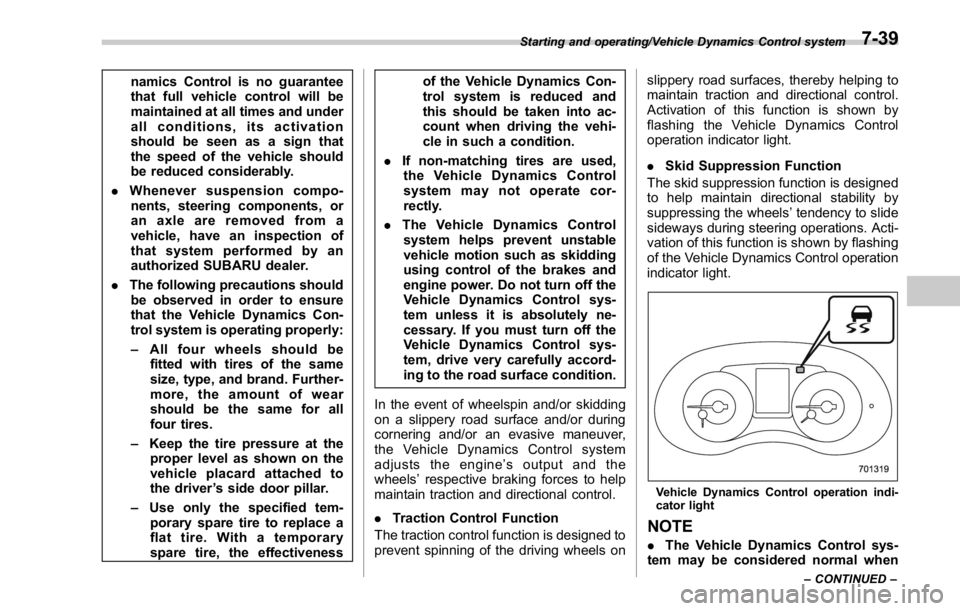
indicator light.
Vehicle Dynamics Control operation indi-
cator light
NOTE
. The Vehicle Dynamics Control sys-
tem may be considered normal whenStarting and operating/Vehicle Dynamics Control system
– CONTINUED –7-39
Page 429 of 594
Starting and operating/Vehicle Dynamics Control system
the following conditions occur.
– Slight twitching of the brake
pedal is felt.
– The vehicle or steering wheel
shakes to a small degree.
– An operating sound from the
engine compartment is heard
briefly when starting the engine
and when driving off after starting
the engine.
– The brake pedal seems to jolt
when driving off after starting the
engine.
. In the circumstances shown in the
following list, the vehicle may be less
stable than it feels to the driver. The
Vehicle Dynamics Control System may
therefore operate. Such operation does
not indicate a system malfunction.
– on gravel-covered or rutted
roads
– on unfinished roads
– when the vehicle is fitted with
snow tires or winter tires
. Activation of the Vehicle Dynamics
Control system will cause operation of
the steering wheel to feel slightly
different compared to that for normal
conditions.
. It is always important to reduce
speed when approaching a corner,
even if your vehicle is equipped with the Vehicle Dynamics Control system.
. Always turn off the engine before
replacing a tire. Failure to do so may
render the Vehicle Dynamics Control
system unable to operate correctly.
& Vehicle Dynamics Control
system monitor Refer to “ Vehicle Dynamics Control warn-
ing light/Vehicle Dynamics Control opera-
tion indicator light ” F 3-26 and “ Vehicle
Dynamics Control OFF indicator light/
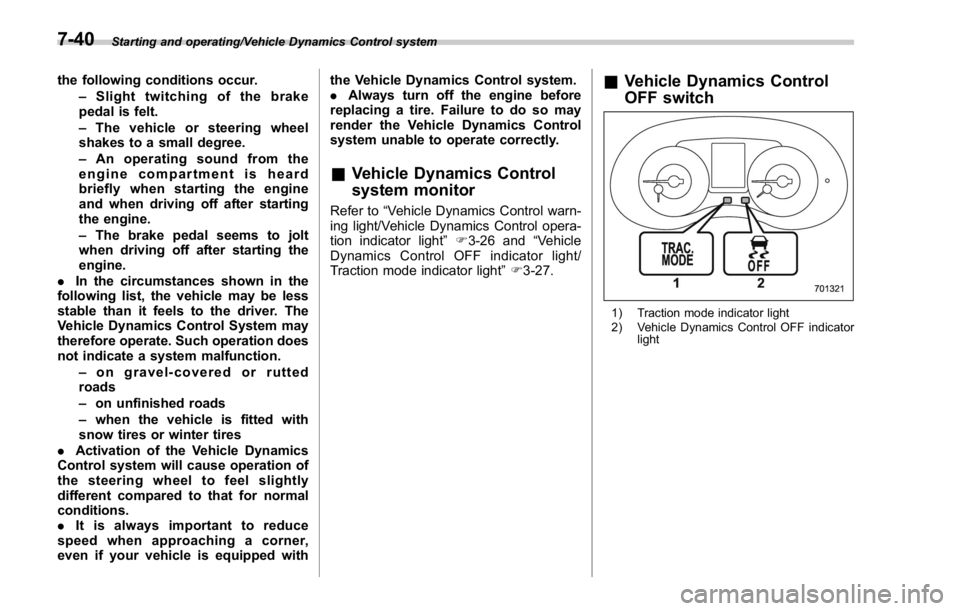
Traction mode indicator light ” F 3-27.& Vehicle Dynamics Control
OFF switch
1) Traction mode indicator light
2) Vehicle Dynamics Control OFF indicator
light7-40
Page 430 of 594
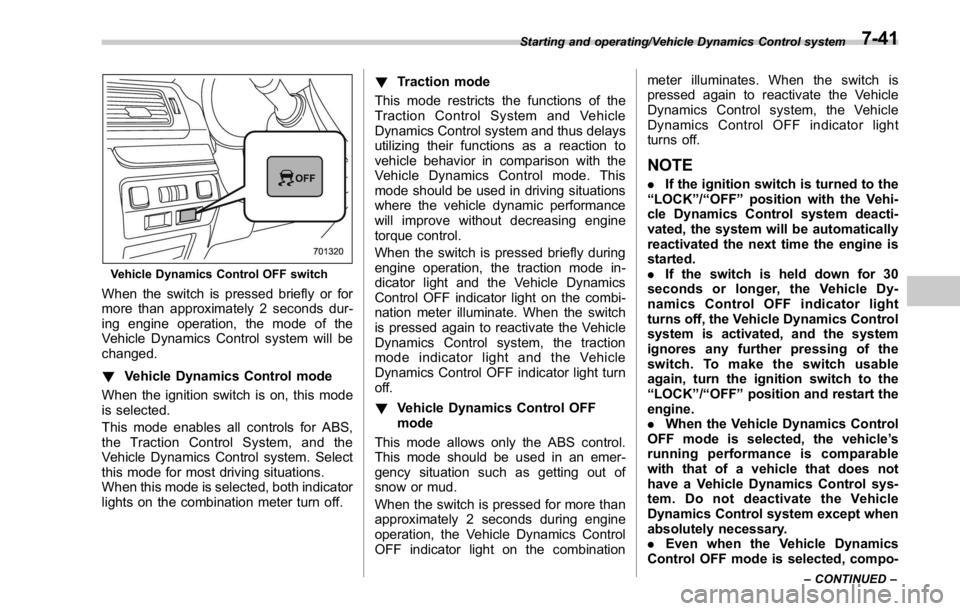
Vehicle Dynamics Control OFF switch
When the switch is pressed briefly or for
more than approximately 2 seconds dur-
ing engine operation, the mode of the
Vehicle Dynamics Control system will be
changed.
! Vehicle Dynamics Control mode
When the ignition switch is on, this mode
is selected.
This mode enables all controls for ABS,
the Traction Control System, and the
Vehicle Dynamics Control system. Select
this mode for most driving situations.
When this mode is selected, both indicator
lights on the combination meter turn off. ! Traction mode
This mode restricts the functions of the
Traction Control System and Vehicle
Dynamics Control system and thus delays
utilizing their functions as a reaction to
vehicle behavior in comparison with the
Vehicle Dynamics Control mode. This
mode should be used in driving situations
where the vehicle dynamic performance
will improve without decreasing engine
torque control.
When the switch is pressed briefly during
engine operation, the traction mode in-
dicator light and the Vehicle Dynamics
Control OFF indicator light on the combi-
nation meter illuminate. When the switch
is pressed again to reactivate the Vehicle
Dynamics Control system, the traction
mode indicator light and the Vehicle
Dynamics Control OFF indicator light turn
off.
! Vehicle Dynamics Control OFF
mode
This mode allows only the ABS control.
This mode should be used in an emer-
gency situation such as getting out of
snow or mud.
When the switch is pressed for more than
approximately 2 seconds during engine
operation, the Vehicle Dynamics Control
OFF indicator light on the combination meter illuminates. When the switch is
pressed again to reactivate the Vehicle
Dynamics Control system, the Vehicle
Dynamics Control OFF indicator light
turns off.
NOTE . If the ignition switch is turned to the
“ LOCK ” / “ OFF ” position with the Vehi-
cle Dynamics Control system deacti-
vated, the system will be automatically
reactivated the next time the engine is
started.
. If the switch is held down for 30
seconds or longer, the Vehicle Dy-
namics Control OFF indicator light
turns off, the Vehicle Dynamics Control
system is activated, and the system
ignores any further pressing of the
switch. To make the switch usable
again, turn the ignition switch to the
“ LOCK ” / “ OFF ” position and restart the
engine.
. When the Vehicle Dynamics Control
OFF mode is selected, the vehicle ’ s
running performance is comparable
with that of a vehicle that does not
have a Vehicle Dynamics Control sys-
tem. Do not deactivate the Vehicle
Dynamics Control system except when
absolutely necessary.
. Even when the Vehicle Dynamics
Control OFF mode is selected, compo-Starting and operating/Vehicle Dynamics Control system
– CONTINUED –7-41
Page 458 of 594
Driving tips for AWD models WARNING. Always maintain a safe driving
speed according to the road and
weather conditions in order to
avoid having an accident on a
sharp turn, during sudden brak-
ing or under other similar condi-
tions.
. Always use the utmost care in
driving – overconfidence be-
cause you are driving an All-
Wheel Drive vehicle could easily
lead to a serious accident.
. When you replacing or installing
tire(s), all four tires must be the
same for following items.
(a) Size
(b) Circumference
(c) Speed symbol
(d) Load index
(e) Construction
(f) Manufacturer
(g) Brand (tread pattern)
(h) Degrees of wear
For the items (a) to (d), you must
obey the specification that is printed on the tire placard. The
tire placard is located on the
bottom of driver ’ s door pillar.
If all of four tires are not the same
for items (a) to (h), there is a
possibility that serious mechan-
ical damage could occur to the
drive train of your car, and affect
the following.
— Ride
— Handling
— Braking
— Speedometer/Odometer
calibration
— Clearance between the body
and tires
It also may be dangerous and
lead to loss of vehicle control,
and it can lead to an accident.
CAUTION
If you use a temporary spare tire to
replace a flat tire, be sure to use the
original temporary spare tire stored
in the vehicle. Using other sizes may
result in severe mechanical damage
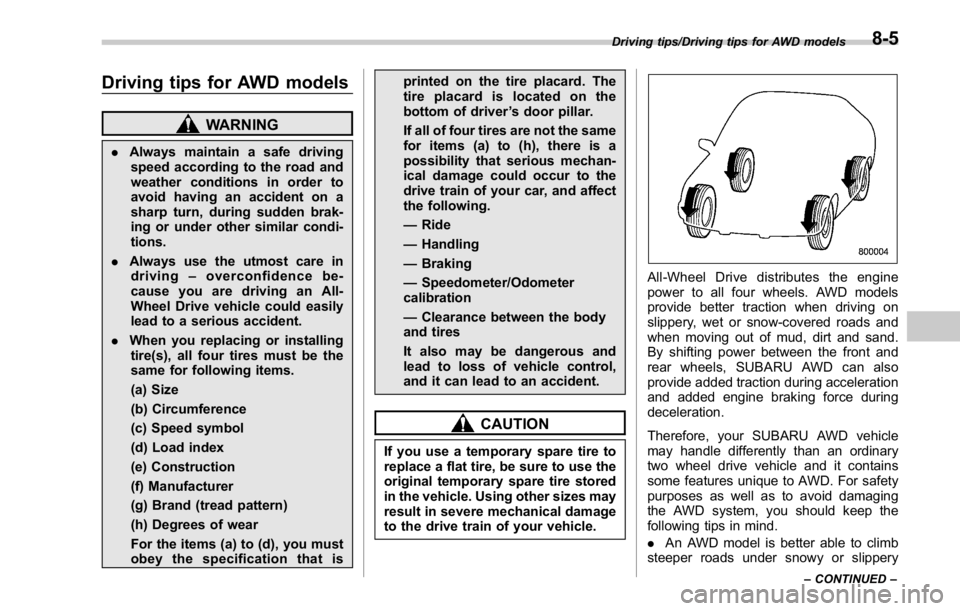
to the drive train of your vehicle. All-Wheel Drive distributes the engine
power to all four wheels. AWD models
provide better traction when driving on
slippery, wet or snow-covered roads and
when moving out of mud, dirt and sand.
By shifting power between the front and
rear wheels, SUBARU AWD can also
provide added traction during acceleration
and added engine braking force during
deceleration.
Therefore, your SUBARU AWD vehicle
may handle differently than an ordinary
two wheel drive vehicle and it contains
some features unique to AWD. For safety
purposes as well as to avoid damaging
the AWD system, you should keep the
following tips in mind.
. An AWD model is better able to climb
steeper roads under snowy or slippery Driving tips/Driving tips for AWD models
– CONTINUED –8-5
Page 574 of 594
form to Federal Safety Require-
ments in addition to these grades.
& Treadwear
The treadwear grade is a compara-
tive rating based on the wear rate of
the tire when tested under con-
trolled conditions on a specified
government test course.
For example, a tire graded 150
would wear one and one-half (1-
1/2) times as well on the govern-
ment course as a tire graded 100.
The relative performance of tires
depends upon the actual conditions
of their use, however, and may
depart significantly from the norm
due to variations in driving habits,
service practices and differences in
road characteristics and climate.
& Traction AA, A, B, C
The traction grades, from highest to
lowest, are AA, A, B and C. Those
grades represent the tire ’ s ability to
stop on wet pavement as measured
under controlled conditions on spe- cified government test surfaces of
asphalt and concrete. A tire marked
C may have poor traction perfor-
mance. WARNING
The traction grade assigned to
this tire is based on straight-
ahead braking traction tests,
and does not include accel-
eration, cornering, hydroplan-
ing, or peak traction charac-
teristics.
& Temperature A, B, C
The temperature grades are A (the
highest), B, and C, representing the
tire ’ s resistance to the generation of
heat and its ability to dissipate heat
when tested under controlled con-
ditions on a specified indoor labora-
tory test wheel. Sustained high
temperature can cause the material
of the tire to degenerate and reduce
tire life, and excessive temperature
can lead to sudden tire failure. The grade C corresponds to a level of
performance which all passenger
car tires must meet under the
Federal Motor Vehicle Safety Stan-
dards No. 109. Grades B and A
represent higher levels of perfor-
mance on the laboratory test wheel
than the minimum required by law.
WARNING
The temperature grade for this
tire is established for a tire
that is properly inflated and
not overloaded. Excessive
speed, underinflation, or ex-
cessive loading, either sepa-
rately or in combination, can
cause heat buildup and possi-
ble tire failure.Consumer information and Reporting safety defects/Uniform tire quality grading standards
13-15
Page 581 of 594

14-6 Index
Bulb wattage ....................................................... 12-16
Control switch ........................................................ 3-94
Flasher ................................................................. 3-96
Indicator light ......................................................... 3-35
HID headlights .......................................................... 11-44
High beam indicator light ............................................ 3-35
High/low beam change (dimmer) .................................. 3-96
Hill Holder ................................................................. 7-46
Indicator light ................................................. 3-24, 7-48
Switch .................................................................. 7-47
Hill start assist .................................................. 7-49, 11-29
OFF indicator light .................................................. 3-24
To activate/deactivate ............................................. 7-51
Warning light ......................................................... 3-24
HomeLink ®
.............................................................. 3-105
Hook
Coat ..................................................................... 6-11
Towing and tie-down ............................................... 9-12
Horn ........................................................................ 3-114
Hose and connections ............................................... 11-17
I
Ignition switch .............................................................. 3-4
Light ....................................................................... 3-6
Illumination brightness control ...................................... 3-98
Immobilizer. ................................................................. 2-3
Indicator light (security indicator light) ....................... 3-33
Indicator light
BSD/RCTA OFF. .................................................... 3-37
BSD/RCTA warning ................................................ 3-37
Cruise control ........................................................ 3-35 Cruise control set ................................................... 3-35
Front fog light ......................................................... 3-35
Headlight ............................................................... 3-35
High beam ............................................................. 3-35
Hill Holder ............................................................. 3-24
Hill start assist OFF ................................................ 3-24
Immobilizer ............................................................ 3-33
REV. ..................................................................... 3-37
Security ................................................................. 3-33
Select lever/Gear position ........................................ 3-34
Shift-up ................................................................. 3-34
SI-DRIVE .............................................................. 3-34
Steering responsive fog lights OFF ... ........................ 3-37
Traction control OFF ............................................... 3-27
Turn signal ............................................................ 3-35
Vehicle Dynamics Control OFF ................................. 3-27
Vehicle Dynamics Control operation .......................... 3-26
Inside mirror ............................................................ 3-103
Interior lights ............................................................... 6-2
Internal trunk lid release handle .................................... 2-37
J
Jack-up point .............................................................. 9-4
Jump starting .............................................................. 9-9
K
Key............................................................................ 2-3
Number .................................................................. 2-3
Reminder chime ...................................................... 3-5
Replacement. .......................................................... 2-4
Keyless access entry function ...................................... 2-13