2016 SUBARU WRX torque
[x] Cancel search: torquePage 468 of 594

The temporary spare tire is smaller and
lighter than a conventional tire and is
designed for emergency use only. Re-
move the temporary spare tire and re-
install the conventional tire as soon as
possible because the spare tire is de-
signed only for temporary use.
Check the inflation pressure of the tem-
porary spare tire periodically to keep the
tire ready for use. The correct pressure is
as follows.
Mexico models: 33 psi (230 kPa, 2.3
kgf/cm 2
)
Other models: 60 psi (420 kPa, 4.2
kgf/cm 2
)
When using the temporary spare tire, note
the following.
. Do not exceed 50 mph (80 km/h).
. Do not put a tire chain on the temporary
spare tire. Because of the smaller tire size,
a tire chain will not fit properly.
. Do not use two or more temporary
spare tires at the same time.
. Do not drive over obstacles. This tire
has a smaller diameter, so road clearance
is reduced. 1) Tread wear indicator bar
2) Indicator location mark
. When the wear indicator appears on
the tread, replace the tire.
. The temporary spare tire must be used
only on a rear wheel. If a front wheel tire
gets punctured, replace the wheel with a
rear wheel and install the temporary spare
tire in place of the removed rear wheel.
. Always set the driver ’ s control center
differential to the manual mode and adjust
the initial LSD torque to the minimum. Maintenance tools Your vehicle is equipped with the following
maintenance tools.
. Jack
. Jack handle
. Screwdriver
. Towing hook (eye bolt)
. Wheel nut wrench In case of emergency/Maintenance tools
– CONTINUED –9-3
Page 472 of 594
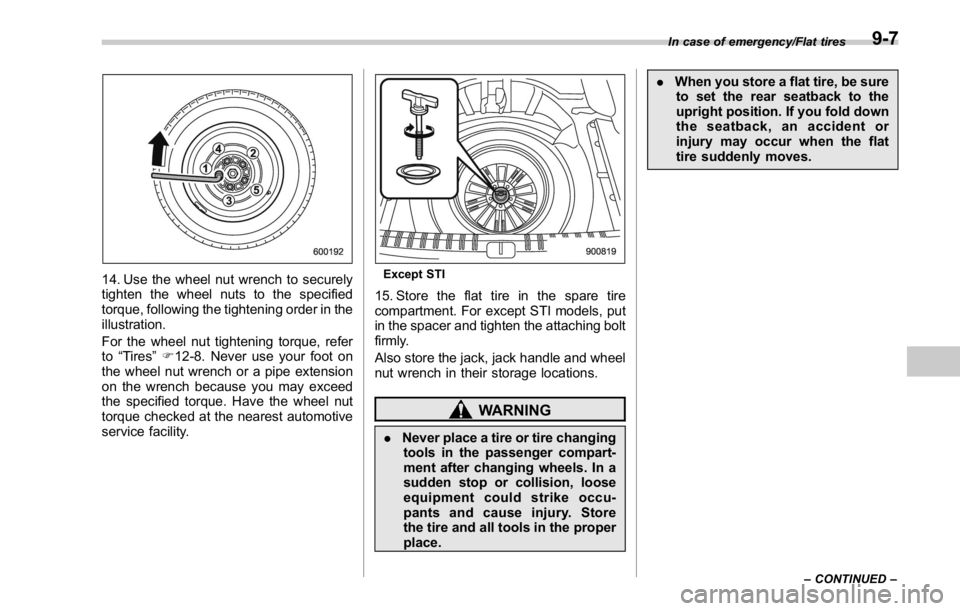
14. Use the wheel nut wrench to securely
tighten the wheel nuts to the specified
torque, following the tightening order in the
illustration.
For the wheel nut tightening torque, refer
to “ Tires ” F 12-8. Never use your foot on
the wheel nut wrench or a pipe extension
on the wrench because you may exceed
the specified torque. Have the wheel nut
torque checked at the nearest automotive
service facility. Except STI
15. Store the flat tire in the spare tire
compartment. For except STI models, put
in the spacer and tighten the attaching bolt
firmly.
Also store the jack, jack handle and wheel
nut wrench in their storage locations.
WARNING
. Never place a tire or tire changing
tools in the passenger compart-
ment after changing wheels. In a
sudden stop or collision, loose
equipment could strike occu-
pants and cause injury. Store
the tire and all tools in the proper
place. . When you store a flat tire, be sure
to set the rear seatback to the
upright position. If you fold down
the seatback, an accident or
injury may occur when the flat
tire suddenly moves. In case of emergency/Flat tires
– CONTINUED –9-7
Page 526 of 594
from controllability, ride comfort, braking
performance, speedometer accuracy and
odometer accuracy. It also creates incor-
rect body-to-tire clearances and inappro-
priately changes the vehicle ’ sground
clearance.
All four tires must be the same in terms of
manufacturer, brand (tread pattern), con-
struction, and size. You are advised to
replace the tires with new ones that are
identical to those fitted as standard equip-
ment.
For safe vehicle operation, SUBARU
recommends replacing all four tires at
the same time.
WARNING. When replacing or installing
tire(s), all four tires must be the
same for the following items.
(a) Size
(b) Circumference
(c) Speed symbol
(d) Load index
(e) Construction
(f) Manufacturer
(g) Brand (tread pattern)
(h) Degrees of wear For items (a) to (d), you must
obey the specification that is
printed on the tire placard. The
tire placard is located on the
driver ’ s door pillar.
If all four tires are not the same in
items (a) to (h), there is a possi-
bility that it may lead to serious
mechanical damage to the drive
train of your car and affect the
following factors.
— Ride
— Handling
— Braking
— Speedometer/Odometer
calibration
— Clearance between the body
and the tires
It also may be dangerous and
lead to loss of vehicle control,
and it can lead to an accident.
. Use only radial tires. Do not use
radial tires together with belted
bias tires and/or bias-ply tires.
Doing so can dangerously re-
duce controllability, resulting in
an accident. & Wheel replacement When replacing wheels due, for example,
to damage, make sure the replacement
wheels match the specifications of the
wheels that are fitted as standard equip-
ment. Replacement wheels are available
from SUBARU dealers.
WARNINGUse only those wheels that are
specified for your vehicle. Wheels
not meeting specifications could
interfere with brake caliper opera-
tion and may cause the tires to rub
against the wheel well housing dur-
ing turns. The resulting loss of
vehicle control could lead to an
accident.
NOTE When any of the wheels are removed
and replaced for tire rotation or to
change a flat tire, always check the
tightness of the wheel nuts after driv-
ing approximately 600 miles (1,000 km).
If any nut is loose, tighten it to the
specified torque. Maintenance and service/Tires and wheels
11-37
Page 527 of 594

Maintenance and service/Aluminum wheels
Aluminum wheels Aluminum wheels can be scratched and
damaged easily. Handle them carefully to
maintain their appearance, performance,
and safety.
. When any of the wheels are removed
and replaced for tire rotation or to change
a flat tire, always check the tightness of
the wheel nuts after driving approximately
600 miles (1,000 km). If any nut is loose,
tighten it to the specified torque.
. Never apply oil to the threaded parts,
wheel nuts, or tapered surface of the
wheel.
. Never let the wheel rub against sharp
protrusions or curbs.
. When wheel nuts, balance weights, or
the center cap is replaced, be sure to
replace them with genuine SUBARU parts
designed for aluminum wheels. Windshield washer fluid CAUTIONNever use engine coolant as washer
fluid because it could cause paint
damage.
When there is only a small amount of
washer fluid remaining, the windshield
washer fluid warning indicator will illumi-
nate. When this occurs, refill the washer
fluid as follows. Remove the washer tank filler cap, then
add windshield washer fluid until it
reaches the “ FULL ” mark on the tank. If
windshield washer fluid is unavailable use
clean water.
In areas where water freezes in winter,
use an anti-freeze type windshield washer
fluid. SUBARU Windshield Washer Fluid
contains 58.5% methyl alcohol and 41.5%
surfactant, by volume. Its freezing tem-
perature varies according to how much it
is diluted, as indicated in the following
table.11-38
Page 549 of 594

Specifications/Specifications
& Electrical system Battery type and capacity (5HR) 55D23L
Alternator STI 12V-110A
Except STI 12V-130A
Spark plugs STI SILFR6A (NGK)
Except STI ILKAR8H6 (NGK)
& Tires Tire size 235/45R17 94W 245/40R18 97W
Wheel size
17 6 8J 18 6 8 1/2J
Pressure Front
33 psi (230 kPa, 2.3 kgf/cm 2
) 33 psi (230 kPa, 2.3 kgf/cm 2
)
Rear
32 psi (220 kPa, 2.2 kgf/cm 2
) 32 psi (220 kPa, 2.2 kgf/cm 2
)
Wheel nut tightening torque
89 lbf·ft (120 N·m, 12 kgf·m)* 1
*1: This torque is equivalent to applying approximately 88 to 110 lbf (40 to 50 kgf) at the end of the wheel nut wrench. If you have tightened the wheel
nuts by yourself, have the tightening torque checked at the nearest automotive service facility as soon as possible. For the wheel nut tightening
procedure, refer to “ Changing a flat tire ” F 9-4.
& Temporary spare tires Temporary spare tire size T145/70D17 205/50R17
Temporary spare tire inflation pressure
(recommended cold tire inflation pressure) 60 psi (420 kPa, 4.2 kgf/cm 2
) 33 psi (230 kPa, 2.3 kgf/cm 2
)
Wheel nut tightening torque
89 lbf·ft (120 N·m, 12 kgf·m)* 1
* 2
*1: This torque is equivalent to applying approximately 88 to 110 lbf (40 to 50 kgf) at the end of the wheel nut wrench. If you have tightened the wheel
nuts by yourself, have the tightening torque checked at the nearest automotive service facility as soon as possible.
*2: For the wheel nut tightening procedure, refer to “ Changing a flat tire ” F 9-4.12-8
Page 569 of 594

Consumer information and Reporting safety defects/Tire information
& Tire care – maintenance and
safety practices.
Check on a daily basis that the
tires are free from serious damage,
nails, and stones. At the same time,
check the tires for abnormal wear. .
Inspect the tire tread regularly
and replace the tires before their
tread wear indicators become visi-
ble. When a tire ’ streadwear
indicator becomes visible, the tire
is worn beyond the acceptable limit
and must be replaced immediately.
With a tire in this condition, driving
at even low speeds in wet weather
can cause the vehicle to hydro-
plane. Possible resulting loss of
vehiclecontrolcanleadtoan
accident. .
Replace any damaged or un-
evenly worn tires at the time of
rotation. For information about the
tire rotation order, refer to “ Tire
rotation ” F 11-36 .
After tire rotation,
adjust the tire pressures and make
sure the wheel nuts are correctly
tightened. For information about the tightening torque and tighten-
ing sequence for the wheel nuts,
refer to “ Flat tires ” F 9-4 .
& Vehicle load limit – how to
determine
The load capacity of your vehicle is
determined by weight, not by avail-
able cargo space. The load limit of
your vehicle is shown on the
vehicle placard attached to the
driver ’ s side B-pillar. Locate the
statement “ The combined weight
of occupants and cargo should
never exceed XXX kg or XXX lbs ”
on your vehicle ’ s placard.
Thevehicleplacardalsoshows
seating capacity of your vehicle.
The total load capacity includes the
total weight of driver and all pas-
sengers and their belongings, any
cargo, any optional equipment such
as a roof rack or bike carrier, etc.
Therefore cargo capacity can be
calculated by the following method.
Cargo capacity = Load limit − (total weight of occupants + total weight
of optional equipment)
For information about vehicle load-
ing, refer to “ Loading your vehicle ”
F 8-10 .
13-10
Page 587 of 594

14-12 Index
SRS airbag system ................................................ 3-15
Vehicle Dynamics Control ....................................... 3-26
Windshield washer fluid .......................................... 3-18
Warranties ..................................................................... 1
Washing ................................................................... 10-2
Waxing and polishing ................................................. 10-3
Wear indicators ......................................................... 11-35
What to do if... ......................................................... 5-103
Troubleshooting ................................................... 5-103
Wheel
Aluminum ............................................................. 11-38
Balance ............................................................... 11-35
Nut tightening torque ........................................ 9-4, 12-8
Replacement ........................................................ 11-37
Windows ................................................................... 2-32
Windshield
Washer fluid ......................................................... 11-38
Wiper and washer switches ................................... 3-102
Wiper blades ........................................................ 11-40
Wiper deicer ......................................................... 3-112
Winter
Driving .................................................................... 8-6
Tires ............................................................. 8-9, 11-31
Wiper and washer .................................................... 3-101
Wiper deicer ............................................................. 3-112