2016 SUBARU OUTBACK Head rest
[x] Cancel search: Head restPage 9 of 572
with considerable speed and
force and can injure or even kill
children, especially if they are
not restrained or improperly re-
strained. Because children are
lighter and weaker than adults,
their risk of being injured from
deployment is greater.
.NEVER INSTALL A REARWARD
FACING CHILD SAFETY SEAT IN
THE FRONT SEAT. DOING SO
RISKS SERIOUS INJURY OR
DEATH TO THE CHILD BY PLA-
CING THE CHILD’S HEAD TOO
CLOSE TO THE SRS AIRBAG.
.Always turn the child safety locks
to the“LOCK”position whenever
a child rides in the rear seat.
Serious injury could result if a
child accidentally opened the
door and fell out. Refer to“Child
safety locks”F2-33.
.Always lock the passengers’win-
dows using the lock switch when
children are riding in the vehicle.
Failure to follow this procedure
could result in injury to a child
operating the power window. Re-
fer to“Windows”F2-33.
.Never leave unattended children,
adults or animals in the vehicle.They could accidentally injure
themselves or others through
inadvertent operation of the ve-
hicle. Also, on hot or sunny days,
the temperature in a closed ve-
hicle could quickly become high
enough to cause severe or pos-
sibly fatal injuries.
.Help prevent children, adults or
animals from locking themselves
in the trunk. On hot or sunny
days, the temperature in the
trunk could quickly become high
enough to cause death or serious
heat-related injuries including
brain damage to anyone locked
inside, particularly for small chil-
dren.
.When leaving the vehicle, close
all windows and lock all doors.
Also make certain that the trunk
is closed.
For instructions and precautions, carefully
read the following sections.
.For the seatbelt system, refer to“Seat-
belts”F1-16.
.For the child restraint system, refer to
“Child restraint systems”F1-27.
.For the SRS airbag system, refer to
“*SRS airbag (Supplemental RestraintSystem airbag)”F1-41.
&Engine exhaust gas (carbon
monoxide)
WARNING
.Never inhale engine exhaust gas.
Engine exhaust gas contains
carbon monoxide, a colorless
and odorless gas which is dan-
gerous, or even lethal, if inhaled.
.Always properly maintain the en-
gine exhaust system to prevent
engine exhaust gas from enter-
ing the vehicle.
.Never run the engine in a closed
space, such as a garage, except
for the brief time needed to drive
the vehicle in or out of it.
.Avoid remaining in a parked
vehicle for a long time while the
engine is running. If that is
unavoidable, then use the venti-
lation fan to force fresh air into
the vehicle.
.Always keep the front ventilator
inlet grille free from snow, leaves
or other obstructions to ensure
that the ventilation system al-
ways works properly.
–CONTINUED–
5
Page 31 of 572

Front seats........................................................... 1-2
Manual seat (if equipped).................................... 1-4
Power seat (if equipped)...................................... 1-5
Head restraint adjustment.................................... 1-8
Seat heater (if equipped).................................... 1-9
Front seat heater (if equipped)............................ 1-10
Rear seat heater (if equipped)............................. 1-10
Rear seats........................................................... 1-11Reclining the seatback (Outback)........................ 1-11
Folding down the rear seatback.......................... 1-12
Head restraint adjustment................................... 1-14
Armrest............................................................. 1-15
Seatbelts............................................................. 1-16Seatbelt safety tips............................................. 1-16
Emergency Locking Retractor (ELR)................... 1-17
Automatic Locking Retractor/Emergency Locking
Retractor (ALR/ELR)......................................... 1-17
Seatbelt warning light and chime........................ 1-17
Fastening the seatbelt........................................ 1-17
Seatbelt maintenance......................................... 1-24
Front seatbelt pretensioners............................. 1-24System monitors................................................ 1-26
System servicing................................................ 1-26Precautions against vehicle modification............ 1-27
Child restraint systems..................................... 1-27Where to place a child restraint system.............. 1-28
Choosing a child restraint system...................... 1-30
Installing child restraint systems with ALR/ELR
seatbelt........................................................... 1-30
Installing a booster seat..................................... 1-34
Installation of child restraint systems by use of
lower and tether anchorages (LATCH).............. 1-35
Top tether anchorages....................................... 1-38
*SRS airbag (Supplemental Restraint
System airbag)................................................ 1-41
General precautions regarding SRS airbag
system............................................................ 1-41
Components...................................................... 1-48
SUBARU advanced frontal airbag system, SRS
seat cushion airbag, SRS side airbag and SRS
curtain airbag.................................................. 1-51
System operation............................................... 1-56
SRS airbag system monitors.............................. 1-68
SRS airbag system servicing ............................. 1-69
Precautions against vehicle modification............ 1-70
Seat, seatbelt and SRS airbags
1
Page 33 of 572
for the child’s age, height and
weight.
Secure ALL types of child restraint
devices (including forward facing
child seats) in the REAR seats at
all times.
NEVER INSTALL A REARWARD FA-
CING CHILD SEAT IN THE FRONT
SEAT. DOING SO RISKS SERIOUS
INJURY OR DEATH TO THE CHILD
BY PLACING THE CHILD’S HEAD
TOO CLOSE TO THE SRS AIRBAG.
According to accident statistics,
children are safer when properly
restrained in the rear seating posi-
tions than in the front seating posi-
tions. For instructions and precau-
tions concerning child restraint sys-
tems, refer to“Child restraint sys-
tems”F1-27.
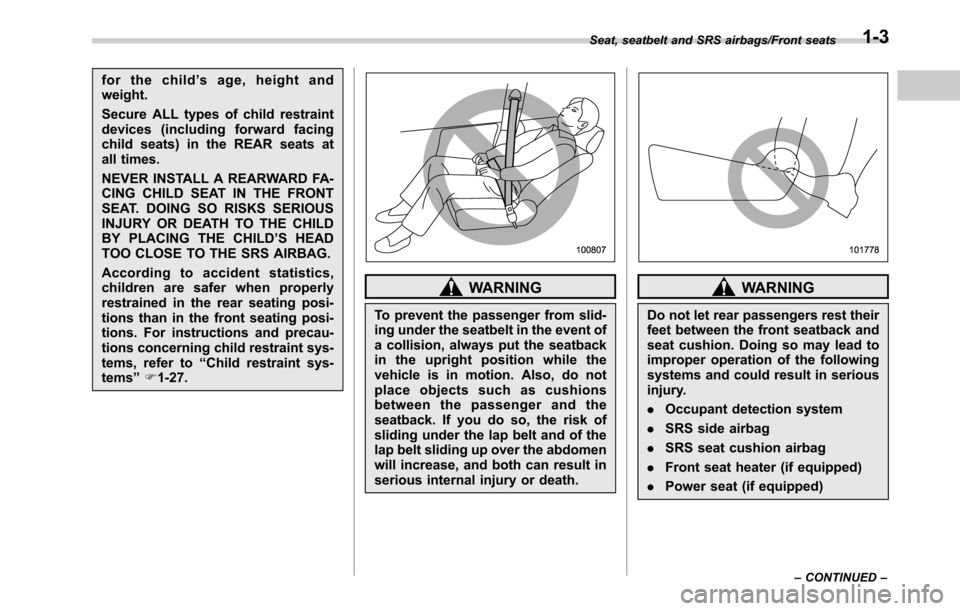
WARNING
To prevent the passenger from slid-
ing under the seatbelt in the event of
a collision, always put the seatback
in the upright position while the
vehicle is in motion. Also, do not
place objects such as cushions
between the passenger and the
seatback. If you do so, the risk of
sliding under the lap belt and of the
lap belt sliding up over the abdomen
will increase, and both can result in
serious internal injury or death.
WARNING
Do not let rear passengers rest their
feet between the front seatback and
seat cushion. Doing so may lead to
improper operation of the following
systems and could result in serious
injury.
.Occupant detection system
.SRS side airbag
.SRS seat cushion airbag
.Front seat heater (if equipped)
.Power seat (if equipped)
Seat, seatbelt and SRS airbags/Front seats
–CONTINUED–1-3
Page 38 of 572

Seat, seatbelt and SRS airbags/Front seats
NOTE
.If the registered seat position cannot
be retrieved after performing the pre-
vious procedures, try the following
procedures.
(1) Press the“SET”button on the
driver’s door.
(2) Press the“
”button on the
access key or touch the door lock
sensor to lock the doors.
(3) Perform the prior procedures
again.
.If the keyless access function is
disabled, the seat position cannot be
retrieved by gripping the driver’s door
handle. However, the seat position can
still be retrieved by pressing the“
”
button on the access key. For informa-
tion about how to enable/disable the
keyless access function, refer to“Dis-
abling keyless access function”F2-18.
.If a new position is registered for the
same access key, the previously regis-
tered seat position is deleted.
!Clearing the registered seat
position with access key
1. Close the driver’s door.
2. While holding the access key and
pressing the“SET”button, press the“
”
button on the access key.A chirp will sound, and the registered seat
position will be cleared.
&Head restraint adjustment
WARNING
.Never drive the vehicle with the
head restraints removed because
they are designed to reduce the
risk of serious neck injury in the
event that the vehicle is struck
from the rear. Also, never install
the head restraints the opposite
way around. Doing so will pre-
vent the head restraints from
functioning as intended. There-
fore, when you remove the head
restraints, you must reinstall all
head restraints correctly to pro-
tect vehicle occupants.
.All occupants, including the dri-
ver, should not operate a vehicle
or sit in a vehicle’s seat until the
head restraints are placed in their
proper positions in order to mini-
mize the risk of neck injury in the
event of a crash.
Both the driver’s seat and front passen-
ger’s seat are equipped with head re-
straints. Both head restraints are adjusta-
ble in the following ways.!Head restraint height adjustment
1) Head restraint
2) Release button
Each head restraint should be adjusted so
that the center of the head restraint is
closest to the top of the occupant’s ears.
To raise:
Pull the head restraint up.
To lower:
Push the head restraint down while
pressing the release button on the top of
the seatback.
To remove:
While pressing the release button, pull out
the head restraint.
To install:
Install the head restraint into the holes that
1-8
Page 39 of 572
are located on the top of the seatback until
the head restraint locks. Press and hold
the release button to lower the head
restraint.
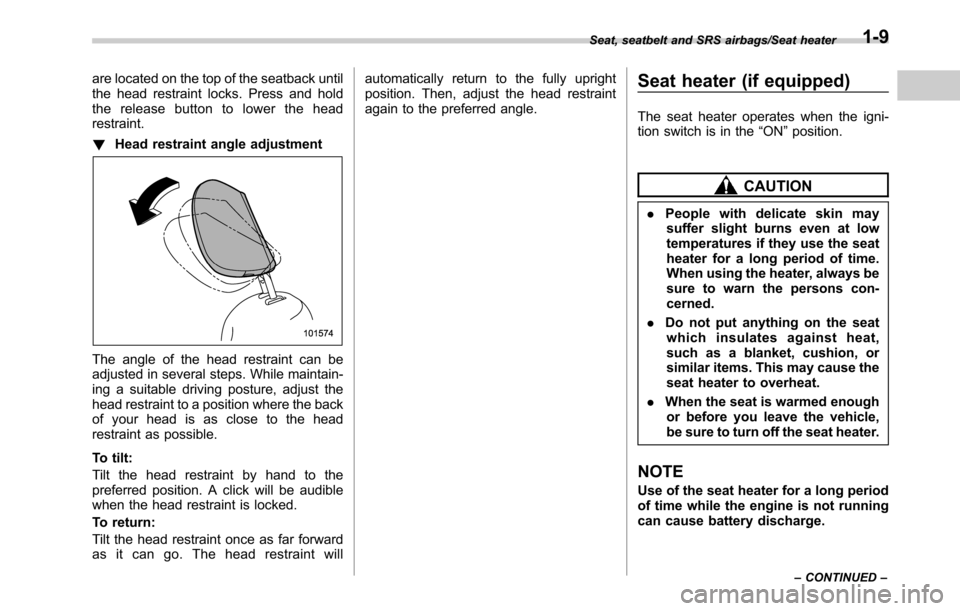
!Head restraint angle adjustment
The angle of the head restraint can be
adjusted in several steps. While maintain-
ing a suitable driving posture, adjust the
head restraint to a position where the back
of your head is as close to the head
restraint as possible.
To tilt:
Tilt the head restraint by hand to the
preferred position. A click will be audible
when the head restraint is locked.
To return:
Tilt the head restraint once as far forward
as it can go. The head restraint willautomatically return to the fully upright
position. Then, adjust the head restraint
again to the preferred angle.
Seat heater (if equipped)
The seat heater operates when the igni-
tion switch is in the“ON”position.
CAUTION
.People with delicate skin may
suffer slight burns even at low
temperatures if they use the seat
heater for a long period of time.
When using the heater, always be
sure to warn the persons con-
cerned.
.Do not put anything on the seat
which insulates against heat,
such as a blanket, cushion, or
similar items. This may cause the
seat heater to overheat.
.When the seat is warmed enough
or before you leave the vehicle,
be sure to turn off the seat heater.
NOTE
Use of the seat heater for a long period
of time while the engine is not running
can cause battery discharge.
Seat, seatbelt and SRS airbags/Seat heater
–CONTINUED–1-9
Page 41 of 572
Rear seats
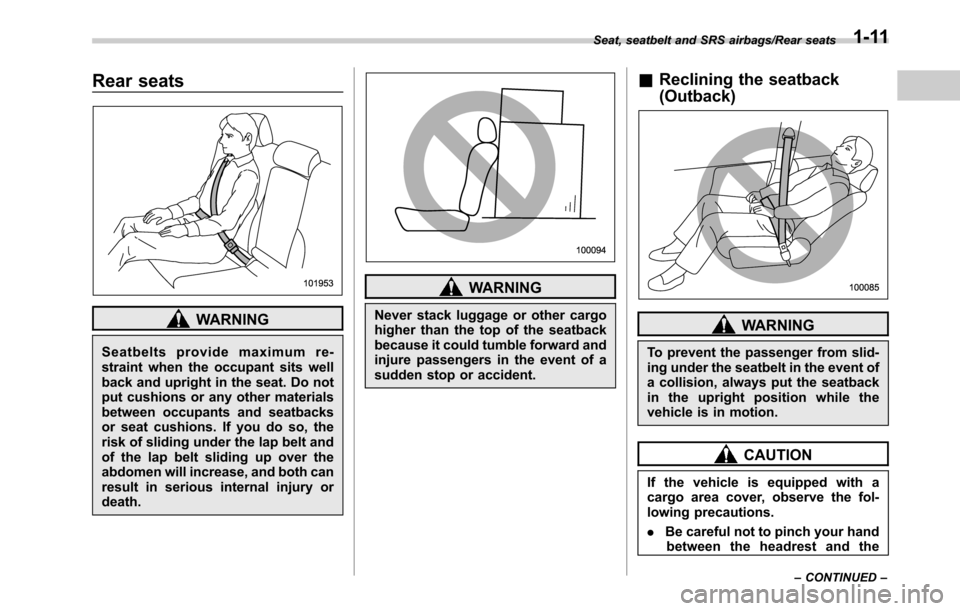
WARNING
Seatbelts provide maximum re-
straint when the occupant sits well
back and upright in the seat. Do not
put cushions or any other materials
between occupants and seatbacks
or seat cushions. If you do so, the
risk of sliding under the lap belt and
of the lap belt sliding up over the
abdomen will increase, and both can
result in serious internal injury or
death.
WARNING
Never stack luggage or other cargo
higher than the top of the seatback
because it could tumble forward and
injure passengers in the event of a
sudden stop or accident.
&Reclining the seatback
(Outback)
WARNING
To prevent the passenger from slid-
ing under the seatbelt in the event of
a collision, always put the seatback
in the upright position while the
vehicle is in motion.
CAUTION
If the vehicle is equipped with a
cargo area cover, observe the fol-
lowing precautions.
.Be careful not to pinch your hand
between the headrest and the
Seat, seatbelt and SRS airbags/Rear seats
–CONTINUED–1-11
Page 44 of 572
Seat, seatbelt and SRS airbags/Rear seats
&Head restraint adjustment
Both the rear window side seats and the
rear center seat are equipped with head
restraints.
WARNING
.Never drive the vehicle with the
head restraints removed because
they are designed to reduce the
risk of serious neck injury in the
event that the vehicle is struck
from the rear. Therefore, when
you remove the head restraints,
you must reinstall all head re-
straints to protect vehicle occu-
pants.
.All occupants, including the dri-
ver, should not operate a vehicle
or sit in a vehicle’s seat until the
head restraints are placed in their
proper positions in order to mini-
mize the risk of neck injury in the
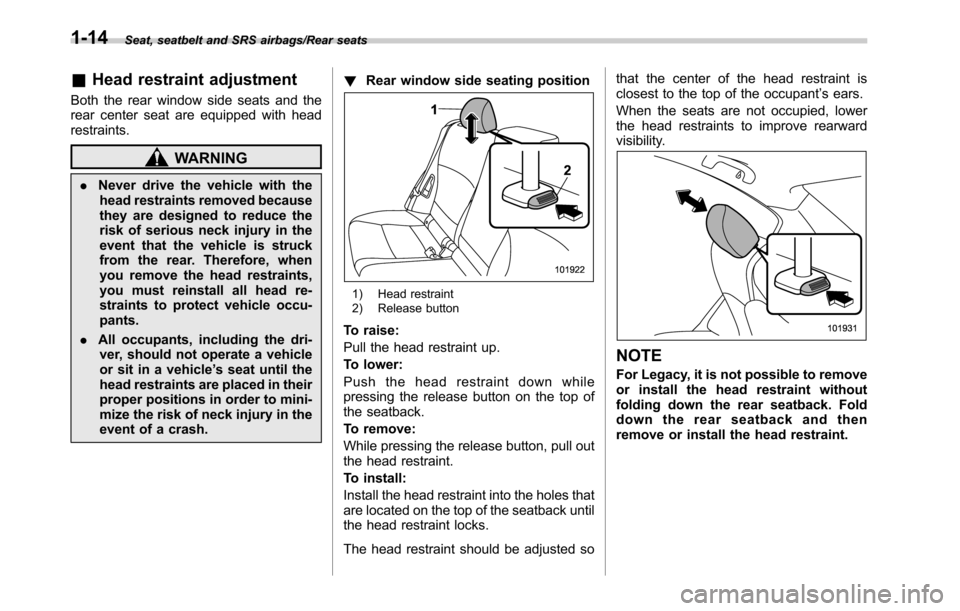
event of a crash.!Rear window side seating position
1) Head restraint
2) Release button
To raise:
Pull the head restraint up.
To lower:
Push the head restraint down while
pressing the release button on the top of
the seatback.
To remove:
While pressing the release button, pull out
the head restraint.
To install:
Install the head restraint into the holes that
are located on the top of the seatback until
the head restraint locks.
The head restraint should be adjusted sothat the center of the head restraint is
closest to the top of the occupant’s ears.
When the seats are not occupied, lower
the head restraints to improve rearward
visibility.
NOTE
For Legacy, it is not possible to remove
or install the head restraint without
folding down the rear seatback. Fold
down the rear seatback and then
remove or install the head restraint.
1-14
Page 45 of 572
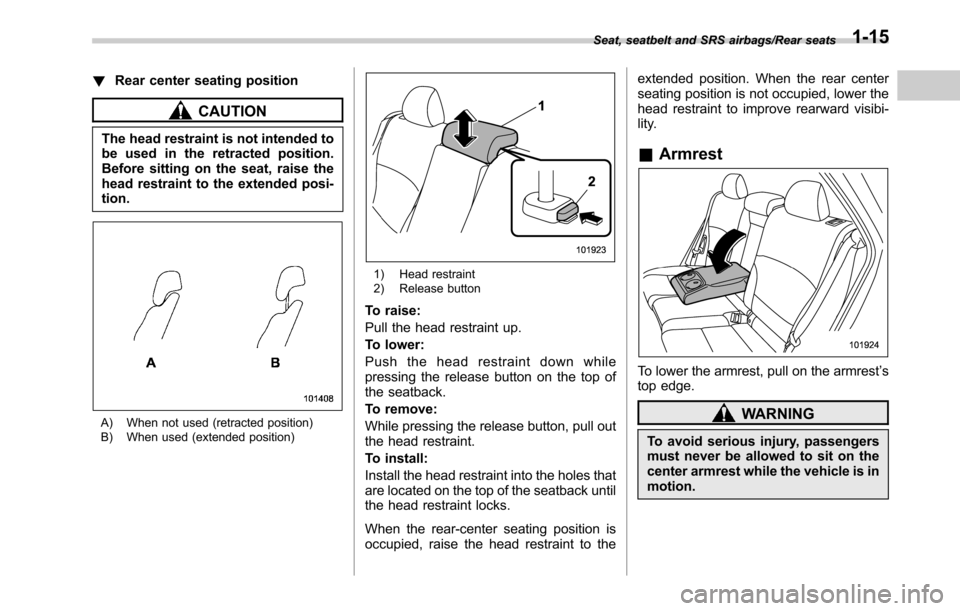
!Rear center seating position
CAUTION
The head restraint is not intended to
be used in the retracted position.
Before sitting on the seat, raise the
head restraint to the extended posi-
tion.
A) When not used (retracted position)
B) When used (extended position)
1) Head restraint
2) Release button
To raise:
Pull the head restraint up.
To lower:
Push the head restraint down while
pressing the release button on the top of
the seatback.
To remove:
While pressing the release button, pull out
the head restraint.
To install:
Install the head restraint into the holes that
are located on the top of the seatback until
the head restraint locks.
When the rear-center seating position is
occupied, raise the head restraint to theextended position. When the rear center
seating position is not occupied, lower the
head restraint to improve rearward visibi-
lity.
&Armrest
To lower the armrest, pull on the armrest’s
top edge.
WARNING
To avoid serious injury, passengers
must never be allowed to sit on the
center armrest while the vehicle is in
motion.
Seat, seatbelt and SRS airbags/Rear seats1-15