2016 SUBARU OUTBACK Speed indicator
[x] Cancel search: Speed indicatorPage 492 of 572
Maintenance and service/Replacement of brake pad
Replacement of brake pad
CAUTION
.If you continue to drive despite
the scraping noise from the audi-
ble brake pad wear indicator, it
will result in the need for costly
brake rotor repair or replace-
ment.
.It is recommended that you dis-
connect the vehicle battery be-
fore replacing the brake pad.
However, it is dangerous to dis-
connect the vehicle battery. We
recommend that you have your
SUBARU dealer replace the
brake pad.
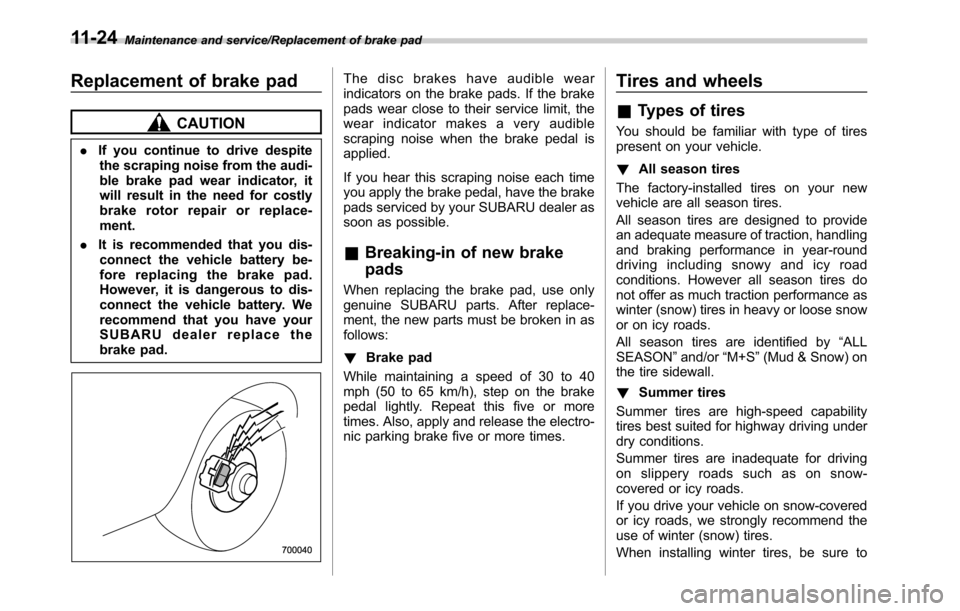
The disc brakes have audible wear
indicators on the brake pads. If the brake
pads wear close to their service limit, the
wear indicator makes a very audible
scraping noise when the brake pedal is
applied.
If you hear this scraping noise each time
you apply the brake pedal, have the brake
pads serviced by your SUBARU dealer as
soon as possible.
&Breaking-in of new brake
pads
When replacing the brake pad, use only
genuine SUBARU parts. After replace-
ment, the new parts must be broken in as
follows:
!Brake pad
While maintaining a speed of 30 to 40
mph (50 to 65 km/h), step on the brake
pedal lightly. Repeat this five or more
times. Also, apply and release the electro-
nic parking brake five or more times.
Tires and wheels
&Types of tires
You should be familiar with type of tires
present on your vehicle.
!All season tires
The factory-installed tires on your new
vehicle are all season tires.
All season tires are designed to provide
an adequate measure of traction, handling
and braking performance in year-round
driving including snowy and icy road
conditions. However all season tires do
not offer as much traction performance as
winter (snow) tires in heavy or loose snow
or on icy roads.
All season tires are identified by“ALL
SEASON”and/or“M+S”(Mud & Snow) on
the tire sidewall.
!Summer tires
Summer tires are high-speed capability
tires best suited for highway driving under
dry conditions.
Summer tires are inadequate for driving
on slippery roads such as on snow-
covered or icy roads.
If you drive your vehicle on snow-covered
or icy roads, we strongly recommend the
use of winter (snow) tires.
When installing winter tires, be sure to
11-24
Page 497 of 572
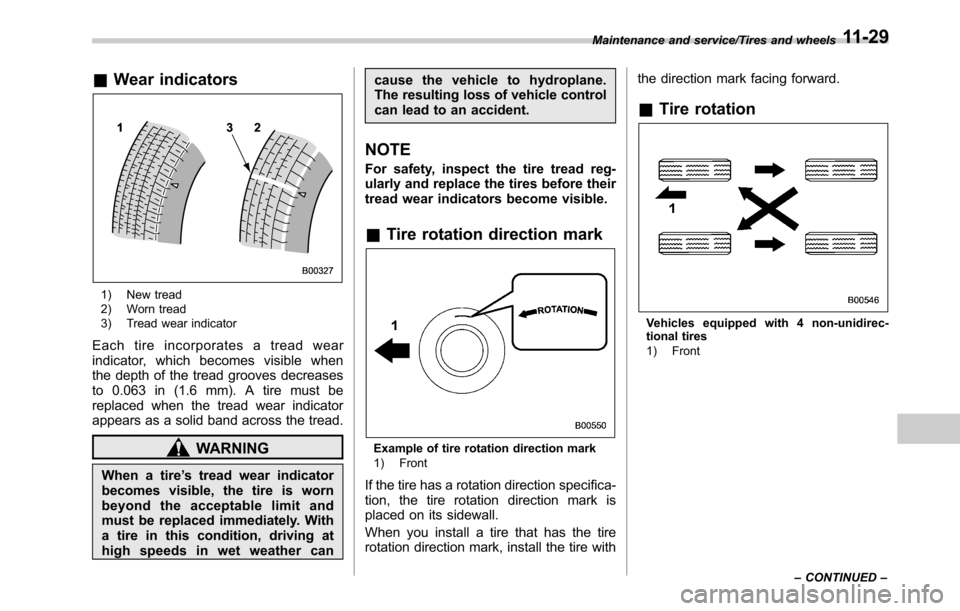
&Wear indicators
1) New tread
2) Worn tread
3) Tread wear indicator
Each tire incorporates a tread wear
indicator, which becomes visible when
the depth of the tread grooves decreases
to 0.063 in (1.6 mm). A tire must be
replaced when the tread wear indicator
appears as a solid band across the tread.
WARNING
When a tire’s tread wear indicator
becomes visible, the tire is worn
beyond the acceptable limit and
must be replaced immediately. With
a tire in this condition, driving at
high speeds in wet weather cancause the vehicle to hydroplane.
The resulting loss of vehicle control
can lead to an accident.
NOTE
For safety, inspect the tire tread reg-
ularly and replace the tires before their
tread wear indicators become visible.
&Tire rotation direction mark
Example of tire rotation direction mark
1) Front
If the tire has a rotation direction specifica-
tion, the tire rotation direction mark is
placed on its sidewall.
When you install a tire that has the tire
rotation direction mark, install the tire withthe direction mark facing forward.
&Tire rotation
Vehicles equipped with 4 non-unidirec-
tional tires
1) Front Maintenance and service/Tires and wheels
–CONTINUED–
11-29
Page 547 of 572

Table 1—Occupant loading and distribution for vehicle normal load for
various designated seating capacities
Designated seating
capacity, number of
occupantsVehicle normal load,
number of occupantsOccupant distribution in a
normally loaded vehicle
2 through 4 2 2 in front.
5 through 10 32 in front, 1 in second
seat.
11 through 15 52 in front, 1 in second
seat, 1 in third seat, 1 in
fourth seat.
16 through 22 72 in front, 2 in second
seat, 2 in third seat, 1 in
fourth seat.&Tire care–maintenance and
safety practices
.Check on a daily basis that the
tires are free from serious damage,
nails, and stones. At the same time,
check the tires for abnormal wear.
.Inspect the tire tread regularly
and replace the tires before their
tread wear indicators become visi-
ble. When a tire’s tread wear
indicator becomes visible, the tire
is worn beyond the acceptable limit
and must be replaced immediately.
With a tire in this condition, driving
at even low speeds in wet weather
can cause the vehicle to hydro-
plane. Possible resulting loss of
vehicle control can lead to an
accident.
Consumer information and Reporting safety defects/Tire information
–CONTINUED–13-9
Page 564 of 572

14-10Index
Security
Alarm system........................................................ 2-28
Immobilizer.............................................................. 2-4
Indicator light......................................................... 3-29
Shock sensors....................................................... 2-32
Select lever
Position indicator................................................... 3-30
Shift lock function................................................... 7-27
Shock sensors........................................................... 2-32
Shopping bag hook.................................................... 6-14
Snow tires........................................................ 8-11, 11-25
Snowy and icy roads.................................................. 8-10
Spark plugs...................................................... 11-18, 12-9
Specifications............................................................ 12-2
Speedometer............................................................... 3-8
SRS airbag (Supplemental Restraint System airbag) ... 4, 1-41
SRS airbag system
Monitors................................................................ 1-68
Servicing............................................................... 1-69
Warning light......................................................... 3-14
Starting & stopping engine.................................... 7-9, 7-12
State emission testing (U.S. only).................................. 7-7
Steering responsive fog lights system........................... 3-49
OFF indicator........................................................ 3-31
Steering switches for audio......................................... 5-63
Steering wheel
Lock............................................................. 7-11, 7-15
Power................................................................... 7-31
Tilt/telescopic......................................................... 3-63
Stop light................................................................ 12-15
Storage compartment................................................... 6-6Sun shade................................................................. 2-50
Sun visors.................................................................. 6-4
Supplemental Restraint System airbag (SRS)................ 1-41
Synthetic leather upholstery......................................... 10-5
T
Tachometer................................................................. 3-9
Temperature gauge..................................................... 3-11
Temperature warning light
AT OIL TEMP......................................................... 3-16
Temporary spare tire.................................................... 9-2
Tether (child restraint system).............................. 1-35, 1-38
Tie-down hooks.......................................................... 9-14
Tire................................................................. 11-24, 12-9
Chains.................................................................. 8-12
Inspection............................................................ 11-26
Pressures and wear.............................................. 11-27
Replacement........................................................ 11-30
Rotation.............................................................. 11-29
Size and pressure.................................................. 12-9
Types.................................................................. 11-24
Tire pressure monitoring system (TPMS)..... 7-40, 9-10, 11-25
Warning light.......................................................... 3-16
Tires and wheels...................................................... 11-24
Tools
.......................................................................... 9-3
Top tether anchorages........................................ 1-35, 1-38
Towing...................................................................... 9-13
All wheels on the ground......................................... 9-17
Flat-bed truck......................................................... 9-16
Hooks................................................................... 9-14
Weight .................................................................. 8-21