Page 276 of 490
Maintenance and care4
275
4-1. Maintenance and care
Cleaning and protecting
the vehicle exterior......... 276
Cleaning and protecting
the vehicle interior.......... 280
Cleaning and protecting
the Alcantara
® area ....... 284
4-2. Maintenance
Maintenance
requirements .................. 286
General maintenance....... 289
Emission inspection and
maintenance (I/M)
programs........................ 2924-3. Do-it-yourself
maintenance
Do-it-yourself service
precautions .................... 293
Engine hood ..................... 296
Engine compartment ........ 298
Tires ................................. 312
Tire inflation pressure ...... 319
Wheels ............................. 323
Air conditioning filter......... 326
Transmitter/access key
battery ............................ 329
Checking and replacing
fuses .............................. 334
Light bulbs........................ 342
Page 296 of 490
295 4-3. Do-it-yourself maintenance
4
Maintenance and care
WARNING
The engine compartment contains many mechanisms and fluids that may
move suddenly, become hot, or become electrically energized. To avoid death
or serious injury, observe the following precautions.
■When working in the engine compartment
●Keep hands, clothing, and tools away from the moving fan and engine
drive belt.
●Be careful not to touch the engine, radiator, exhaust manifold, etc. right
after driving as they may be hot. Oil and other fluids may also be hot.
●Do not leave anything that may burn easily, such as paper or rags, in the
engine compartment.
●Do not smoke, cause sparks or expose an open flame to fuel or the bat-
tery. Fuel and battery fumes are flammable.
●Be extremely cautious when working on the battery. It contains poisonous
and corrosive sulfuric acid.
■When working near the electric cooling fans or radiator grille
Vehicles without a keyless access with push button start system: Be sure the
engine switch is off. With the engine switch in the “ON” position, the electric
cooling fans may automatically start to run if the air conditioning is on and/or
the coolant temperature is high. (oP. 304)
Vehicles with a keyless access with push button start system: Be sure the
push-button ignition switch is off. With the push-button ignition switch in
“ON” mode, the electric cooling fans may automatically start to run if the air
conditioning is on and/or the coolant temperature is high. (oP. 304)
■Safety glasses
Wear safety glasses to prevent flying or falling material, fluid spray, etc. from
getting in the eyes.
CAUTION
■If you remove the air cleaner filter
Driving with the air cleaner filter removed may cause excessive engine wear
due to dirt in the air. Also a backfire could cause a fire in the engine compart-
ment.
Page 309 of 490

308 4-3. Do-it-yourself maintenance
■Before recharging
When recharging, the battery produces hydrogen gas which is flammable
and explosive. Therefore, before recharging:
●If recharging with the battery installed on the vehicle, be sure to discon-
nect the ground cable.
●Make sure the power switch on the charger is off when connecting and
disconnecting the charger cables to the battery.
■After recharging/reconnecting the battery (vehicles with a keyless
access with push button start system)
●Unlocking the doors using the keyless access with push button start sys-
tem may not be possible immediately after reconnecting the battery. If
this happens, use the remote keyless entry system or the mechanical
key to lock/unlock the doors.
●Start the engine with the push-button ignition switch in “ACC” mode. The
engine may not start with the push-button ignition switch turned off. How-
ever, the engine will operate normally from the second attempt.
●The push-button ignition switch mode is recorded by the vehicle. If the
battery is reconnected, the vehicle will return the push-button ignition
switch mode to the status it was in before the battery was disconnected.
Make sure to turn off the engine before disconnect the battery. Take extra
care when connecting the battery if the push-button ignition switch mode
prior to discharge is unknown.
If the engine will not start even after multiple attempts, contact your
SUBARU dealer.
Page 317 of 490

316 4-3. Do-it-yourself maintenance
■Initializing the tire pressure monitoring system (if equipped)
Initialize the system with the tire inflation pressure adjusted to the speci-
fied level.
■Routine tire inflation pressure checks (vehicles with a tire pressure
monitoring system)
The tire pressure monitoring system does not replace routine tire infla-
tion pressure checks. Make sure to check tire inflation pressure as part
of your routine of daily vehicle checks.
■Tire pressure monitoring system certification (if equipped)
MODEL/FCC IDs:
Transmitter: PAXPMVC010
Receiver: HYQ23AAA (vehicles without a keyless access with push
button start system)
HYQ23AAE (vehicles with a keyless access with push but-
ton start system)
NOTE:
This device complies with part 15 of the FCC Rules. Operation is subject
to the following two conditions: (1) This device may not cause harmful
interference, and (2) this device must accept any interference received,
including interference that may cause undesired operation.
FCC WARNING:
Changes or modifications not expressly approved by the party responsi-
ble for compliance could void the user's authority to operate the equip-
ment.
Page 327 of 490
326
4-3. Do-it-yourself maintenance
Air conditioning filter
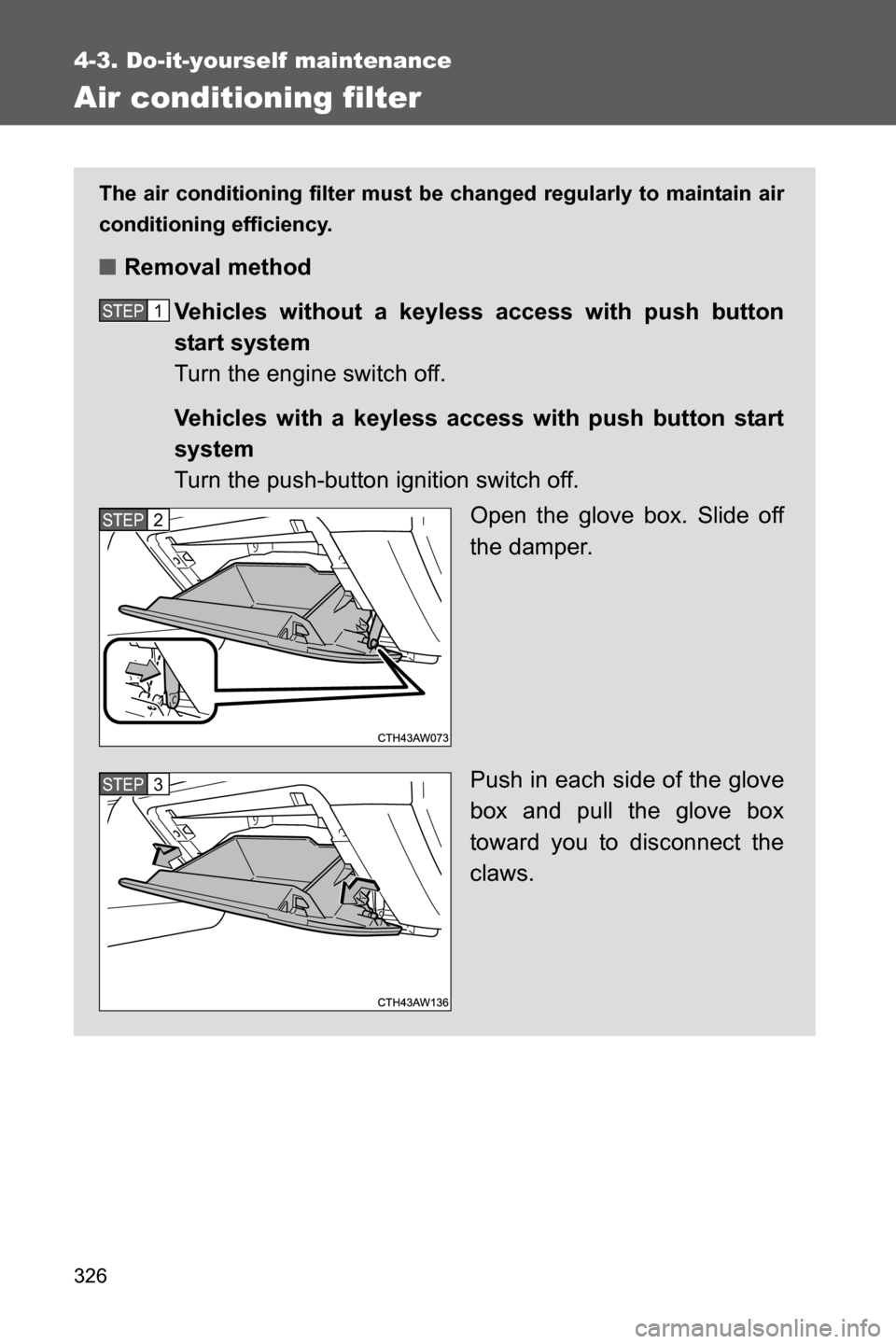
The air conditioning filter must be changed regularly to maintain air
conditioning efficiency.
■Removal method
Vehicles without a keyless access with push button
start system
Turn the engine switch off.
Vehicles with a keyless access with push button start
system
Turn the push-button ignition switch off.
Open the glove box. Slide off
the damper.
Push in each side of the glove
box and pull the glove box
toward you to disconnect the
claws.
STEP 1
STEP 2
STEP 3
Page 330 of 490
329
4-3. Do-it-yourself maintenance
4
Maintenance and care
Transmitter/access key batter y
Replace the battery with a new one if it is depleted.
■You will need the following items:
●Flathead screwdriver
●Lithium battery CR2016 (vehicles without a keyless access
with push button start system), or CR2032 (vehicles with a
keyless access with push button start system)
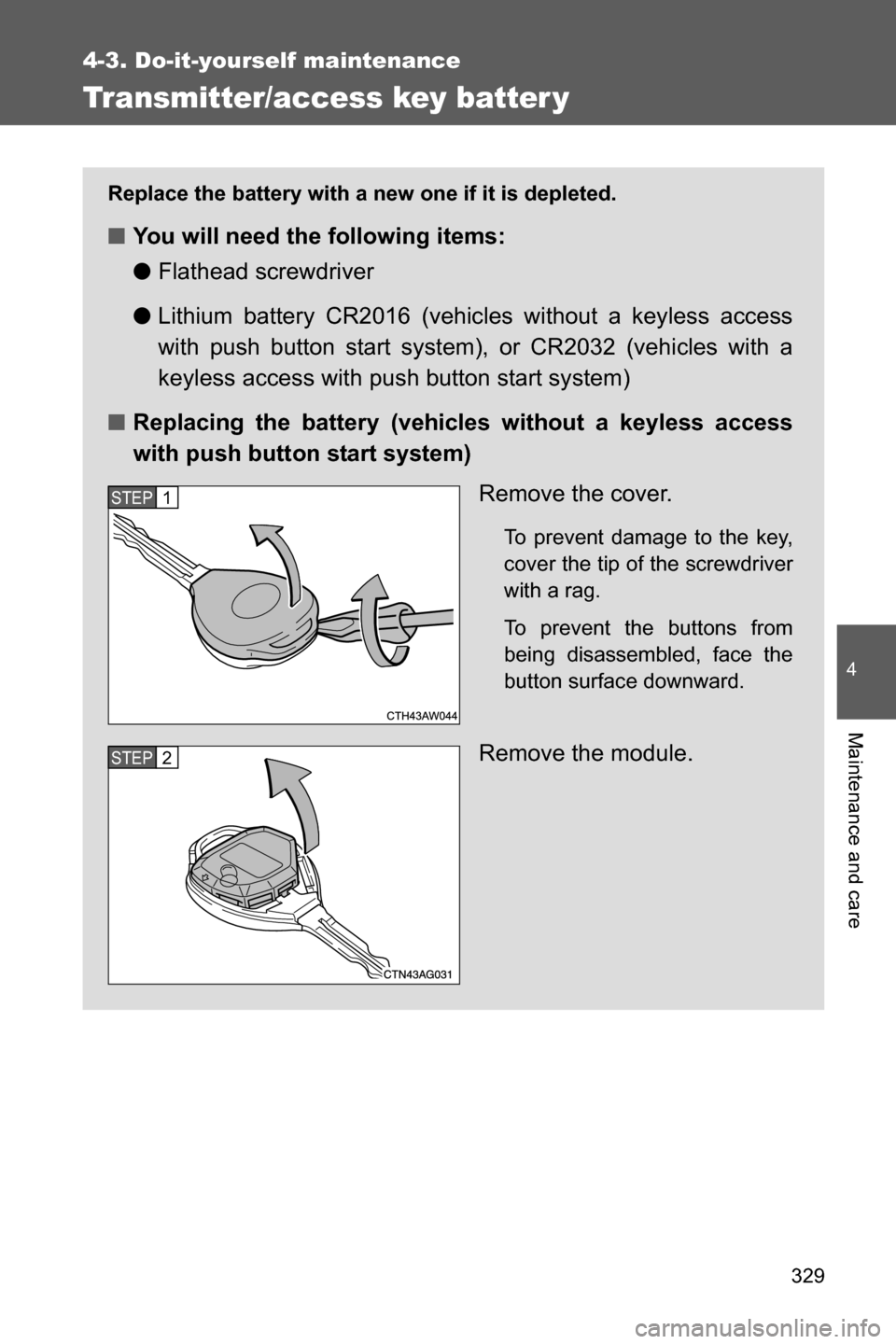
■Replacing the battery (vehicles without a keyless access
with push button start system)
Remove the cover.
To prevent damage to the key,
cover the tip of the screwdriver
with a rag.
To prevent the buttons from
being disassembled, face the
button surface downward.
Remove the module.
STEP1
STEP2
Page 331 of 490
330 4-3. Do-it-yourself maintenance
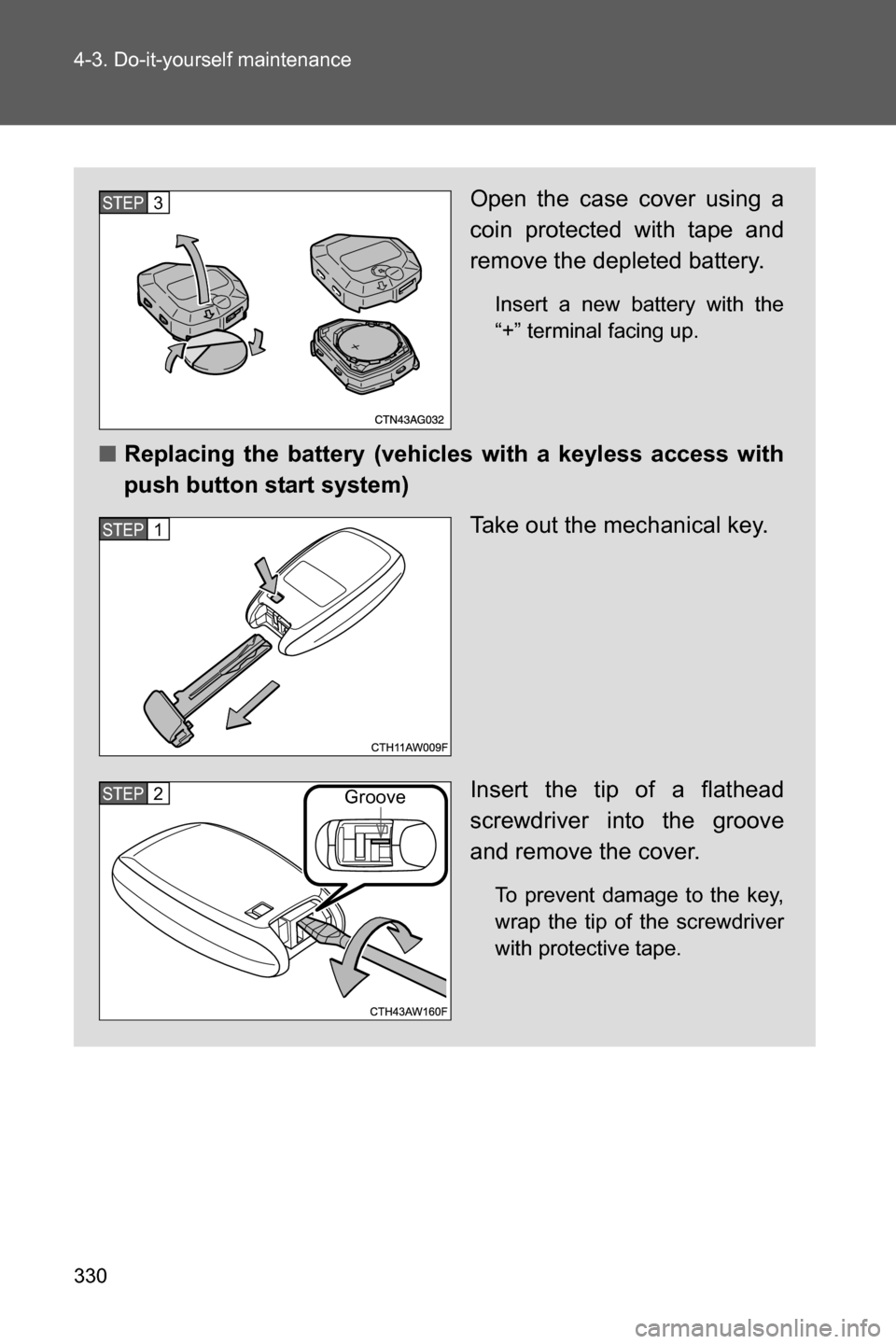
Open the case cover using a
coin protected with tape and
remove the depleted battery.
Insert a new battery with the
“+” terminal facing up.
■Replacing the battery (vehicles with a keyless access with
push button start system)
Take out the mechanical key.
Insert the tip of a flathead
screwdriver into the groove
and remove the cover.
To prevent damage to the key,
wrap the tip of the screwdriver
with protective tape.
STEP3
STEP1
STEP2Groove
Page 332 of 490
331 4-3. Do-it-yourself maintenance
4
Maintenance and care
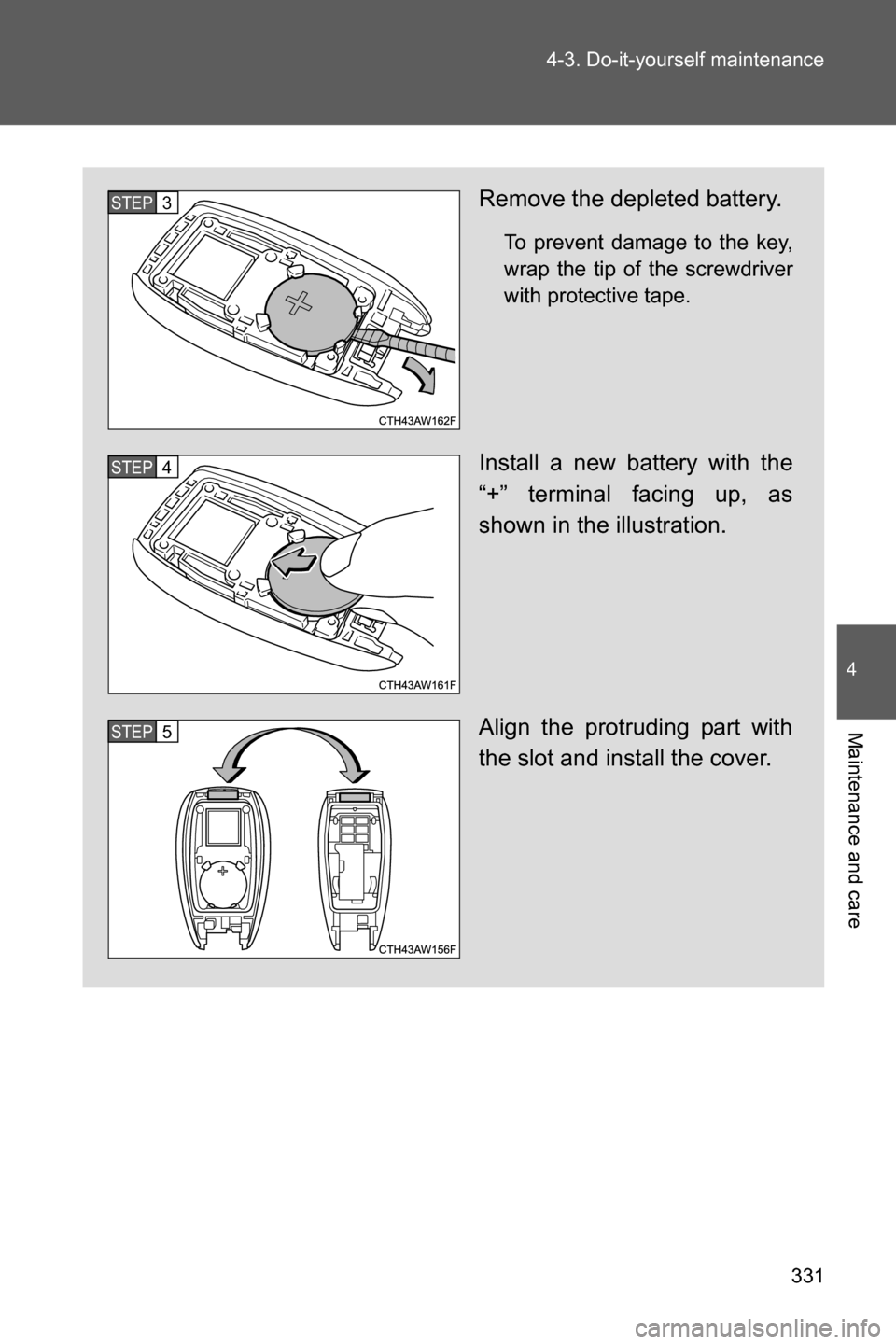
Remove the depleted battery.
To prevent damage to the key,
wrap the tip of the screwdriver
with protective tape.
Install a new battery with the
“+” terminal facing up, as
shown in the illustration.
Align the protruding part with
the slot and install the cover.
STEP3
STEP4
STEP5