2016 SMART FORTWO brake
[x] Cancel search: brakePage 199 of 214
Direction of rotation
Tires with a specified direction of rotation
have additional benefits, e.g. if there is a
risk of hydroplaning. These advantages can
only be gained if the tires are fitted corre-
sponding to the direction of rotation.
An arrow on the sidewall of the tire indicates
its correct direction of rotation.
Storing wheels
Store wheels that are not being used in a cool,
dry and preferably dark place. Protect the
tires from oil, grease, gasoline and diesel.
Mounting a wheel
Preparing the vehicle
XMake sure that you have the appropriate
tire-changing tools. For further informa-
tion inquire at any smart center.
XStop the vehicle on solid, non-slippery and
level ground.
XApply the parking brake (Ypage 101).
XBring the front wheels into the straight-
ahead position.
XVehicles with automatic transmission:
shift the transmission to position P.
XVehicles with manual transmission:
depress the clutch pedal fully and engage
first or reverse gear.
XSwitch off the engine.
XRemove the SmartKey from the ignition
lock.
XAlso secure the vehicle against rolling
away.
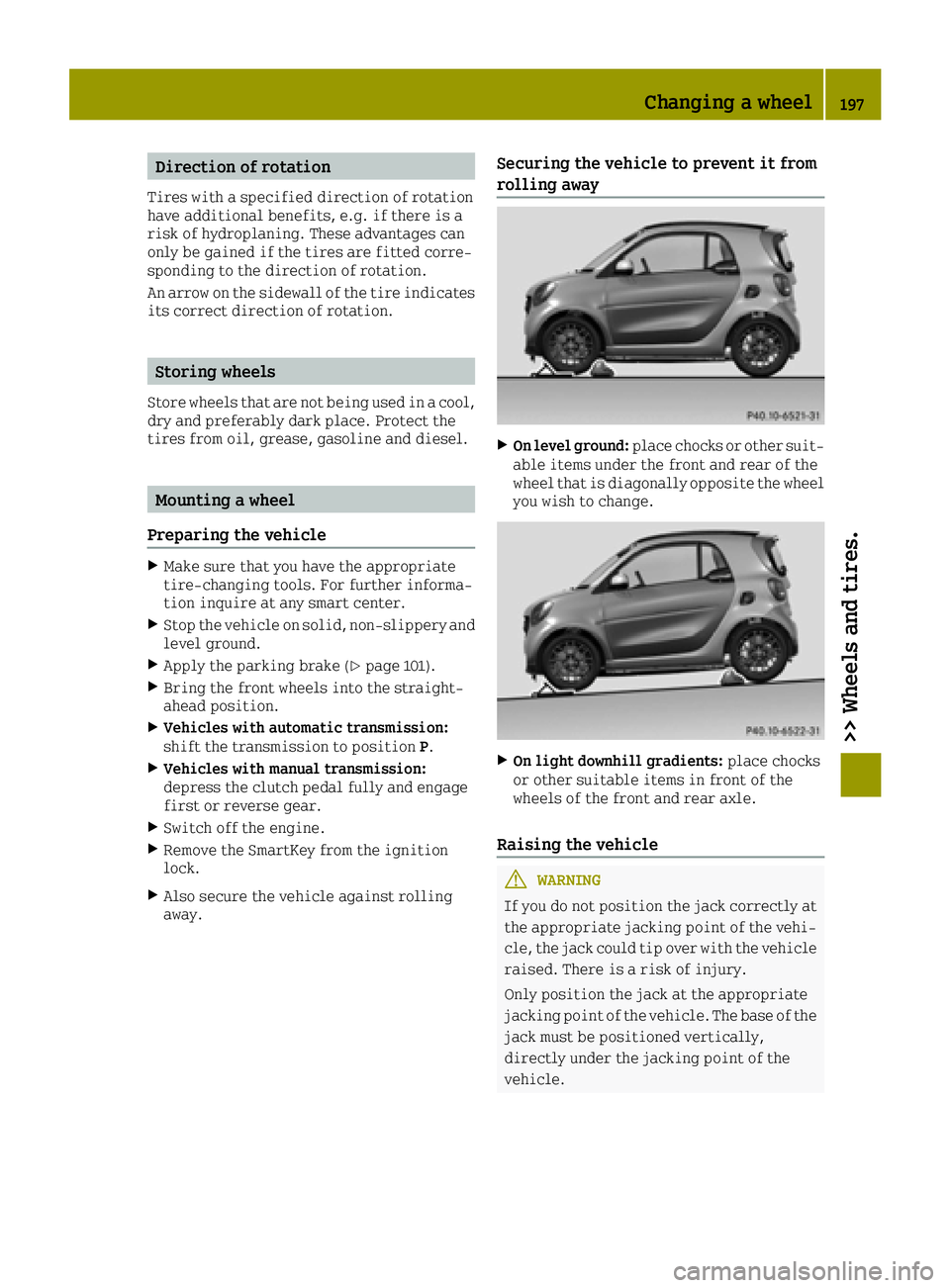
Securing the vehicle to prevent it from
rolling away
XOn level ground:place chocks or other suit-
able items under the front and rear of the
wheel that is diagonally opposite the wheel
you wish to change.
XOn light downhill gradients: place chocks
or other suitable items in front of the
wheels of the front and rear axle.
Raising the vehicle
GWARNING
If you do not position the jack correctly at
the appropriate jacking point of the vehi- cle, the jack could tip over with the vehicle
raised. There is a risk of injury.
Only position the jack at the appropriate
jacking point of the vehicle. The base of the jack must be positioned vertically,
directly under the jacking point of the
vehicle.
Changing a wheel197
>> Wheels and tires.
Z
Page 200 of 214

Observe the following when raising the vehi-
cle:
Rmake sure you have a suitable jack and
wheel wrench. If used incorrectly, the jack
could tip over with the vehicle raised.
For further information inquire at any
smart center.
Rthe jack is designed only to raise and hold
the vehicle for a short time while a wheel
is being changed. It is not suited for per-
forming maintenance work under the vehi-
cle.
Ravoid changing the wheel on uphill and
downhill slopes.
Rbefore raising the vehicle, secure it from
rolling away by applying the parking brake
and inserting wheel chocks. Never disen-
gage the parking brake while the vehicle is
raised.
Rthe jack must be placed on a firm, flat and
non-slip surface. On a loose surface, a
large, flat load-bearing underlay must be
used. On a slippery surface, a non-slip
underlay must be used, e.g. rubber mats.
Rdo not use wooden blocks or similar objects
as a jack underlay. Otherwise, the jack will
not be able to achieve its load-bearing
capacity due to the restricted height.
Rmake sure that the distance between the
underside of the tires and the ground does
not exceed 1.2 in (3 cm).
Rnever place your hands and feet under the
raised vehicle.
Rdo not lie under the vehicle.
Rdo not start the engine when the vehicle is
raised.
Rdo not open or close a door or the tailgate
while the vehicle is raised.
Rmake sure that no persons are present in the
vehicle when the vehicle is raised.
!The jack is designed exclusively for
jacking up the vehicle at the jacking
points. Otherwise, your vehicle could be
damaged.
Steel wheel with hub cap
XVehicles with steel wheels and hub caps:
carefully reach into two of the hub cap
openings and remove the hub cap.
Steel wheel with hub cap
XVehicles with steel wheels and hub caps:
remove the hub cap.
XUsing wheel wrench 0043, loosen the bolts on
the wheel you wish to change by about one
full turn. Do not unscrew the bolts com-
pletely.
198Changing a wheel
>> Wheels and tires.
Page 209 of 214

Service products and filling capaci-
ties
Important safety notes
GWARNING
Service products may be poisonous and haz-
ardous to health. There is a risk of injury.
Comply with instructions on the use, stor-
age and disposal of service products on the
labels of the respective original contain-
ers. Always store service products sealed
in their original containers. Always keep
service products out of the reach of chil-
dren.
HEnvironmental note
Dispose of service products in an environ-
mentally responsible manner.
Service products include the following:
RFuels
RLubricants (e.g. engine oil, transmission
oil)
RCoolant
RBrake fluid
RWindshield washer fluid
RClimate control system refrigerant
Components and service products must be
matched. You should therefore only use prod-
ucts that have been tested and approved by
Mercedes-Benz.
Information on tested and approved products
can be obtained at a smart center.
You can recognize service products approved by Mercedes-Benz by the following inscrip-
tion on the containers:
RMB-Freigabe (e.g. MB-Freigabe 229.51)
RMB Approval (e.g. MB Approval 229.51)
Other designations or recommendations
indicate a level of quality or a specification in accordance with an MB Sheet Number (e.g.
MB 229.5). They have not necessarily been
approved by Mercedes-Benz.
iFor further information inquire at any
smart center.
Fuel
Important safety notes
GWARNING
Fuel is highly flammable. If you handle fuel
incorrectly, there is a risk of fire and
explosion.
You must avoid fire, open flames, creating
sparks and smoking. Switch off the engine
and, if applicable, the auxiliary heating
before refueling.
GWARNING
Fuel is poisonous and hazardous to health.
There is a risk of injury.
You must make sure that fuel does not come
into contact with your skin, eyes or cloth-
ing and that it is not swallowed. Do not
inhale fuel vapors. Keep fuel away from
children.
If you or others come into contact with fuel,
observe the following:
RWash away fuel from skin immediately
using soap and water.
RIf fuel comes into contact with your eyes,
immediately rinse them thoroughly with
clean water. Seek medical assistance
without delay.
RIf fuel is swallowed, seek medical assis-
tance without delay. Do not induce vom-
iting.
RImmediately change out of clothing
which has come into contact with fuel.
Tank capacity
ModelTotal capa- city
All models8.7 US gal(33.0 l)
Service products and filling capacities207
>> Technical data.
Z
Page 212 of 214

Engine oil viscosity
Viscosity describes the flow characteristics
of a fluid. If an engine oil has a high viscos-
ity, this means that it is thick; a low viscos-
ity means that it is thin.
Select an engine oil with an SAE (viscosity)
classification suitable for the prevailing
outside temperatures. The table shows you
which SAE classifications are to be used. The
low-temperature properties of engine oils
can be significantly impaired during oper-
ation due to, for example, aging or soot and
fuel accretion. It is therefore strongly rec-
ommended that you carry out regular oil
changes using an approved engine oil with
the appropriate SAE classification.
Brake fluid
When handling brake fluid, observe the
important safety notes on service products
(
Ypage 207).
The brake fluid change intervals can be found
in the Maintenance Booklet.
Only use brake fluid approved by Mercedes-
Benz according to MB Approval 331.0.
Information about approved brake fluid can
be obtained at any qualified specialist work-
shop or on the Internet at
http://bevo.mercedes-benz.com.
iHave the brake fluid regularly replaced at
a qualified specialist workshop and the
replacement confirmed in the Maintenance
Booklet.
Coolant
General notes
!Only add coolant that has been premixed
with the desired antifreeze protection.
You could otherwise damage the engine.
Further information on coolants can be
found in the Mercedes-Benz Specifications
for Service Products, MB BeVo 310.1, e.g. on
the Internet at
http://bevo.mercedes-benz.com. Or con-
tact a qualified specialist workshop.
!Always use a suitable coolant mixture,
even in countries where high temperatures
prevail.
Otherwise, the engine cooling system is not sufficiently protected from corrosion and
overheating.
iHave the coolant regularly replaced at a
qualified specialist workshop and the
replacement confirmed in the Maintenance
Booklet.
Comply with the important safety precautions
for service products when handling coolant
(
Ypage 207).
The coolant is a mixture of water and anti-
freeze/corrosion inhibitor. It performs the
following tasks:
Rcorrosion protection
Rantifreeze protection
Rraising the boiling point
If the coolant has antifreeze protection down
to -35 ‡(-37 †), the boiling point of the cool-
ant during operation is approximately 266 ‡
(130 †).
The antifreeze/corrosion inhibitor concen-
tration in the engine cooling system should:
Rbe at least 50 %. This will protect the
engine cooling system against freezing
down to around -13‡(-25 †).
Rnot exceed 50 % (antifreeze protection down
to-35 ‡[-37 †]). Otherwise, heat will not be
dissipated as effectively.
smart recommends an antifreeze/corrosion
inhibitor concentrate in accordance with MB
Specifications for Operating Fluids 310.1 or
325.6.
Antifreeze/corrosion inhibitor concentrate
in accordance with MB Specifications for
210Service products and filling capacities
>> Technical data.