2016 SMART FORTWO ABS
[x] Cancel search: ABSPage 136 of 214

ProblemPossible causes/consequences and0050Solutions
0025
The yellow ABS warning
lamp is lit while the
engine is running.ABS is malfunctioning. This means that ESP®, Crosswind Assist and
hill start assist, for example, are also unavailable.
Other driving systems could be switched off automatically.
GWARNING
The brake system continues to function normally, but without the
functions listed above. The wheels could therefore lock if you
brake hard, for example.
The steerability and braking characteristics may be severely
affected. The braking distance in an emergency braking situation
can increase.
If ESP
®is not operational, ESP®is unable to stabilize the vehicle.
There is an increased risk of skidding and an accident.
XDrive on carefully.
XVisit a qualified specialist workshop.
If the ABS control unit is faulty, there is also a possibility that
other systems may be unavailable.
00E5
The yellow ESP®warn-
ing lamp is on when you
are driving.
In addition, the \
door warning lamp and
other warning lamps,
e.g. 0077, light up.
The central vehicle electronics system is malfunctioning.
After the engine is switched off:
Rdo not lock/unlock the doors using the remote control function of
the key
Ryou can no longer start the engine.
XObserve the additional display messages in the display.
XPull over and stop the vehicle safely as soon as possible, paying
attention to road and traffic conditions. Do not continue driv-
ing under any circumstances.
XSecure the vehicle against rolling away (Ypage 100).
XConsult a qualified specialist workshop.
00E5
The yellow ESP®warn-
ing lamp flashes while
the vehicle is in
motion.
ESP®or traction control has intervened because there is a risk of
skidding or at least one wheel has started to spin.
Cruise control is automatically deactivated.
XWhen pulling away, only depress the accelerator pedal as far as
necessary.
XEase off the accelerator pedal while the vehicle is in motion.
XAdapt your driving style to suit the road and weather condi-
tions.
134Warning and indicator lamps in the instrument cluster
>> On-board computer and displays.
Page 166 of 214

GWARNING
If the required tire pressure is not reached after driving for a short period, the tire is
too badly damaged. The tire sealant cannot repair the tire in this instance. Damaged
tires and a tire pressure that is too low can
significantly impair the vehicle's brakingand driving characteristics. There is a
risk of accident.
Do not continue driving. Contact a quali-
fied specialist workshop.
XCorrect the tire pressure if it is still at
least 130 kPa (1.3 bar/19 psi). For values, see
the tire and loading information table on
the driver's side B-pillar.
XTo increase the tire pressure: switch on the
tire inflation compressor.
XTo reduce the tire pressure: depress pres-
sure release button 0043next to pressure
gauge 0044.
XIf the tire pressure is correct, unscrew the
filler hose from the valve of the sealed
tire.
XScrew the valve cap onto the valve of the
sealed tire.
XDrive to the nearest qualified specialist
workshop and have the tire changed there.
XHave the tire sealant bottle and the filler
hose replaced as soon as possible at a
qualified specialist workshop.
XHave the tire sealant bottle replaced every
four years at a qualified specialist work-
shop.
Battery (vehicle)
Important safety notes
Special tools and expert knowledge are
required when working on the battery, e.g.
removal and installing. You should therefore
have all work involving the battery carried
out at a qualified specialist workshop.
GWARNING
Work carried out incorrectly on the battery
can lead, for example, to a short circuit and
thus damage the vehicle electronics. This
can lead to function restrictions applying
to safety-relevant systems, e.g the lighting system, the ABS (anti-lock braking system)
or the ESP
®(Electronic Stability Program).
The operating safety of your vehicle may be restricted.
You could lose control of the vehicle, for
example:
Rwhen braking
Rin the event of abrupt steering maneuvers
and/or when the vehicle's speed is not
adapted to the road conditions
There is a risk of an accident.
In the event of a short circuit or a similar
incident, contact a qualified specialist
workshop immediately. Do not drive any
further. You should have all work involving
the battery carried out at a qualified spe-
cialist workshop.
Further information about ABS (
Ypage 47) and
esp®(Ypage 49).
GWARNING
Electrostatic build-up can lead to the cre- ation of sparks, which could ignite the
highly explosive gases of a battery. There
is a risk of an explosion.
Before handling the battery, touch the
vehicle body to remove any existing elec-
trostatic build-up.
The highly flammable gas mixture forms when charging the battery as well as when jump-
starting.
164Battery (vehicle)
>> Breakdown assistance.
Page 181 of 214

RAfter fitting new tires, run them in at mod-
erate speeds for the first 60 miles (100 km),
as they only reach their full performance
after this distance.
RDo not drive with tires which have too little
tread depth, as this significantly reduces
the traction on wet roads (hydroplaning).
RReplace the tires after six years at the lat-
est, regardless of wear.
Winter operation
General notes
Have your vehicle winterproofed at a quali-
fied specialist workshop at the onset of win-
ter.
Observe the notes in the "Changing a wheel"
section (
Ypage 196).
Driving with summer tires
At temperatures below 45 ‡(+7 †), summer
tires lose elasticity and therefore traction
and braking power. Change the tires on your
vehicle to M+S tires. Using summer tires at
very cold temperatures could cause tears to
form, thereby damaging the tires perma-
nently. smart cannot accept responsibility
for this type of damage.
GWARNING
Damaged tires can cause tire inflation
pressure loss. As a result, you could lose
control of your vehicle. There is a risk of
accident.
Check the tires regularly for signs of dam- age and replace any damaged tires imme-
diately.
M+S tires
GWARNING
M+S tires with a tire tread depth of less
than 00CFin (4 mm) are not suitable for use in
winter and do not provide sufficient trac-
tion. There is a risk of an accident.
M+S tires with a tread depth of less than 00CF
in (4 mm) must be replaced immediately.
At temperatures below 45 ‡(+7 †) use winter
tires marked with M+S.
Only winter tires bearing the 004Dsnowflake
symbol in addition to the M+S marking pro-
vide the best possible grip in wintry road
conditions. Only these tires will allow driv-
ing safety systems such as ABS and ESP
®to
function optimally in winter. These tires
have been developed specifically for driving
in snow.
Use M+S tires of the same make and tread on
all wheels to maintain safe handling charac- teristics.
Always observe the maximum permissible
speed specified for the M+S tires you have
mounted. Therefore, only use tire types and
sizes approved for smart. Observe the tire
load rating and speed rating required for
smart.
Tires with a specified direction of rotation
have additional benefits, e.g. if there is a
risk of aquaplaning. These advantages can
only be gained if the tires are fitted corre-
sponding to the direction of rotation.
An arrow on the sidewall of the tire indicates
its correct direction of rotation.
When you have mounted the M+S tires:
XCheck the tire pressures (Ypage 180).
XVehicles for USA: restart the tire pressure
monitor (Ypage 185).
Snow chains
GWARNING
If snow chains are installed to the front
wheels, they may drag against the vehicle
body or chassis components. This could
cause damage to the vehicle or the tires.
There is a risk of an accident.
To avoid hazardous situations:
Rnever install snow chains to the front
wheels
Ralways install snow chains in pairs to the rear wheels.
Winter operation179
>> Wheels and tires.
Z
Page 202 of 214
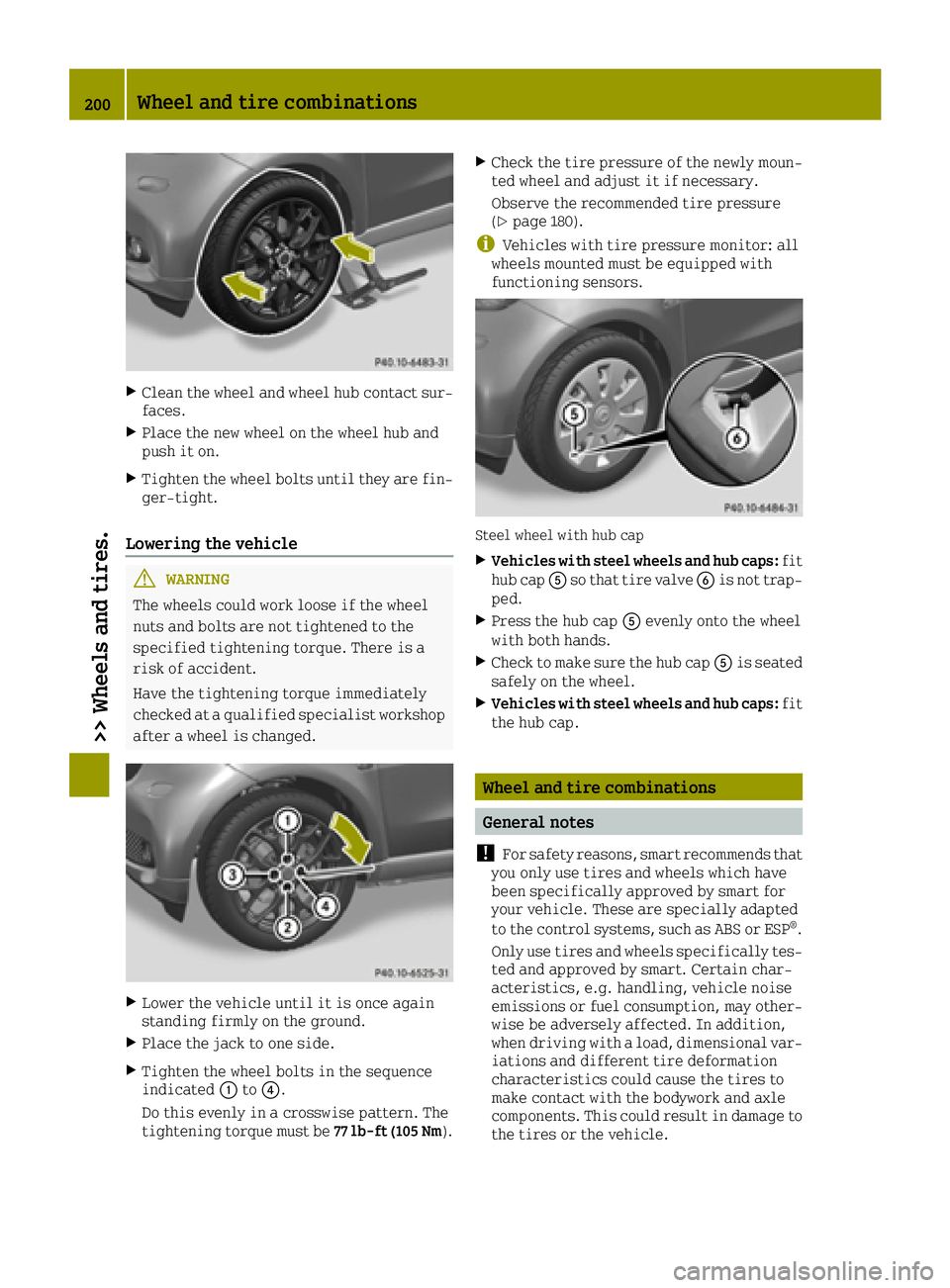
XClean the wheel and wheel hub contact sur-faces.
XPlace the new wheel on the wheel hub and
push it on.
XTighten the wheel bolts until they are fin-
ger-tight.
Lowering the vehicle
GWARNING
The wheels could work loose if the wheel
nuts and bolts are not tightened to the
specified tightening torque. There is a
risk of accident.
Have the tightening torque immediately
checked at a qualified specialist workshop
after a wheel is changed.
XLower the vehicle until it is once again
standing firmly on the ground.
XPlace the jack to one side.
XTighten the wheel bolts in the sequence
indicated 0043to0085.
Do this evenly in a crosswise pattern. The
tightening torque must be 77 lb-ft (105 Nm).
XCheck the tire pressure of the newly moun-
ted wheel and adjust it if necessary.
Observe the recommended tire pressure
(
Ypage 180).
iVehicles with tire pressure monitor: all
wheels mounted must be equipped with
functioning sensors.
Steel wheel with hub cap
XVehicles with steel wheels and hub caps: fit
hub cap 0083so that tire valve 0084is not trap-
ped.
XPress the hub cap 0083evenly onto the wheel
with both hands.
XCheck to make sure the hub cap 0083is seated
safely on the wheel.
XVehicles with steel wheels and hub caps: fit
the hub cap.
Wheel and tire combinations
General notes
!
For safety reasons, smart recommends that
you only use tires and wheels which have
been specifically approved by smart for
your vehicle. These are specially adapted
to the control systems, such as ABS or ESP
®.
Only use tires and wheels specifically tes-
ted and approved by smart. Certain char-
acteristics, e.g. handling, vehicle noise
emissions or fuel consumption, may other-
wise be adversely affected. In addition,
when driving with a load, dimensional var-
iations and different tire deformation
characteristics could cause the tires to
make contact with the bodywork and axle
components. This could result in damage to
the tires or the vehicle.
200Wheel and tire combinations
>> Wheels and tires.