2016 SKODA OCTAVIA light
[x] Cancel search: lightPage 94 of 324

›Take out the glowing lighter instantly, use it and insert it back into the sock-
et.WARNING■ The cigarette lighter also works if the ignition is switched off. When leav-
ing the vehicle, never leave people who are not completely independent,
such as children, unattended in the vehicle - there is a risk of burns, fire or
damage to the vehicle interior.■
Be careful when using the cigarette lighter - There is a risk of burns.
Note
The cigarette lighter socket can also be used as a 12 volt socket.
Tablet holder
Introduction
This chapter contains information on the following subjects:
Attaching the rear headrests
92
Handle holder
93
External devices (e.g. tablet, smartphone, etc.) measuring min. 122 mm and
max. 195 mm can be secured in the support.
The maximum permissible load of the holder is 750 g.
CAUTION
Never exceed the maximum permissible load of the holder - there is a risk of
damage or functional impairment.Attaching the rear headrestsFig. 98
Inserting: Adapter / holder
Fig. 99
Removing: Holder / adapter
Read and observe
on page 92 first.
›
To insert , attach the opened adapter to the guide rods of the front headrest
and clip in the direction of arrow
1
» Fig. 98 » .
›
Clip the holder in the direction of arrow
2
into the adapter.
›
To remove , pull on the securing tab
A
in direction of arrow
3
and take the
holder in direction of arrow
4
out of the adapter » Fig. 99.
›
Press the adapter and remove from the guide rods of the headrest in the di-
rection of arrow
5
.
WARNINGBe careful with the adapter- otherwise there is a risk of finger injury.92Using the system
Page 95 of 324

Handle holderFig. 100
Tilt and rotate holder
Fig. 101
Adjust holder size
Read and observe on page 92 first.
The holder may be by 30° in the direction of the arrow
1
tipped and by 360°
in the direction of arrow
2
turned » Fig. 100 .
›
To adjust the holder size , pull out the securing tab
A
in the direction of ar-
row
3
and push the part
B
in the direction of arrow
4
to the desired posi-
tion » Fig. 101 .
Note
If there is no external device in the holder, then we recommend that the partB is moved down fully. Otherwise, irritating noise may occur at certain
speeds.Transport of cargo
Luggage compartment and transporting objects
Introduction
This chapter contains information on the following subjects:
Fastening elements
94
Fixing nets
95
Multifunction pocket
95
Folding double hooks
96
Foldable hook
96
Fasten the flooring
96
Floor covering on both sides
96
Net on the luggage compartment cover
97
Luggage compartment cover
97
Roll-up cover
98
Storage compartment with cargo element
99
Storage compartments under the floor covering
99
Multi-function pocket
100
Class N1 vehicles
100
When transporting heavy objects, the driving characteristics change due to the
shift in centre-of-gravity. The speed and style of driving must be adjusted ac-
cordingly.
When transporting cargo the following the instructions must be adhered to
▶ Distribute the load evenly in the luggage compartment and secure it with
suitable lashing straps to the lashing eyes or fixing nets so that they cannot
slip.
▶ Place heavy objects as far forward as possible.
▶ Tyre pressure is to match the load.
In the event of an accident, even small and light objects gain so much kinetic
energy that they can cause severe injuries.
The magnitude of the kinetic energy is dependent on the speed at which the
vehicle is travelling and the weight of the object.
Luggage compartment light
The light switches on/off when the luggage compartment lid is opened or
closed.
93Transport of cargo
Page 96 of 324

If the boot lid is open and the ignition switched off, the light will go out auto-
matically after 10 minutes.WARNING■ Never exceed the maximum permissible load of the respective fasteners,
nets, hooks etc. Heavy objects were not secured sufficiently – There is a
risk of injury!■
Do not exceed the permissible axle loads and permissible gross weight of
the vehicle – There is a risk of an accident!
■
An unsecured dirt or improperly attached load could slip during a sudden
manoeuvre or in an accident in the vehicle - There is a risk of injury!
■
Loose cargo could hit a deployed airbag and injure occupants – danger of
death!
■
When transporting loads in the luggage compartment that has been en-
larged by folding the rear seats forward, ensure the safety of the passen-
gers transported on the other rear seats .
CAUTION
■ Never exceed the maximum permissible load of the respective fasteners,
nets, hooks etc. - these could be damaged.■
Make sure that the heating elements of the rear window heater, the ele-
ments of the integrated aerial in the rear window or in the rear side windows
are not damaged by abrasive items.
■
Do not place sharp objects in the nets and storage compartments in the lug-
gage compartment - there is a risk of damage to the net as well as the com-
partments.
■
Put the items in the storage compartments carefully and not load these
punctiform - there is a risk of damage to the compartments.
Fastening elementsFig. 102
Fastening elements: Variant 1/variant 2 (G-TEC)
Fig. 103
Fastening elements: Variant 3/variant 4
Read and observe
and on page 94 first.
The fasteners are located on both sides of the luggage compartment.
Overview of the fastening elements » Fig. 102 and » Fig. 103
Fasteners for securing fastening nets and multifunction pocket
Lashing eyes only for fastening fixing nets
Lashing eyes for fastening of cargo and fastening nets (in variant 1, the
rear and centre eye is additionally provided for securing the multifunction-
al bag)
Lashing eyes for fastening cargo and fastening nets
Lashing eyes for fastening cargo and fastening nets
The lashing eyelet
B
is located behind the folding rear seat backrest .
ABCDE94Using the system
Page 99 of 324
CAUTIONThe double sided floor covering can only be used in vehicles without the varia-
ble loading floor » page 100 - There is a risk of damage to the variable loading
floor.
Net on the luggage compartment cover
Fig. 110
Net on the luggage compartment
cover
Read and observe and on page 94 first.
The net at the bottom of the luggage compartment cover » Fig. 110 is provided
for transporting light and soft items.
The maximum permissible load of the net is 1.5 kg.
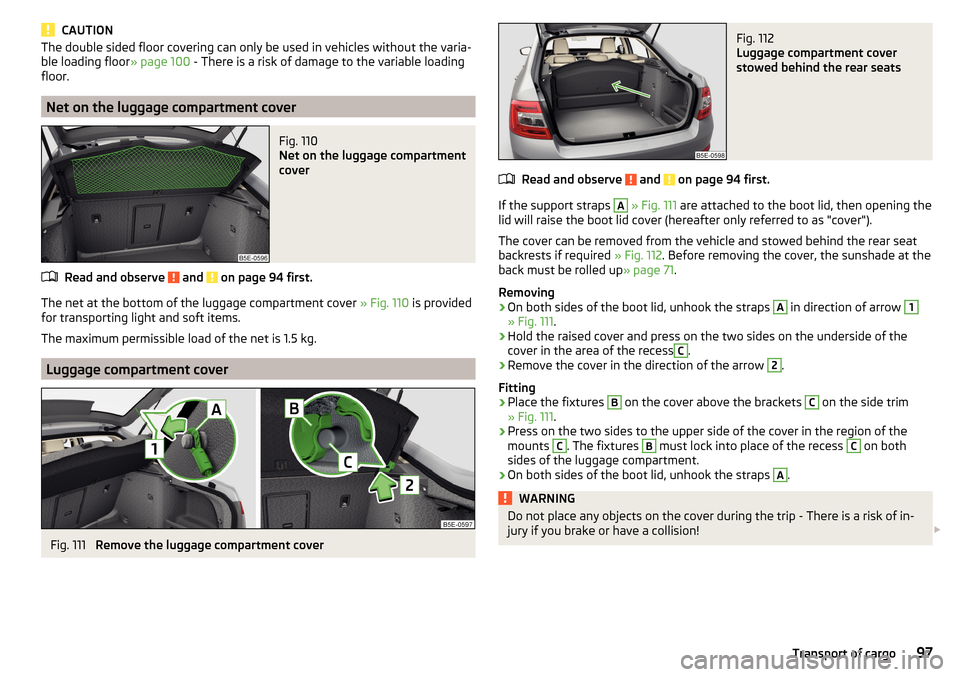
Luggage compartment cover
Fig. 111
Remove the luggage compartment cover
Fig. 112
Luggage compartment cover
stowed behind the rear seats
Read and observe and on page 94 first.
If the support straps
A
» Fig. 111 are attached to the boot lid, then opening the
lid will raise the boot lid cover (hereafter only referred to as "cover").
The cover can be removed from the vehicle and stowed behind the rear seat
backrests if required » Fig. 112. Before removing the cover, the sunshade at the
back must be rolled up » page 71.
Removing
›
On both sides of the boot lid, unhook the straps
A
in direction of arrow
1
» Fig. 111 .
›
Hold the raised cover and press on the two sides on the underside of the
cover in the area of the recess
C
.
›
Remove the cover in the direction of the arrow
2
.
Fitting
›
Place the fixtures
B
on the cover above the brackets
C
on the side trim
» Fig. 111 .
›
Press on the two sides to the upper side of the cover in the region of the
mounts
C
. The fixtures
B
must lock into place of the recess
C
on both
sides of the luggage compartment.
›
On both sides of the boot lid, unhook the straps
A
.
WARNINGDo not place any objects on the cover during the trip - There is a risk of in-
jury if you brake or have a collision! 97Transport of cargo
Page 102 of 324

Multi-function pocketFig. 118
Multi-function pocket: Pull out / insert / push in / remove multi-
function pocket
Read and observe
and on page 94 first.
The multifunction pocket (hereinafter referred to as pocket) is provided for
storing clothing and light objects with no sharp edges.
The maximum permissible load of the multifunction box is 3 kg.
Removal and fitting
›
Fold down the front hooks on both sides of the luggage compartment in the
direction of arrow
1
» Fig. 118 .
›
Grasp the rear bar
A
with both hands and withdraw the pocket in arrow di-
rection
2
.
›
Place the rear bar onto the two hooks that are folded forward in the direc-
tion of the arrow
3
all the way to the stop.
Pushing in
›
Remove the rear bar of the hook in direction of arrow
4
push in the pocket
in the direction of arrow
5
» Fig. 118 .
›Place the rear bar against the front bar and press them together at both
ends B.›
The front hooks on both sides of the luggage compartment fold back oppo-
site to the direction of arrow
1
.
Removing/inserting
›
Remove the roll-up cover » page 98.
›
Remove the pocket from the fittings in the direction of the arrow
6
» Fig. 118.
Insertion takes place in reverse order.
›
Insert the end of the bar marked with
in the right-hand mounting and the
end of the bar marked with
in the left-hand mounting. The arrows should
be pointing forward.
Class N1 vehicles
Read and observe
and on page 94 first.
In class N1 vehicles that are not fitted with a protective grille, a lashing set that
complies with the EN 12195 standard (1-4) must be used for fastening the load.
Proper functioning of the electrical installation is essential for safe vehicle op-
eration. It is important to ensure that the electrical installation is not damaged
during the adjustment process or when the storage area is being loaded and
unloaded.
Variable loading floor in the luggage compartment (Estate)
Introduction
This chapter contains information on the following subjects:
Positions of the variable loading floor
101
Fold together / fold out the variable loading floor
101
Dividing the luggage compartment
102100Using the system
Page 107 of 324

WARNING■The blower should always be on to prevent the windows from misting.
Otherwise there is a risk of an accident.■
Under certain circumstances, air at a temperature of about 5 °C can flow
out of the vents when the cooling system is switched on.
Note
■ The air inlet in front of the windscreen must be free of e.g. ice, snow or
leaves to ensure that the heating and cooling system operates properly.■
After switching on the cooling Condensation from the evaporator of the air
conditioning may drip down and form a puddle below the vehicle. This is not a
leak!
■
If the coolant temperature is too high, the cooling system is switched off to
ensure that the engine cools down.
Heating and manual air conditioning
Fig. 128
Controls of the heating / air conditioning
Read and observe
on page 105 first.
Individual functions can be set or switched on by turning the dial or pressing the corresponding button » Fig. 128.
Setting temperature
▶ Reduce the temperature /
Increase the temperature
Set the blower speed (Level 0: Fan off, level 6: highest speed)
Set the direction of the air outlet » page 108
Depending on equipment fitted:
▶ Auxiliary heating and ventilation on / switch off
» page 109
▶ Switching the windscreen heater on/off
» page 71
ABCDSwitch the cooling system on/off
Switch on/off the rear window heater » page 71
Switch recirculation on/off » page 107
When the function is switched on, the warning light illuminates below the but-
ton.
Information on the cooling system
After pressing the button
, the warning light underneath the button illumi-
nates even if not all conditions are met for the cooling system. The cooling
system starts to work as soon as the following conditions have been met
» page 104 .
When the air distribution control is turned to position the cooling system is
activated.
Note
To ensure adequate thermal comfort, during operation of the manual air condi-
tioning there could be an increase in the engine idle speed in some circum-
stances.
Climatronic (automatic air conditioning)
Fig. 129
Controls the Climatronic
Read and observe
on page 105 first.
Individual functions can be set or switched on by turning the dial or pressing the corresponding button » Fig. 129.
Display the temperature setting for the left side
Display the temperature setting for the right side
Set the direction of the air outlet » page 108
ABC105Heating and ventilation
Page 108 of 324

Adjust fan speed (the setting is indicated by the number of illuminated
control lamps shown in the knob)
Adjust the temperature for the left side (or for both sides) 1)
▶ Reduce the temperature /
Increase the temperature
Adjust the temperature for the right side (or for both sides) 2)
▶ Reduce the temperature /
Increase the temperature
Depending on equipment fitted:
▶ Auxiliary heating and ventilation on / switch off » page 109
▶ Switch off Climatronic
Interior temperature sensor
Switch recirculation on/off » page 107
Intense air flow to the windscreen on / off (when switching on, the air
flow to the windows and
is also switched on)
Switch on/off the rear window heater » page 71
Switch on/off the windscreen heating » page 71
Setting Climatronic in Infotainment (also operate with some functions)
Synchronize the temperature inside the entire vehicle according to the
temperature setting on the driver's side
Switching automatic mode on » page 107
Switch the cooling system on/off
When the function is switched on, a warning light lights up within or below the
button.
Setting temperature
The temperature can be set on the Climatronic control unit or in Infotain-
ment » page 106 . In the range between 16 ° C to 29.5 ° C, an automatic tem-
perature control takes place.
At a temperature setting below 16 ° C, lights up in the temperature display,
the Climatronic functions with maximum cooling performance .
At a temperature setting over 29.5 ° C, lights up in the temperature display,
the Climatronic functions with maximum heating output.
CAUTION
Do not cover the interior temperature sensor H » Fig. 129 - the function of the
Climatronic could be affected.DEFGHNoteIn order to ensure adequate thermal comfort, there may be an increase in en-
gine idle speed during operation of the Climatronic in some circumstances.
Operate Climatronic in Infotainment
Fig. 130
Infotainment Columbus, Amund-
sen, Bolero:Climatronic main
menu
Fig. 131
Infotainment Swing: Climatronic
main menu
Read and observe on page 105 first.
›
To display the main menupress the button
on the Climatronic control
unit.
Function surfaces and screen display » Fig. 130 and. » Fig. 131ADisplays the current operation mode (or set the operation mode) of
the ClimatronicBSet the desired temperature, front - left sideCSet the desired temperature, front - right sideDSetting the power in operation 1)
Applies to left-hand drive vehicles.
2)
Applies to right-hand drive vehicles.
106Using the system
Page 109 of 324

Colour representation of the air flow from the air vents at the front
(Blue colour - temperature reduction / red colour - temperature in-
crease)Switching on/off the ClimatronicSet the auxiliary heater and ventilationSwitch on/off the windscreen heating a)Other Climatronic settingsa)
When switched on, the symbol in the function surface is green.
Other Climatronic settings
Press the
button on the Climatronic control panel → tap the function sur-
face on the Infotainment screen.
■
Air con. profile
- Setting the operating performance during operation (ap-
plies to the infotainment Swing)
■
Automatic air recirculation
- Automatic re-circulated air mode on/off
■
Automatic auxiliary heater
- Quick interior heating on/off
■
Automatic windscreen heating
- Activates/deactivates the automatic windscreen
heating
Climatronic - automatic operation
Read and observe
on page 105 first.
The automatic mode is used in order to maintain a constant temperature andto demist the windows in the interior of the car.
›
To turn on , press the
» Fig. 129 on page 105 .
›
To turn off , press any button for the air distribution or change the blower
speed. The temperature regulation is continued.
Holding the button will turn on
automatically.
Operating modes
Automatic mode works in three modes - moderate, medium, and intensive.
Setting the different modes is carried out via the function surface
D
» Fig. 130
on page 106 and. » Fig. 131 on page 106 .
After the automatic mode is switched on, Climatronic works in the last selec-
ted mode. The currently selected mode is displayed on the Infotainment
screen.
Air distribution control
Read and observe
on page 105 first.
The recirculation mode prevents contaminated outside air getting into the In-terior of the vehicle. In recirculated air mode air is sucked out of the interior of
the vehicle and then fed back into the interior.
›
To switch on press the
button. The warning light below the button lights
up.
›
To switch off , press the
button again. The warning light below the button
goes out.
Heating and manual air conditioning system
If the air distribution control is set to position when the recirculation modes
is switched on, the recirculated-air mode is switched off. By pressing the
button, the air recirculation also in this position can be switched on again.
When the cooling system (button ) is switched on and the temperature reg-
ulator is “turned” to the left, the recirculated-air mode is switched on.
Climatronic
The Climatronic can have a sensor that measures the air recirculation mode
and automatically turns on if there is an increased concentration of pollutants
in the incoming air.
When the pollutant concentration decreases to the normal level, the recircula-
ted air mode is automatically switched off.
Automatically switch on / off the air recirculation function can be set in the In-
fotainment screen. by pressing the button on the Climatronic and by sub-
sequently pressing the function surfaces
→
Automatic air recirculation
. Auto-
matic power on / off function at a temperature above 2 ° C.
A shut-off of the air recirculation function is carried out by pressing the
button, possibly depending on the moisture conditions in the vehicle interior.
WARNINGThe recirculation system cannot be switched on for a longer period of time,
because no fresh air is fed through from the outside. “Stale air” may result
in fatigue in the driver and occupants, reduce attention levels and also
cause the windows to mist up. As soon as windows mist up, turn on the re-
circulation system immediately - The is a risk of an accident! 107Heating and ventilation