2016 SKODA FABIA mirror
[x] Cancel search: mirrorPage 109 of 196

Distance of the orientation lines behind the vehicle » Fig. 133
The distance is about 40 cm (safety distance limit).
The distance is about 100 cm.
The distance is about 200 cm.
The distance may vary slightly depending on the load of the vehicle and the
road inclination.
The distance between the side lines corresponds approximately to the vehicle
width including mirrors.
Functional surfaces » Fig. 133
Depending on the Infotainment Type: Turns the display of the area be-
hind the vehicle off
Display settings - brightness, contrast, colour Switching audible parking signals on/off
Enabling and reduced park assistance display
Change to park assistance display
CAUTION
The objects shown in the display can be closer or even further away than they
appear. This is especially the case in the following situations.■
Protruding objects, such as the rear of a truck and the like.
■
When driving from a horizontal surface into a slope or a depression.
■
When driving from a slope or a depression onto a horizontal surface.
Cruise Control System
Introduction
This chapter contains information on the following subjects:
Operation
107
Operation description
108
The Cruise Control System (CCS) maintains a set speed without you having to
actuate the accelerator pedal. The status where the CCS maintains the speed
is referred to hereinafter as the control.
ABC WARNING■
The general information relating to the use of assistance systems must
be observed » page 100, in section Introduction .■
After pressing the clutch pedal, no interrupted control occurs! For exam-
ple, if a different gear is engaged and the clutch pedal is released, control is
continued.
Operation
Fig. 134
Maxi DOT display: Examples of status displays the CCS
Fig. 135
Segment display: Examples of status displays the CCS
Read and observe
on page 107 first.
CCS status displays » Fig. 134 , » Fig. 135
Speed set, but control is inactive.
Control is active.
No speed set.
System fault - seek assistance from a specialist garage immediately.
107Assist systems
Page 125 of 196

CAUTION■Place the tow bar in the standby position, with the key upwards, and store in
the box - otherwise there is a risk of damage to the key!■
Do not use excessive force when handling the operating lever (e.g. do not
step on it).
Vertical load with mounted accessories
Fig. 161
Representation of the maximum
length of the mounted accesso-
ries and the permissible total
weight of the accessory depend-
ing on the load centre of gravity
Read and observe on page 119 first.
When using the accessories (e.g. bicycle carrier), the maximum length and the
permissible total weight including load must be considered.
The maximum length of the mounted accessories (from the ball of the towing
device) is 70 cm » Fig. 161 .
The total permitted weight of the accessories including load changes with in-
creasing distance of the load centre of gravity from the ball head of the towing
device.
Distance of the load centre of gravity from the ball headPermissible total weight of the ac-cessories, including load0 cm50 kg30 cm50 kg60 cm25 kg70 cm0 kg
CAUTION
Never exceed the permissible total weight of the accessories incl. load and
maximum length of the accessories - risk of damage to the towing device.NoteWe recommend that you use the accessories from ŠKODA Original Accessories.
Using hitch
Trailer (accessory) connect and disconnect
Fig. 162
Housing of the 13 pin socket,
safety eyelet
Connect and disconnect
›
Install the ball bar and the remove the protective cap
3
» Fig. 150 on page 119
lose weight.
›
Place the trailer (the accessory) onto the tow ball.
›
Plug the trailer cable into 13-pin socket
A
» Fig. 162 . (If the trailer / accesso-
ries have a 7-pin connector, use a corresponding reduction piece from the
ŠKODA Original Accessories).
›
Suspend the breakaway cable of the trailer at the safety eyelet
B
(the
breakaway cable must sag in all trailer settings in view of the vehicle).
Uncoupling takes place in reverse order.
Exterior mirrors
You should have additional exterior mirrors fitted if you are not able to see the
traffic behind the trailer using the standard rear-view mirrors.
Headlights
The front of the vehicle may lift up when a trailer (accessory) is being towed
and the headlights may dazzle other road users. Set the range of the head-
lights » page 53 , Operating the lights .
Power supply of the trailer / accessory power system
In the electrical connection between the vehicle and trailer (accessory), the
trailer (accessories) is supplied with power from the vehicle (with ignition
switched on and off).
123Towing device and trailer
Page 134 of 196

Automatic Car Washes
The usual precautionary measures must be taken before washing the vehicle
(e.g. closing the windows and the tilt/slide roof etc.).
If your vehicle is fitted with any particular attached parts (e.g. spoiler, roof rack system, two-way radio aerial etc.), it is best to consult the operator of the car
wash system beforehand.
After an automatic wash with wax treatment, the wiper blades should be
cleaned with cleaning agents specially designed for the purpose, and then de-
greased.
Pressure Washers
When washing the vehicle with a high-pressure cleaner, the instructions for
use of the equipment must be observed. This particularly applies to instruc-
tions regarding the pressure and spraying distance from the vehicle surface.WARNING■
Washing your vehicle in the winter: Water and ice in the brake system can
affect the braking efficiency – there is the risk of an accident.■
Take care when cleaning the underbody or the inside of the wheel wells -
there is a risk of injury from sharp metal parts!
CAUTION
■ Do not wash the vehicle in direct sunlight, do not exert pressure on the body
while washing. The temperature of the washing water should be no more than
60 °C max. - otherwise there is a risk of damaging the vehicle paint.■
Before driving through a car wash fold in the exterior mirrors - There is a risk
of damage.
■
For vehicles with a roof antenna, the antenna rod should be unscrewed be-
fore driving through a car wash - there is a risk of damage.
CAUTION
Washing the vehicle with high-pressure cleaners■Films should not be washed with any high-pressure cleaners - risk of dam-
age.■
Do not aim the water jet directly at the lock cylinders or the door or opening
joints when washing the vehicle in the winter – there is a risk of freezing.
■
Hold a large spraying distance to the rear camera lens, to plastic parts (e.g.
Roof racks, spoilers, protective strips and the like), as well as soft materials
such as rubber hoses or insulation material.
■
The sensors of the parking aid can be sprayed only for a short time and there
must be a minimum distance of 10 cm - there is a risk of damage.
Exterior car care
Read and observe
and on page 131 first.
Vehicle compo- nentsCircumstancesRemedy
Paint
Spilled fuelClear water, cloth, (clean as soon as
possible)No water drop-
lets form on the
paintUse hard wax preserve (at least twice a
year), apply wax to clean and dry bodyPaint has gone
mattUse polish, then wax (if the polish does
not contain any preservative ingredi-
ents)Plastic partsSoilingClear water, cloth / sponge, possibly
cleaners provided for this purposeChrome
and anodised
partsSoilingclear water, cloth, possibly cleaners
provided for this purpose, clean then
polish with a soft dry clothFilmsSoilingSoft sponge and mild soap solution a)Windows
and door mirrorsSoilingWash with clean water and dry with a
wipe specifically for that purposeHead / tail lightsSoilingSoft sponge and mild soap solution a)
Reversing cameraSoilingWash with clean water and dry with a
soft clothSnow/iceHand brush / de-icerDoor lock cylin-
dersSnow/iceDe-icing fluid specifically for that pur-
poseWipers / wiper
bladesSoilingWindscreen cleaner, sponge or clothWheelsSoilingClear water, then apply appropriate
substancea)
Mild soap solution = 2 tablespoons of natural soap to 1 litre of lukewarm water.
The jack is maintenance-free. If necessary, the moving parts of the jack should
be lubricated with a suitable lubricant.
The towing device is maintenance-free. Coat the ball head of the towing de-
vice with a suitable grease whenever necessary.
132General Maintenance
Page 135 of 196
Protection of cavities
All the cavities of your vehicle which are at risk from corrosion are protected by
a layer of long-lasting protective wax applied in the factory.
If any small amount of wax flow out of the cavities at high temperatures, these
must be removed with a plastic scraper and the stains cleaned using a petrole-
um cleaner.
Underbody
The underside of your vehicle is already permanently protected by the factory
against chemical and mechanical influences.
We recommend having the protective coating — preferably before the begin-
ning of winter and at the end of winter.
Product life of the films
Environmental influences (e.g. sunlight, humidity, air pollution, rockfall) affect
the life of the films. The films age and become brittle, which is normal; this
shall not be considered a fault.
The sunlight may also affect the depth of the film colour.
When transporting a load on the roof rack (e.g. roof box, etc.), there is an in- creased risk of film damage (e.g. due to rockfall from the secured load).
CAUTION
■ Vehicle paint
■ Repair damaged areas as soon as possible.
■ Matt-painted parts should not be treated with polishes or hard waxes.
■ Do not polish in a dusty environment - risk of paint scratches.
■ Do not apply polish to door seals or window guides.■
Plastic parts
■ Do not use paint polish.
■
Chromed and anodised parts
■ Do not polish in a dusty environment - risk of surface scratches.
■
Films
The following instructions must be observed, otherwise there is a risk of film
damage.
■ Do not use dirty cloths or sponges for cleaning.
■ Do not use a scraper or other means to remove ice and snow.
■ Do not polish the films
■ Do not use a high pressure cleaner on the films.
■
Rubber seals
■ Do not treat the door seals and window guides deal with anything - the
protective varnish coating could be damaged.
■ Windows and door mirrors
■ Do not clean the insides of the windows/mirrors with sharp objects - risk of
damage to the filaments or the antenna. ■ Do not use a cloth which has been used to polish the body - this could dirty
the window and impair visibility.■
Head / tail lights
■ Do not wipe head/tail lamps dry, do not use any sharp objects - risk of dam-
age to the protective coating and cracks forming on the headlamp glass cov-
ers.
■
Reversing camera
The following instructions must be observed, otherwise there is a risk of
camera damage.
■ Do not remove snow / ice with warm / hot water.
■ To wash, never use a pressure washer or steam jet.
■ For cleaning, do not use abrasive cleaners.
■
Door lock cylinders
■ Make sure that as little water as possible gets into the locking cylinder
when washing the vehicle - there is a risk of freezing the lock cylinder!
■
Wheels
■ Heavy soiling of the wheels can affect the balance of the wheels - the re-
sult can be a vibration, which can cause premature wear of the steering.
Removing ice and snow from the windows
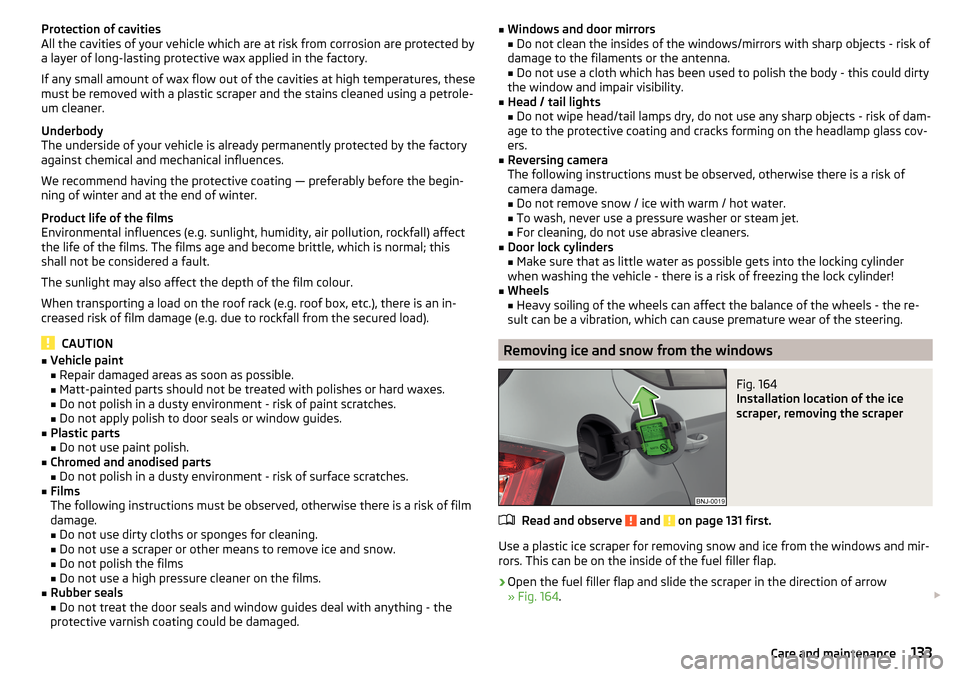
Fig. 164
Installation location of the ice
scraper, removing the scraper
Read and observe and on page 131 first.
Use a plastic ice scraper for removing snow and ice from the windows and mir-
rors. This can be on the inside of the fuel filler flap.
›
Open the fuel filler flap and slide the scraper in the direction of arrow
» Fig. 164 .
133Care and maintenance
Page 166 of 196

No.Power consumer24Blower fan for the air conditioning system, heating, air conditioning,
heating25Not assigned26Heated front seats27Rear window wiper28Not assigned29airbag30Electric windows, light switches, reversing light switch, exterior mir-
rors, feed for the central toolbar, feed for the side toolbar, rear view
mirror, air-conditioning system, park assist31Fuel pump, radiator fan, cruise control, front and rear window wash-
er, engine start32Diagnostic connector, headlight range adjustment33Clutch pedal switch34Heated windscreen washer jets35Not assigned36Heated front seats37Radar38Not assigned39Electrical auxiliary heating system40Not assigned41Rear window heating42Power windows - front passenger43Trailer device - electrical outlet44Cigarette lighter, 12-volt power socket45Power windows - rear right46Front and rear window washer, operating lever under the steering
wheel47Trailer device - electrical outlet48Towing hitch - right light49Fuel pump50Infotainment51Heating of the external mirrorNo.Power consumer52KESSY53KESSY steering lock54Not assigned55Heated front seats56Not assigned57Not assigned58Not assigned59Not assigned
Fuses in the engine compartment
Fig. 203
Remove the cover
Read and observe
and on page 162 first.
Replacing fuses
›
Remove the ignition key, turn off the lights and all electrical consumers.
›
Press together the lock buttons of the cover simultaneously in the direction
of arrow
1
and remove the cover in the direction of arrow
2
» Fig. 203 .
›
Remove the plastic clip from the holder on the cover of the fuse box in the
dash panel.
›
Replace the defective fuse.
›
Replace the cover, push the lock buttons of the cover together and lock.
›
Replace the clamp in the original position.
CAUTION
The cover of the fuse box in the engine compartment must always be used
correctly, otherwise water may penetrate into the fuse box – there is a danger
of damage to the vehicle!164Do-it-yourself
Page 178 of 196

DimensionsFig. 221
Vehicle dimensions
Vehicle dimensions by operating weight without driver (in mm)
» Fig. 221SpecificationFabiaFabia CombiAHeight14671467BFront trackBasic dimension14631463Vehicles with the 1.2 l/81 kW TSI and 1.4 l/77 kW TDI engine14571457CWidth17321732DRear trackBasic dimension14571457Vehicles with the 1.2 l/81 kW TSI and 1.4 l/77 kW TDI engine14511451EWidth including exterior mirrors19581958FClearance133135GWheelbase24702470HLength39924257176Technical data
Page 187 of 196

Force limiterWindow52
Front Assist114
Deactivation/activation116
Distance warning115
Malfunctions116
Operation114
Radar sensor100
Warning and automatic braking115
Warning light36
Front seats62
Fuel135
Diesel136
Fuel gauge28
refer to Fuel135
Refuelling135
Unleaded petrol135
Warning light32
fuel consumption175
Fuel reserve32
Fuses162
in the dash panel163
in the engine compartment164, 165
G
Gearbox Information messages
33
Gear change Gear recommendation
37
Information on the selected gear37
Gear changing Gear stick
95
Genuine parts128
Glasses compartment71
GPS See Owner´s Manual -Infotainment
6
H
handbrake warning light
29
Handbrake94
Hazard warning light system56
HBA102
Headrests64
heater Rear window
58
Heater Recirculated air mode
88
Heating85, 86
Mirrors61
Seats65
Help in an emergency8
HHC102
Hill Start Assist (HHC)102
hitch123
Hitch119
Hooks77
horn26
I
I-PAD holder
73
Ignition lock91
Images See Owner´s Manual -Infotainment
6
Immobilizer90
In an emergency Changing a wheel
151
Inertia reel15
Information about the towing process157
information system Auto Check Control
36
door alarm36
Information system36
Gear recommendation37
MAXI DOT display40
Multifunction display38
Service interval display41
Infotainment6
Instrument cluster27
Warning lights28
interior light57
Interior lighting58
Interior monitor49
ISOFIX23
J
Jack
150
Jacking points Raise vehicle
153
Jump-starting156, 157
K
KESSY Unlocking/locking
46
key Starting / stopping the engine
91
Switch on/off ignition91
Key Change battery
159
Locking45
Unlocking45
L
Lamp failure Warning light
35
Lamps Warning light
35
LEAVING HOME56
lever Turn signal/main beam
54
Lever ACC
111
Cruise control108
Front Assist116
185Index
Page 188 of 196

Operation of the information system38
Speed regulating system109
Windscreen wipers60
light Flash
54
Fog lights/rear fog light55
Light COMING HOME / LEAVING HOME
56
Replacing bulbs165
Turn signal/main beam54
Lighting Interior lighting
57
Luggage compartment75
Lights53
Abroad57
Automatic driving light control55
Cockpit57
Daylight running54
Dipped beam53
Fog lights with the CORNER function56
Hazard warning light system56
Headlight cleaning system60
Headlight range control53
Parking lights53, 56
Switching on and off53
Warning lights28
Load175
Lock Individual settings
47
Locking Central locking button
46
in case of emergency160
KESSY46
Key45
Remote control45
Lock steering lock90
Luggage compartment75
Cover78
Fastening elements76
Fixing nets76
Flexible storage compartment80
Lighting75
Net partition79
Storage compartments under the floor80
unlock manually160
Unlock the boot lid160
Variable loading floor81
Luggage compartment cover78
Other positions78
Roll-up cover79
Luggage Storage bike carriers
82
Roll-up cover79
Storage compartments77
M
Main beam
54
Warning light33
Manual air conditioning Controls
86
Recirculated air mode88
Manual gear changing see Gear changing
95
Materials defect liability4
MAXI DOT See MAXI DOT display
40
MAXI DOT display assist systems menu item
41
Audio menu item40
Main menu40
Navigation menu item40
Operation38
telephone menu item41
Maximum speed178
MCB103
Mechanical window lifter open/close
51
Mechanical windows50
Media AUX67
See Owner´s Manual -Infotainment6
USB67
Memory39
Mirror61
Vanity59
mobility warranty5
Modes of the automatic transmission96
Modifications and technical alterations127
MSR101
Multi collision brake (MCB)103
Multifunction display Data
39
Functions38
Memory39
Multifunction pocket77
Multifunction steering wheel38
Multimedia holder70
N
N1
80
Nameplate173
Navigation S Owner´s Manual -Infotainment
6
Net partition79
Nets76
O
oil see Engine oil
140
Oil Information messages
34
Oil changing Engine oil
139
Onboard computer see multifunction display
38
Operating weight174
186Index