2016 Seat Toledo ABS
[x] Cancel search: ABSPage 157 of 248
Driving
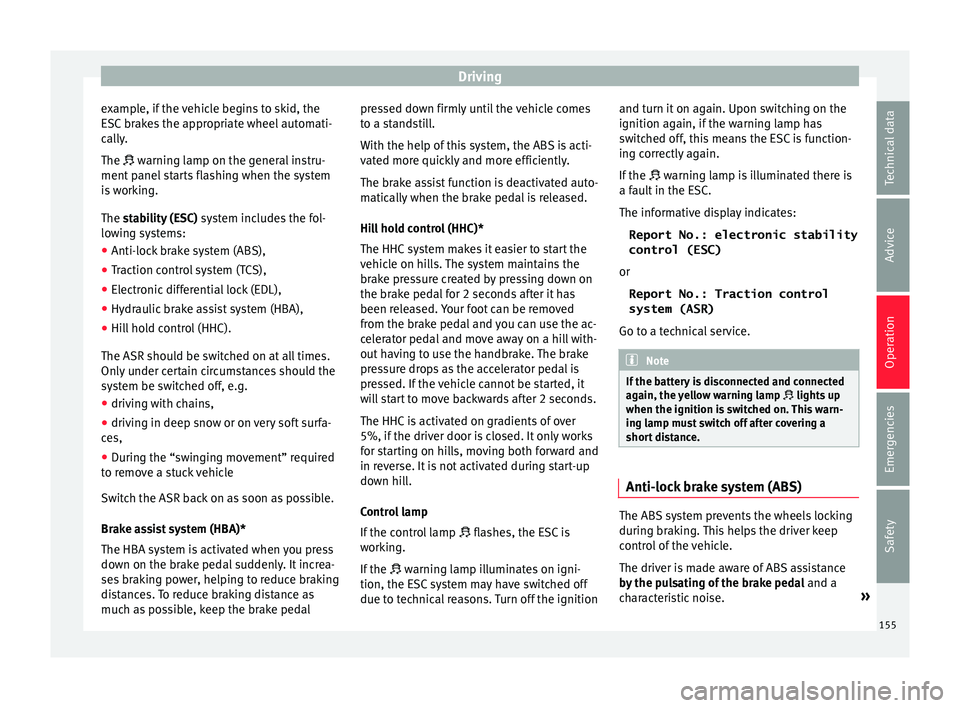
example, if the vehicle begins to skid, the
E SC
br
akes the appropriate wheel automati-
cally.
The warning lamp on the general instru-
ment panel starts flashing when the system
is working.
The stability (ESC) system includes the fol-
lowing systems:
● Anti-lock brake system (ABS),
● Traction control system (TCS),
● Electronic differential lock (EDL),
● Hydraulic brake assist system (HBA),
● Hill hold control (HHC).
The ASR should be sw
itched on at all times.
Only under certain circumstances should the
system be switched off, e.g.
● driving with chains,
● driving in deep snow or on very soft surfa-
ces,
● D
uring the “swinging movement” required
to remo
ve a stuck vehicle
Switch the ASR back on as soon as possible.
Brake assist system (HBA)*
The HBA system is activated when you press
down on the brake pedal suddenly. It increa-
ses braking power, helping to reduce braking
distances. To reduce braking distance as
much as possible, keep the brake pedal pressed down firmly until the vehicle comes
to a st
andstill.
With the help of this system, the ABS is acti-
vated more quickly and more efficiently.
The brake assist function is deactivated auto-
matically when the brake pedal is released.
Hill hold control (HHC)*
The HHC system makes it easier to start the
vehicle on hills. The system maintains the
brake pressure created by pressing down on
the brake pedal for 2 seconds after it has
been released. Your foot can be removed
from the brake pedal and you can use the ac-
celerator pedal and move away on a hill with-
out having to use the handbrake. The brake
pressure drops as the accelerator pedal is
pressed. If the vehicle cannot be started, it
will start to move backwards after 2 seconds.
The HHC is activated on gradients of over
5%, if the driver door is closed. It only works
for starting on hills, moving both forward and
in reverse. It is not activated during start-up
down hill.
Control lamp
If the control lamp flashes, the ESC is
working.
If the warning lamp illuminates on igni-
tion, the ESC system may have switched off
due to technical reasons. Turn off the ignition and turn it on again. Upon switching on the
ignition again, if the w
arning lamp has
switched off, this means the ESC is function-
ing correctly again.
If the warning lamp is illuminated there is
a fault in the ESC.
The informative display indicates:
Report No.: electronic stability
control (ESC)
or Report No.: Traction control
system (ASR)
Go to a technical service. Note
If the battery is disconnected and connected
again, the y
ellow warning lamp lights up
when the ignition is switched on. This warn-
ing lamp must switch off after covering a
short distance. Anti-lock brake system (ABS)
The ABS system prevents the wheels locking
durin
g br
ak
ing. This helps the driver keep
control of the vehicle.
The driver is made aware of ABS assistance
by the pulsating of the brake pedal and a
characteristic noise. »
155
Technical data
Advice
Operation
Emergencies
Safety
Page 158 of 248

Operation
Keep the brake pedal pressed down while the
ABS i
s
working. The ABS will switch off when
the brake pedal is released. Never brake in-
termittently while the ABS is working!
Control lamp
If the warning lamp is illuminated, there is
a fault in the ABS.
The informative display indicates:
ABS fault
The brake system alone is operational in the
vehicle, without ABS.
Go to a technical service. WARNING
● If the w
arning lamp illuminates together
with the ››› page 153 warning lamp, ,
stop the vehicle! Go to a technical service.
● A fault in the Anti-lock brake system (ABS)
can le
ad to longer braking distances – Risk of
accident! Anti-slip regulation of the driving
wheel
s
(ASR)
*If the wheels start to slip, the TCS adapts the
en
gine s
peed t
o the driving conditions. Par-
ticularly in unfavourable conditions, the TCS
helps starting, accelerating and hill starts. If the control lamp
flashe
s, the ASR is
working.
If the warning lamp illuminates on igni-
tion, the TCS system may have switched off
due to technical reasons. Turn off the ignition
and turn it on again. Upon switching on the
ignition again, if the warning lamp has
switched off, this means the TCS is function-
ing correctly again.
If the warning lamp remains illuminated,
there is a fault in the TCS.
The informative display indicates:
Report No.: Traction control
system (ASR)
Go to a technical service.
Electronic differential lock If one of the wheels starts to skid, the EDL
br
ak
e
s that wheel, transmitting the driving
force to the other wheels. This increases ve-
hicle stability and improves driving stability.
To prevent the disc brake of the braking
wheel from overheating, the EDL cuts out au-
tomatically if subjected to excessive loads.
The vehicle will continue to function normally
without EDL. The EDL will switch on again au-
tomatically when the brake has cooled down. Manual gearbox
Changin
g gears Fig. 176
Gear shift diagram of a 5- or 6-speed
m anual
g
earbox Read the additional information carefully
› ›
›
page 34
When changing gear, always depress the
clutch pedal fully and keep it pressed down
to avoid excessive clutch wear.
In order to drive at an optimum RPM, follow
the gear change indications ›››
page 25.
Engage reverse gear only when the vehicle is
stopped. On engaging reverse gear while the
engine is running, first wait a moment with
the clutch pedal pressed down fully to limit
gear shift noise.
The reverse lights switch on when the reverse
gear is selected and the ignition is on.
156
Page 200 of 248

Advice
The dye used in many garments, for example
d ark
j
eans, is not always sufficiently colour-
fast. Seat upholstery (fabric and leather), es-
pecially when light-coloured, may visibly dis-
colour if the dye comes out of clothing, even
in normal conditions. This is not an uphols-
tery defect but indicates that the dye in the
item of clothing is not solid enough.
Heated seat upholstery Do not clean the seat upholstery with
damp
pr oduct
s, as this could damage the seat
heating system.
Clean the upholstery with special products,
e.g. dry foam, etc.
Natural leather Leather should be looked after from time to
time, dependin
g on its
u
se.
Normal cleaning
Moisten a cotton or woollen cloth with water
and wipe over the leather surfaces.
More stubborn dirt
Do not let water soak through the leather or
penetrate the seams.
Dry it with a soft, dry cloth. Removing stains
Remov
e fresh water-based stains such as cof-
fee, tea, juices, blood, etc. with an absorbent
cloth or kitchen roll. Use the special deter-
gent to clean dried-on stains.
Remove fresh fat-based stains such as but-
ter, mayonnaise, chocolate, etc. with an ab-
sorbent cloth or paper towel or use the spe-
cial detergent if the stain has not yet soaked
through the surface.
Use a grease-dissolving product to treat
dried-in, fat-based stains.
Treat less common stains such as ball-pen
and other inks, felt-tip pens, nail polish,
emulsion paint, shoe cream etc. with a spe-
cial leather stain remover.
Leather care
The leather should be treated regularly
(about twice a year) with a leather-care prod-
uct.
Apply the protective product very sparingly.
Dry the leather with a soft, dry cloth. CAUTION
● Av oid e
xposing leather to direct sunlight
for long periods so that it does not lose its
colour. If the car is left for a prolonged period
outdoors, cover the leather so that it does
not lose its colour. ●
Sharp-edg ed o
bjects on clothing, such as
zips, rivets or belts can leave permanent
scratches and rough marks on the surface of
the leather.
● Use of a mechanical steering wheel lock
can dam
age the leather surface of the steer-
ing wheel. Note
● Use a s uit
able impregnating cream with ul-
tra-violet protection at regular intervals and
after cleaning. The cream will nourish and
moisturise the leather, keep it supple and
able to breathe. In addition, it will also help
to protect the surface of the leather.
● Clean the leather every 2 to 3 months and
remov
e fresh dirt as necessary.
● Preserve the colour of the leather. A special
colour
ed cream for leather will renew the col-
our of more heavily worn areas as required.
● Leather is a natural material with specific
propertie
s. During vehicle use, the appear-
ance of parts of the leather covers may
change; folds or wrinkles may appear as a re-
sult of their use. Seat belts
Keep the seat belts clean!
W
a
sh soi
led seat belts with mild, soapy wa-
ter, removing any heavier dirt with a soft
brush.
198
Page 212 of 248

Advice
The brake fluid reservoir is located in the en-
gine c omp
ar
tment of the vehicle.
– Switch the ignition off.
– Open the bonnet ›››
page 202.
– Check the brake fluid level in the reservoir
›››
Fig. 209. It should be between the “MIN”
and “MAX” marks.
The fluid level drops slightly after a period of
time due to automatic compensation for
brake pad wear. This is quite normal.
However, if the level goes down noticeably in
a short time, or drops below the “MIN” mark,
there may be a leak in the brake system. If
the brake fluid level in the reservoir is too
low, this will be indicated by the warning
lamp illuminating on the instrument panel
››› page 153, Control lamp .WARNING
● If the fluid l ev
el has dropped below the MIN
mark, do not continue driving. Risk of acci-
dent! Go to a technical service.
● Heavy use of the brakes may cause a va-
pour lock if
the brake fluid is left in the brake
system for too long. This would seriously af-
fect the efficiency of the brakes and the safe-
ty of the vehicle. Changing the brake fluid
Brake fluid absorbs moisture. Therefore, it
gra
dual
ly absorbs moisture from the atmos-
phere. If the water content in the brake fluid
is too high, the brake system could corrode.
The water content also reduces the boiling
point of the brake fluid.
The brake fluid must comply with one of the
following standards or specifications:
● VW 50114
● FMVSS 116 DOT4 CAUTION
Brake fluid damages the vehicle paintwork. Windscreen washer
Top
pin
g up windscreen washer fluid Fig. 210
Engine compartment: windscreen
w a
sher r
eservoir. Read the additional information carefully
› ›
›
page 41
The container for the windscreen washer con-
tains the cleaning fluid for the windscreen or
rear window and the headlight washer sys-
tem. The container is located in the engine
compartment.
The capacity of the reservoir is approximately
3.5 litres; in vehicles with a headlight washer
system, it is approximately 5.4 litres 1)
.
Plain water on its own is not enough to clean
the glass and the headlights properly. We 1)
Valid only for certain countries. 5.4 litres for both
ver s
ions.
210
Page 221 of 248

Wheels and tyres
CAUTION
Follow the instructions given on the tempora-
ry s
pare wheel label. Note
The tyre pressure of the spare wheel must al-
wa y
s correspond to the highest pressure pre-
scribed for the model of vehicle in question. Tyre monitoring systems
Ty r
e pressure* The tyre pressure monitoring system uses
ABS
sen
sor
s to compare the revolutions and
the circumference of each wheel. Should the
circumference of any wheel change, the
warning lamp on the general instrument
panel will light up and an audible warning
will be heard.
Tyre circumference may change if:
● Tyre pressure is too low
● Tyre structure is damaged
● Vehicle load not evenly distributed
● wheels on one axle are subjected to greater
load, (e.
g. driving with trailer, uphill, down-
hill);
● Snow chains are fitted
● The temporary spare wheel is fitted ●
One wheel on the axl
e has been changed
Basic system settings
Should the tyre pressure change or if one or
more wheels are changed or the position of
the wheel on the vehicle is changed, e.g.
changing round the front and rear wheels, or
where a warning lamp lights up when driv-
ing, the system must be adjusted as follows: ● Inflate all tyres to the prescribed pressures
›››
page 216.
● Switch the ignition on.
● Store the new tyre pressure in the Easy
Connect sy
stem with the button and the
f u
nction b
utton Setup
› ›
›
page 21.
The warning lamp lights up
If the pressure on at least one tyre is signifi-
cantly lower than the pressure set by the driv-
er, the warning lamp will light up ››› .
The w arnin
g l
amp flashes
If the warning lamp flashes, there is a fault in
the system. Contact a specialised service to
have it fixed. WARNING
● If the w arnin
g lamp lights up, slow down
immediately and avoid any severe braking or
steering manoeuvres. Stop and check the
tyres and their pressure as soon as possible. ●
Under cer t
ain conditions (e.g. sporty driv-
ing style, driving on loose surfaces or in win-
ter) the warning lamp may take a while to
light up or may remain switched off.
● Despite the tyre pressure monitoring sys-
tem, the driver r
emains responsible for main-
taining the correct tyre pressure. You must
therefore check the tyre pressure often. Note
● The ty re pr
essure monitoring system is not
a replacement for regularly checking the tyre
pressure, as it is unable to recognise an even
drop in pressure.
● The tyre pressure monitoring system is un-
able t
o warn of a sudden drop in tyre pres-
sure, e.g. a puncture. In this case, try to stop
the vehicle carefully with no severe braking
or steering manoeuvres.
● To ensure the tyre pressure monitoring sys-
tem work
s correctly, the basic setting must
be performed every 10 000 km (6000 miles)
or once a year.
● If the battery is disconnected the warning
lamp lights
up when the ignition is switch-
ed on. This warning lamp must switch off af-
ter covering a short distance. 219
Technical data
Advice
Operation
Emergencies
Safety
Page 235 of 248

Index
Index
A
ABS contr
o
l lamp . . . . . . . . . . . . . . . . . . . . . . . . . . . 155
see also Anti-lock brake system . . . . . . 154, 155
Accessories . . . . . . . . . . . . . . . . . . . . . . . . . 134, 192
Additional electrical appliances (efficiency pro- gramme) . . . . . . . . . . . . . . . . . . . . . . . . . . . . . . . 28
Adjusting front head restraints . . . . . . . . . . . . . . . . . . . . . . 59
Adjusting the head restraints front head restraints . . . . . . . . . . . . . . . . . . . . . 128
Adjustment CAR menu . . . . . . . . . . . . . . . . . . . . . . . . . . . . . . 99
front head restraints . . . . . . . . . . . . . . . . . . . . . 128
lights . . . . . . . . . . . . . . . . . . . . . . . . . . . . . . . . . 117
rear head restraints . . . . . . . . . . . . . . . . . . . . . . 59
seats . . . . . . . . . . . . . . . . . . . . . . . . . . . . . . . . . . 56
Aerial . . . . . . . . . . . . . . . . . . . . . . . . . . . . . . . . . . . 194
Air-conditioning economic use . . . . . . . . . . . . . . . . . . . . . . . . . . 143
Airbag covers . . . . . . . . . . . . . . . . . . . . . . . . . . . . . 14
Airbags . . . . . . . . . . . . . . . . . . . . . . . . . . . . . . . . . . 66 description . . . . . . . . . . . . . . . . . . . . . . . . . . . . . 67
Airbag system . . . . . . . . . . . . . . . . . . . . . . . . . . 14, 66 activation . . . . . . . . . . . . . . . . . . . . . . . . . . . . . . 68
control lamp . . . . . . . . . . . . . . . . . . . . . . . . . . . . 68
deactivation of front airbag . . . . . . . . . . . . . 68, 71
description . . . . . . . . . . . . . . . . . . . . . . . . . . . . . 67
front airbags . . . . . . . . . . . . . . . . . . . . . . . . . 14, 69
functioning . . . . . . . . . . . . . . . . . . . . . . . . . . . . . 68
head-protection airbags . . . . . . . . . . . . . . . . . . 16
side airbags . . . . . . . . . . . . . . . . . . . . . . . . . . . . 15 Air conditioning . . . . . . . . . . . . . . . . . . . . . . . . 36, 37
air vents . . . . . . . . . . . . . . . . . . . . . . . . . . . . . . 143
faults . . . . . . . . . . . . . . . . . . . . . . . . . . . . . . . . . 143
introduction . . . . . . . . . . . . . . . . . . . . . . . . . . . 142
operation . . . . . . . . . . . . . . . . . . . . . . . . . . . . . . 145
Alarm system . . . . . . . . . . . . . . . . . . . . . . . . . . . . 112
Alternator control lamp . . . . . . . . . . . . . . . . . . . . . . . . . . . 212
Ambient lighting . . . . . . . . . . . . . . . . . . . . . . . . . 123
Anti-freeze . . . . . . . . . . . . . . . . . . . . . . . . . . . . . . . 40
Anti-lock brake system . . . . . . . . . . . . . . . . 154, 155
Anti-puncture . . . . . . . . . . . . . . . . . . . . . . . . . . 45, 76
Anti-puncture kit . . . . . . . . . . . . . . . . . . . . . . . . 45, 76 check after 10 minutes . . . . . . . . . . . . . . . . . . . . 78
Anti-slip regulation . . . . . . . . . . . . . . . . . . . . . . . 156
Anti-theft alarm . . . . . . . . . . . . . . . . . . . . . . . . . . 112
Anti-theft security system . . . . . . . . . . . . . . . . . . . . 9
Anti-theft system . . . . . . . . . . . . . . . . . . . . . . . . . 108
Armrest front seats . . . . . . . . . . . . . . . . . . . . . . . . . . . . . 129
rear seats . . . . . . . . . . . . . . . . . . . . . . . . . . . . . 130
Ashtrays . . . . . . . . . . . . . . . . . . . . . . . . . . . . . . . . 134
Aspects to take into account before starting the vehicle . . . . . . . . . . . . . . . . . . . . . . . . . . . . . . . . . 55
ASR control lamp . . . . . . . . . . . . . . . . . . . . . . . . . . . 156
see also Traction control system . . . . . . 154, 156
Assistance systems ABS . . . . . . . . . . . . . . . . . . . . . . . . . . . . . . . . . . 155
ASR . . . . . . . . . . . . . . . . . . . . . . . . . . . . . . . . . . 156
cruise speed . . . . . . . . . . . . . . . . . . . . . . . . . . . 174
EDS . . . . . . . . . . . . . . . . . . . . . . . . . . . . . . . . . . 156
front Assist Monitoring system . . . . . . . . . . . . 176
parking aid . . . . . . . . . . . . . . . . . . . . . . . 167, 168
Start-Stop . . . . . . . . . . . . . . . . . . . . . . . . . . . . . 181
tiredness detection . . . . . . . . . . . . . . . . . . . . . 182
tyre monitoring system . . . . . . . . . . . . . . . . . . 219
Assisted starting . . . . . . . . . . . . . . . . . . . . . . . . . . 51 Audible signal . . . . . . . . . . . . . . . . . . . . . . . . . . . . 61
Audible w
arning signal
warning and control lamps . . . . . . . . . . . . . . . . 98
warning and indication lamps . . . . . . . . . . . . . . 98
Automatic air conditioning climatronic . . . . . . . . . . . . . . . . . . . . . . . . . . . . 147
Automatic car washes see Washing . . . . . . . . . . . . . . . . . . . . . . . . . . . 194
Automatic gearbox backup programme . . . . . . . . . . . . . . . . . . . . . 160
driving programmes . . . . . . . . . . . . . . . . . . . . . 160
instructions for use . . . . . . . . . . . . . . . . . . . . . 157
kick-down . . . . . . . . . . . . . . . . . . . . . . . . . . . . . 158
manual release of selector lever . . . . . . . . . . . . 35
parking . . . . . . . . . . . . . . . . . . . . . . . . . . . . . . . 157
selector lever lock . . . . . . . . . . . . . . . . . . . . . . . 159
selector lever positions . . . . . . . . . . . . . . . . . . 158
starting . . . . . . . . . . . . . . . . . . . . . . . . . . . . . . . 157
stopping . . . . . . . . . . . . . . . . . . . . . . . . . . . . . . 157
tiptronic . . . . . . . . . . . . . . . . . . . . . . . . . . 157, 159
AUX-IN . . . . . . . . . . . . . . . . . . . . . . . . . . . . . . . . . . 104
B Back seat folding down and raising the back seat back- rest . . . . . . . . . . . . . . . . . . . . . . . . . . . . . . . . . 130
Ball coupling disassembly . . . . . . . . . . . . . . . . . . . . . . . . . . . 190
Battery . . . . . . . . . . . . . . . . . . . . . . . . . . . . . . . . . . 106
Before starting the vehicle . . . . . . . . . . . . . . . . . . 55
Belt tightening . . . . . . . . . . . . . . . . . . . . . . . . . . . . 65
Biodiesel . . . . . . . . . . . . . . . . . . . . . . . . . . . . . . . . 201
Blown bulbs change a bulb . . . . . . . . . . . . . . . . . . . . . . . . . . . 83
Bonnet . . . . . . . . . . . . . . . . . . . . . . . . . . . . . 11, 205 opening the bonnet . . . . . . . . . . . . . . . . . . . . . 203
233
Page 243 of 248
Index
Top Tether system . . . . . . . . . . . . . . . . . . . . . . . . . 17
T o
w-
starting . . . . . . . . . . . . . . . . . . . . . . . . . . . . . . 51
Tow-starting the engine . . . . . . . . . . . . . . . . . . . . . 78
Tow-starting the vehicle . . . . . . . . . . . . . . . . . . . . . 78
Towing bracket device . . . . . . . . . . . . . . . . . . . . . 184
Towing the vehicle . . . . . . . . . . . . . . . . . . . . . . . . . 50
Towline anchorages . . . . . . . . . . . . . . . . . . . . . . . . 50 front . . . . . . . . . . . . . . . . . . . . . . . . . . . . . . . . . . . 79
Traction control . . . . . . . . . . . . . . . . . . . . . . . . . . . 156
Traction control system . . . . . . . . . . . . . . . . . . . . 154
Trailer . . . . . . . . . . . . . . . . . . . . . . . . . . . . . . . . . . 184 ball coupling . . . . . . . . . . . . . . . . . . . . . . . . . . . 188
correct placement . . . . . . . . . . . . . . . . . . . . . . . 189
driving with a trailer . . . . . . . . . . . . . . . . . . . . . 185
parking Aid . . . . . . . . . . . . . . . . . . . . . . . . . . . . 171
service position . . . . . . . . . . . . . . . . . . . . . . . . 187
towing bracket device . . . . . . . . . . . . . . . . . . . 186
trailer weights . . . . . . . . . . . . . . . . . . . . . . . . . . 184
use and maintenance . . . . . . . . . . . . . . . . . . . . 191
Trailer weights . . . . . . . . . . . . . . . . . . . . . . . . . . . 223
Transporting children . . . . . . . . . . . . . . . . . . . . . . . 72
Transporting items carrier system . . . . . . . . . . . . . . . . . . . . . . . . . . 141
roof carrier . . . . . . . . . . . . . . . . . . . . . . . . . . . . . 141
Trip recorder . . . . . . . . . . . . . . . . . . . . . . . . . . . . . . 94
Tyre mobility set . . . . . . . . . . . . . . . . . . . . . . . . . . . 45 components . . . . . . . . . . . . . . . . . . . . . . . . . . . . 77
sealing a tyre . . . . . . . . . . . . . . . . . . . . . . . . . . . 77
Tyre Mobility Set inflating a tyre . . . . . . . . . . . . . . . . . . . . . . . . . . . 77
Tyre Mobility System see Anti-puncture kit . . . . . . . . . . . . . . . . . . . . . 76
Tyre monitoring system . . . . . . . . . . . . . . . . . . . . 219
Tyre pressure monitoring control lamp . . . . . . . . . . . . . . . . . . . . . . . . . . . 219
Tyre pressures . . . . . . . . . . . . . . . . . . . . . . . . . . . . 224
Tyre Profile . . . . . . . . . . . . . . . . . . . . . . . . . . . . . . 216 Tyre repair . . . . . . . . . . . . . . . . . . . . . . . . . . . . . . . . 76
Tyr
e repair kit
see Anti-puncture kit . . . . . . . . . . . . . . . . . . . . . 76
Tyres . . . . . . . . . . . . . . . . . . . . . . . . . . . . . . . . . . . 215 changing . . . . . . . . . . . . . . . . . . . . . . . . . . . . . . . 46
dimensions . . . . . . . . . . . . . . . . . . . . . . . . . . . . 217
new tyres . . . . . . . . . . . . . . . . . . . . . . . . . . . . . . 217
useful life . . . . . . . . . . . . . . . . . . . . . . . . . . . . . 216
wear indicators . . . . . . . . . . . . . . . . . . . . . . . . . 216
with compulsory direction of rotation . . . . . . . . 49
with directional tread pattern . . . . . . . . . . . . . 218
Tyre tread depth . . . . . . . . . . . . . . . . . . . . . . . . . . 216
Tyre wear . . . . . . . . . . . . . . . . . . . . . . . . . . . . . . . . 216
U Unfasten the seat belt . . . . . . . . . . . . . . . . . . . . . . 12
Unlocking central locking . . . . . . . . . . . . . . . . . . . . . . . . . 108
remote control . . . . . . . . . . . . . . . . . . . . . . . . . 104
Unlocking and locking . . . . . . . . . . . . . . . . . . . . . . . 9 with Keyless Access . . . . . . . . . . . . . . . . . . . . . 110
with the central locking button . . . . . . . . . . . . 109
USB/AUX-IN input . . . . . . . . . . . . . . . . . . . . . . . . 104
V Vehicle chassis number . . . . . . . . . . . . . . . . . . . . . . . . 221
data label . . . . . . . . . . . . . . . . . . . . . . . . . . . . . 221
identification data . . . . . . . . . . . . . . . . . . . . . . 221
identification number . . . . . . . . . . . . . . . . . . . . 221
raising . . . . . . . . . . . . . . . . . . . . . . . . . . . . . . . . . 48
unlocking and locking with Keyless Access . . 110
Vehicle battery . . . . . . . . . . . . . . . . . . . . . . . 41, 211 assisted starting . . . . . . . . . . . . . . . . . . . . . . . . . 51
automatic disconnection of electrical equip-ment . . . . . . . . . . . . . . . . . . . . . . . . . . . . . . . 214
checking electrolyte level . . . . . . . . . . . . . . . . . 213 connecting and disconnecting . . . . . . . . . . . . 211
disc
onnect and connect . . . . . . . . . . . . . . . . . . . 31
lifting the cover . . . . . . . . . . . . . . . . . . . . . . . . . 212
replacing . . . . . . . . . . . . . . . . . . . . . . . . . . . . . . 214
winter conditions . . . . . . . . . . . . . . . . . . . . . . . 211
winter service . . . . . . . . . . . . . . . . . . . . . . . . . . 213
Vehicle care car wash . . . . . . . . . . . . . . . . . . . . . . . . . . . . . . 194
cleaning of chromed parts . . . . . . . . . . . . . . . . 195 headlights . . . . . . . . . . . . . . . . . . . . . . . . . . . . . 196
heated seats . . . . . . . . . . . . . . . . . . . . . . . . . . . 198
high-pressure cleaners . . . . . . . . . . . . . . . . . . 194
paint polishing . . . . . . . . . . . . . . . . . . . . . . . . . 195
rubber seals . . . . . . . . . . . . . . . . . . . . . . . . . . . 196
stickers . . . . . . . . . . . . . . . . . . . . . . . . . . . . . . . 195
waxing . . . . . . . . . . . . . . . . . . . . . . . . . . . . . . . . 195
wheel cleaning . . . . . . . . . . . . . . . . . . . . . . . . . 197
windscreen wipers service position . . . . . . . . . 53
Vehicle interior monitoring and anti-tow system activation . . . . . . . . . . . . . . . . . . . . . . . . . . . . . 113
Vehicle seats . . . . . . . . . . . . . . . . . . . . . . . . . . . . . 61
Vehicle tool kit . . . . . . . . . . . . . . . . . . . . . . . . . 46, 75
Vehicle underbody protection . . . . . . . . . . . . . . . . . . . . . . . . . . . . . 197
Vehicle washing . . . . . . . . . . . . . . . . . . . . . . . . . . 194
Ventilation slits . . . . . . . . . . . . . . . . . . . . . . . . . . 137
W Warning and control lamps . . . . . . . . . . . . . . . 32, 98 ABS . . . . . . . . . . . . . . . . . . . . . . . . . . . . . . . . . . 155
airbags . . . . . . . . . . . . . . . . . . . . . . . . . . . . . . . . 68
ASR . . . . . . . . . . . . . . . . . . . . . . . . . . . . . . . . . . 156
audible warning signal . . . . . . . . . . . . . . . . . . . 98
coolant temperature . . . . . . . . . . . . . . . . . . . . . 208
engine management . . . . . . . . . . . . . . . . . . . . 165
engine pre-heating/fault system . . . . . . . . . . . 165
hand brake . . . . . . . . . . . . . . . . . . . . . . . . . . . . 154
241