2016 Seat Alhambra service
[x] Cancel search: servicePage 279 of 324
Checking and refilling levels
Engine oils are being continuously further
dev eloped.
T
echnical services are constantly
updated with any modifications. SEAT there-
fore recommends that you have the engine
oil changed by a technical service. CAUTION
● Only u
se engine oils whose specifications
are expressly approved by SEAT. The use of
any other type of oil could cause engine dam-
age! Checking engine oil level
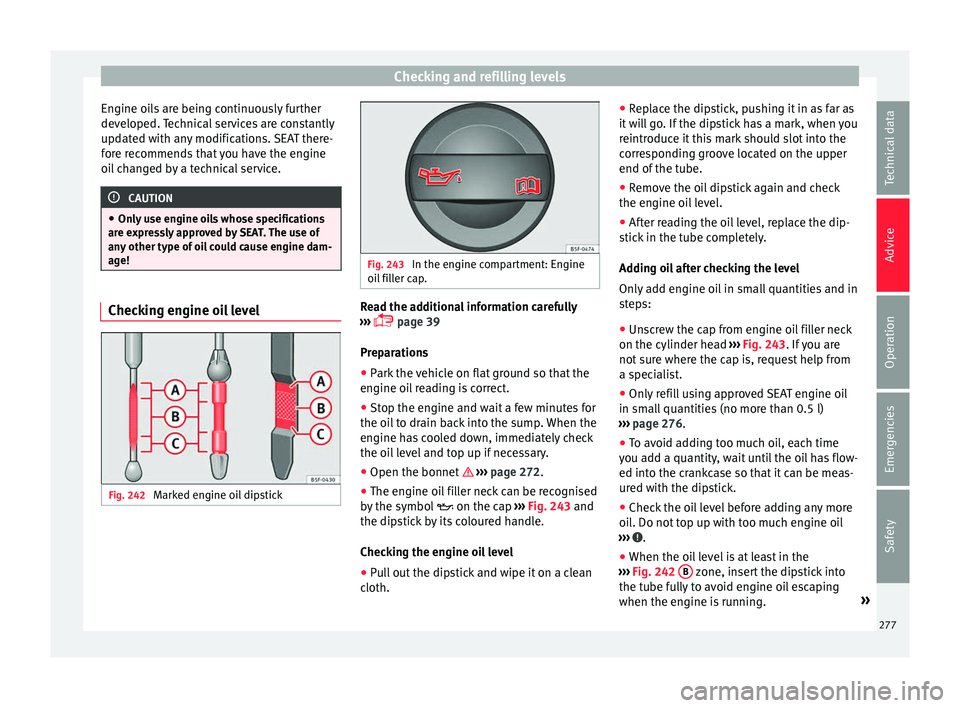
Fig. 242
Marked engine oil dipstick Fig. 243
In the engine compartment: Engine
oil fi
ller cap. Read the additional information carefully
› ›
›
page 39
Preparations ● Park the vehicle on flat ground so that the
engine oil
reading is correct.
● Stop the engine and wait a few minutes for
the oil t
o drain back into the sump. When the
engine has cooled down, immediately check
the oil level and top up if necessary.
● Open the bonnet ›››
page 272.
● The engine oil filler neck can be recognised
by the symbo
l on the cap ››› Fig. 243 and
the dipstick by its coloured handle.
Checking the engine oil level
● Pull out the dipstick and wipe it on a clean
cloth. ●
Repl
ace the dipstick, pushing it in as far as
it will go. If the dipstick has a mark, when you
reintroduce it this mark should slot into the
corresponding groove located on the upper
end of the tube.
● Remove the oil dipstick again and check
the engine oil
level.
● After reading the oil level, replace the dip-
stick
in the tube completely.
Adding oil after checking the level
Only add engine oil in small quantities and in
steps:
● Unscrew the cap from engine oil filler neck
on the cylinder head ›
›› Fig. 243. If you are
not sure where the cap is, request help from
a specialist.
● Only refill using approved SEAT engine oil
in small
quantities (no more than 0.5 l)
››› page 276.
● To avoid adding too much oil, each time
you ad
d a quantity, wait until the oil has flow-
ed into the crankcase so that it can be meas-
ured with the dipstick.
● Check the oil level before adding any more
oil. Do not
top up with too much engine oil
››› .
● When the oil level is at least in the
› ›
›
Fig. 242 B zone, insert the dipstick into
the t ube f
u
lly to avoid engine oil escaping
when the engine is running. »
277
Technical data
Advice
Operation
Emergencies
Safety
Page 280 of 324

Advice
● Af t
er t
opping up the oil, ensure that the
cap is screwed on to the filler neck correctly. WARNING
Oil could catch fire if it comes into contact
with hot en
gine components. This could lead
to a fire, explosion and severe injuries.
● Always ensure that after topping of oil, the
engine oil
filler cap is correctly tightened.
This will avoid engine oil spilling onto hot en-
gine parts when the engine is running. CAUTION
● If the en gine oi
l level is above the area
››› Fig. 242 A do not start the engine. Seek
spec i
alist assistance. Otherwise catalytic
converter and engine damage may occur.
● When refilling or changing service liquids,
ensur
e that you put the liquids into the right
tank. Making a mistake when refilling could
cause serious malfunctions and damage the
engine! For the sake of the environment
The oil level must never be above area
›› ›
Fig. 242 A . Otherwise oil can be drawn in
through the c r
ankcase breather and escape
into the atmosphere via the exhaust system. Engine oil consumption
The consumption of engine oil can be differ-
ent fr
om one en
gine to another and can vary
during the useful life of the engine.
Depending on driving style and the condi-
tions of use, the consumption of engine oil
can reach 1 litre every 2,000 km (one quarter
of a gallon every 1,200 miles); for new vehi-
cles, this could be higher for the first
5,000 km (3,000 miles). For this reason the
engine oil level must be checked at regular
intervals, preferably when filling the tank and
before a journey.
Topping up engine oil Read the additional information carefully
› ›
›
page 39
The engine oil must be changed regularly ac-
cording to the specifications of the Mainte-
nance Programme.
Due to the problems linked with disposing of
used oil and the need for suitable tools and
special knowledge, always visit a specialised
workshop to have the engine oil and filter
changed. SEAT recommends taking your car
in for technical service.
Detailed information on the service intervals
is shown in the Maintenance Programme. WARNING
If, in exceptional circumstances, you must
ch an
ge the engine oil yourself, please note
the following:
● Wear eye protection.
● Always wait until the engine has complete-
ly coo
led to avoid being burned.
● Always keep your arms horizontal when un-
scr
ewing the oil drainage bolt so that it does
not run down your arms.
● Use a suitable container large enough to
col
lect all of the used oil in the engine.
● Never collect engine oil in empty food con-
tainers, c
ans, bottles or other containers as
not all people are able to identify engine oil.
● Oil is toxic and must be kept out of the
reac
h of children. CAUTION
No additives should be used with engine oil.
This c
ould result in engine damage. Any dam-
age caused by the use of such additives
would not be covered by the factory warranty. For the sake of the environment
● Bef or
e changing the engine oil, find a suita-
ble location or service for proper disposal.
● Always dispose of engine oil with the ut-
most
respect for the environment. Never dis-
pose of used engine oil in places such as a
garden, woods, drains, roads, paths, rivers
and drainage systems. 278
Page 282 of 324

AdviceIt lights upGauge position
››› Fig. 244Possible causeSolution
Warning area
CExcessive engine coolant temperature.
Stop the vehicle!
Stop the vehicle safely as soon as possible. Switch off the engine and wait
for it to cool down and for the needle to return to the normal area. Check
the engine coolant level ››› page 281.
Normal area BInsufficient engine coolant level.Check the engine coolant when the engine has cooled and, if it is low, refill
with engine coolant
››› page 281.
Although the coolant level is correct, there is a fault.
--Engine coolant system faulty. Do not drive any further.
Obtain professional assistance.
--Cold area A--Avoid revving the engine too much or making it work hard while it has not
reached normal service temperature.
Flashes
Engine coolant
system faulty.Seek specialist assistance.
WARNING
Observe the safety warnings ›››
in Warning
and indication l amp
s on page 105. Coolant specifications
Read the additional information carefully
› ››
page 40 WARNING
If there is not enough anti-freeze in the cool-
ant sy s
tem, the engine may fail leading to se-
rious damage.
● Please make sure that the percentage of
additiv
e is correct with respect to the lowest
expected ambient temperature in the zone in
which the vehicle is to be used.
● When the outside temperature is very low,
the cool
ant could freeze and the vehicle
would be immobilised. In this case, the heat-
ing would not work either and inadequately
dressed passengers could die of cold. CAUTION
The original additives should never be mixed
with c oo
lants which are not approved by SEAT. Otherwise, you run the risk of causing
sever
e d
amage to the engine and the engine
cooling system.
● If the fluid in the expansion tank is not pur-
ple b
ut is, for example, brown, this indicates
that the G 13 additive has been mixed with
an inadequate coolant. The coolant must be
changed as soon as possible if this is the
case! This could result in serious faults and
engine damage. For the sake of the environment
Coolants and additives can contaminate the
en vir
onment. If any fluids are spilled, they
should be collected and correctly disposed
of, with respect to the environment. 280
Page 284 of 324

Advice
●
When refi l
ling liquids, avoid spilling them
on parts of the engine and the exhaust sys-
tem. Spilled liquids could cause a fire. Under
specific circumstances, the ethylene glycol
can catch fire. CAUTION
● On ly fi
ll with distilled water. Any other type
of water may lead to considerable rusting in
the engine due to its chemical components.
This could consequently damage the engine.
If you have not used distilled water but an-
other type of water to top up the coolant, a
specialised workshop must immediately re-
place all of the fluid in the engine cooling
system.
● Only top up coolant to the top level of the
marked ar
ea ››› Fig. 245. Otherwise the ex-
cess coolant will be forced out of the cooling
system when the engine is hot, causing dam-
age.
● If a lot of liquid coolant has been lost, wait
for the engine t
o cool down completely before
adding coolant. Extensive coolant loss is an
indication of leaks in the engine cooling sys-
tem. Have the engine cooling system inspec-
ted immediately by a specialised workshop.
Otherwise engine damage may occur.
● When refilling service liquids, ensure that
you put
the liquids into the right tank. Mak-
ing a mistake when refilling could cause seri-
ous malfunctions and damage the engine! Brake fluid
Chec k
in
g the brake fluid level Fig. 247
In the engine compartment: brake
fluid r e
ser
voir cap Read the additional information carefully
› ›
›
page 41
In the course of time, the brake fluid absorbs
water from the ambient air. If there is too
much water in the brake fluid, the brake sys-
tem could be damaged. In addition, the boil-
ing point of the brake fluid is significantly
lowered. When the brake fluid contains too
much water and the brakes are subject to
considerable forces, bubbles of water vapour
can form in the system. These bubbles can
significantly reduce braking power, notably
increasing braking distance, and could even
result in the total failure of the brake system.
Ensuring that the brake system is always
functioning correctly is essential for your own safety and the safety of other road users
›››
.
Br ak
e fluid s
pecifications
SEAT have developed a special brake fluid
optimised for the brake systems of their vehi-
cles. To ensure the optimum working of the
brake system, SEAT recommends the use of
brake fluid in accordance with the VW 501 14
standard. If this brake fluid is not available or
another brake fluid is used for different rea-
sons, use a brake fluid that complies with the
United States standard FMVSS 116 DOT 4 or
the German standard DIN ISO 4925 CLASS 4
››› .
Br ak
e fluid
s conforming to the standard
VW 501 14, fulfil the American requirements
of the FMVSS 116 DOT 4 standard and the
German DIN ISO 4925 CLASS 4 standard.
However, fluids that comply with the US
FMVSS 116 DOT 4 standard or the German
DIN ISO 4925 CLASS 4 standard do not nec-
essarily comply with the VW 501 14 stand-
ard. Always check the information on the
brake fluid container and ensure that you are
using suitable brake fluid.
A suitable brake fluid can be obtained from
technical service centres.
282
Page 285 of 324

Checking and refilling levels
Brake fluid level
The l ev
el
of the brake fluid should always be
between the MIN and MAX marks, or above
the MIN mark ››› .
It i
s
not always possible to check the level of
the brake fluid, as in some models the en-
gine components make it difficult to see the
brake fluid reservoir. If you cannot read the
exact brake fluid level, consult a specialist.
The brake fluid level drops slightly when the
vehicle is being used due to wear of the
brake pads and the automatic readjustment
of the brake.
Changing the brake fluid
The brake fluid should be changed in accord-
ance with the instructions given in the Main-
tenance Programme. Have the brake fluid
changed by a specialised workshop. SEAT
recommends taking your car in for technical
service. This means that only brake fluid
complying with the required specifications
will be used. WARNING
If the brake fluid level is low or unsuita-
bl e/o
ld brake fluid is used, the brake system
may fail or braking power may be reduced.
● Check the brake system and the brake fluid
level
regularly! ●
The brak e fluid shou
ld be changed regular-
ly in accordance with the instructions given
in the Maintenance Programme.
● When the brake fluid is used and brakes
are sub
jected to extreme braking forces, bub-
bles of vapour form in the brake system.
These bubbles can significantly reduce brak-
ing power, notably increasing braking dis-
tance, and could result in the total failure of
the brake system.
● Only used brake fluid that conforms to the
VW 501 14 stand
ard, FMVSS 116 DOT 4
standard or even the DIN ISO 4925 CLASS 4
standard. Other types of brake fluid could af-
fect brake operation and reduce braking pow-
er. Do not use a brake fluid if the container
does not specify compliance with the
VW 501 14, FMVSS 116 DOT 4 or
DIN ISO 4925 CLASS 4 standards.
● The replacement brake fluid must be new.
● Always ensure that you use suitable brake
fluid. Do not use a br
ake fluid if the container
does not specify compliance with the
VW 501 14, FMVSS 116 DOT 4 or
DIN ISO 4925 CLASS 4 standards. WARNING
Brake fluid is poisonous.
● To reduce the risk of poisoning, do not keep
brak e fluid in drink
s bottles/containers or
similar. Other people could drink from these
recipients even if the contents are clearly
marked. ●
Alw a
ys keep brake fluid in the original con-
tainer; keep it correctly sealed and out of
reach of children. CAUTION
Brake fluid damages the vehicle paintwork.
W ipe off an
y brake fluid from the paintwork
immediately. For the sake of the environment
Brake fluid is an environmental pollutant.
Co l
lect any spilt service fluids and allow a
professional to dispose of them. 283
Technical data
Advice
Operation
Emergencies
Safety
Page 286 of 324

Advice
Windscreen washer reservoir Chec k
in
g and topping up the wind-
screen washer reservoir Fig. 248
In the engine compartment: wind-
s c
r
een washer reservoir top Read the additional information carefully
› ›
›
page 41
Check the level in the windscreen washer
tank regularly and top up as required.
● Open the bonnet ›››
page 272.
● The washer reservoir is marked with the
symbol
on the lid ››› Fig. 248.
● Check there is enough water in the reser-
voir.
● T
o top up, mix water with a window cleaner
recommended b
y SEAT ››› . Please follow
the in struction
s for use found on the packag-
ing. ●
In col
d weather, a special antifreeze should
also be added to prevent the water from
freezing ››› .
Fi l
lin
g amounts
The capacity of the tank is approximately 3 li-
tres; in vehicles with a headlight washer sys-
tem, it is approximately 7 litres. WARNING
Never mix an unsuitable antifreeze or other
simi l
ar additives with the windscreen washer
water. A greasy layer may be formed on the
windscreen which will impair visibility.
● Use clean water with a window cleaner rec-
ommended by
SEAT.
● If necessary, add a suitable antifreeze to
the water in the r
eservoir. CAUTION
● Do not mi x
cleaning products recommen-
ded by SEAT with other products. This could
lead to flocculation and may block the wind-
screen washer jets.
● When topping up service fluids, make abso-
lutely c
ertain that you fill the fluids into the
correct reservoirs. Using the wrong fluids
could cause serious malfunctions and engine
damage! Vehicle battery
Intr oduction The battery is a component of the vehicle's
electric
al
system.
Never work on the electrical system without
fully understanding the operations required,
the applicable safety standards and without
the correct tools ››› ! If required, have any
work c
arried out by a specialised workshop.
SEAT recommends taking your car in for tech-
nical service. Negligent work can cause seri-
ous injury.
Location and number of batteries in the vehi-
cle
The battery is located in the engine compart-
ment.
Explanation of the warning indications on
the vehicle's battery
SymbolMeaning
Wear eye protection!
Battery acid is extremely corrosive. Al-
ways wear protective gloves and eye pro-
tection!
Fires, sparks, open flames and smoking
are prohibited.
284
Page 289 of 324

Checking and refilling levels
and they must be charged in a controlled en-
v ir
onment
››› . SEAT recommends taking
y our c
ar in f
or technical service.
Replacing a vehicle battery
The battery has been developed to suit the
conditions of its location and has special
safety features. If the battery must be re-
placed, consult a technical service for infor-
mation on electromagnetic compatibility, the
size and maintenance, performance and
safety requirements of the new battery in
your vehicle before you purchase one. SEAT
recommends you have the battery replaced
by a technical service.
Use only maintenance-free genuine batteries
conforming to TL 825 06 and VW 7 50 73
Standards. These standards must be dated
April 2008 or later.
Start-Stop systems ( ››› page 209) are equip-
ped with a special battery. Therefore, it must
only be replaced with a battery of the same
specifications.
Disconnecting the vehicle's battery
If you must disconnect the battery from the
electrical system, please note the following:
● Switch off the ignition and all electrical
equipment. ●
The vehic le must be unlocked before dis-
connecting the battery, otherwise the alarm
will be triggered.
● First disconnect the negative cable and
then the positiv
e ››› .
C onnectin
g the
vehicle's battery
● Before reconnecting the battery, switch off
the engine and all
electrical devices.
● First reconnect the positive cable and then
the negativ
e ››› .
Diff er
ent
control lamps may light up after
connecting the battery and switching the ig-
nition on. They will be turned off after a short
trip at a speed of between 15-20 km/h
(10-12 mph). If the warning indicators remain
lit, please visit a specialised workshop to
have the vehicle checked.
If the battery has been disconnected for a
long time, it is possible that the next service
date is not displayed or calculated correctly
››› page 100. Respect the maximum service
intervals permitted ››› Booklet Maintenance
Programme.
Vehicles with Keyless Access (››› page 117):
if, after connecting the battery, the ignition
cannot be switched on, lock and unlock the
vehicle from outside. Then try to switch on
the ignition again. If the ignition does not
work, seek professional assistance. Automatically disconnecting devices
The intellig
ent vehicle electrical system auto-
matically implements a range of measures to
prevent the battery from discharging when
high demands are made on it:
● the idling speed is increased so that the al-
ternat
or provides more electricity.
● where necessary, the power of the most
power
ful devices is reduced or even com-
pletely disconnected.
● On starting the engine, the power supply
from the 12-v
olt power sockets and the ciga-
rette lighter may be interrupted for a short
time.
The on-board management program cannot
always prevent the battery from running flat.
For example, if the ignition is left on for a
long period with the engine off or if the side
lights or parking lights are left on while the
vehicle is stationary.
Why does the battery run flat?
● When stationary for a long time without
star
ting the engine, particularly if the ignition
is switched on.
● Use of electrical devices with the engine
switc
hed off.
● If the auxiliary heater is running
›››
page 180. »
287
Technical data
Advice
Operation
Emergencies
Safety
Page 290 of 324

Advice
WARNING
Incorrectly securing the battery or using the
wron g b
attery can cause short-circuits, fire
and serious injuries.
● Always use only maintenance free batteries
that do not
run flat alone and whose proper-
ties, specifications and size correspond to
the standard battery. The specifications are
indicated on the battery case. WARNING
A highly explosive mixture of gases is re-
le a
sed when the battery is under charge.
● The batteries should be charged in a well-
ventil
ated room only.
● Never charge a frozen or recently thawed
batter
y. A flat battery can also freeze at tem-
peratures close to 0°C (+32°F).
● Always replace a battery which has frozen.
● Battery cables not correctly connected may
cause a shor
t circuit. Reconnect first the posi-
tive cable and then the negative cable. CAUTION
● Never di s
connect the battery if the ignition
is switched on or if the engine is running.
This could damage the electrical system or
electronic components.
● Never plug accessories that supply current,
such a
s solar panels or a battery charger, to
the 12-volt power sockets or the cigarette lighter. This could damage the vehicle's elec-
trica
l
system. For the sake of the environment
● Di spo
se of the battery in an environment-
friendly manner. Batteries contain toxic sub-
stances such as sulphuric acid and lead.
● Battery acid can contaminate the environ-
ment. If it
has leaked use adequate care col-
lecting it (gloves and protective glasses), and
dispose of it correctly. Wheels and tyres
T y
r
es
Introduction The SEAT Alhambra is equipped as standard
with anti-p
u
ncture technology tyres (Conti-
Seal). In the event of a puncture or air leak of
up to 5 mm, the tyre seals the hole with a
protective layer inside the tread.
The inclusion of this technology means that
there is no type of spare wheel included in
the vehicle's equipment.
SEAT recommend that all work on tyres and
wheels is carried out by a specialised work-
shop. These workshops have the necessary
special tools and replacement parts, trained
personnel and facilities for disposing of the
old tyres while respecting the environment.
SEAT recommends taking your car in for tech-
nical service. WARNING
The vehicle cannot be totally controlled or
brak ed if
the tyres (new or used) are worn or
damaged.
● Incorrect use of wheels and tyres could
make driv
ing more dangerous and result in
serious accidents and damage. 288