Page 238 of 328
3.48
Permissible nose weight, maxi-
mum permissible towing weight,
braked and unbraked: refer to
the information on “Weights” in
Section 6.
Choice and fitting of towing
equipment
Maximum weight of towing equip-
ment: 38 kg
For fitting and conditions of use,
refer to the equipment’s fitting ins-
tructions.
Please keep these instructions with
the rest of the vehicle documenta-
tion.
TRANSPORTING OBJECTS towbar
A
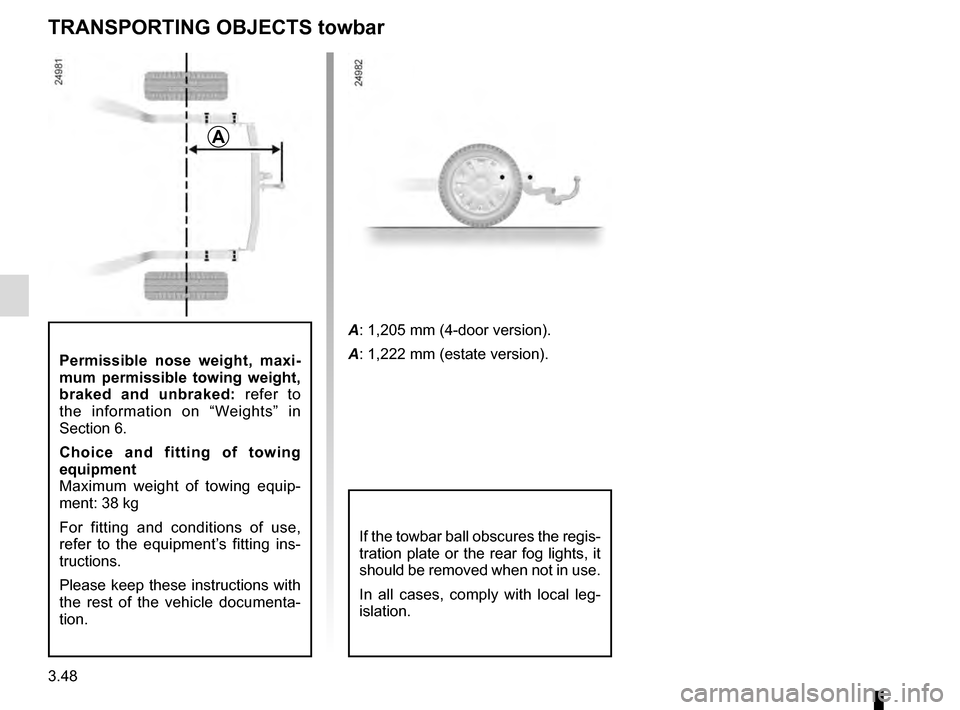
A: 1,205 mm (4-door version).
A: 1,222 mm (estate version).
If the towbar ball obscures the regis-
tration plate or the rear fog lights, it
should be removed when not in use.
In all cases, comply with local leg-
islation.
Page 269 of 328
5.9
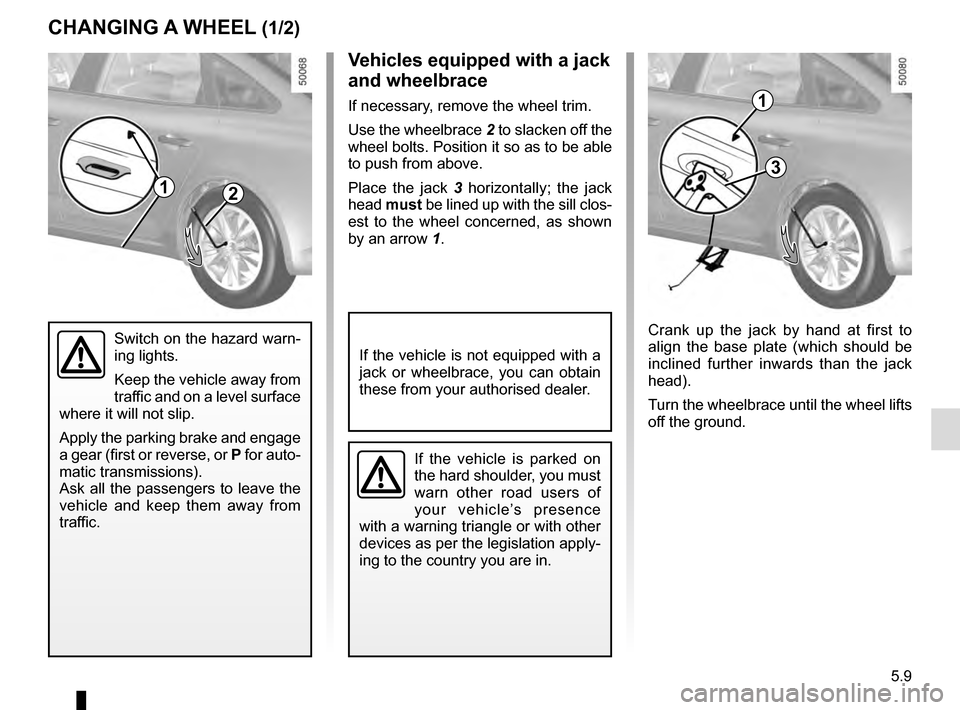
CHANGING A WHEEL (1/2)
2
Crank up the jack by hand at first to
align the base plate (which should be
inclined further inwards than the jack
head).
Turn the wheelbrace until the wheel lifts
off the ground.
Vehicles equipped with a jack
and wheelbrace
If necessary, remove the wheel trim.
Use the wheelbrace 2 to slacken off the
wheel bolts. Position it so as to be able
to push from above.
Place the jack 3 horizontally; the jack
head must be lined up with the sill clos-
est to the wheel concerned, as shown
by an arrow 1.
Switch on the hazard warn-
ing lights.
Keep the vehicle away from
traffic and on a level surface
where it will not slip.
Apply the parking brake and engage
a gear (first or reverse, or P for auto-
matic transmissions).
Ask all the passengers to leave the
vehicle and keep them away from
traffic.
If the vehicle is parked on
the hard shoulder, you must
warn other road users of
your vehicle’s presence
with a warning triangle or with other
devices as per the legislation apply-
ing to the country you are in.
If the vehicle is not equipped with a
jack or wheelbrace, you can obtain
these from your authorised dealer.
1
3
1
Page 280 of 328
5.20
REAR LIGHTS AND SIDE LIGHTS: replacing the bulbs (5/5)Side repeaters 14 and
courtesy lighting 15
Consult an approved Dealer.
14
Number plate lights 13
Consult an approved Dealer.
13
15
13
Page 289 of 328

5.29
Operating faults
If the battery is too weak to ensure cor-
rect operation, you can still start and
lock/unlock the vehicle (please refer to
the information on “Locking/unlocking
the opening elements” in Section 1).
RENAULT CARD: battery
Replacing the battery
When the message “Keycard battery
low” appears on the instrument panel,
replace the battery in the RENAULT
card:
– slide the rear casing 1 downwards
while pressing on zone A;
– remove the battery cover 2;
– remove the battery by pressing on
one side and lifting the other;
– replace it according to the direc-
tion and template shown inside the
cover.
Do not throw away your
used batteries; give them to
an organisation responsible
for collecting and recycling
batteries.
When refitting, proceed in the reverse
order, then press one of the buttons on
the card four times, close to the vehicle:
the message will disappear.
Note: it is not advisable to touch the
electronic circuit or contacts on the
RENAULT card when replacing the bat-
tery.
The batteries are available from ap-
proved Dealers, and their service
life approximately two years. Check
that there is no dye on the battery:
risk of an incorrect electrical con-
tact.
2
A
1
Page 301 of 328

6.1
Section 6: Technical specifications
Vehicle identification plates . . . . . . . . . . . . . . . . . . . . . . . . . . . . . . . . . . . . \
. . . . . . . . . . . . . . . . . . . . 6.2
Engine identification plates . . . . . . . . . . . . . . . . . . . . . . . . . . . . . . . . . . . .\
. . . . . . . . . . . . . . . . . . . . 6.3
Dimensions . . . . . . . . . . . . . . . . . . . . . . . . . . . . . . . . . . . .\
. . . . . . . . . . . . . . . . . . . . . . . . . . . . . . . . 6.4
Engine specifications . . . . . . . . . . . . . . . . . . . . . . . . . . . . . . . . . . . . \
. . . . . . . . . . . . . . . . . . . . . . . . . 6.6
Weights . . . . . . . . . . . . . . . . . . . . . . . . . . . . . . . . . . . .\
. . . . . . . . . . . . . . . . . . . . . . . . . . . . . . . . . . . 6.7
Towing weights . . . . . . . . . . . . . . . . . . . . . . . . . . . . . . . . . . . .\
. . . . . . . . . . . . . . . . . . . . . . . . . . . . . 6.7
Replacement parts and repairs . . . . . . . . . . . . . . . . . . . . . . . . . . . . . . . . . . . . \
. . . . . . . . . . . . . . . . . 6.8
Service sheets . . . . . . . . . . . . . . . . . . . . . . . . . . . . . . . . . . . . \
. . . . . . . . . . . . . . . . . . . . . . . . . . . . . . 6.9
Anti-corrosion check . . . . . . . . . . . . . . . . . . . . . . . . . . . . . . . . . . . .\
. . . . . . . . . . . . . . . . . . . . . . . . . 6.15
Page 302 of 328
6.2
VEHICLE IDENTIFICATION PLATES
A
B
A
97
8
10
5
1
2
3
4
6
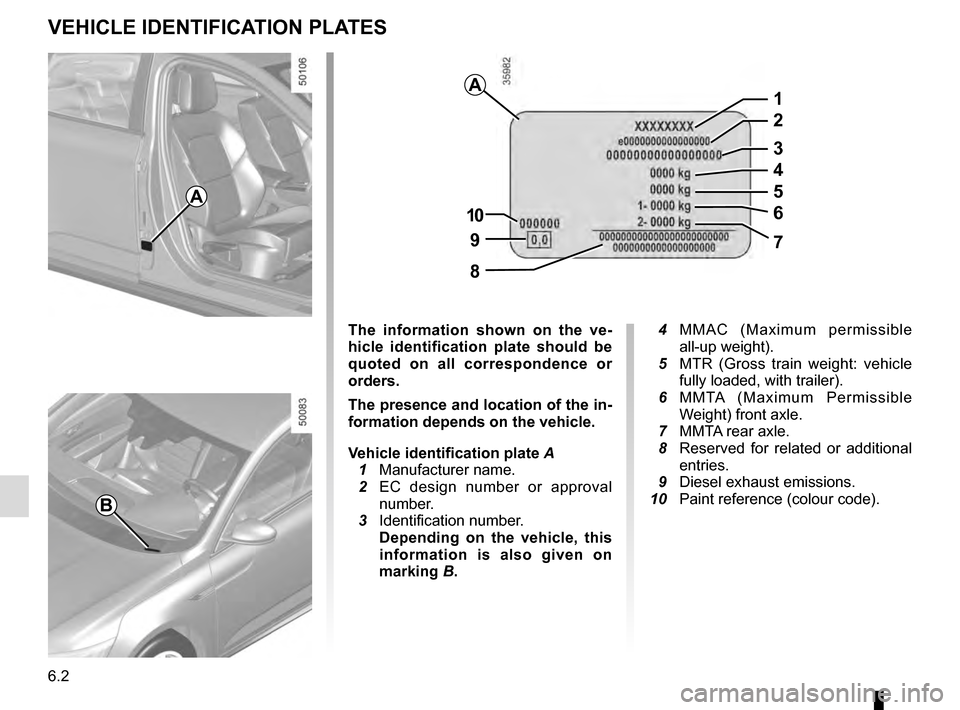
The information shown on the ve-
hicle identification plate should be
quoted on all correspondence or
orders.
The presence and location of the in-
formation depends on the vehicle.
Vehicle identification plate A
1 Manufacturer name.
2 EC design number or approval
number.
3 Identification number.
Depending on the vehicle, this
information is also given on
marking B.
4 MMAC (Maximum permissible
all-up weight).
5 MTR (Gross train weight: vehicle
fully loaded, with trailer).
6 MMTA (Maximum Permissible
Weight) front axle.
7 MMTA rear axle.
8 Reserved for related or additional
entries.
9 Diesel exhaust emissions.
10 Paint reference (colour code).
Page 303 of 328
6.3
ENGINE IDENTIFICATION PLATES
C
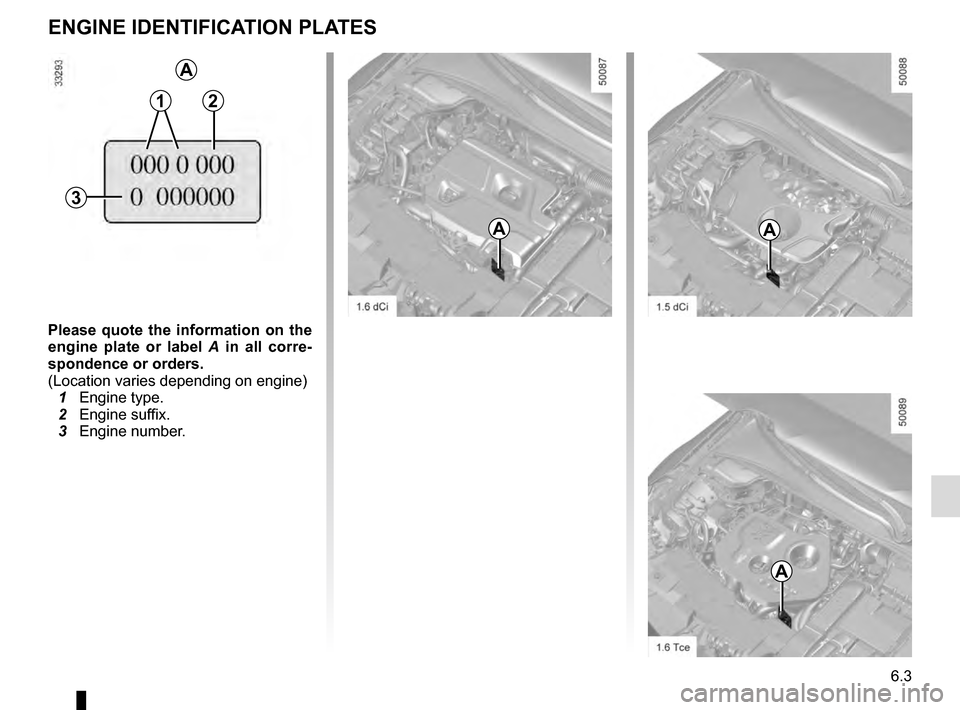
Please quote the information on the
engine plate or label A in all corre-
spondence or orders.
(Location varies depending on engine)
1 Engine type.
2 Engine suffix.
3 Engine number.
C
12
3
A
A
12
3
A
A
Page 306 of 328
6.6
ENGINE SPECIFICATIONS
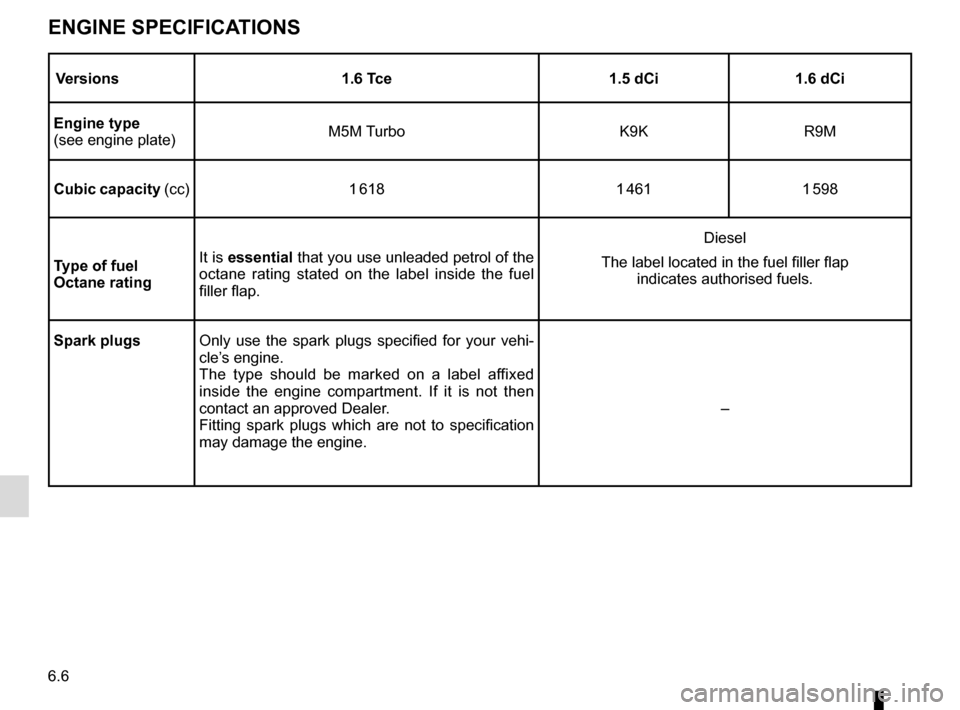
Versions1.6 Tce1.5 dCi1.6 dCi
Engine type
(see engine plate) M5M Turbo
K9KR9M
Cubic capacity (cc) 1 6181 4611 598
Type of fuel
Octane rating It is
essential that you use unleaded petrol of the
octane rating stated on the label inside the fuel
filler flap. Diesel
The label located in the fuel filler flap indicates authorised fuels.
Spark plugs Only use the spark plugs specified for your vehi-
cle’s engine.
The type should be marked on a label affixed
inside the engine compartment. If it is not then
contact an approved Dealer.
Fitting spark plugs which are not to specification
may damage the engine. –