2016 RENAULT TALISMAN ESP
[x] Cancel search: ESPPage 209 of 328

3.19
ELECTRIC SUNROOF (1/3)
To slide the curtain 1
With the ignition on:
– Full opening: move marker 3 on
button 2 to position A . The points
in between correspond to the three
progressive opening positions of the
curtain;
– to close: move mark 3 on button 2
to position 0.
To slide the sunroof
With the ignition on:
– to open: move mark 3 on button 2
to position B, depending how far
you wish it to open. The points in
between correspond to the five pro-
gressive opening positions;
– To close: move the marker 3 on
button 2 to position A.
1
2
0
A
B
Moving the position 0 directly to po-
sition B causes the simultaneous
opening of the curtain and the roof.
Driver’s responsibility
when parking or stopping
the vehicle
Never leave an animal,
child or adult who is not self-suffi-
cient alone on your vehicle, even for
a short time.
The reason for this is that the child
may endanger himself or others by
starting the engine, activating equip-
ment such as the window winders
for example, or locking the doors.
If something gets trapped, reverse
the direction of travel as soon as
possible by turning button 2 fully to
the right (position B).
Risk of serious injury.23
Page 211 of 328

3.21
Operating fault
– If the sunroof will not close, turn switch 2 to position B to open the
sunroof, then turn switch 2 to posi-
tion 0 until the sunroof is completely
closed.
– If the curtain does not close, turn switch 2 to position A to open the
curtain, then turn switch 2 to posi-
tion 0 until the curtain is fully closed.
2
ELECTRIC SUNROOF (3/3)
If the blockage persists, keep switch 2
pressed until it closes completely.
Please consult an authorised dealer.
0
A
B
Important: during this operation, the
sunroof anti-pinch function is de-
activated. Contact your approved
Dealer as soon as possible.
Driver’s responsibility
when parking or stopping
the vehicle
Never leave an animal,
child or adult who is not self-suffi-
cient alone on your vehicle, even for
a short time.
The reason for this is that the child
may endanger himself or others by
starting the engine, activating equip-
ment such as the window winders
for example, or locking the doors.
If something gets trapped, reverse
the direction of travel as soon as
possible by turning button 2 fully to
the right (position B).
Risk of serious injury.
Page 217 of 328
3.27
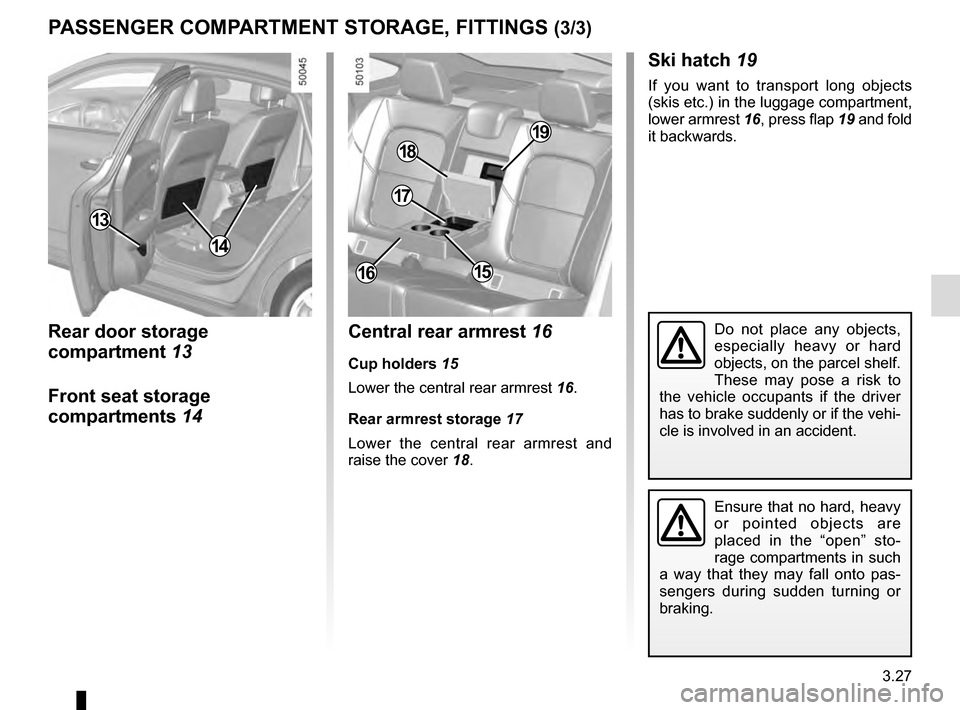
Ski hatch 19
If you want to transport long objects
(skis etc.) in the luggage compartment,
lower armrest 16, press flap 19 and fold
it backwards.
PASSENGER COMPARTMENT STORAGE, FITTINGS (3/3)
Ensure that no hard, heavy
or pointed objects are
placed in the “open” sto-
rage compartments in such
a way that they may fall onto pas-
sengers during sudden turning or
braking.
Rear door storage
compartment 13
Front seat storage
compartments 14
13
14
Central rear armrest 16
Cup holders 15
Lower the central rear armrest 16.
Rear armrest storage 17
Lower the central rear armrest and
raise the cover 18.
17
16
18
19
15
Do not place any objects,
especially heavy or hard
objects, on the parcel shelf.
These may pose a risk to
the vehicle occupants if the driver
has to brake suddenly or if the vehi-
cle is involved in an accident.
Page 220 of 328

3.30
To manually fold down the
seatbacks
Ensure that the front seats are far
enough forward.
Raise the side headrests to the highest
position and lower the central headrest
fully.
Pull the control 1 and lower the seat-
back A.
REAR BENCH SEAT (1/2)
1
To raise the seatback
To replace the seatback, proceed in the
reverse order to removal.
Refit the seatback and click it back into
place.
A
For safety reasons, carry
out any adjustments when
the vehicle is not being
driven.
The configuration of the
two-seat bench with the
small seatback A pulled
down, does not allow the
central seat to be used as it would
be impossible to buckle the seat belt
(belt buckles inaccessible).
When refitting the seat-
back, make sure it is cor-
rectly locked in place.
If seat covers are fitted ,
make sure these do not prevent the
seatback latch from locking in.
Make sure that the seat belts are
positioned correctly.
Reposition the headrests.
When moving the rear
seats, ensure that nothing
obstructs the anchorage
points (passenger’s arm or
leg, a pet, gravel, cloth, toys, etc.).
Before folding down any side rear seat,
fasten the seat belt buckle from the seat
concerned into its corresponding catch.
This will prevent the seat belt becoming
trapped when the seat is returned to its
position for use.
In all cases, check that the seat belts
are operating correctly.
Page 230 of 328
3.40
AUTOMATIC TAILGATE (4/5)
Stopping the tailgate
manoeuvre
The automatic tailgate manoeuvre can
be stopped at any time by a short press
on one of the controls. Depending on
the opening position, the tailgate hatch
can however continue to be opened
manually.
If the tailgate is stationary in the inter-
mediate position, your next press will
move the tailgate in the opposite direc-
tion to when you stopped it.
Manual mode
After stopping the tailgate, you can per-
form the manoeuvre manually if you
wish.
You can switch to automatic movement
at any time by pressing one of the con-
trols.
Obstacle detection
When the tailgate window encounters
an obstacle (presence of an object or
person) when it is moving, it stops.
Depending on the opening position, the
tailgate hatch can however continue to
be opened manually.
Press the tailgate opening/closing con-
trol to reperform the tailgate movement
in the same direction as before encoun-
tering the obstacle.
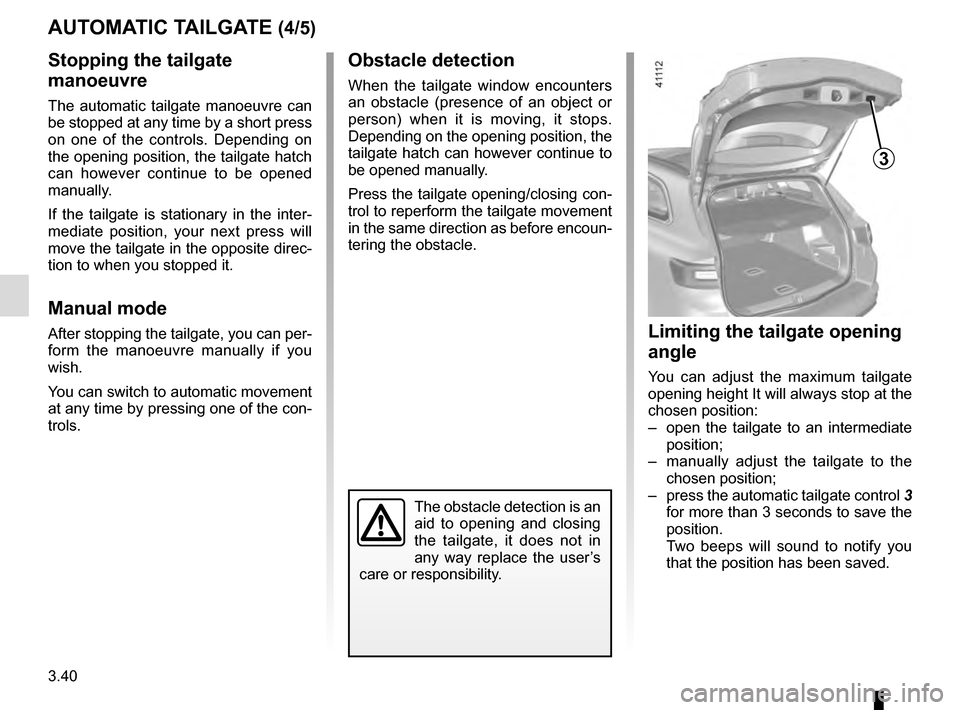
Limiting the tailgate opening
angle
You can adjust the maximum tailgate
opening height It will always stop at the
chosen position:
– open the tailgate to an intermediate position;
– manually adjust the tailgate to the chosen position;
– press the automatic tailgate control 3
for more than 3 seconds to save the
position.
Two beeps will sound to notify you
that the position has been saved.
3
The obstacle detection is an
aid to opening and closing
the tailgate, it does not in
any way replace the user’s
care or responsibility.
Page 231 of 328

3.41
AUTOMATIC TAILGATE (5/5)Operating faults
If you activate the automatic tailgate
continuously for around a minute (se-
quence of opening and closing), it will
stop in order to avoid overheating. The
operation will return to normal after
about a minute.
The automatic tailgate will not operate
if the battery is on low charge. In this
case, operate the automatic tailgate
with the engine started.
Note
In very cold weather conditions, the au-
tomatic opening may not operate if the
trunk lid joints are frozen.
Precautions during use
Before opening/closing the tailgate,
ensure that the surrounding space is
sufficient to allow the tailgate to ope-
rate. If not, stop the tailgate movement
with the external tailgate control and
hold the tailgate in position by hand
(the tailgate may continue to open ma-
nually).
If the tailgate is moving and the engine
is started, the movement will stop for a
seconds before continuing.
Avoid multiple manual stops during the
automatic tailgate movement (risk of
damaging the tailgate system).
Make sure that the sensors are not
obscured (by dirt, mud, snow, road salt
etc.).
Driver’s responsibility
when parking or stopping
the vehicle
Never leave your vehicle
with a child, an adult who is not self-
sufficient or a pet inside or at the
rear of the tailgate, even for a short
while.
They may pose a risk to themselves
or to others by starting the engine,
activating equipment such as the
electric windows, the automatic
tailgate or by locking the doors.
RISK OF DEATH OR SERIOUS
INJURY.
Disable the «hands-free» function before washing the vehicle manua\
lly
or handling the emergency spare wheel or the towbar.
Risk of accidental opening or closing of the tailgate which may
cause injury.
Page 252 of 328
4.10
BATTERY (1/2)
1
Handle the battery with care
as it contains sulphuric acid
which must not come into
contact with the eyes or
skin. If it does, wash the affected
area with plenty of cold water. If
necessary, consult a doctor.
Ensure that naked flames, red hot
objects and sparks do not come into
contact with the battery as there is a
risk of explosion.
Depending on the vehicle, a system
continuously checks the battery charge
status. If this decreases, the message
“Battery low start engine” is displayed
on the instrument panel. In this case,
start the engine and the message on
the instrument panel will disappear.
The charge status of your battery can
decrease especially if you use your ve-
hicle:
– for short journeys;
– for driving in town;
– when the temperature drops;
– after extended use of energy-con- suming devices (radio, etc.) with the
engine switched off.
The engine may be hot
during operations in close
proximity. In addition, the
engine cooling fan may
start at any moment.
Risk of injury.
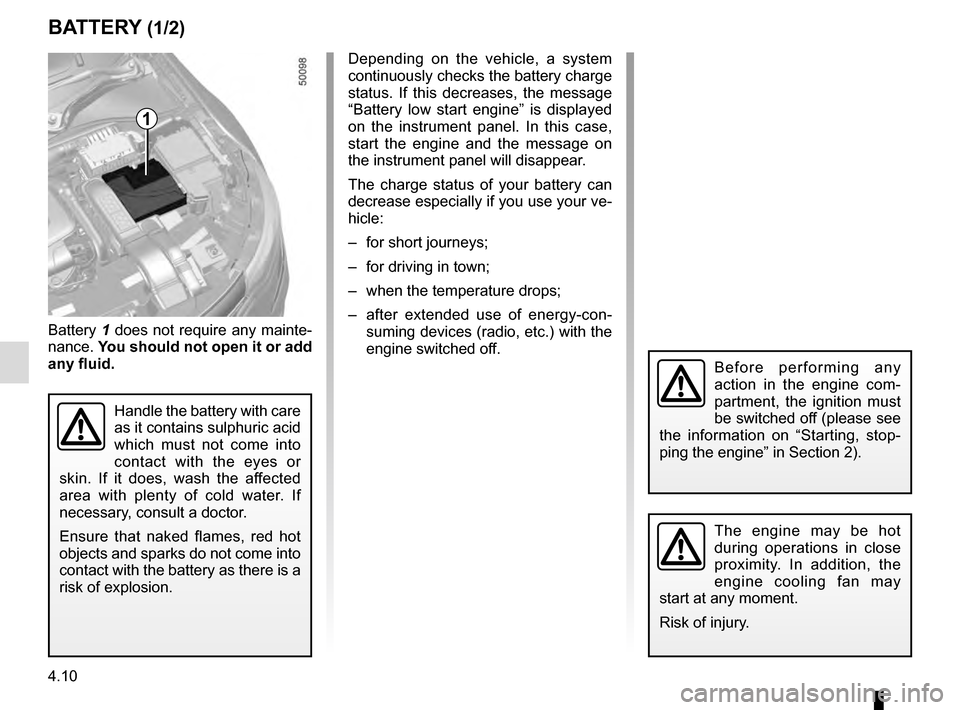
Battery 1 does not require any mainte-
nance. You should not open it or add
any fluid.
Before performing any
action in the engine com-
partment, the ignition must
be switched off (please see
the information on “Starting, stop-
ping the engine” in Section 2).
Page 257 of 328
4.15
Respect local regulations about wash-
ing vehicles (e.g. do not wash your ve-
hicle on a public highway).
Observe the vehicle stopping distances
when driving on gravelled surfaces to
prevent paint damage.
Repair, or have repaired quickly, areas
where the paint has been damaged, to
prevent corrosion spreading.
Remember to visit the body shop pe-
riodically in order to maintain your
anti-corrosion warranty. Refer to the
Maintenance Document.
If it is necessary to clean mechani-
cal components, hinges, etc., spray
them with products approved by our
Technical Department to protect them
after they have been cleaned.
BODYWORK MAINTENANCE (2/2)
We have selected special products
to care for your vehicle and you can
obtain these from the manufactur-
er’s accessory outlets.
Using a roller type car wash
Return the windscreen wiper stalk to
the Park position (refer to the informa-
tion on the “Windscreen washer, wiper”
in Section 1). Check the mounting of
external accessories, additional lights
and mirrors, and ensure that the wiper
blades are secured with adhesive tape.
Remove the radio aerial mast if your
vehicle is fitted with this equipment.
Remember to remove the tape and refit
the antenna after washing.
Cleaning the headlights
As the headlights are made of plastic
“glass”, use a soft cloth or cotton wool
to clean them. If this does not clean
them properly, moisten the cloth with
soapy water, then wipe clean with a soft
damp cloth or cotton wool.
Finally, carefully dry off with a soft dry
cloth.
Cleaning products containing alco-
hol must not be used.
Vehicles with a matte paint
finish
This type of paint requires certain pre-
cautions.
Do not do the following
– use wax-based products (polishing);
– rub hard;
– wash the vehicle in a roller-type car
wash;
– wash the vehicle using a high-pres-
sure device;
– attach stickers to the paintwork (risk
of leaving marks).
You should do the following
Wash the vehicle by hand using plenty
of water, using a soft cloth or a gentle
sponge.