Page 182 of 242

5.4
Depending on the vehicle, remove the
central partition in the storage compart-
ment to access the inflation kit.
Open the kit, remove caps 1 and 3 (the
cap must not be removed from the
bottle) then screw bottle 2 to its base 3.
Engine running, handbrake applied:
– unscrew the valve cap on the wheel concerned and screw inflation
adapter 6 onto the valve;
– connect adapter 8 to the accessories
socket on the dashboard of the vehi-
cle;
– press switch 5 to inflate the tyre to
the recommended pressure (check
the label affixed to the edge of the
driver’s door);
– after a maximum of 5 minutes, stop inflating and read the pressure (on
pressure gauge 4);
Note: while the bottle is emptying
(approximately 30 seconds), pres-
sure gauge 4 will briefly indicate a
pressure of 6 bar, then the pressure
will drop.
TYRE INFLATION KIT (2/5)
143
5
6
78
2– adjust the pressure: to increase it, continue inflating with the kit, to
reduce it, turn button 7 located on
the inflation adapter.
If a minimum pressure of 1.8 bar is
not reached after 15 minutes, repair
is not possible; do not drive the ve-
hicle but contact an approved dealer.
Inflation kit C
Depending on the vehicle, in the event
of a puncture, use the kit located under-
neath the boot carpet.
Before using this kit, park
the vehicle at a sufficient
distance from traffic, switch
on the hazard warning
lights, apply the handbrake, ask all
passengers to leave the vehicle and
keep them away from traffic.
If the vehicle is parked on
the hard shoulder, you must
warn other road users of
your vehicle’s presence
with a warning triangle or with other
devices as per the legislation apply-
ing to the country you are in.
C
Page 184 of 242

5.6
TYRE INFLATION KIT (4/5)
Inflation kit D
Depending on the vehicle, in the event
of a puncture, use the kit located in the
boot or underneath the luggage com-
partment carpet.
Engine running, handbrake applied:
– unroll the hose from the container;
– connect the compressor hose 12 to
the container’s inlet 17;
– depending on the vehicle, connect the container 17 to the compressor
from the container recess 16;
– unscrew the valve cap on the rel- evant wheel and screw on the con-
tainer’s inflation adapter 10;
– adapter 11 must be connected to the
vehicle accessories socket;
– press switch 13 to inflate the tyre to
the recommended pressure (please
refer to the information in the section
on “Tyre pressure”);
1314
10
Before using this kit, park
the vehicle at a sufficient
distance from traffic, switch
on the hazard warning
lights, apply the handbrake, ask all
passengers to leave the vehicle and
keep them away from traffic.
17
If the vehicle is parked on
the hard shoulder, you must
warn other road users of
your vehicle’s presence
with a warning triangle or with other
devices as per the legislation apply-
ing to the country you are in.
– after a maximum of 15 minutes, stop inflating and read the pressure (on
pressure gauge 14).
Note: while the container is empty-
ing (approximately 30 seconds), the
pressure gauge 14 will briefly indi-
cate a pressure of up to 6 bar. The
pressure will then drop.
– adjust the pressure: to increase it, continue inflation with the kit; to
reduce it, press button 15.
If a minimum pressure of 1.8 bar is
not reached after 15 minutes, repair
is not possible; do not drive the ve-
hicle but contact an approved dealer.
11
12
16
15
D
Page 208 of 242
5.30
TOWING: breakdown (2/2)
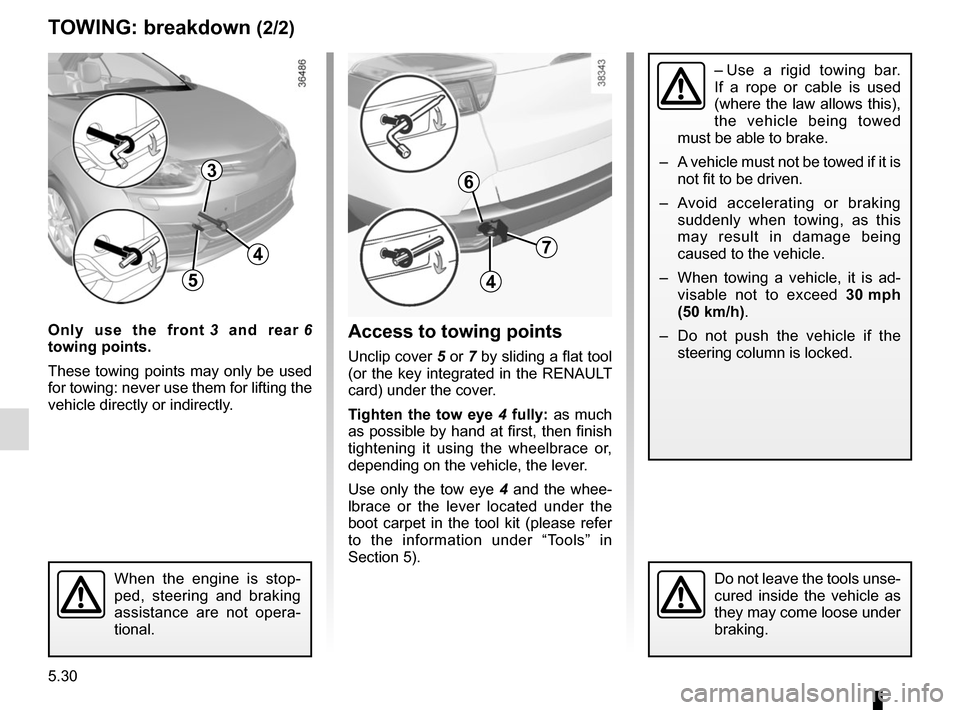
Only use the front 3 and rear 6
towing points.
These towing points may only be used
for towing: never use them for lifting the
vehicle directly or indirectly.Access to towing points
Unclip cover 5 or 7 by sliding a flat tool
(or the key integrated in the RENAULT
card) under the cover.
Tighten the tow eye 4 fully: as much
as possible by hand at first, then finish
tightening it using the wheelbrace or,
depending on the vehicle, the lever.
Use only the tow eye 4 and the whee-
lbrace or the lever located under the
boot carpet in the tool kit (please refer
to the information under “Tools” in
Section 5).
When the engine is stop-
ped, steering and braking
assistance are not opera-
tional.Do not leave the tools unse-
cured inside the vehicle as
they may come loose under
braking.
– Use a rigid towing bar.
If a rope or cable is used
(where the law allows this),
the vehicle being towed
must be able to brake.
– A vehicle must not be towed if it is not fit to be driven.
– Avoid accelerating or braking suddenly when towing, as this
may result in damage being
caused to the vehicle.
– When towing a vehicle, it is ad- visable not to exceed 30 mph
(50 km/h).
– Do not push the vehicle if the steering column is locked.
3
4
54
7
6