Page 18 of 284
1.12
FRONT DOORS (1/2)
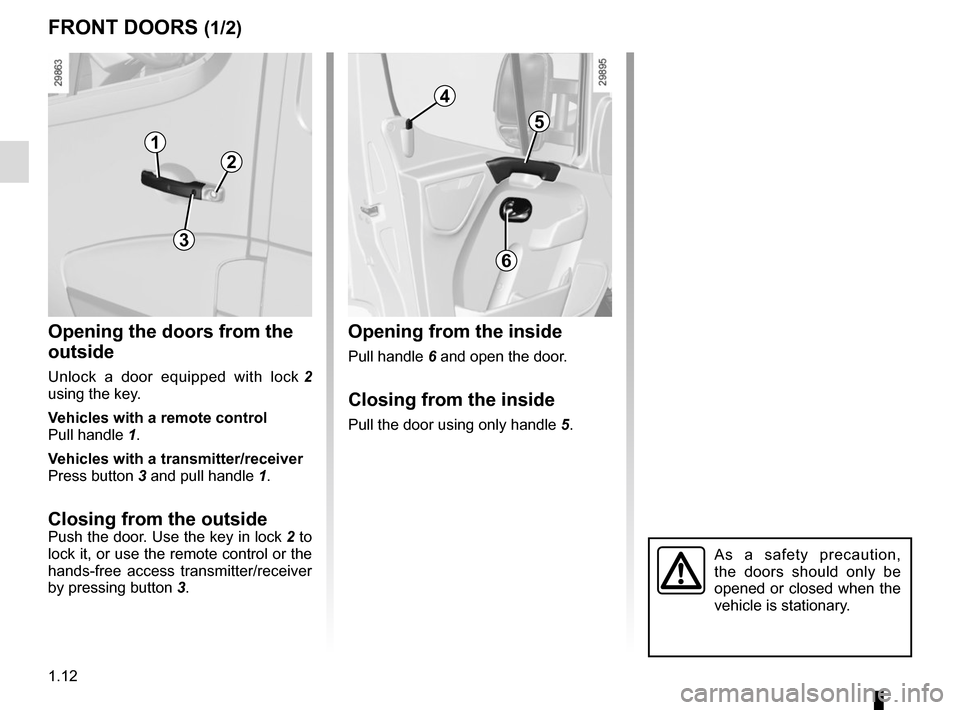
Opening the doors from the
outside
Unlock a door equipped with lock 2
using the key.
Vehicles with a remote control
Pull handle 1.
Vehicles with a transmitter/receiver
Press button 3 and pull handle 1.
Closing from the outsidePush the door. Use the key in lock 2 to
lock it, or use the remote control or the
hands-free access transmitter/receiver
by pressing button 3.
Opening from the inside
Pull handle 6 and open the door.
Closing from the inside
Pull the door using only handle 5.
As a safety precaution,
the doors should only be
opened or closed when the
vehicle is stationary.
1
2
4
5
6
3
Page 20 of 284
1.14
SLIDING SIDE DOOR (1/2)
Opening from the inside
Pull lever 2 towards the rear and open
the sliding door until it locks into posi-
tion.
12
3
Opening the doors from the
outside
Unlock the lock with the key or with
the remote control, if the vehicle is
equipped with this function.
Pull handle 1 towards you and slide the
door towards the rear.
Note: the transmitter/receiver does not
work on the sliding side door (no button
on the handle).
Closing from the outside
Pull handle 1 and slide the door to-
wards the front of the vehicle until it
closes completely. Lock with the key or
using the remote control.
Closing from the inside
Pull lever 2 towards the front and close
the door until it latches.
Manual locking from inside
Lower button 3.
As a safety precaution,
the doors should only be
opened or closed when the
vehicle is stationary.
Page 22 of 284
1.16
Lower lever 4 to open the door.
If the vehicle is parked on
the hard shoulder with tail-
gate open, the rear lights
may be obscured. You
should make other road users aware
of your vehicle by using a warning
triangle or other equipment speci-
fied by the road traffic regulations of
the country you are driving in.
REAR DOORS (1/2)
Opening the doors from the
outside
Unlock lock 1 using the key or, on
equipped vehicles, use the remote con-
trol or the hands-free access remote
control by pressing button 3. Pull
handle 2 towards you and open the
door.
Opening the doors to 180°
Open the door, but not fully.
Remove tie rod 7 from its housing 5.
Lock the tie rod on the hook 6.
Open the door as far as possible.
1
24
1
Do not leave the hinged
rear doors open in case of
strong winds. Risk of injury.For your safety, check that
all the vehicle’s doors are
properly closed before
starting the engine.
3
5
6
7
Page 88 of 284

1.82
TRIP COMPUTER: general information (1/2)
Trip computer and warning
system A
Depending on the vehicle, this includes
the following functions:
– distance travelled;
– journey settings;
– information messages;
– operating fault messages (con-
nected to the
© warning light);
– warning messages (connected to the
® warning light);
– setting the time.
All these functions are described on the
following pages.
Display selection keys 1
and 2
Scroll through the following informa-
tion upwards (button 1) or downwards
(button 2 ) by pressing briefly and suc-
cessively (the display depends on the
vehicle equipment and country). a) Total mileage and trip mileage re-
corder,
b) journey parameters: – fuel consumed;
– average fuel consumption;
– current fuel consumption;
– estimated range;
– distance travelled;
– average speed;
c) distance before service;
d) Reset the tyre pressure
e) cruise control and speed limiter pro- grammed speed;
f) trip log, operating faults and informa- tion message readout.
A
1
2
Page 89 of 284

1.83
TRIP COMPUTER: general information (2/2)
Trip mileage resetting
With “trip mileage recorder” selected on
the display, press button 1 or 2 until the
mileage recorder resets to zero.
Resetting the journey
parameters (reset button)
With one of the journey parameters se-
lected on the display, press button 1
or 2 until the display resets.
Interpreting some of the
values displayed after
resetting
The values showing average fuel con-
sumption, range and average speed
will become more stable and reliable
the further you travel after pressing the
reset button.
For the first few miles after pressing
the reset key you will notice that the
range increases as you travel. This
range takes into account the average
fuel consumption since the last time the
reset button was pressed. Therefore,
the average fuel consumption may de-
crease when:
– the vehicle stops accelerating;
– the engine reaches its operating
temperature (if the engine was cold
when the reset key was pressed);
– when driving from an urban area
onto the open road.
Automatic resetting of the
journey parameters
Resetting occurs automatically when
the maximum value of any of the pa-
rameters is exceeded.
1
2
Page 95 of 284

1.89
These appear with the © warning light and mean that you should drive very carefully to an author\
ised dealer as soon
as possible. If you fail to follow this recommendation, you risk damagin\
g your vehicle.
They disappear when the display selection key is pressed or after severa\
l seconds and are stored in the computer log. The
©
warning light stays on. Examples of operating fault messages are given o\
n the following pages .
TRIP COMPUTER: operating fault messages
Examples of messagesInterpretation of messages
CHECK ESC Indicates a fault in the traction control system or in the Electronic St\
ability
Program system (please refer to the information on “Driver correctio\
n de-
vices and aids” in Section 2).
CHECK FUEL FILTER Indicates that there is water present in the diesel fuel.
Contact an approved Dealer as soon as possible.
CHECK GEARBOX Indicates that a fault has occurred in the gearbox; contact an approved
Dealer as soon as possible.
CHECK AUTO LIGHTS Indicates an automatic lighting operating fault; contact an approved Dea\
ler.
CHECK ANTI- POLLUTION – Indicates a fault in the vehicle’s emission control system.
– Indicates a fault in the emissions reduction system when it is acco\
mpanied
by the
warning light. Refer to the information on “Additive tank” in
Section 1.
Page 107 of 284

1.101
FUEL TANK (1/2)
Filling the tank
Open the driver’s door in order to open
flap 1.
Depending on the vehicle, unlock cap 2
using the key.
Remove cap 2 and attach it to flap 1.
Useful capacity of fuel tank: approxi-
mately 105 litres or 80 litres (depend-
ing on the vehicle).
Filling with fuel
When the pump cuts out automatically
at the end of the filling procedure, a
maximum of two further filling attempts
may be made to maintain an expansion
volume.
Fuel grade
It is essential to use diesel. Make
sure that no water accidentally enters
the fuel tank during filling. The shut-off
system and its surrounding area must
be dust-free. The diesel fuel must be of
a high grade.
2
1
After filling, check that the cap and
cover are closed.
Fuel filler cap: this is of a
special type.
If you have to replace it,
make sure it is identical
to the original cap. Contact an ap-
proved Dealer.
Never place the cap near a source
of heat or flame.
Do not wash the filler area with a
high-pressure washer.
Do not mix even small
amounts of petrol (un-
leaded or E85) with diesel.
Do not add additive to the
fuel – otherwise you risk damaging
the engine.
Vehicle fitted with the Stop and
Start function
To fill up with fuel, the engine must
be stopped (and not on standby):
stop the engine (please refer to the
information on “Starting and stop-
ping the engine” in Section 2).
Page 116 of 284

2.2
RUNNING IN, IGNITION SWITCH
Start position D
If the engine fails to start at the first at-
tempt, turn the key back before activat-
ing the starter again. Release the key
as soon as the engine starts.
Note: several seconds may pass be-
tween turning the key and the engine
starting to allow for engine preheating.
Special note on vehicles with a se-
quential gearbox
Depress the brake pedal with the lever
in the N position.
Note: If a gear other than neutral is dis-
played, it flashes; starting is not pos-
sible unless you depress the brake
pedal, while holding the key in the start-
ing position.
Ignition switch
Stop and steering lock position St
To lock: remove the key and turn the
steering wheel until the steering column
locks.
To unlock: turn the key and the steering
wheel slightly.
Accessories position A
When the ignition is switched off, any
accessories (radio, etc.) will continue to
function.
Ignition on position M
With the ignition on, the engine will be
preheating.
In the “Accessories” or “On” posi-
tion, a system may automatically
switch off your vehicle’s accessories
depending on the battery charge, to
prevent it from discharging com-
pletely.
Up to 900 miles (1,500 km), do not exceed 2,500 rpm or approximately
54 mph (90 km/h) in the highest gear.
After completing this mileage you may
drive faster, although you may only
expect top performance after approxi-
mately 3,600 miles (6,000 km).
During the running in period, do not ac-
celerate hard while the engine is still
cold and do not let the engine over-rev.
Service intervals: refer to the
Maintenance Document for the vehicle.