2016 RENAULT KANGOO warning light
[x] Cancel search: warning lightPage 73 of 173

ABS ...................................................... (up to the end of the DU)
anti-lock braking system: ABS .............. (up to the end of the DU) 2.11
ENG_UD7283_1
Système antiblocage des roues : ABS (X76 - Renault)
ENG_NU_854-2_X76LL_Renault_2
Anti-lock braking system
ANtI-locK BRAKING SyStEM: ABS
Depending on the vehicle, this is com-
posed of:
–
ABS (anti-lock braking system);
– emergency brake assist with, de -
pending on the vehicle, braking
anticipation;
These functions are an ad-
ditional aid in the event of
critical driving conditions,
enabling the vehicle behav-
iour to be adapted to suit the driving
conditions.
However, the functions do not take
the place of the driver. th
ey do
not increase the vehicle’s limits
and should not encourage you
to drive more quickly. Therefore,
they can under no circumstances
replace the vigilance or responsibil-
ity of the driver when manoeuvring
the vehicle (the driver must always
be ready for sudden incidents which
may occur when driving).
ABS (Anti-lock Braking
System)
Under heavy braking, the ABS prevents
the wheels from locking, allowing the
stopping distance to be managed and
keeping control of the vehicle.
Under these circumstances, the vehi-
cle can be steered to avoid an obstacle
whilst braking. In addition, this system
can increase stopping distances, par-
ticularly on roads with low surface grip
(wet ground etc.).
You will feel a pulsation through the
brake pedal each time the system is
activated. The ABS does not in any way
improve the vehicle’s physical perform-
ance relating to the road surface and
roadholding. It is still essential to follow
the rules of good driving practice (such
as driving at a safe distance from the
vehicle in front etc.).
In an emergency, apply firm and
continuous pressure to the brake
pedal. There is no need to pump
it repeatedly. The ABS will modu-
late the force applied in the braking
system.
operating faults:
– If the
x warning light on the in-
strument panel comes on while driv-
ing, braking is still operational ;
–
If the
x and D warning
lights on the instrument panel come
on when driving, this indicates a
fault with the braking system.
In such cases, the ABS and emergency
brake assist are also deactivated and,
depending on the vehicle, the mes-
sages “check ABS” and “check brak-
ing system” appear on the instrument
panel.
Consult an approved dealer.
Yo u r b r a k i n g s y s t e m s
are partially operational.
However, it is dangerous
to brake suddenly and
it is essential to stop immediately,
as soon as traffic conditions allow.
Contact an approved dealer.
Page 74 of 173

emergency brake assist........................ (up to the end of the DU)
emergency braking ............................... (up to the end of the DU)
2.12
ENG_UD7284_1
Assistance au freinage d urgence (X76 - Renault)
ENG_NU_854-2_X76LL_Renault_2
Emergency brake assist
EMERGENcy BRAKE ASSISt
Emergency brake assist
This is an additional system to ABS
which helps reduce vehicle stopping
distances.
o
perating principle
The system detects an emergency
braking situation. In this case, the brak-
ing assistance immediately develops
maximum power and may trigger ABS
regulation.
ABS braking is maintained as long as
the brake pedal is not released.
hazard warning lights
switching on
Depending on the vehicle, these may
light up in the event of sudden decel-
eration.
These functions are an ad-
ditional aid in the event of
critical driving conditions,
enabling the vehicle behav-
iour to be adapted to suit the driving
conditions.
However, the functions do not take
the place of the driver. th
ey do
not increase the vehicle’s limits
and should not encourage you
to drive more quickly. Therefore,
they can under no circumstances
replace the vigilance or responsibil-
ity of the driver when manoeuvring
the vehicle (the driver must always
be ready for sudden incidents which
may occur when driving).
Page 78 of 173

rear screen de-icing/demisting ............. (up to the end of the DU)
windscreen de-icing/demisting ............. (up to the end of the DU)
3.4
ENG_UD7268_1
Dégivrage / Désembuage (X76 - Renault)
ENG_NU_854-2_X76LL_Renault_3
Rear screen and windscreen de-icing and demisting
Demisting the windscreen
and side windows
Move control 3 to position W.
For greater efficiency, close the
dashboard centre air vents.
This directs the entire flow of air to the
demisting outlets for the windscreen
and front side windows. Position the air
outlets so that they direct the air towards
the windscreen and side windows.
VHeated rear screen
With the engine running , press
b
utton 1 (depending on the vehicle,
warning
light 2, located on the button or
the instrument panel, comes on).
This function demists the rear screen
and the electric door mirrors (if these
are fitted to the vehicle).
P
ress button 1 again to switch off the
demister (the light goes out).
De-iCinG/DeMistinG
3
1
2
Page 101 of 173

maintenance:mechanical ...................................... (up to the end of the DU)
engine oil .............................................. (up to the end of the DU)
dipstick.................................................. (up to the end of the DU)
engine oil level ...................................... (up to the end of the DU) 4.3
ENG_UD13985_2
Niveau huile moteur (X76 - Renault)
ENG_NU_854-2_X76LL_Renault_4
Engine oil level
general information
If the level is at minimum: “ok” will not
appear on the display; dashes and “oil”
will flash (message 2) and, depending
on the vehicle,
ø lights up on the
instrument panel.
It is vital to top up the oil as soon as
possible.
The
ø warning light comes on
while driving when the oil change/serv-
ice interval is reached.
Message 1
Level above
minimum
Message 2
Minimum level
(flashing)
Minimum oil level warning on
the instrument panel
When the ignition has been switched
on for approximately 30 seconds:
If the level is above the minimum
level , the display shows display mes-
sage
1.
For more information, press the trip
mileage recorder reset button.
The squares which appear on the dis-
play indicate the level. These symbols
disappear as the oil level drops and
they are replaced by dashes.
engIne OIL LeveL: general information (1/2)
The display only warns the
driver if the oil level is at the
minimum level. It does not
inform the driver that the oil
level has exceeded the maximum
level as this can only be measured
using a dipstick.
It is normal for an engine to use oil for
lubrication and cooling of moving parts
and it is normal to top up the level be-
tween oil changes. However, contact an
approved Dealer if more than 0.5 litres
is being consumed every 600 miles
(1,000 km) after the running in period.
Oil change frequency: check the oil
level from time to time and certainly
before any long journey to avoid the
risk of damaging your engine.
Reading the oil level
The oil level should be read with the
vehicle on level ground, after the engine
has been switched off for some time.
t h
e dipstick must be used to read
the exact oil level and make sure
that the maximum level has not been
exceeded (risk of engine damage).
Refer to the following pages.
The instrument panel display only alerts
the driver when the oil level is at its min-
imum.
Page 145 of 173

5.33
ENG_UD7332_1
Anomalies de fonctionnement (X76 - Renault)
ENG_NU_854-2_X76LL_Renault_5
Operating faults
OPErA ting FAults (1/4)
the following advice will enable you to carry out quick, temporary repairs. For safety reasons, you should always contact
an
approved Dealer as soon as possible.
the starter is activated POssiBlE cAusEsWhAt tO DO
Warning lights dim or fail to come on;
the starter does not run. Battery terminals disconnected,
oxidised or incorrectly secured.Retighten, reconnect or clean them if they
are oxidised.
Battery discharged or worn. Connect another battery to the faulty bat-
tery. Refer to the paragraph “Battery: trou-
bleshooting” in Section 5 or replace the bat-
tery if necessary.
Do not push the vehicle if the steering
column is locked.
The engine will not start. Starting conditions are not fulfilled. Refer to the information on “Starting/stop-
ping the engine” in Section 2.
The steering column remains locked. Steering wheel locked. To unlock, move the key and the steer-
ing wheel (refer to the information on the
“Ignition switch” in Section 2).
Page 146 of 173
5.34
ENG_UD7332_1
Anomalies de fonctionnement (X76 - Renault)
ENG_NU_854-2_X76LL_Renault_5
Jaune NoirNoir texte
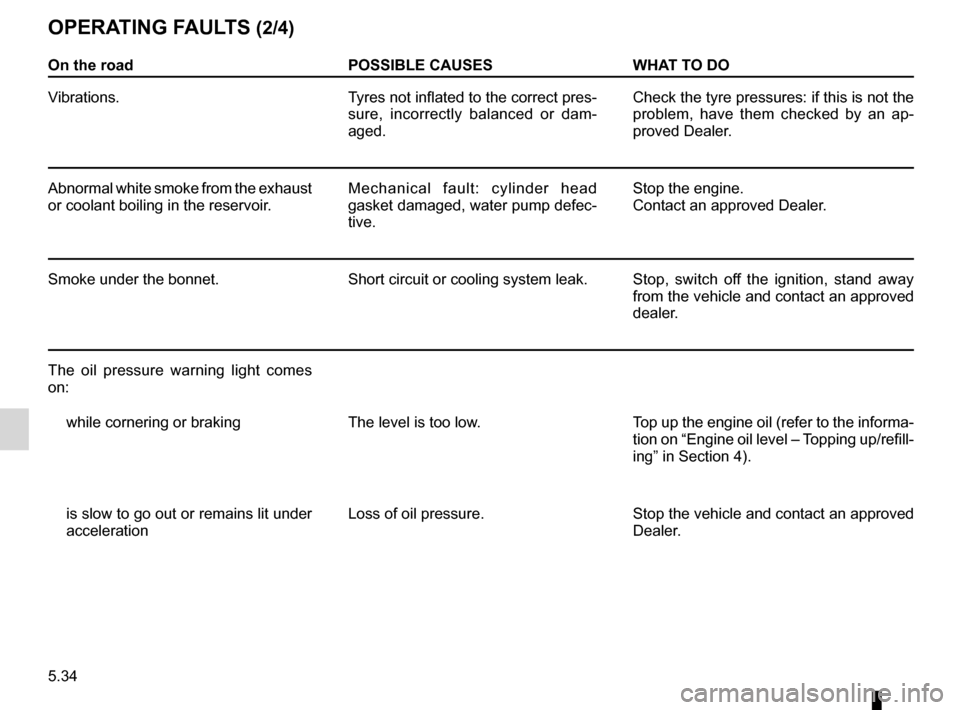
OPErA ting FAults (2/4)
On the road POssiBlE cAusEsWhAt tO DO
Vibrations. Tyres not inflated to the correct pres-
sure, incorrectly balanced or dam-
aged.Check the tyre pressures: if this is not the
problem, have them checked by an ap-
proved Dealer.
Abnormal white smoke from the exhaust
or coolant boiling in the reservoir. Mechanical fault: cylinder head
gasket damaged, water pump defec-
tive.Stop the engine.
Contact an approved Dealer.
Smoke under the bonnet. Short circuit or cooling system leak. Stop, switch off the ignition, stand away
from the vehicle and contact an approved
dealer.
The oil pressure warning light comes
on: while cornering or braking The level is too low. Top up the engine oil (refer to the informa-
tion on “Engine oil level – Topping up/refill-
ing” in Section 4).
is slow to go out or remains lit under
acceleration Loss of oil pressure.
Stop the vehicle and contact an approved
Dealer.
Page 147 of 173
JauneNoirNoir texte
5.35
ENG_UD7332_1
Anomalies de fonctionnement (X76 - Renault)
ENG_NU_854-2_X76LL_Renault_5
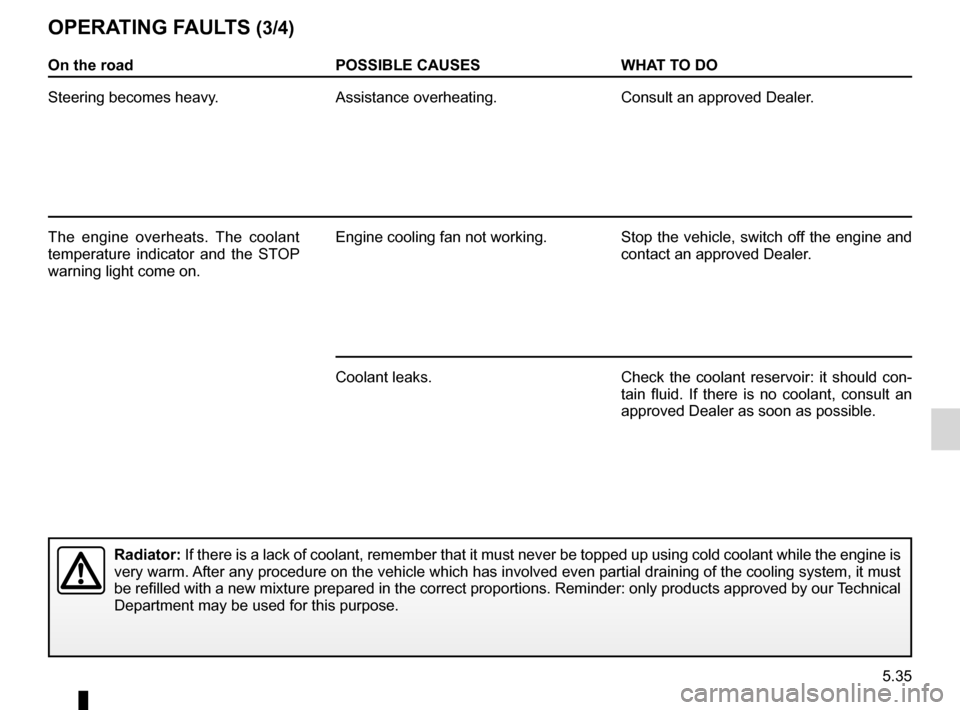
OPErA ting FAults (3/4)
On the road POssiBlE cAusEsWhAt tO DO
Steering becomes heavy. Assistance overheating.Consult an approved Dealer.
The engine overheats. The coolant
temperature indicator and the STOP
warning light come on. Engine cooling fan not working. Stop the vehicle, switch off the engine and
contact an approved Dealer.
Coolant leaks. Check the coolant reservoir: it should con-
tain fluid. If there is no coolant, consult an
approved Dealer as soon as possible.
radiator: If there is a lack of coolant, remember that it must never be topped up using cold coolant while the engine is
very warm. After any procedure on the vehicle which has involved even partial draining of the cooling system, it must
be refilled with a new mixture prepared in the correct proportions. Reminder: only products approved by our Technical
Department may be used for this purpose.
Page 170 of 173
7.2
FRA_UD14024_2
Index (X76 - Renault)
ENG_NU_854-2_X76LL_Renault_7
Jaune NoirNoir texte
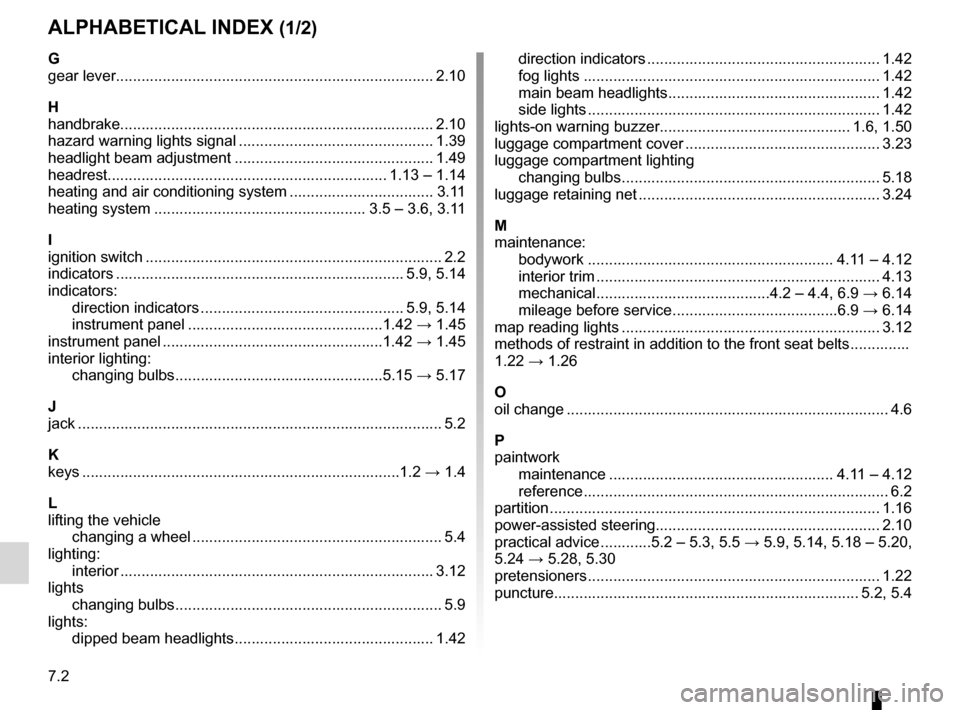
direction indicators ....................................................... 1.42
fog lights ...................................................................... 1.42
main beam headlights .................................................. 1.42
side lights ..................................................................... 1.42
lights-on warning buzzer............................................. 1.6,
1.50
luggage compartment cover .............................................. 3.23
luggage compartment lighting changing bulbs ............................................................. 5.18
luggage retaining net ......................................................... 3.24
M
maintenance: bodywork .......................................................... 4.1
1 – 4.12
interior trim ................................................................... 4.13
mechanical ......................................... 4.2 – 4.4,
6.9 → 6.14
mileage before service ....................................... 6.9 → 6.14
map reading lights ............................................................. 3.12
methods of restraint in addition to the front seat belts ..............
1.22 → 1.26
O
oil change ........................................................................\
.... 4.6
p
paintwork maintenance ..................................................... 4.1
1 – 4.12
reference ........................................................................\
6.2
partition ........................................................................\
...... 1.16
power-assisted steering..................................................... 2.10
practical advice ............ 5.2 – 5.3,
5.5 → 5.9, 5.14, 5.18 – 5.20,
5.24 → 5.28, 5.30
pretensioners ..................................................................... 1.22
puncture........................................................................\
5.2,
5.4
G
gear lever........................................................................\
... 2.10
h
handbrake........................................................................\
.. 2.10
hazard warning lights signal
.............................................. 1.39
headlight beam adjustment ............................................... 1.49
headrest.................................................................. 1.13
– 1.14
heating and air conditioning system .................................. 3.11
heating system .................................................. 3.5 – 3.6,
3.11
i
ignition switch ...................................................................... 2.2
indicators .................................................................... 5.9,
5.14
indicators: direction indicators ................................................ 5.9,
5.14
instrument panel .............................................. 1.42 → 1.45
instrument panel .................................................... 1.42 → 1.45
interior lighting: changing bulbs ................................................. 5.15 → 5.17
J
jack ........................................................................\
.............. 5.2
K
keys ........................................................................\
... 1.2 → 1.4
l
lifting the vehicle changing a wheel ........................................................... 5.4
lighting: interior ........................................................................\
.. 3.12
lights changing bulbs ............................................................... 5.9
lights: dipped beam headlights ............................................... 1.42
AlphABEtiCAl inDEx (1/2)