Page 13 of 256
1.7
AUTOMATIC LOCKING WHEN DRIVING
Operating principle
After the vehicle is started, the system
automatically locks the doors once your
speed reaches approximately 5 mph
(7 km/h).
Activating/deactivating the
function
To activate: with the vehicle at a
standstill and the engine running, press
the switch 1 until a beep sounds.
To deactivate: with the vehicle at a
standstill and the engine running, press
the switch 1 until a beep sounds.
If you decide to keep the
doors locked when you
are driving, remember that
it may be more difficult for
those assisting you to gain access
to the passenger compartment in
the event of an emergency.
Operating faults
If you notice an operating fault (auto-
matic locking impossible), first check
that all doors are correctly locked. If
they are correctly locked and the fault
is still present, contact an approved
Dealer.
Also make sure that locking has not
been inadvertently deactivated.
If this is the case, reactivate it.
1
Page 15 of 256

1.9
OPENING AND CLOSING THE DOORS (2/2)
Driver’s responsibility
when parking or stopping
the vehicle
Never leave an animal,
child or adult who is not self-suffi-
cient alone on your vehicle, even for
a short time.
They may pose a risk to themselves
or to others by starting the engine,
activating equipment such as the
electric windows or by locking the
doors.
Also, in hot and/or sunny weather,
please remember that the tempera-
ture inside the passenger compart-
ment increases very quickly.
RISK OF DEATH OR SERIOUS
INJURY.Lights-on reminder buzzer
If you have left the lights on after switch-
ing off the ignition, a warning buzzer will
sound when a front door is opened (to
prevent the battery from discharging,
etc.).
Door/tailgate open buzzer
Depending on the vehicle, this alarm is
fitted to the driver’s side door or on all
opening elements.
With the vehicle at a standstill, a warn-
ing light
2 will come on if a door or the
boot is open or not properly closed.
While driving, as soon as the vehicle
reaches 12 mph (20 km/h), a warning
light
2 comes on with an audio beep.
Special note
Depending on the vehicle, accessories
(e.g. radio) stop working either when
the engine is switched off or when the
driver’s door is opened or when the
doors are locked.
Page 19 of 256

1.13
SEAT BELTS (1/4)
Always wear your seat belt when trav-
elling in your vehicle. You must also
comply with the legislation of the par-
ticular country you are in.
Incorrectly adjusted or
twisted seat belts may
cause injuries in the event
of an accident.
The seatbelt is for the use of one
person only, whether adult or child.
Even pregnant women should wear
a seat belt. In this case, ensure that
the lap belt is not exerting too much
pressure on the abdomen, but do
not allow any slack.
Before starting, adjust your driving
position and then have each occu-
pant adjust their seat belt to ensure
optimum protection.
Adjusting your driving position
(depending on the vehicle)
– Sit well back in your seat (having
removed your coat or jacket etc.).
This is essential to ensure your back
is positioned correctly;
– adjust the distance between the
seat and the pedals. Your seat
should be as far back as possible
while still allowing you to depress
the clutch pedal fully. The seatback
should be adjusted so that your arms
are slightly bent when you hold the
steering wheel;
– adjust the position of your head- rest. For the maximum safety, your
head must be as close as possible to
the headrest;
– adjust the height of the seat. This
adjustment allows you to select the
seat position which offers you the
best possible view;
– adjust the position of the steering
wheel.
Adjusting the seat belts
Sit with your back firmly against the
seatback.
Shoulder strap 1 should be as close as
possible to the base of the neck but not
on it.
Lap belt 2 must be worn flat over the
thighs and against the pelvis. The seat
belt must be worn as close to the body
as possible. i.e.: avoid wearing heavy
clothing or keeping bulky objects under
the belts, etc.
1
2
Make sure that the rear bench seat
is locked in position correctly so that
the rear seat belts will operate effi-
ciently. Refer to the information on
the “Rear bench seat: functions” in
Section 3.
Page 25 of 256

1.19
METHODS OF RESTRAINT IN ADDITION TO THE FRONT SEAT BELTS (3/3)
Warnings concerning the driver’s air bag
– Do not modify the steering wheel or the steering wheel boss.
– Do not cover the steering wheel boss under any circumstances.
– Do not attach any objects (badge, logo, clock, telephone holder, etc.) to the steering wheel boss.
– You must not remove the steering wheel (such work must only be performed\
by trained personnel from our Network).
– When driving, do not sit too close to the steering wheel. Sit with your \
arms slightly bent (see the information on “Adjusting
your driving position” in Section 1). This will allow sufficient space for the air bag to inflate properly and be fully effective.
Warnings concerning the passenger air bag
– Do not attach or glue any objects (badge, logo, clock, telephone holder\
, etc.) to the dashboard in the proximity of the air b ag
housing.
– Do not place anything between the dashboard and the passenger (pet, umb\
rella, walking stick, parcels, etc.).
– The passenger must not put his or her feet on the dashboard or seat as t\
here is a risk that serious injuries may occur. In general, all parts of the body should be kept away from the dashboard (\
knees, hands, head etc.).
– You should reactivate the passenger air bag as soon as you remove the chi\
ld seat to ensure the protection of the front pas- senger in the event of an impact.
A REAR-FACING CHILD SEAT MUST NOT BE FITTED TO THE FRONT PASSENGER SEAT UNLESS THE RESTRAINT SYSTEMS IN ADDITION TO THE SEAT BELT, I.E. AIR BAG, ARE DEACTIVATED.
(refer to the information on “Child safety: deactivating/activating \
the front passenger air bag” in Section 1)
All of the warnings below are given so that the air bag is not obstructe\
d in any way when it is deployed and also to pre-
vent the risk of serious injuries caused by items which may be dislodged\
when the air bag deploys.
Page 31 of 256
1.25
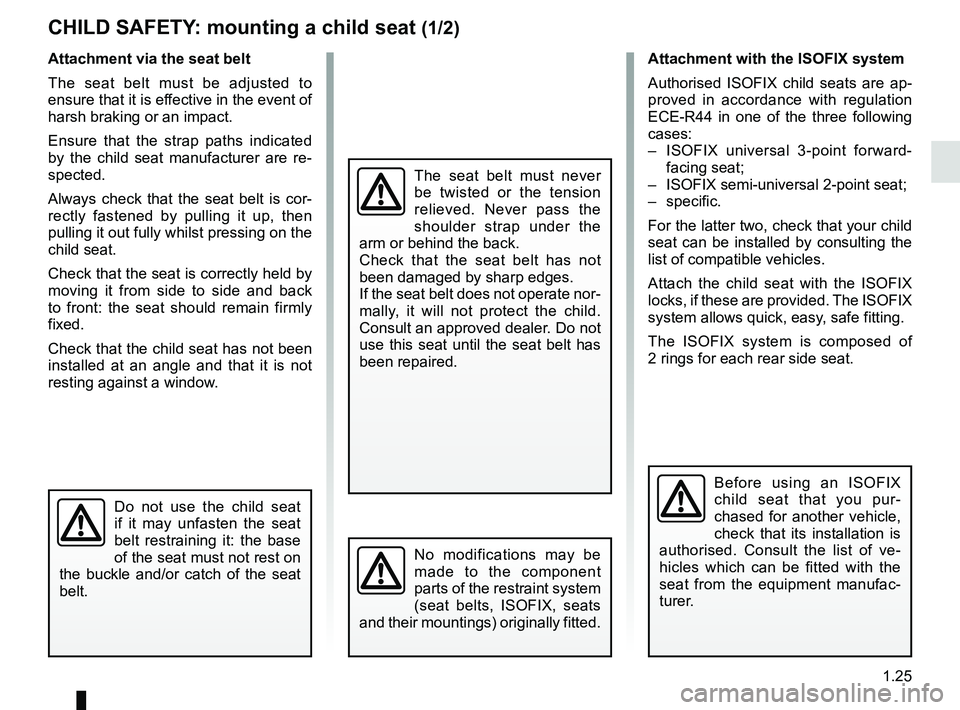
CHILD SAFETY: mounting a child seat (1/2)
Attachment via the seat belt
The seat belt must be adjusted to
ensure that it is effective in the event of
harsh braking or an impact.
Ensure that the strap paths indicated
by the child seat manufacturer are re-
spected.
Always check that the seat belt is cor-
rectly fastened by pulling it up, then
pulling it out fully whilst pressing on the
child seat.
Check that the seat is correctly held by
moving it from side to side and back
to front: the seat should remain firmly
fixed.
Check that the child seat has not been
installed at an angle and that it is not
resting against a window.Attachment with the ISOFIX system
Authorised ISOFIX child seats are ap-
proved in accordance with regulation
ECE-R44 in one of the three following
cases:
– ISOFIX universal 3-point forward-
facing seat;
– ISOFIX semi-universal 2-point seat;
– specific.
For the latter two, check that your child
seat can be installed by consulting the
list of compatible vehicles.
Attach the child seat with the ISOFIX
locks, if these are provided. The ISOFIX
system allows quick, easy, safe fitting.
The ISOFIX system is composed of
2 rings for each rear side seat.
Before using an ISOFIX
child seat that you pur-
chased for another vehicle,
check that its installation is
authorised. Consult the list of ve-
hicles which can be fitted with the
seat from the equipment manufac-
turer.
No modifications may be
made to the component
parts of the restraint system
(seat belts, ISOFIX, seats
and their mountings) originally fitted.
The seat belt must never
be twisted or the tension
relieved. Never pass the
shoulder strap under the
arm or behind the back.
Check that the seat belt has not
been damaged by sharp edges.
If the seat belt does not operate nor-
mally, it will not protect the child.
Consult an approved dealer. Do not
use this seat until the seat belt has
been repaired.
Do not use the child seat
if it may unfasten the seat
belt restraining it: the base
of the seat must not rest on
the buckle and/or catch of the seat
belt.
Page 42 of 256

1.36
REAR VIEW MIRRORS
Door mirrors with electrical
adjustment:
With the ignition on, move button 1:
– position A to adjust the left-hand
door mirror;
– position B to adjust the right-hand
door mirror;
0 is the neutral centre position.
Heated door mirrors
With the engine running, de-icing is per-
formed when the rear screen is de-iced/
demisted; refer to the information in the
paragraph on “Heated rear screen”.
Interior rear view mirror
The interior rear-view mirror is adjusta-
ble. When driving at night, tilt lever 3 to
avoid being dazzled by the headlights
of the vehicle behind.
Door mirrors with manual
adjustment
To adjust the door mirror, move
switch 2.
Folding door mirrors
Fold the door mirror manually against
the door window.
For safety reasons, carry
out any adjustments when
the vehicle is not being
driven.
0
B
A
13
2
Objects observed in the
door mirror glass are actu-
ally closer than they appear.
For your safety, take this
into account in order to correctly
assess the distance before any ma-
noeuvre.
Page 45 of 256
1.39
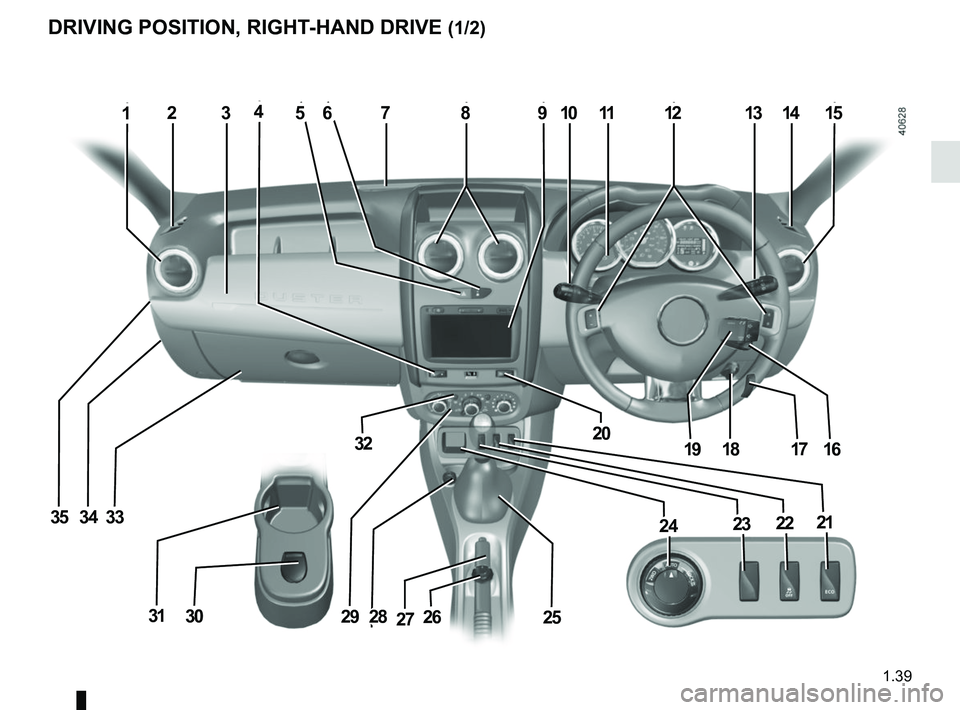
DRIVING POSITION, RIGHT-HAND DRIVE (1/2)
12379101115
34
813
33
19161718
56414
35
12
2122
20
2324
28262730312925
32
Page 46 of 256

1.40
DRIVING POSITION, RIGHT-HAND DRIVE (2/2)
The presence of the equipment DEPENDS ON THE VEHICLE VERSION AND COUNTRY.
1 Side air vent.
2 Side demister outlet.
3 Location for passenger airbag or storage compartment.
4 Activation/deactivation control for the
parking distance control.
5 Hazard warning lights switch.
6 Electric central locking switch.
7 Central demister outlet.
8 Centre air vents.
9 Location for radio, navigation system or storage compartments.
10 Stalk for: – direction indicator lights,
– exterior lights,
– front fog lights,
– rear fog light,
– horn. 11
Instrument panel.
12 Cruise control/speed limiter controls.
13 – Steering column stalk for wind-
screen and rear screen wash/
wiper.
– On-board computer information
readout control.
14 Side demister outlet.
15 Side air vent.
16 Ignition switch.
17 Bonnet release control.
18 Beam height adjustment control.
19 Radio remote control.
20 Cruise control/speed limiter main
control.
21 ECO mode switch.
22ESC control.
23 Not used.
24 4x2 ( 2WD), 4x4 (4WD) mode selec-
tor or storage compartment.
25 Gearstick.
26 Door mirror adjustment control.
27 Handbrake.
28 Cigarette lighter or accessories
socket.
29 Heating and ventilation controls.
30 Accessories socket.
31 Bottle holder
32 Rear screen and door mirror de-icing control
33 Glove compartment
34 Fuse box.
35 Passenger airbag activation/deacti-
vation switch.