Page 62 of 145

Cooling System Tips — Automated Manual
Transmission
To reduce potential for engine and transmission over-
heating in high ambient temperature conditions, take the
following actions:
•City Driving
— When stopped, shift the transmis-
sion into NEUTRAL and increase engine idle
speed.
• Highway Driving— Reduce your speed.
•Up Steep Hills— Select a lower transmission gear.
•Air Conditioning— Turn it off temporarily. Do Not Operate The Engine With Low Oil
Pressure
If the low oil pressure warning light turns on while
driving, stop the vehicle and shut down the engine as
soon as possible. A chime will sound when the light turns
on.
NOTE:
Do not operate the vehicle until the cause is
corrected. This light does not show how much oil is in the
engine. The engine oil level must be checked under the
hood.
CAUTION!
If oil pressure falls to less than normal readings, shut
the engine off immediately. Failure to do so could
result in immediate and severe engine damage.
60 STARTING AND OPERATING
Page 79 of 145

For most year-round service, No. 2 diesel fuel meeting
ASTM (formerly known as the American Society for
Testing and Materials) specification D-975 Grade S15 will
provide good performance.
If the vehicle is exposed to extreme cold (below 20°F or
-7°C), or is required to operate at colder-than-normal
conditions for prolonged periods, use climatized No. 2
diesel fuel or dilute the No. 2 diesel fuel with 50% No. 1
diesel fuel. This will provide better protection from fuel
gelling or wax-plugging of the fuel filter.
WARNING!
Do not use alcohol or gasoline as a fuel blending
agent. They can be unstable under certain conditions
and hazardous or explosive when mixed with diesel
fuel.Diesel fuel is seldom completely free of water. If water is
detected in the water separator while the engine is
running or while the ignition switch is in the ON/RUN
position, the “Generic Warning Light” will illuminate
and the specific message, “Service Fuel Filter” will ap-
pear in the Electronic Vehicle Information Center (EVIC).
If this occurs you should stop the engine and drain the
water from the filter housing.
NOTE:
Please see your authorized dealer for draining the
fuel/water separator and fuel filter replacement.
Purchasing good quality fuel and by following the cold
weather advice above, fuel conditioners should not be
required in your vehicle.
NOTE: If available in your area, a high cetane “pre-
mium” diesel fuel may offer improved cold-starting and
warm-up performance.
5
STARTING AND OPERATING 77
Page 80 of 145
CAUTION!
If the “Generic Warning Light” remains on and a
“Service Fuel Filter” message displays, DO NOT
START engine before you drain the water from the
fuel filter housing to avoid engine damage. Please
see your authorized dealer for draining the fuel
filter/water separator and fuel filter replacement.
Fuel Specifications
This diesel engine has been developed to take advantage
of the high energy content and generally lower cost No.
2 Ultra Low Sulfur diesel fuel or No. 2 Ultra Low Sulfur
climatized diesel fuels.NOTE:
•
If you accidentally fill the fuel tank with gasoline on
your diesel vehicle, do not start the engine. Damage to
the engine and fuel system could occur. Please call
your authorized dealer for service.
• A maximum blend of 5% biodiesel meeting ASTM
specification D-975 may be used with your diesel
engine without any adjustments to regular service
schedules.
• Commercially available fuel additives are not neces-
sary for the proper operation of your diesel engine.
• No. 1 Ultra Low Sulfur diesel fuel should only be used
where extended arctic conditions (-10°F or -23°C) exist.
78 STARTING AND OPERATING
Page 93 of 145
WARNING!(Continued)
•Weight Distributing Systems may not be compat-
ible with Surge Brake Couplers. Consult with your
hitch and trailer manufacturer or a reputable Rec-
reational Vehicle dealer for additional information.
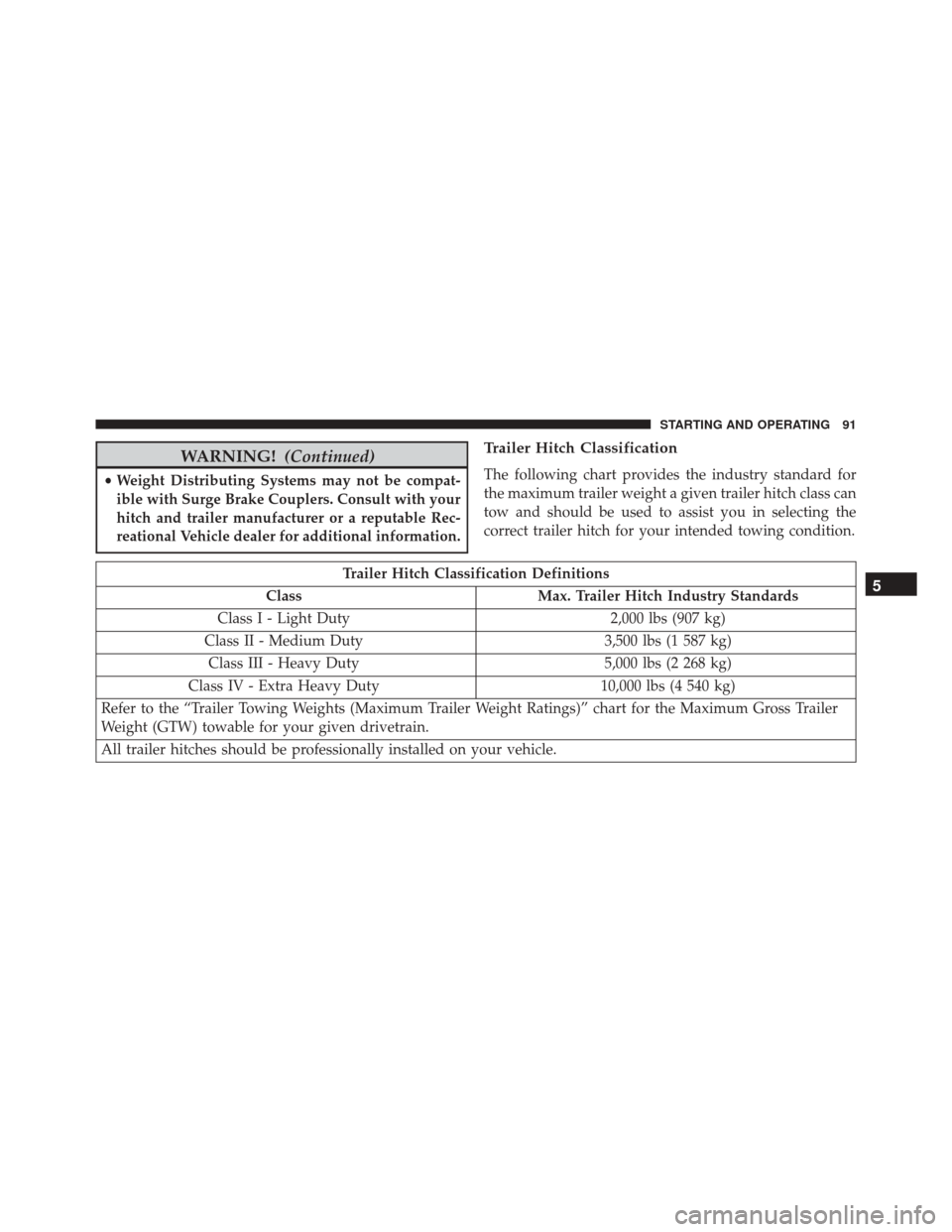
Trailer Hitch Classification
The following chart provides the industry standard for
the maximum trailer weight a given trailer hitch class can
tow and should be used to assist you in selecting the
correct trailer hitch for your intended towing condition.
Trailer Hitch Classification Definitions
Class Max. Trailer Hitch Industry Standards
Class I - Light Duty 2,000 lbs (907 kg)
Class II - Medium Duty 3,500 lbs (1 587 kg)
Class III - Heavy Duty 5,000 lbs (2 268 kg)
Class IV - Extra Heavy Duty 10,000 lbs (4 540 kg)
Refer to the “Trailer Towing Weights (Maximum Trailer Weight Ratings)” chart for the Maximum Gross Trailer
Weight (GTW) towable for your given drivetrain.
All trailer hitches should be professionally installed on your vehicle.5
STARTING AND OPERATING 91
Page 98 of 145
WARNING!
•Do not connect trailer brakes to your vehicle’s
hydraulic brake lines. It can overload your brake
system and cause it to fail. You might not have
brakes when you need them and could have a
collision.
• Towing any trailer will increase your stopping
distance. When towing you should allow for addi-
tional space between your vehicle and the vehicle
in front of you. Failure to do so could result in a
collision.
CAUTION!
If the trailer weighs more than 1,000 lbs (454 kg)
loaded, it should have its own brakes and they
should be of adequate capacity. Failure to do this
could lead to accelerated brake lining wear, higher
brake pedal effort, and longer stopping distances.
Towing Requirements — Trailer Lights And Wiring
Whenever you pull a trailer, regardless of the trailer size,
stoplights and turn signals on the trailer are required for
motoring safety.
The Trailer Tow Package may include a four- and seven-
pin wiring harness. Use a factory approved trailer har-
ness and connector.
96 STARTING AND OPERATING
Page 109 of 145
WARNING!
The air induction system (air cleaner, hoses, etc.)
provides a measure of protection. Do not remove the
air induction system (air cleaner, hoses, etc.) unless
such removal is necessary for repair or maintenance.
Make sure that no one is near the engine compart-
ment before starting the vehicle with the air induc-
tion system (air cleaner, hoses, etc.) removed. Failure
to do so can result in serious personal injury.
CAUTION!
Many aftermarket performance air filter elements do
not adequately filter the air entering the engine. Use
of such filters can severely damage your engine.
Engine Air Cleaner Filter Selection
The quality of replacement engine air cleaner filters
varies considerably. Only high quality filters should be
used to assure most efficient service. MOPAR engine air
cleaner filters are a high quality filter and are recom-
mended.
Draining Fuel Filter/Water Separator
If water is detected in the water separator while the
engine is running or while the ignition switch is in the
ON/RUN position, the “Generic Warning Light” will
illuminate and the specific message, “Service Fuel Filter”
will appear in the EVIC. At this point you should stop the
engine and drain the water from the filter housing.
Please see your authorized dealer for draining the
fuel/water separator and fuel filter replacement.6
MAINTAINING YOUR VEHICLE 107
Page 110 of 145

NOTE:If the�Generic Warning Light� comes on, a
Service Fuel Filter message displays and a single chime is
heard with the ignition in the ON/RUN position or while
driving, there may there may be a problem with your
water separator wiring or sensor.
Please see your authorized dealer for service.
CAUTION!
If the “Generic Warning Lamp” remains on and a
Service Fuel Filter message displays, DO NOT
START engine before you drain the water from the
fuel filter to avoid engine damage.
Fuel Filter Replacement
Please see your authorized dealer for fuel filter replace-
ment.
Priming If The Engine Has Run Out Of Fuel
WARNING!
• Do not open the high pressure fuel system with the
engine running. Engine operation causes high fuel
pressure. High pressure fuel spray can cause seri-
ous injury or death.
• Do not drain the fuel filter/water separator when
the engine is running. Fuel and fuel vapors may
escape causing as fire that can result in serious
injury or death.
1. Add a substantial amount of fuel to the tank, approxi- mately 2 to 5 gal (8L to 19L).
2. Turn the ignition to the ON/RUN position. This will activate the in-tank fuel pump for approximately 30
seconds. Repeat this process twice.
108 MAINTAINING YOUR VEHICLE
Page 119 of 145
Brake System
Brake Master Cylinder — Brake Fluid Level Check
The fluid level of the master cylinder should be checked
when performing under the hood service, or immedi-
ately if the “Brake System Warning Light” indicates
system failure.
The brake master cylinder has a translucent plastic
reservoir. On the outboard side of the reservoir, there is a
“MAX” mark and a “MIN” mark. The fluid level must be
kept within these two marks. Do not add fluid above the
full mark because leakage may occur at the cap.
With disc brakes, the fluid level can be expected to fall as
the brake linings wear. However, an unexpected drop in
fluid level may be caused by a leak and a system check
should be conducted.Refer to “Fluids, Lubricants, And Genuine Parts” in
“Maintaining Your Vehicle” for further information.WARNING!
•
Use only manufacturer’s recommended brake
fluid. Refer to “Fluids, Lubricants, and Genuine
Parts” in “Maintaining Your Vehicle” for further
information. Using the wrong type of brake fluid
can severely damage your brake system and/or
impair its performance. The proper type of brake
fluid for your vehicle is also identified on the
original factory installed hydraulic master cylinder
reservoir.
• To avoid contamination from foreign matter or
moisture, use only new brake fluid or fluid that has
been in a tightly closed container. Keep the master
cylinder reservoir cap secured at all times. Brake
(Continued)
6
MAINTAINING YOUR VEHICLE 117