Page 30 of 145
Oil Pressure Warning Light
Red TelltaleLight What It Means
Oil Pressure Warning Light
This light indicates low engine oil pressure. The light should turn on momentarily when the
engine is started; if the bulb does not come on, have the system checked by an authorized
dealer. If the light turns on while driving, stop the vehicle and shut off the engine as soon as
possible. A chime will sound when this light turns on.
Do not operate the vehicle until the cause is corrected. This light does not indicate how
much oil is in the engine. The engine oil level must be checked under the hood.
28 UNDERSTANDING YOUR INSTRUMENT PANEL
Page 31 of 145
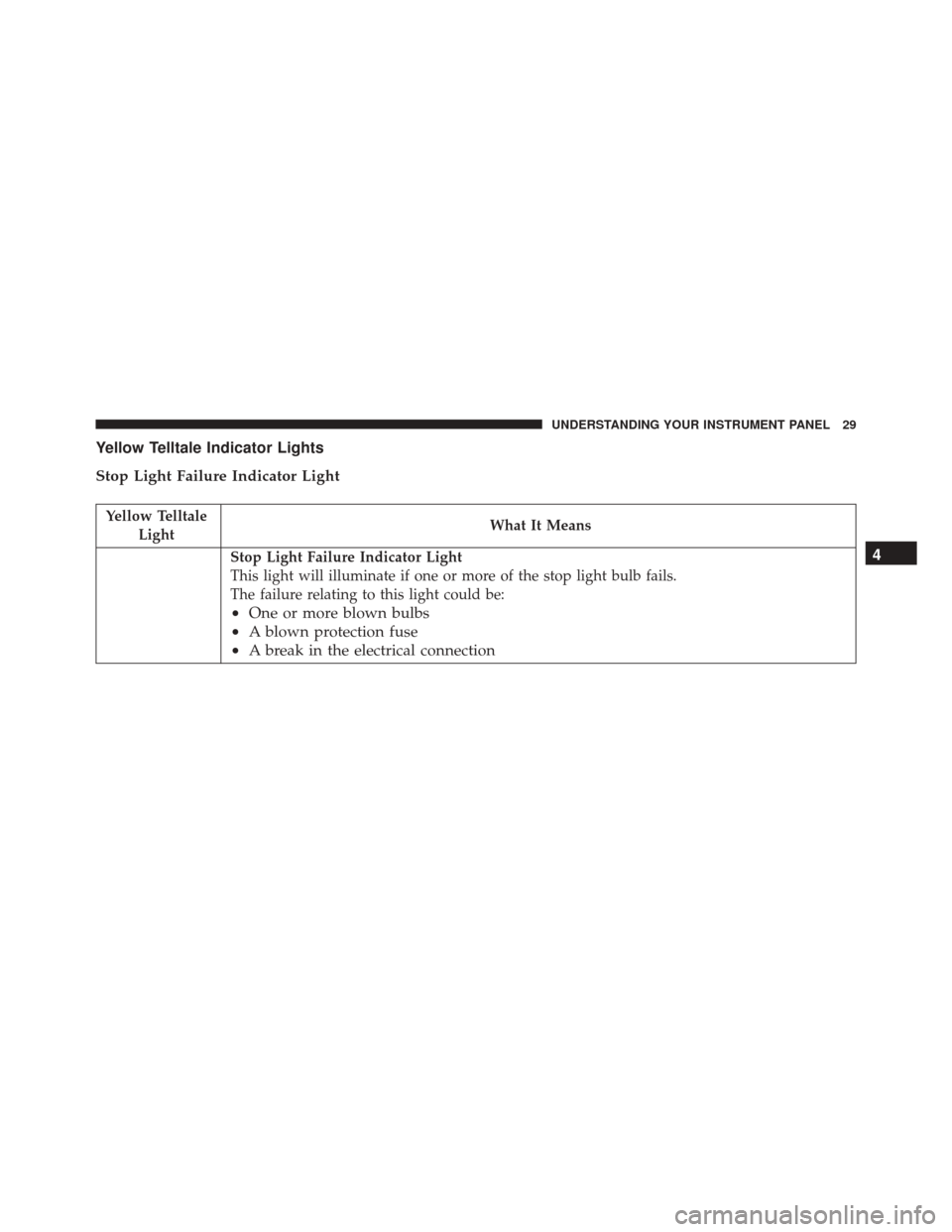
Yellow Telltale Indicator Lights
Stop Light Failure Indicator Light
Yellow TelltaleLight What It Means
Stop Light Failure Indicator Light
This light will illuminate if one or more of the stop light bulb fails.
The failure relating to this light could be:
•
One or more blown bulbs
• A blown protection fuse
• A break in the electrical connection 4
UNDERSTANDING YOUR INSTRUMENT PANEL 29
Page 32 of 145
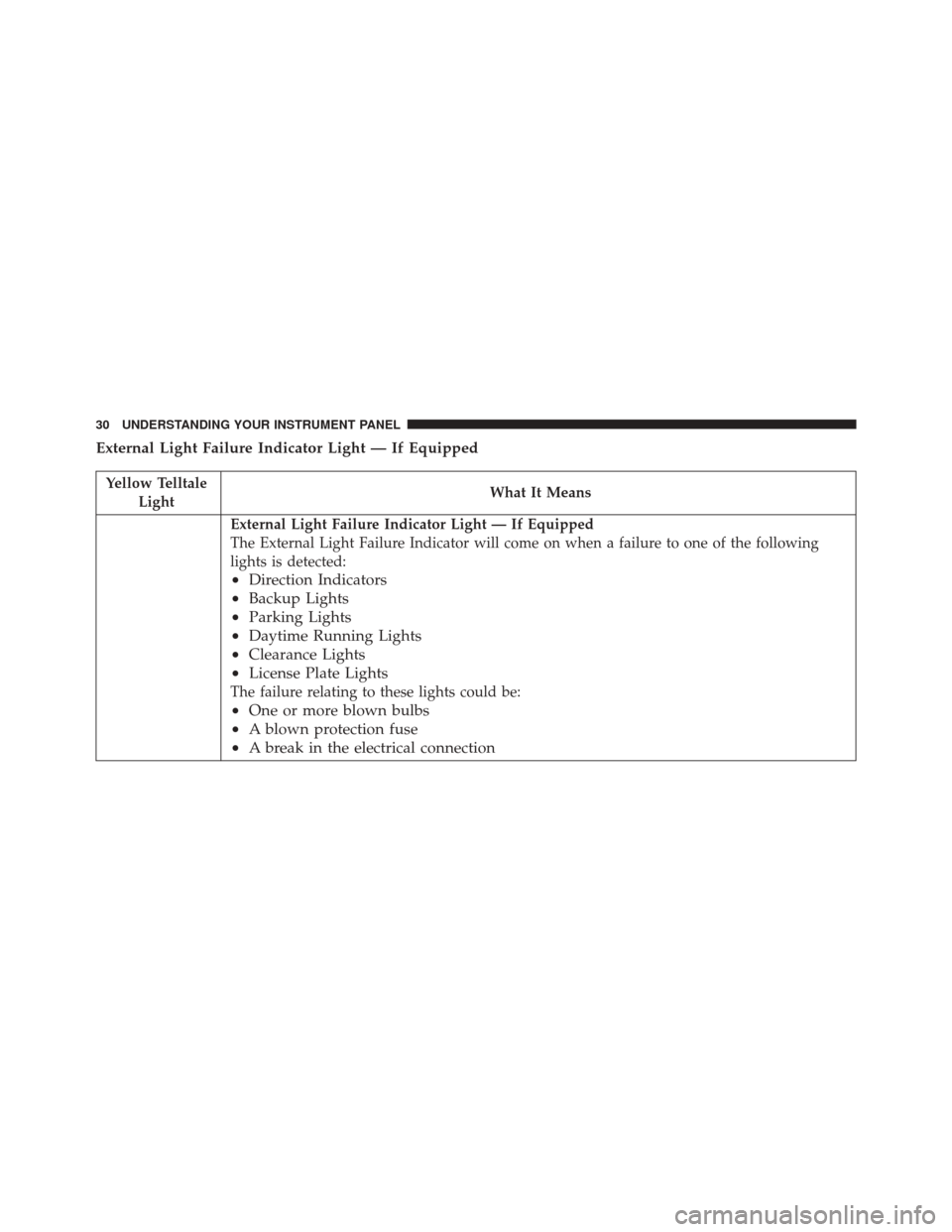
External Light Failure Indicator Light — If Equipped
Yellow TelltaleLight What It Means
External Light Failure Indicator Light — If Equipped
The External Light Failure Indicator will come on when a failure to one of the following
lights is detected:
•
Direction Indicators
• Backup Lights
• Parking Lights
• Daytime Running Lights
• Clearance Lights
• License Plate Lights
The failure relating to these lights could be:
•One or more blown bulbs
• A blown protection fuse
• A break in the electrical connection
30 UNDERSTANDING YOUR INSTRUMENT PANEL
Page 33 of 145
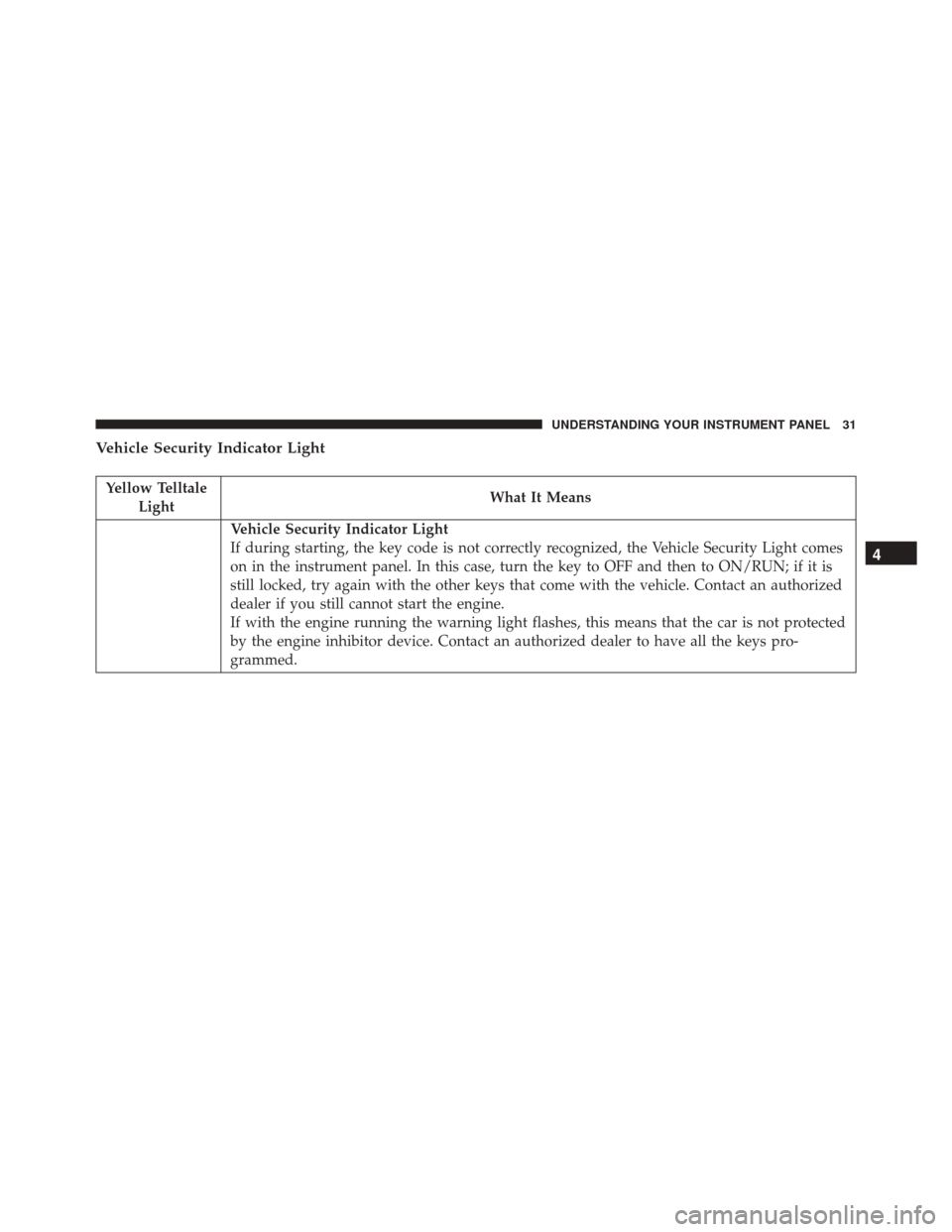
Vehicle Security Indicator Light
Yellow TelltaleLight What It Means
Vehicle Security Indicator Light
If during starting, the key code is not correctly recognized, the Vehicle Security Light comes
on in the instrument panel. In this case, turn the key to OFF and then to ON/RUN; if it is
still locked, try again with the other keys that come with the vehicle. Contact an authorized
dealer if you still cannot start the engine.
If with the engine running the warning light flashes, this means that the car is not protected
by the engine inhibitor device. Contact an authorized dealer to have all the keys pro-
grammed.
4
UNDERSTANDING YOUR INSTRUMENT PANEL 31
Page 34 of 145

Tire Pressure Monitoring Indicator Light
Yellow Telltale LightWhat It Means
Tire Pressure Monitoring Indicator Light
TPMS Failure
The warning light switches on when a failure is detected in the TPMS. In this case, contact
a authorized dealership as soon as possible. Should one or more wheels be fitted without
sensors, the display will show a warning message until initial conditions are restored.
IMPORTANT:Do not continue driving with one or more flat tires as handling may be
compromised. Stop the vehicle, avoiding sharp braking and steering. Repair immediately
using the dedicated tire repair kit and contact your authorized dealership as soon as pos-
sible.
Tire Pressure Low
The warning light switches on and a message is displayed to indicate that the tire pressure
is lower than the recommended value and/or that slow pressure loss is occurring. In these
cases, optimal tire duration and fuel consumption may not be guaranteed.
Should two or more tires be in the condition mentioned above, the display will show the
indications corresponding to each tire in sequence.
In any situation in which the message on the display is �See manual�, it is ESSENTIAL to
refer to the contents of the �Wheels�paragraph in the �Technical data�chapter, strictly com-
plying with the indications that you find there.
32 UNDERSTANDING YOUR INSTRUMENT PANEL
Page 35 of 145

Each tire, including the spare (if provided), should be
checked monthly when cold and inflated to the inflation
pressure recommended by the vehicle manufacturer on
the vehicle placard or tire inflation pressure label. If your
vehicle has tires of a different size than the size indicated
on the vehicle placard or tire inflation pressure label, you
should determine the proper tire inflation pressure for
those tires.
As an added safety feature, your vehicle has been
equipped with a Tire Pressure Monitoring System
(TPMS) that illuminates a low tire pressure telltale when
one or more of your tires is significantly under-inflated.
Accordingly, when the low tire pressure telltale illumi-
nates, you should stop and check your tires as soon as
possible and inflate them to the proper pressure. Driving
on a significantly under-inflated tire causes the tire tooverheat and can lead to tire failure. Under-inflation also
reduces fuel efficiency and tire tread life, and may affect
the vehicle’s handling and stopping ability.
Please note that the TPMS is not a substitute for proper
tire maintenance, and it is the driver ’s responsibility to
maintain correct tire pressure, even if under-inflation has
not reached the level to trigger illumination of the TPMS
low tire pressure telltale.
Your vehicle has also been equipped with a TPMS
malfunction indicator to indicate when the system is not
operating properly. The TPMS malfunction indicator is
combined with the low tire pressure telltale. When the
system detects a malfunction, the telltale will flash for
approximately one minute and then remain continuously
illuminated. This sequence will continue upon subse-
quent vehicle start-ups as long as the malfunction exists.
When the malfunction indicator is illuminated, the sys-
tem may not be able to detect or signal low tire pressure
4
UNDERSTANDING YOUR INSTRUMENT PANEL 33
Page 36 of 145

as intended. TPMS malfunctions may occur for a variety
of reasons, including the installation of replacement or
alternate tires or wheels on the vehicle that prevent the
TPMS from functioning properly. Always check the
TPMS malfunction telltale after replacing one or more
tires or wheels on your vehicle, to ensure that the
replacement or alternate tires and wheels allow the TPMS
to continue to function properly.
CAUTION!
The TPMS has been optimized for the original
equipment tires and wheels. TPMS pressures and
warning have been established for the tire size
equipped on your vehicle. Undesirable system opera-
tion or sensor damage may result when using re-
placement equipment that is not of the same size,
type, and/or style. Aftermarket wheels can cause
(Continued)
CAUTION!(Continued)
sensor damage. Using aftermarket tire sealants may
cause the Tire Pressure Monitoring System (TPMS)
sensor to become inoperable. After using an after-
market tire sealant it is recommended that you take
your vehicle to an authorized dealership to have your
sensor function checked.
34 UNDERSTANDING YOUR INSTRUMENT PANEL
Page 37 of 145
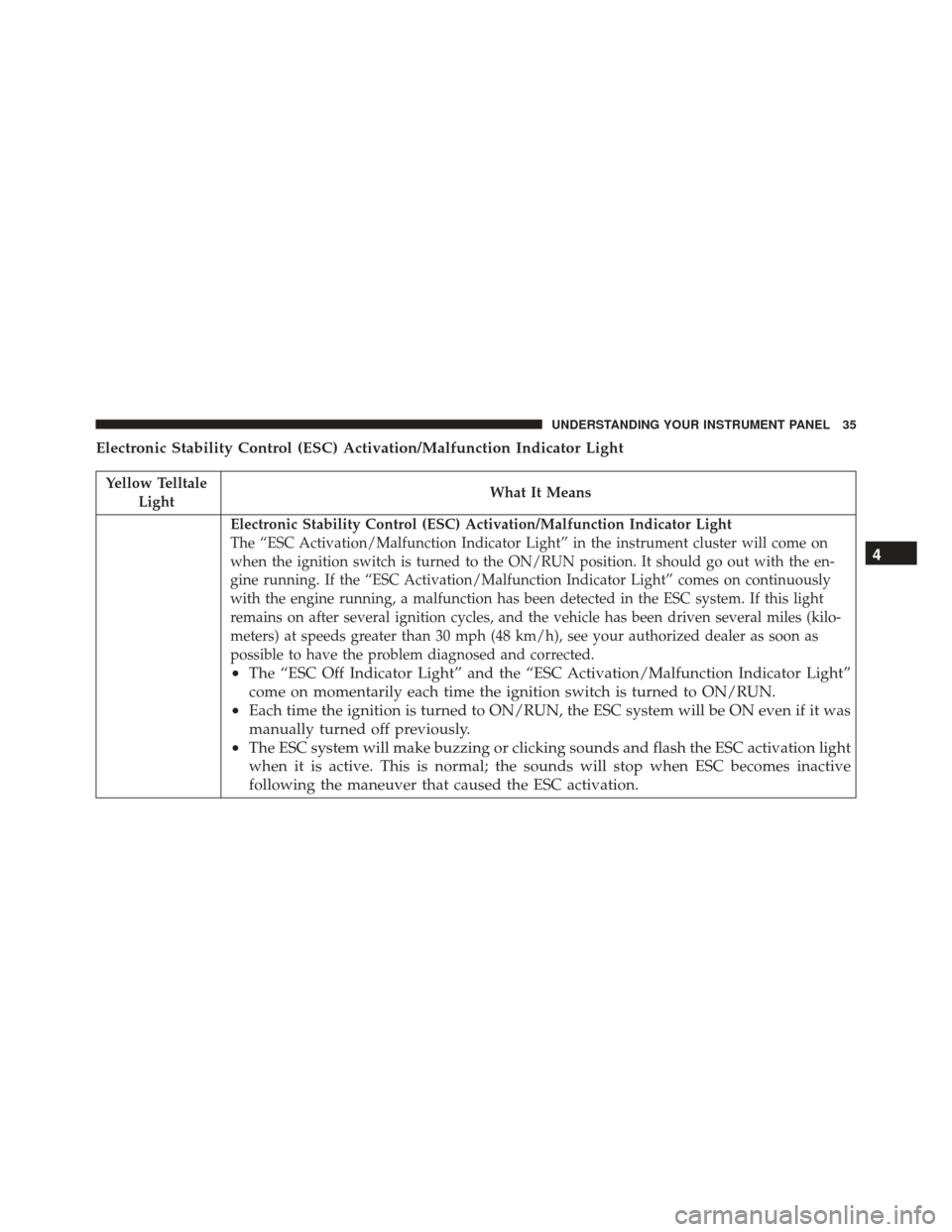
Electronic Stability Control (ESC) Activation/Malfunction Indicator Light
Yellow TelltaleLight What It Means
Electronic Stability Control (ESC) Activation/Malfunction Indicator Light
The “ESC Activation/Malfunction Indicator Light” in the instrument cluster will come on
when the ignition switch is turned to the ON/RUN position. It should go out with the en-
gine running. If the “ESC Activation/Malfunction Indicator Light” comes on continuously
with the engine running, a malfunction has been detected in the ESC system. If this light
remains on after several ignition cycles, and the vehicle has been driven several miles (kilo-
meters) at speeds greater than 30 mph (48 km/h), see your authorized dealer as soon as
possible to have the problem diagnosed and corrected.
•
The “ESC Off Indicator Light” and the “ESC Activation/Malfunction Indicator Light”
come on momentarily each time the ignition switch is turned to ON/RUN.
• Each time the ignition is turned to ON/RUN, the ESC system will be ON even if it was
manually turned off previously.
• The ESC system will make buzzing or clicking sounds and flash the ESC activation light
when it is active. This is normal; the sounds will stop when ESC becomes inactive
following the maneuver that caused the ESC activation. 4
UNDERSTANDING YOUR INSTRUMENT PANEL 35