Page 54 of 145
�ADDING FUEL .........................82
▫ Avoid Using Contaminated Fuel ............83
▫ Bulk Fuel Storage — Diesel Fuel ...........83
▫ Diesel Exhaust Fluid Storage ..............84
▫ Adding Diesel Exhaust Fluid ..............84�
DIESEL EXHAUST FLUID .................87
▫ System Overview ......................87
� TRAILER TOWING ......................88
▫ Common Towing Definitions ..............88
▫ Towing Tips ..........................98
52 STARTING AND OPERATING
Page 70 of 145

To operate in MANUAL (M) mode:
•Press and hold the brake pedal.
• Move the shift lever to the MANUAL (M) position.
The current gear will be displayed in the EVIC.
• To drive, release the brake pedal and press the accel-
erator pedal.
• Tap the shift lever towards the (+) to engage a higher
gear.
• Tap the shift lever towards the (–) position to engage a
lower gear.
• The accelerator pedal need not be released during gear
changes in MANUAL mode.
• You can shift between DRIVE (D) and MANUAL (M)
positions at any speed, without taking your foot off the
accelerator pedal. •
The system will shift down through the gears auto-
matically (to prevent engine lugging) during closed-
throttle decelerations.
• The transmission will automatically downshift to first
gear when coming to a stop. After a stop, the driver
should manually upshift (+) the transmission as the
vehicle is accelerated.
• You can start out, from a stop, in first or second gear.
Tap (+) (at a stop) to select second gear. Starting out in
second gear may be helpful in snowy or icy conditions.
• The system will ignore shift commands that would
cause engine lugging or overspeed. An audible beep
will sound and a �Shift not allowed� message will
display in the EVIC if an inappropriate gear is re-
quested.
NOTE: Avoid keeping your hand on the lever when you
are not requesting a gear shift.
68 STARTING AND OPERATING
Page 71 of 145
Warning Buzzers
To provide awareness, a warning buzzer sounds when
the vehicle is parked with the transmission in NEUTRAL
(N) (the warning sounds when the ignition is turned to
the off position).
The warning buzzer also sounds to indicate an inconsis-
tent shift lever position (i.e. when the shift lever position
does not match the actual transmission gear position).
This can occur, for example, if the driver moves the shift
lever to request a transmission gear that is not allowed
under the current operating conditions.
With the vehicle at a standstill, engine running and the
shift lever in DRIVE (D), REVERSE (R), or MANUAL
(M), the buzzer sounds and the transmission automati-
cally shifts to NEUTRAL (N) when:
•The accelerator and/or brake pedals are not operated
for at least three minutes. •
The brake pedal is pressed for longer than 10 minutes.
• The driver ’s door is opened and the accelerator and
brake are not operated for at least 1.5 seconds.
• The driver selected gear does not match the engaged
transmission gear.
• A fault has been detected in the transmission.
A Blinking Warning:
• The driver selected gear does not match the engaged
transmission gear, the gear information in the cluster
and on the bezel will blink.
When To Use TOW/HAUL Mode
When driving in hilly areas, towing a trailer, carrying a
heavy load, etc., and frequent transmission shifting oc-
curs, press the TOW/HAUL switch to activate TOW/
HAUL mode. This will improve performance and reduce
the potential for transmission overheating or failure due
5
STARTING AND OPERATING 69
Page 72 of 145
to excessive shifting. When operating in TOW/HAUL
mode, the transmission shift calibration is modified to
accommodate steep grades in the smoothest possible
manner. TOW/HAUL mode is only applicable in the
DRIVE (D) position.
Parking The Vehicle
WARNING!
You or others could be injured if you leave the
vehicle unattended without fully applying the park-
ing brake. The parking brake should always be
applied when the driver is not in the vehicle.
To ensure proper parking performance, it is essential to
engage MANUAL (1st) gear, DRIVE (D) or REVERSE (R)
gear while your foot is on the brake pedal. Once
MANUAL (1st) gear, DRIVE (D) or REVERSE (R) gear is
displayed in the EVIC, turn the engine off and engage the parking brake. It is essential to wait until the gear
engaged appears in the display before turning the engine
off and releasing the brake pedal. Always remember to
set your parking brake.
NOTE:
NEVER leave your vehicle with the gearbox in
NEUTRAL (N) without the parking brake engaged. Al-
ways remember to fully apply your parking brake.
Always remember to set the parking brake when the “Set
Park Brake” message is displayed.
General Warnings
• With the vehicle at a standstill and a gear engaged,
keep the brake pedal pressed until you decide to drive
away. Then release the brake and accelerate gradually.
• When parked for long periods with the engine run-
ning, it is advisable to place the transmission in
NEUTRAL (N) and apply the parking brake.
70 STARTING AND OPERATING
Page 78 of 145

Towing The Vehicle
•The manufacturer recommends towing your vehicle
with all four wheels OFFthe ground using a flatbed.
• Automated Manual transmission vehicles can also be
flat towed (all four wheels on the ground) with the
transmission in NEUTRAL. Ensure the transmission is
in NEUTRAL (N) (by checking that the vehicle moves
when pushed) and tow in the same way as a normal
vehicle with a manual transmission.
CAUTION!
• DO NOT flat tow any disabled vehicle if condition
is related to the clutch, transmission or driveline.
Additional damage to the drivetrain could result.
• Towing this vehicle in violation of the above re-
quirements can cause severe engine, transmission,
(Continued)
CAUTION! (Continued)
or drivetrain damage. Damage from improper tow-
ing is not covered under the New Vehicle Limited
Warranty.
If it is not possible to shift the transmission to NEUTRAL
(N), do not flat tow the vehicle and contact your autho-
rized dealer.
FUEL REQUIREMENTS
Use good quality diesel fuel from a reputable supplier in
your vehicle. Federal law requires that you must fuel this
vehicle with Ultra Low Sulfur Highway Diesel fuel (15
ppm Sulfur maximum) and prohibits the use of Low
Sulfur Highway Diesel fuel (500 ppm Sulfur maximum)
to avoid damage to the emissions control system.
76 STARTING AND OPERATING
Page 90 of 145

The DEF injection system and SCR catalyst enable the
achievement of diesel emissions requirements; while
maintaining outstanding fuel economy, drivability,
torque and power ratings.
Refer to “Electronic Vehicle Information Center (EVIC)”
in “Understanding Your Instrument Panel” for system
messages and warnings.
NOTE:
•Your vehicle is equipped with a DEF injection system.
You may occasionally hear an audible clicking noise
from under the vehicle at a stop. This is normal
operation.
• The DEF pump will run for a period of time after
engine shutdown to purge the DEF system. This is
normal operation and may be audible from under the
vehicle.TRAILER TOWING
In this section you will find safety tips and information
on limits to the type of towing you can reasonably do
with your vehicle. Before towing a trailer, carefully
review this information to tow your load as efficiently
and safely as possible.
To maintain the New Vehicle Limited Warranty coverage,
follow the requirements and recommendations in this
manual concerning vehicles used for trailer towing.
Common Towing Definitions
The following trailer towing related definitions will assist
you in understanding the following information:
Gross Vehicle Weight Rating (GVWR)
The GVWR is the total allowable weight of your vehicle.
This includes driver, passengers, cargo and tongue
weight. The total load must be limited so that you do not
88 STARTING AND OPERATING
Page 92 of 145

the trailer tongue that typically provides adjustable fric-
tion associated with the telescoping motion to dampen
any unwanted trailer swaying motions while traveling.
If equipped, the electronic Trailer Sway Control (TSC)
recognizes a swaying trailer and automatically applies
individual wheel brakes and/or reduces engine power to
attempt to eliminate the trailer sway.
Weight-Carrying Hitch
A weight-carrying hitch supports the trailer tongue weight,
just as if it were luggage located at a hitch ball or some other
connecting point of the vehicle. These kinds of hitches are
the most popular on the market today and they are com-
monly used to tow small and medium sized trailers.
Weight-Distributing Hitch
A weight-distributing system works by applying lever-
age through spring (load) bars. They are typically used
for heavier loads to distribute trailer tongue weight to thetow vehicle’s front axle and the trailer axle(s). When used
in accordance with the manufacturer’s directions, it pro-
vides for a more level ride, offering more consistent
steering and brake control thereby enhancing towing
safety. The addition of a friction/hydraulic sway control
also dampens sway caused by traffic and crosswinds and
contributes positively to tow vehicle and trailer stability.
Trailer sway control and a weight distributing (load
equalizing) hitch are recommended for heavier Tongue
Weights (TW) and may be required depending on vehicle
and trailer configuration/loading to comply with Gross
Axle Weight Rating (GAWR) requirements.
WARNING!
•
An improperly adjusted Weight Distributing Hitch
system may reduce handling, stability, braking
performance, and could result in a collision.
(Continued)
90 STARTING AND OPERATING
Page 93 of 145
WARNING!(Continued)
•Weight Distributing Systems may not be compat-
ible with Surge Brake Couplers. Consult with your
hitch and trailer manufacturer or a reputable Rec-
reational Vehicle dealer for additional information.
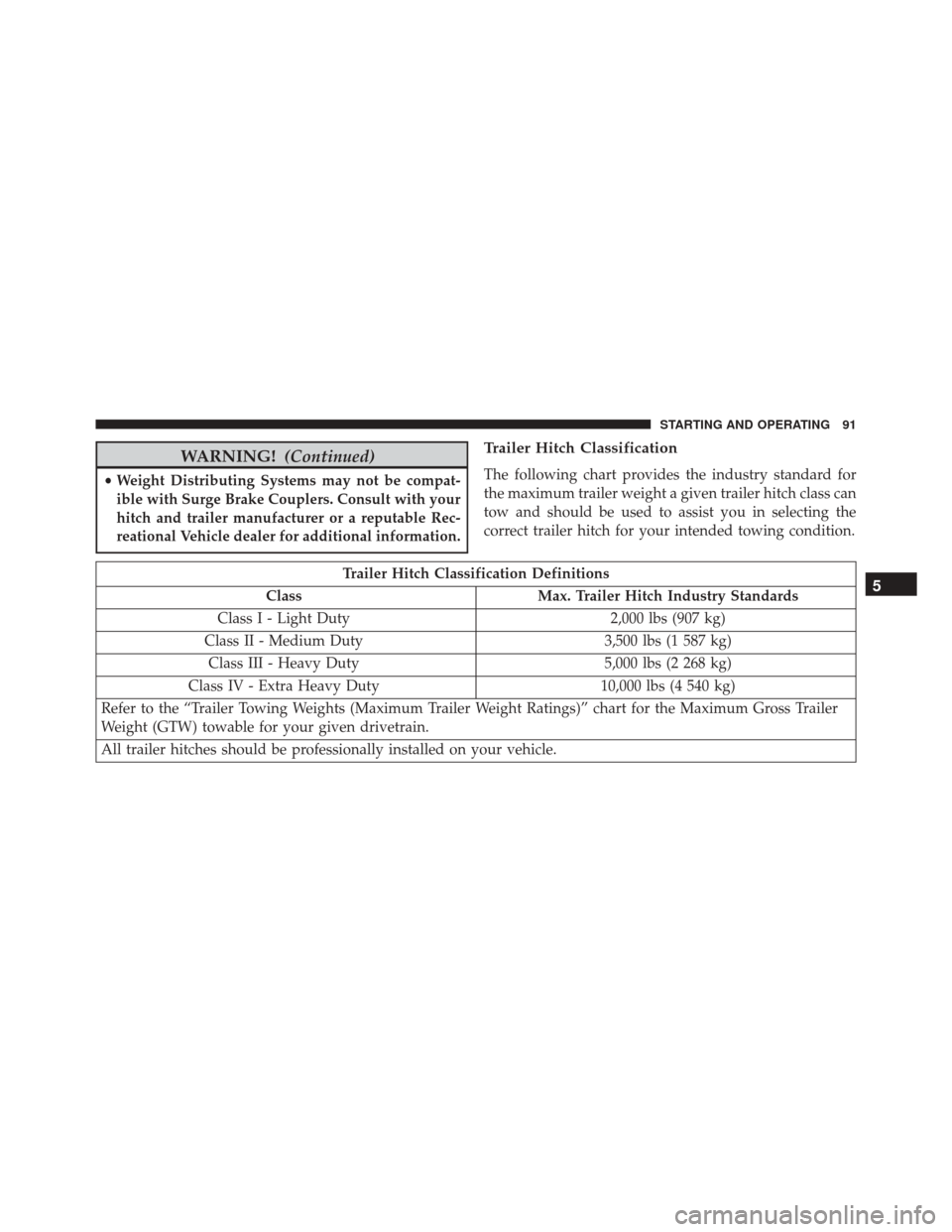
Trailer Hitch Classification
The following chart provides the industry standard for
the maximum trailer weight a given trailer hitch class can
tow and should be used to assist you in selecting the
correct trailer hitch for your intended towing condition.
Trailer Hitch Classification Definitions
Class Max. Trailer Hitch Industry Standards
Class I - Light Duty 2,000 lbs (907 kg)
Class II - Medium Duty 3,500 lbs (1 587 kg)
Class III - Heavy Duty 5,000 lbs (2 268 kg)
Class IV - Extra Heavy Duty 10,000 lbs (4 540 kg)
Refer to the “Trailer Towing Weights (Maximum Trailer Weight Ratings)” chart for the Maximum Gross Trailer
Weight (GTW) towable for your given drivetrain.
All trailer hitches should be professionally installed on your vehicle.5
STARTING AND OPERATING 91