Page 558 of 669
CAUTION!
•Front or rear wheel lifts must not be used. Internal
damage to the transmission or transfer case will
occur if a front or rear wheel lift is used when
towing.
• Towing this vehicle in violation of the above re-
quirements can cause severe transmission and/or
transfer case damage. Damage from improper tow-
ing is not covered under the New Vehicle Limited
Warranty.
556 WHAT TO DO IN EMERGENCIES
Page 559 of 669
MAINTAINING YOUR VEHICLE
CONTENTS
�ENGINE COMPARTMENT — 6.4L ..........559
� ONBOARD DIAGNOSTIC SYSTEM (OBD II) . . .560
▫ Loose Fuel Filler Cap Message ............560
� EMISSIONS INSPECTION AND MAINTENANCE
PROGRAMS ......................... .561
� REPLACEMENT PARTS ..................562
� DEALER SERVICE ..................... .563
� MAINTENANCE PROCEDURES ...........563
▫ Engine Oil ......................... .564
▫ Engine Oil Filter ..................... .566▫
Engine Air Cleaner Filter ................567
▫ Accessory Drive Belt Inspection ...........570
▫ Maintenance-Free Battery ...............572
▫ Air Conditioner Maintenance .............573
▫ Front Prop Shaft Lubrication — Four-Wheel Drive
Models ............................ .575
▫ Body Lubrication .....................576
▫ Windshield Wiper Blades ...............576
▫ Adding Washer Fluid ..................580
▫ Exhaust System ..................... .581
7
Page 577 of 669
Refrigerant Recovery And Recycling HFO 1234yf
— If Equipped
HFO 1234yf Air Conditioning Refrigerant is a hydro-
fluoolefine HFO that is endorsed by the Environmental
Protection Agency and is an ozone-saving product with a
low GWP (Global Warming Potential). However, the
manufacturer recommends that air conditioning service
be performed by authorized dealer or other service
facilities using recovery and recycling equipment.
NOTE:Use only manufacturer approved A/C system
PAG compressor oil and refrigerants.
Front Prop Shaft Lubrication — Four-Wheel Drive
Models
Lubricate the front driveshaft grease fitting at each oil
change. The grease fitting is located at the rear of the
front driveshaft, near the centering mechanism of double
cardan joint. Refer to the “Maintenance Schedule” for the proper maintenance intervals. Use MOPAR Type MS-
6560 (lithium-based grease), or equivalent.
Front Drive Shaft Double Cardan Joint
7
MAINTAINING YOUR VEHICLE 575
Page 601 of 669

•If you detect any stone chips or scratches in the paint,
touch them up immediately. The cost of such repairs is
considered the responsibility of the owner.
• If your vehicle is damaged due to a collision or similar
cause that destroys the paint and protective coating,
have your vehicle repaired as soon as possible. The
cost of such repairs is considered the responsibility of
the owner.
• If you carry special cargo such as chemicals, fertilizers,
de-icer salt, etc., be sure that such materials are well
packaged and sealed.
• If a lot of driving is done on gravel roads, consider
mud or stone shields behind each wheel.
• Use MOPAR Touch Up Paint on scratches as soon as
possible. Your authorized dealer has touch up paint to
match the color of your vehicle.Wheel And Wheel Trim Care
• All wheels and wheel trim, especially aluminum and
chrome plated wheels, should be cleaned regularly
with a mild soap and water to prevent corrosion.
• To remove heavy soil and/or excessive brake dust, use
MOPAR Wheel Cleaner.
NOTE: If your vehicle is equipped with Dark Vapor or
Black Satin Chrome wheels DO NOT USE wheel cleaners,
abrasives or polishing compounds. They will perma-
nently damage this finish and such damage is not cov-
ered by the New Vehicle Limited Warranty. USE ONLY
MILD SOAP AND WATER WITH A SOFT CLOTH. Used
on a regular basis this is all that is required to maintain
this finish.
7
MAINTAINING YOUR VEHICLE 599
Page 602 of 669

CAUTION!
Do not use scouring pads, steel wool, a bristle brush,
or metal polishes. Do not use oven cleaner. These
products may damage the wheel’s protective finish.
Avoid automatic car washes that use acidic solutions
or harsh brushes that may damage the wheel’s pro-
tective finish. Only MOPAR Wheel Cleaner or
equivalent is recommended.
Stain Repel Fabric Cleaning Procedure — If
Equipped
Stain Repel seats may be cleaned in the following man-
ner:
•Remove as much of the stain as possible by blotting
with a clean, dry towel.
• Blot any remaining stain with a clean, damp towel. •
For tough stains, apply MOPAR Total Clean, or a mild
soap solution to a clean, damp cloth and remove stain.
Use a fresh, damp towel to remove soap residue.
• For grease stains, apply MOPAR Multi-Purpose
Cleaner to a clean, damp cloth and remove stain. Use
a fresh, damp towel to remove soap residue.
• Do not use any harsh solvents or any other form of
protectants on Stain Repel products.
Interior Care
Use MOPAR Total Clean to clean fabric upholstery and
carpeting.
Use MOPAR Total Clean to clean vinyl upholstery.
MOPAR Total Clean is specifically recommended for
leather upholstery.
600 MAINTAINING YOUR VEHICLE
Page 614 of 669
Cavity Cartridge Fuse Micro FuseDescription
F97 –25 Amp Clear Rear Heated Seats & Heated Steering Wheel – If
Equipped
F98 –25 Amp Clear Front Heated Seats – If Equipped
F99 –10 Amp Red Climate Control
F100 –10 Amp Red Upfitters – If Equipped
F101 –15 Amp Blue Electrochromatic Mirror / Smart High Beams – If
Equipped
F104 –20 Amp Yellow Power Outlets (Instrument Panel / Center Con-
sole)
612 MAINTAINING YOUR VEHICLE
Page 618 of 669
7. Reach into the front wheel house ahead of the frontwheel, remove the fastener, and lift the cover over the
access hole in the front of the wheel house splash
shield. Access to the rear of the lamp can be gained
through this access hole.
8. Reach through the access hole of the wheel house splash shield and lift the slide lock upward far enough
to disengage it from the lock post on the back of the
front lamp unit housing.
9. Remove the headlamp assembly. Grasp the outboardedge of the lamp and pull it straight forward to
disengage the ball stud from the plastic grommet.
10. Disconnect the wiring harness connectors from the bulb socket.
Slide Lock
616 MAINTAINING YOUR VEHICLE
Page 644 of 669
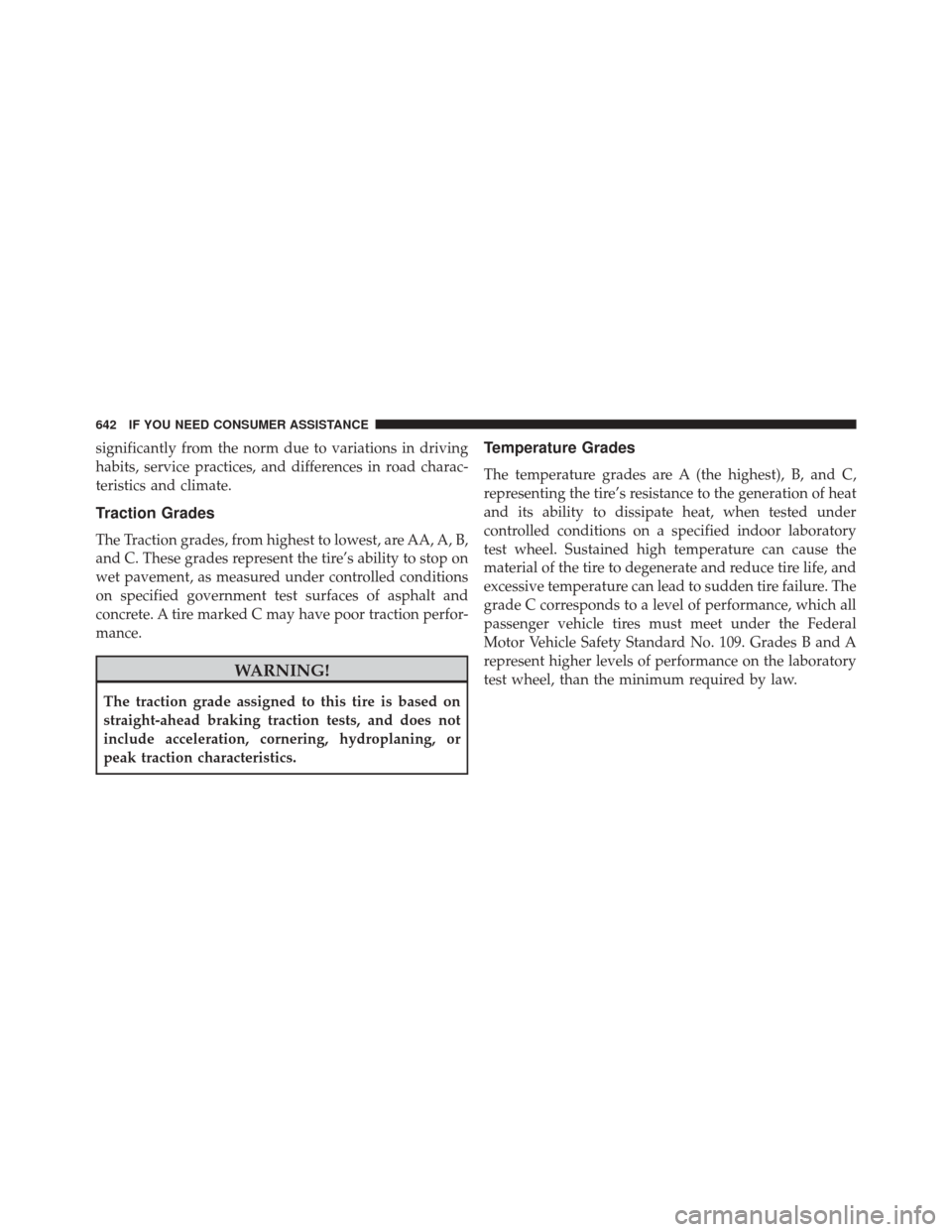
significantly from the norm due to variations in driving
habits, service practices, and differences in road charac-
teristics and climate.
Traction Grades
The Traction grades, from highest to lowest, are AA, A, B,
and C. These grades represent the tire’s ability to stop on
wet pavement, as measured under controlled conditions
on specified government test surfaces of asphalt and
concrete. A tire marked C may have poor traction perfor-
mance.
WARNING!
The traction grade assigned to this tire is based on
straight-ahead braking traction tests, and does not
include acceleration, cornering, hydroplaning, or
peak traction characteristics.
Temperature Grades
The temperature grades are A (the highest), B, and C,
representing the tire’s resistance to the generation of heat
and its ability to dissipate heat, when tested under
controlled conditions on a specified indoor laboratory
test wheel. Sustained high temperature can cause the
material of the tire to degenerate and reduce tire life, and
excessive temperature can lead to sudden tire failure. The
grade C corresponds to a level of performance, which all
passenger vehicle tires must meet under the Federal
Motor Vehicle Safety Standard No. 109. Grades B and A
represent higher levels of performance on the laboratory
test wheel, than the minimum required by law.
642 IF YOU NEED CONSUMER ASSISTANCE


