2016 PEUGEOT 5008 engine
[x] Cancel search: enginePage 31 of 364
29
5008_en_Chap01_controle-marche_ed01-2015
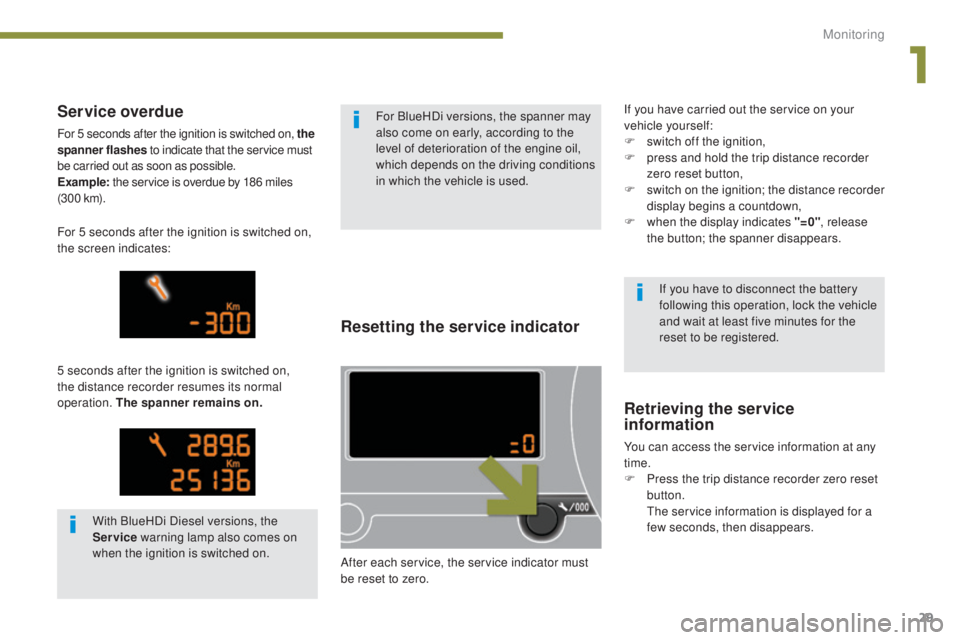
Resetting the service indicator
If you have carried out the service on your
vehicle yourself:
F
s
witch off the ignition,
F
p
ress and hold the trip distance recorder
zero reset button,
F
s
witch on the ignition; the distance recorder
display begins a countdown,
F
w
hen the display indicates "=0" , release
the button; the spanner disappears.Service overdue
For 5 seconds after the ignition is switched on, the
spanner flashes to indicate that the service must
be carried out as soon as possible.
Example: the service is overdue by 186 miles
(3 0 0 k m).
5 seconds after the ignition is switched on,
the distance recorder resumes its normal
operation. The spanner remains on.
Retrieving the service
information
You can access the service information at any
time.
F
P
ress the trip distance recorder zero reset
button.
T
he service information is displayed for a
few seconds, then disappears. If you have to disconnect the battery
following this operation, lock the vehicle
and wait at least five minutes for the
reset to be registered.
After each service, the service indicator must
be reset to zero. For BlueHDi versions, the spanner may
also come on early, according to the
level of deterioration of the engine oil,
which depends on the driving conditions
in which the vehicle is used.
With BlueHDi Diesel versions, the
Service warning lamp also comes on
when the ignition is switched on.
For 5 seconds after the ignition is switched on,
the screen indicates:
1
Monitoring
Page 32 of 364

30
5008_en_Chap01_controle-marche_ed01-2015
Engine oil level indicator*
On versions fitted with an electric oil level
indicator, the state of the engine oil level is
displayed in the instrument panel for a few
seconds when the ignition is switched on, after
the service information.Oil level correct
Oil level lowOil level indicator fault
In the event of a fault with the electric indicator,
the engine oil level is no longer monitored.
When the system has a fault, you should check
the engine oil level using the manual dipstick
(located under the bonnet).
This is signalled by the flashing of " O I L"
, or the
display of a message "Oil level incorrect" in the
instrument panel, accompanied by illumination
of the service warning lamp and an audible
signal.
If the low oil level is confirmed by a check using
the dipstick, the level must be topped up to
prevent damage to the engine.
Refer to the "Checking levels" section. This is signalled by the flashing of "OIL- -"
or the
display of a message "Oil level measurement
invalid" in the instrument panel. Contact a
PEUGEOT dealer or a qualified workshop.
The level shown will only be correct if
the vehicle is on level ground and the
engine has been off for more than
30 minutes. * Depending on version.Refer to the "Checking levels" section.
Monitoring
Page 52 of 364

50
5008_en_Chap02_ouvertures_ed01-2015
Lost keys
Go to a PEUGEOT dealer with the vehicle's registration document, your personal
identification documents and if possible the key code label.
The PEUGEOT dealer will be able to look up the key code and the transponder code
required to order a new key.Do not throw the remote control
batteries away, they contain metals
which are harmful to the environment.
Take them to an approved collection
point.
Remote control
The high frequency remote control is a sensitive system; do not operate it while it is in your
pocket as there is a possibility that it may unlock the vehicle, without you being aware of it.
Do not repeatedly press the buttons of your remote control out of range and out of sight of
your vehicle. You run the risk of stopping it from working and the remote control would have
to be reinitialised.
No remote control can operate when the key is in the ignition switch, even when the ignition
is switched off, except for reinitialisation.
Locking the vehicle
Driving with the doors locked may make access to the passenger compartment by the
emergency services more difficult in an emergency.
As a safety precaution, never leave children alone in the vehicle, except for a very short
period.
In all cases, it is essential to remove the key from the ignition switch when leaving the vehicle.
Anti-theft protection
Do not make any modifications to the electronic engine immobiliser system; this could
cause malfunctions.
When purchasing a second-hand vehicle
Have the pairing of all of the keys in your possession checked by a PEUGEOT dealer, to
ensure that only your keys can be used to open and start the vehicle.
Access
Page 57 of 364
55
5008_en_Chap02_ouvertures_ed01-2015
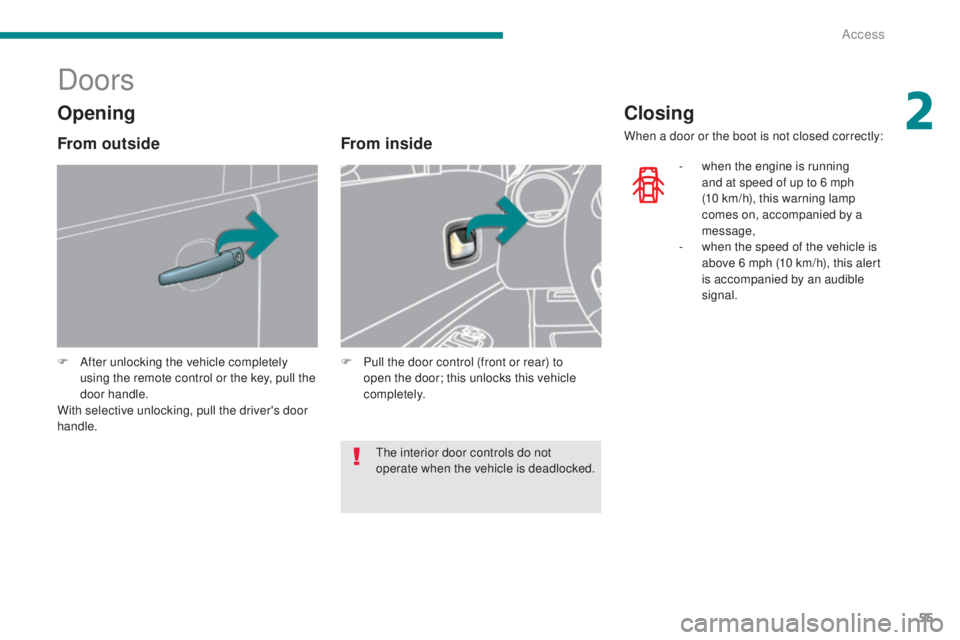
Doors
F After unlocking the vehicle completely using the remote control or the key, pull the
door handle.
With selective unlocking, pull the driver's door
handle.
From inside
F Pull the door control (front or rear) to open the door; this unlocks this vehicle
completely.
Closing
When a door or the boot is not closed correctly:
-
w
hen the engine is running
and at speed of up to 6 mph
(10
km/h), this warning lamp
comes on, accompanied by a
message,
-
w
hen the speed of the vehicle is
above 6 mph (10 km/h), this alert
is accompanied by an audible
signal.
Opening
From outside
The interior door controls do not
operate when the vehicle is deadlocked.
2
Access
Page 60 of 364
58
5008_en_Chap02_ouvertures_ed01-2015
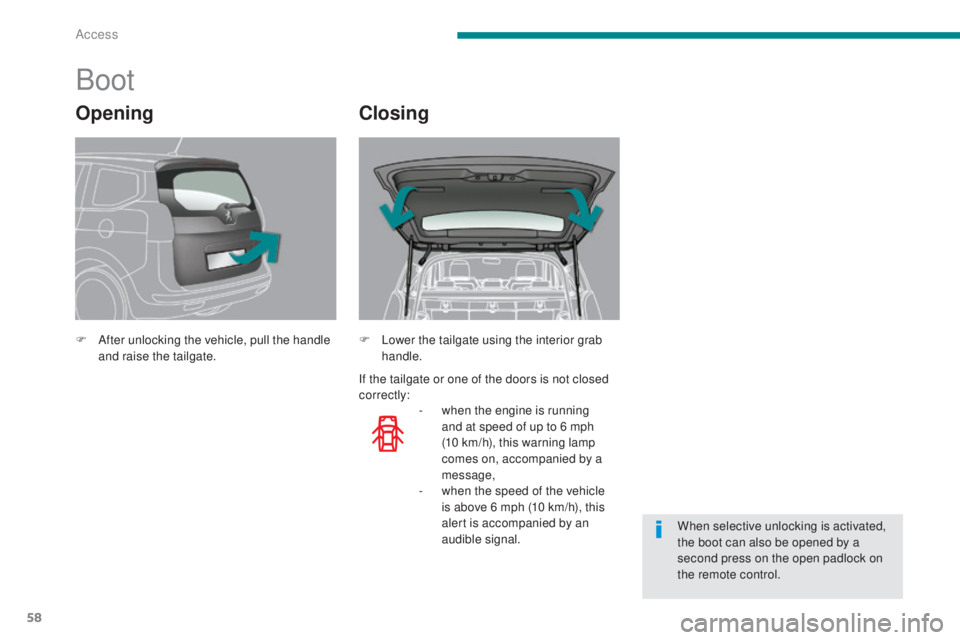
Boot
F After unlocking the vehicle, pull the handle and raise the tailgate.
-
w
hen the engine is running
and at speed of up to 6 mph
(10
km/h), this warning lamp
comes on, accompanied by a
message,
-
w
hen the speed of the vehicle
is above 6 mph (10 km/h), this
alert is accompanied by an
audible signal.
F
L ower the tailgate using the interior grab
handle.
When selective unlocking is activated,
the boot can also be opened by a
second press on the open padlock on
the remote control.
OpeningClosing
If the tailgate or one of the doors is not closed
correctly:
Access
Page 63 of 364

61
5008_en_Chap03_confort_ed01-2015
The air conditioning system does not
contain chlorine and does not present
any danger to the ozone layer.Recommendations for ventilation and air conditioning
In order for these systems to be fully effective, follow the operation and maintenance
guidelines below:
F
I
f the interior temperature remains very high after the vehicle has been parked in the sun
for a considerable time, first ventilate the passenger compartment for a few minutes.
P
lace the air flow control at a sufficient level to provide an adequate renewal of air in the
passenger compartment.
F
T
o obtain an even air distribution, take care not to obstruct the exterior air intake grilles
located at the base of the windscreen, the nozzles, the vents and the air outlets, as well
as the air extractor located in the boot.
F
I
n normal conditions, use the intake of exterior air as prolonged use of the air
recirculation may cause misting of the windows and side windows.
F
D
o not cover the sunshine sensor, located on the dashboard; this is used for regulation
of the automatic air conditioning system.
F
O
perate the air conditioning system for 5 to 10 minutes, once or twice a month to keep it
in good working order.
F
E
nsure that the passenger compartment filter is in good condition and have the filter
elements replaced regularly (refer to the "Checks" section).
W
e recommend the use of a combined passenger compartment filter. Thanks to its
second special active filter, it contributes to the purification of the air breathed by the
occupants and the cleanliness of the passenger compartment (reduction of allergic
symptoms, bad odours and greasy deposits).
F
T
he air conditioning uses power from the engine while operating. This results in an
increase in the vehicle's fuel consumption.
W
hen towing at or near maximum capacity or on steep slopes in high ambient
temperatures, switching off the air conditioning saves engine power and so improves
towing capacity.
C
ondensation created by the air conditioning results in a discharge of water under the
vehicle when stationary, which is per fectly normal.
F
T
o ensure correct operation of the air conditioning system, you are also advised to have
it checked regularly.
F
I
f the system does not produce cold air, do not use it and contact a PEUGEOT dealer or
a qualified workshop.
Rear ventilation
adjustment
After pressing the "REAR" button, turn the
adjustment dial of the rear side vents to
decrease or increase the flow of air.
Take care not to obstruct the side vents and the
air outlets on the floor.
To shut off the flow of air, close the vents and
set the dial to 0.
3
Comfort
Page 64 of 364
62
5008_en_Chap03_confort_ed01-2015
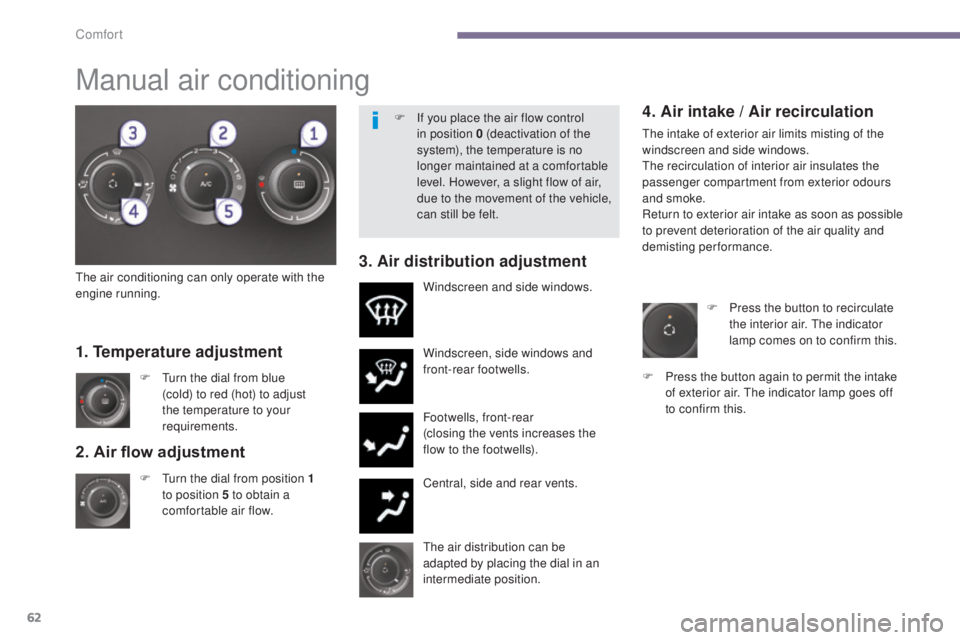
2. Air flow adjustment
F Turn the dial from position 1
to position 5 to obtain a
comfortable air flow. Windscreen, side windows and
front-rear footwells.
Footwells, front-rear
(closing the vents increases the
flow to the footwells).
Central, side and rear vents.
F
T
urn the dial from blue
(cold) to red (hot) to adjust
the temperature to your
requirements. Windscreen and side windows.
1. Temperature adjustment
The air distribution can be
adapted by placing the dial in an
intermediate position.
The air conditioning can only operate with the
engine running.
4. Air intake / Air recirculation
The intake of exterior air limits misting of the
windscreen and side windows.
The recirculation of interior air insulates the
passenger compartment from exterior odours
and smoke.
Return to exterior air intake as soon as possible
to prevent deterioration of the air quality and
demisting performance.
3. Air distribution adjustment
F Press the button to recirculate
the interior air. The indicator
lamp comes on to confirm this.
F
P
ress the button again to permit the intake
of exterior air. The indicator lamp goes off
to confirm this.
Manual air conditioning
F If you place the air flow control in position 0 (deactivation of the
system), the temperature is no
longer maintained at a comfortable
level. However, a slight flow of air,
due to the movement of the vehicle,
can still be felt.
Comfort
Page 66 of 364
64
5008_en_Chap03_confort_ed01-2015
The control button is located on
the air conditioning system control
panel.
Rear screen demist - defrost
Switching onSwitching off
The demist /defrost switches off automatically to
prevent an excessive consumption of current.
F
I
t is possible to stop the demist /defrost
operation before it is switched off
automatically by pressing the button again.
The indicator lamp associated with the
button goes off.
F
P
ress this button to demist /defrost the rear
screen and, depending on version, the door
mirrors. The indicator lamp associated with
the button comes on.
The rear screen demist - defrost can only
operate when the engine is running.
F
S
witch off the demist /defrost of the
rear screen and door mirrors as
soon as it is no longer needed as
lower current consumption results
in reduced fuel consumption.
Comfort