Page 213 of 364
211
5008_en_Chap09_verifications_ed01-2015
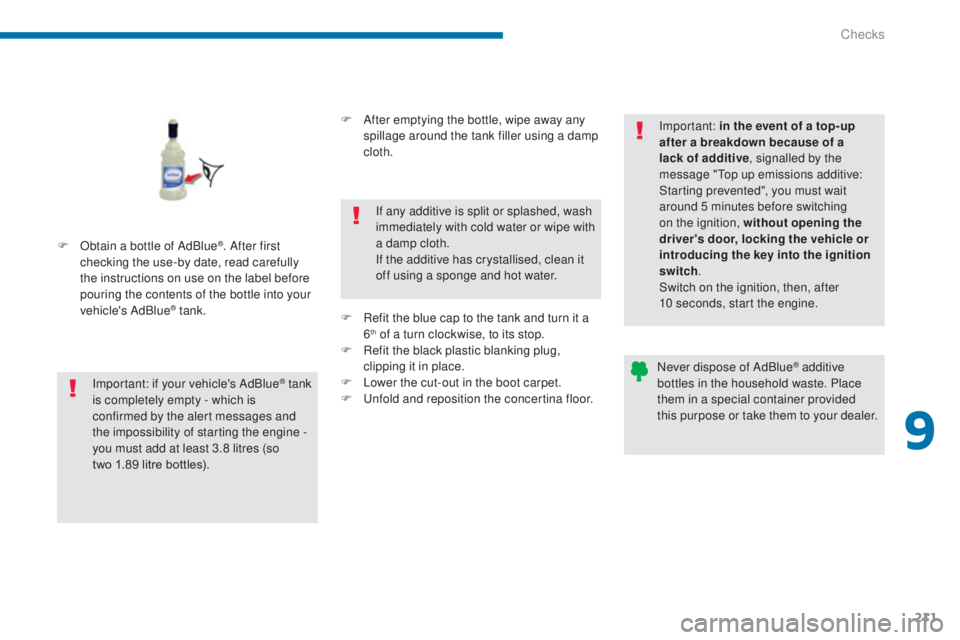
F Obtain a bottle of AdBlue®. After first
checking the use-by date, read carefully
the instructions on use on the label before
pouring the contents of the bottle into your
vehicle's AdBlue
® tank.
Important: if your vehicle's AdBlue
® tank
i
s completely empty - which is
confirmed by the alert messages and
the impossibility of starting the engine
-
you must add at least 3.8 litres (so
two
1.89 litre bottles). F
A
fter emptying the bottle, wipe away any
spillage around the tank filler using a damp
cloth.
If any additive is split or splashed, wash
immediately with cold water or wipe with
a damp cloth.
If the additive has crystallised, clean it
off using a sponge and hot water.
F
R
efit the blue cap to the tank and turn it a
6
th of a turn clockwise, to its stop.
F
R
efit the black plastic blanking plug,
clipping it in place.
F
L
ower the cut-out in the boot carpet.
F
U
nfold and reposition the concertina floor. Important: in the event of a top-up
after a breakdown because of a
lack of additive
, signalled by the
message "Top up emissions additive:
Starting prevented", you must wait
around 5 minutes before switching
on the ignition, without opening the
driver's door, locking the vehicle or
introducing the key into the ignition
switch .
Switch on the ignition, then, after
10 seconds, start the engine.
Never dispose of AdBlue
® additive
bottles in the household waste. Place
them in a special container provided
this purpose or take them to your dealer.
9
Checks
Page 218 of 364
216
5008_en_Chap10_infos-pratiques_ed01-2015
Repair procedure
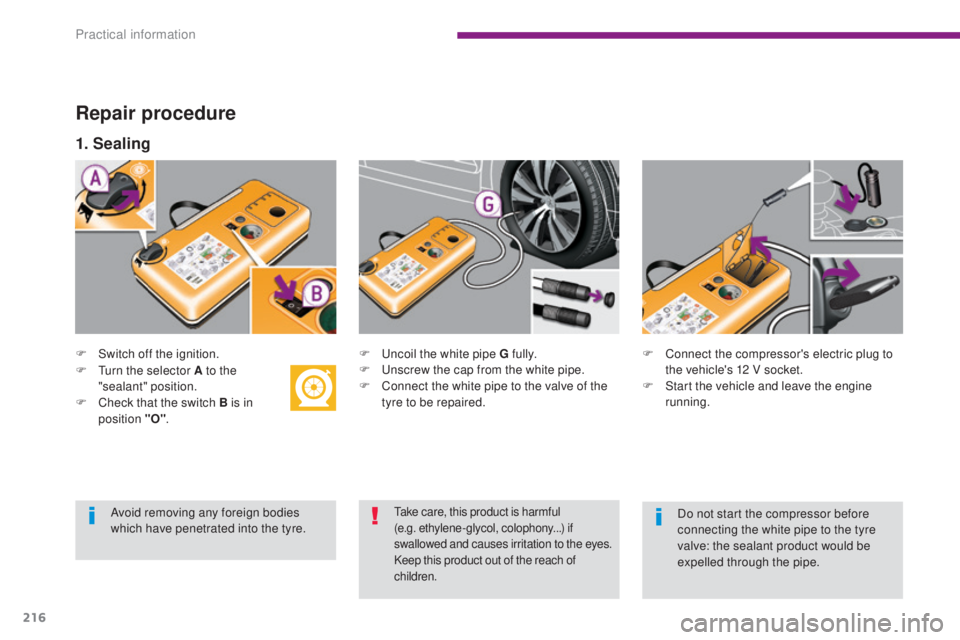
F Switch off the ignition.F U ncoil the white pipe G fully.
F U nscrew the cap from the white pipe.
F
C
onnect the white pipe to the valve of the
tyre to be repaired. F
C onnect the compressor's electric plug to
the vehicle's 12 V socket.
F
S
tart the vehicle and leave the engine
running.
1. Sealing
F Turn the selector A to the "sealant" position.
F
C
heck that the switch B is in
position "O" .
Take care, this product is harmful
(e.g.
ethylene-glycol, colophony...) if
swallowed and causes irritation to the eyes.
Keep this product out of the reach of
children.Avoid removing any foreign bodies
which have penetrated into the tyre. Do not start the compressor before
connecting the white pipe to the tyre
valve: the sealant product would be
expelled through the pipe.
Practical information
Page 220 of 364
218
5008_en_Chap10_infos-pratiques_ed01-2015
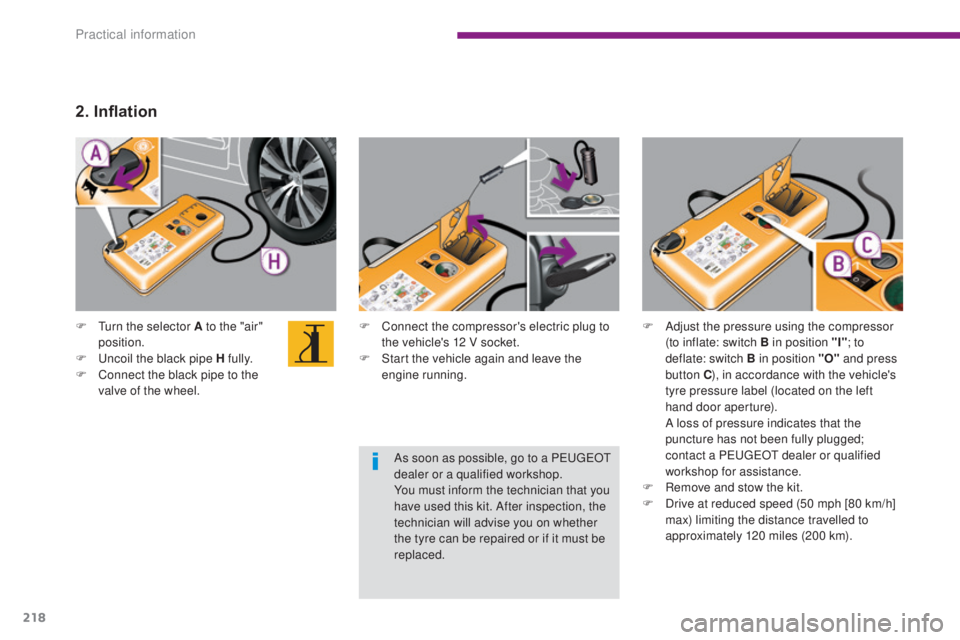
F Connect the compressor's electric plug to the vehicle's 12 V socket.
F
S
tart the vehicle again and leave the
engine running.
F
T
urn the selector A to the "air"
position.
F
U
ncoil the black pipe H fully.
F
C
onnect the black pipe to the
valve of the wheel.
2. Inflation
F Adjust the pressure using the compressor (to inflate: switch B in position "I" ; to
deflate: switch B
in position "O" and press
button C ), in accordance with the vehicle's
tyre pressure label (located on the left
hand door aperture).
A l
oss of pressure indicates that the
puncture has not been fully plugged;
contact a PEUGEOT dealer or qualified
workshop for assistance.
F
R
emove and stow the kit.
F
D
rive at reduced speed (50 mph [80 km/h]
max) limiting the distance travelled to
approximately 120 miles (200 km).
As soon as possible, go to a PEUGEOT
dealer or a qualified workshop.
You must inform the technician that you
have used this kit. After inspection, the
technician will advise you on whether
the tyre can be repaired or if it must be
replaced.
Practical information
Page 221 of 364
219
5008_en_Chap10_infos-pratiques_ed01-2015
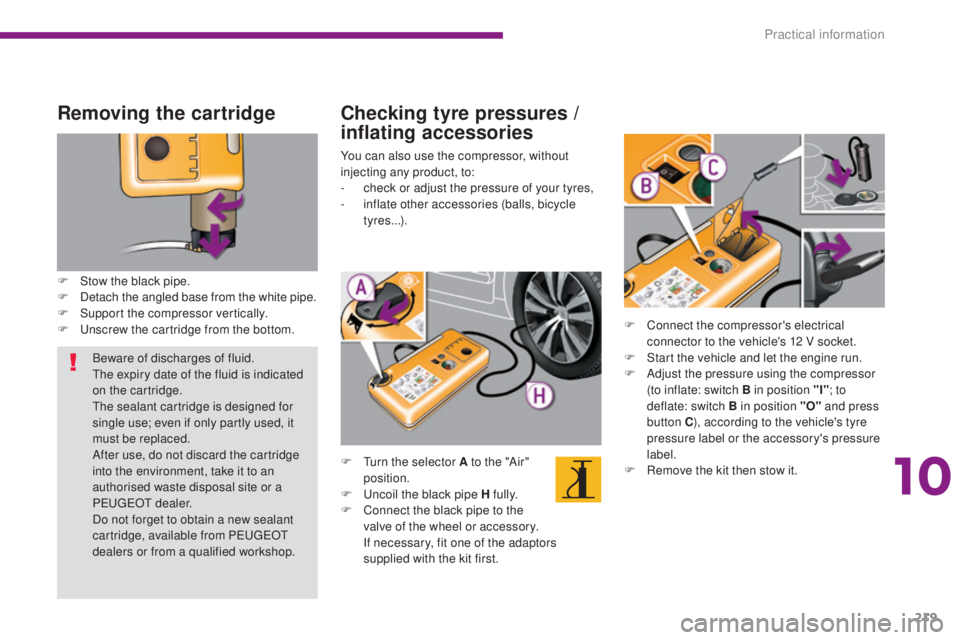
Removing the cartridge
F Stow the black pipe.
F D etach the angled base from the white pipe.
F
S
upport the compressor vertically.
F
U
nscrew the cartridge from the bottom.
Checking tyre pressures /
inflating accessories
You can also use the compressor, without
injecting any product, to:
-
c
heck or adjust the pressure of your tyres,
-
i
nflate other accessories (balls, bicycle
tyres...).
F
T
urn the selector A to the "Air"
position.
F
U
ncoil the black pipe H fully.
F
C
onnect the black pipe to the
valve of the wheel or accessory.
I
f necessary, fit one of the adaptors
supplied with the kit first. F
C
onnect the compressor's electrical
connector to the vehicle's 12 V socket.
F
S
tart the vehicle and let the engine run.
F
A
djust the pressure using the compressor
(to inflate: switch B in position "I" ; to
deflate: switch B in position "O" and press
button C ), according to the vehicle's tyre
pressure label or the accessory's pressure
label.
F
R
emove the kit then stow it.
Beware of discharges of fluid.
The expiry date of the fluid is indicated
on the cartridge.
The sealant cartridge is designed for
single use; even if only partly used, it
must be replaced.
After use, do not discard the cartridge
into the environment, take it to an
authorised waste disposal site or a
PEUGEOT dealer.
Do not forget to obtain a new sealant
cartridge, available from PEUGEOT
dealers or from a qualified workshop.
10
Practical information
Page 223 of 364
221
5008_en_Chap10_infos-pratiques_ed01-2015
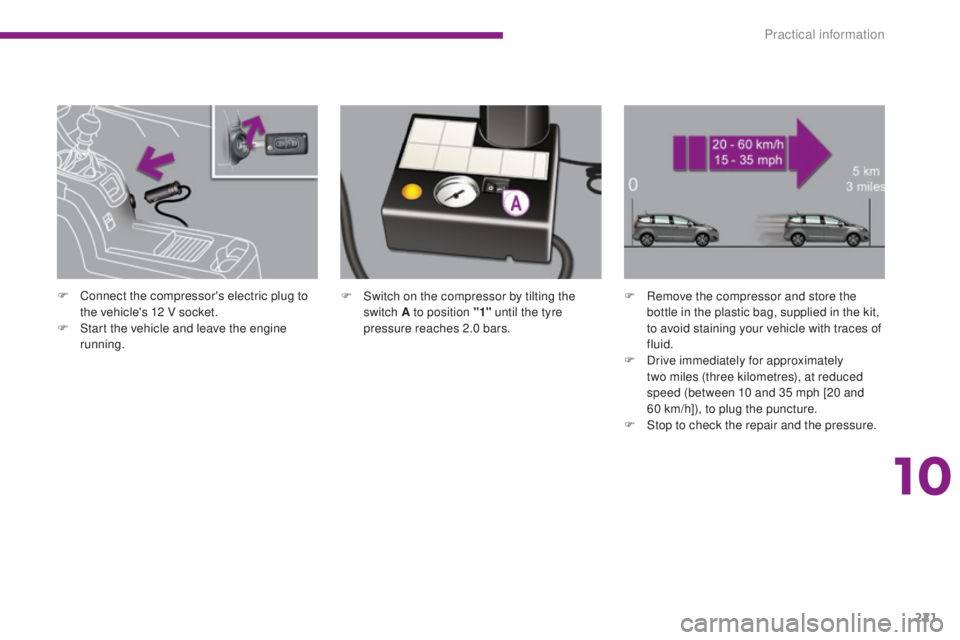
F Switch on the compressor by tilting the switch A to position "1" until the tyre
pressure reaches 2.0 bars. F
R emove the compressor and store the
bottle in the plastic bag, supplied in the kit,
to avoid staining your vehicle with traces of
fluid.
F
D
rive immediately for approximately
two miles (three kilometres), at reduced
speed (between 10 and 35 mph [20 and
60
km/h]), to plug the puncture.
F
S
top to check the repair and the pressure.
F
C
onnect the compressor's electric plug to
the vehicle's 12 V socket.
F
S
tart the vehicle and leave the engine
running.
10
Practical information
Page 224 of 364
222
5008_en_Chap10_infos-pratiques_ed01-2015
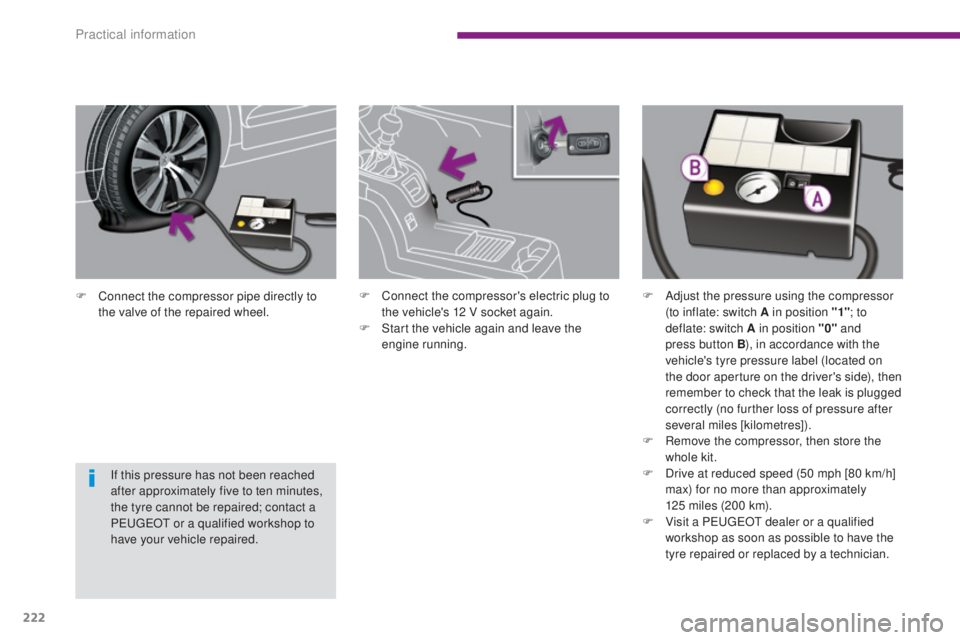
F Connect the compressor pipe directly to the valve of the repaired wheel.
If this pressure has not been reached
after approximately five to ten minutes,
the tyre cannot be repaired; contact a
PEUGEOT or a qualified workshop to
have your vehicle repaired. F
C onnect the compressor's electric plug to
the vehicle's 12 V socket again.
F
S
tart the vehicle again and leave the
engine running. F
A djust the pressure using the compressor
(to inflate: switch A in position "1" ; to
deflate: switch A
in position "0" and
press button B ), in accordance with the
vehicle's tyre pressure label (located on
the door aperture on the driver's side), then
remember to check that the leak is plugged
correctly (no further loss of pressure after
several miles [kilometres]).
F
R
emove the compressor, then store the
whole kit.
F
D
rive at reduced speed (50 mph [80 km/h]
max) for no more than approximately
125
miles (200 km).
F
V
isit a PEUGEOT dealer or a qualified
workshop as soon as possible to have the
tyre repaired or replaced by a technician.
Practical information
Page 241 of 364
239
5008_en_Chap10_infos-pratiques_ed01-2015
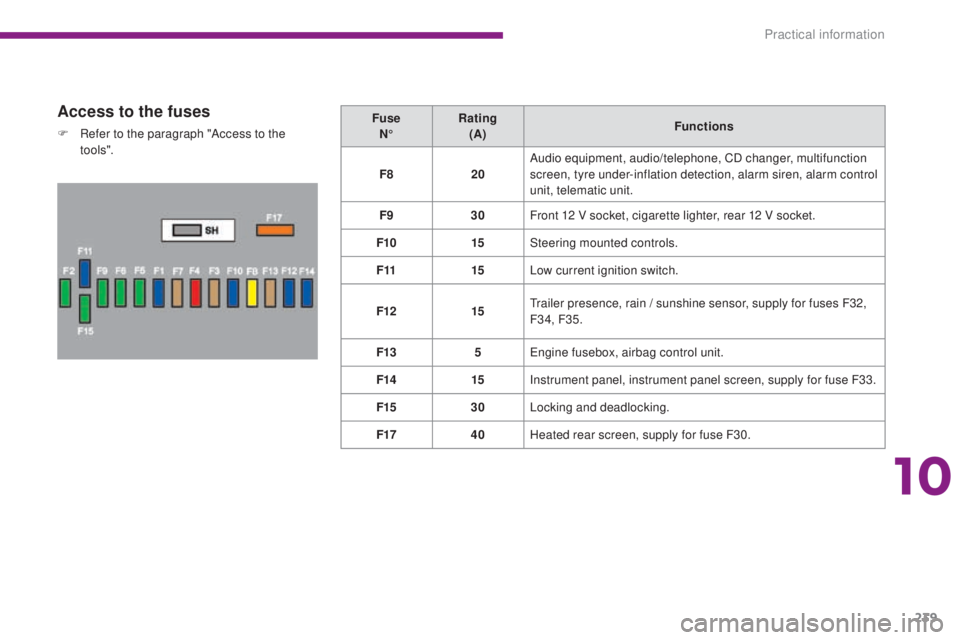
Access to the fuses
F Refer to the paragraph "Access to the to o ls". Fuse
N° Rating
(A) Functions
F8 20Audio equipment, audio/telephone, CD changer, multifunction
screen, tyre under-inflation detection, alarm siren, alarm control
unit, telematic unit.
F9 30Front 12 V socket, cigarette lighter, rear 12 V socket.
F10 15Steering mounted controls.
F11 15Low current ignition switch.
F12 15Trailer presence, rain / sunshine sensor, supply for fuses F32,
F34, F35.
F13 5Engine fusebox, airbag control unit.
F14 15Instrument panel, instrument panel screen, supply for fuse F33.
F15 30Locking and deadlocking.
F17 40Heated rear screen, supply for fuse F30.
10
Practical information
Page 243 of 364
241
5008_en_Chap10_infos-pratiques_ed01-2015
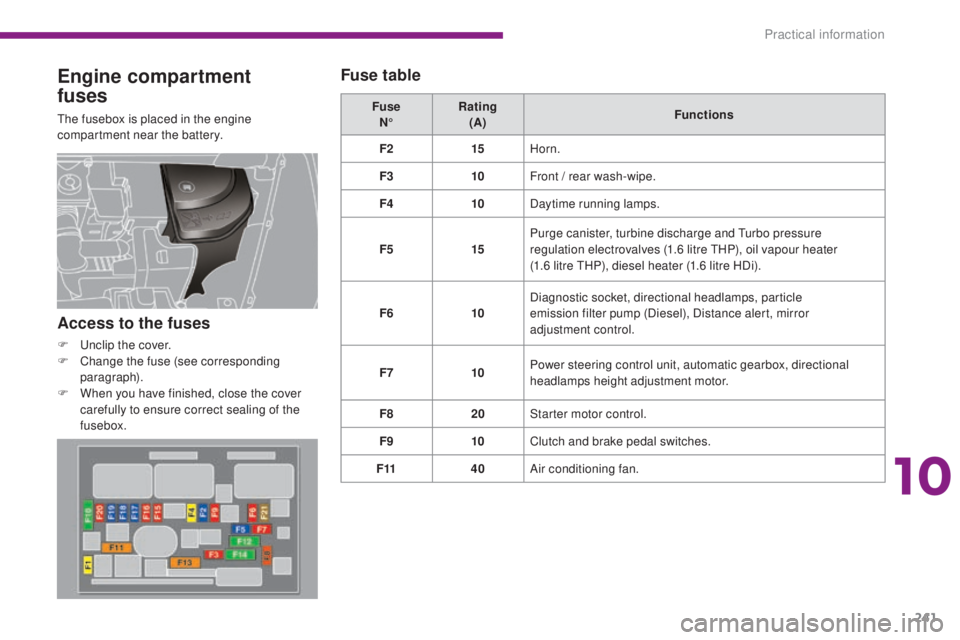
Engine compartment
fuses
The fusebox is placed in the engine
compartment near the battery.Fuse
N° Rating
(A) Functions
F2 15Horn.
F3 10Front / rear wash-wipe.
F4 10Daytime running lamps.
F5 15Purge canister, turbine discharge and Turbo pressure
regulation electrovalves (1.6 litre THP), oil vapour heater
(1.6 litre THP), diesel heater (1.6 litre HDi).
F6 10Diagnostic socket, directional headlamps, particle
emission filter pump (Diesel), Distance alert, mirror
adjustment control.
F7 10Power steering control unit, automatic gearbox, directional
headlamps height adjustment motor.
F8 20Starter motor control.
F9 10Clutch and brake pedal switches.
F11 40Air conditioning fan.
Access to the fuses
F Unclip the cover.
F
C hange the fuse (see corresponding
paragraph).
F
W
hen you have finished, close the cover
carefully to ensure correct sealing of the
fusebox.
Fuse table
10
Practical information