Page 93 of 398
91
308_en_Chap03_ergonomie-et-confort_ed02-2015
In order for these systems to be fully effective, follow the operation and maintenance
guidelines below:
F
t
o ob
tain an even air distribution, take care not to obstruct the exterior air intake grilles
located at the base of the windscreen, the nozzles, the vents and the air outlets, as well
as the air extractor located in the boot.
F
Do n
ot cover the sunshine sensor, located on the dashboard; this is used for regulation
of the air conditioning system.
F
Op
erate the air conditioning system for at least 5 to 10 minutes, once or twice a month
to keep it in per fect working order.
F
e
ns
ure that the passenger compartment filter is in good condition and have the filter
elements replaced regularly.
We r
ecommend the use of a combined passenger compartment filter.
tha
nks to its
special active additive, it contributes to the purification of the air breathed by the
occupants and the cleanliness of the passenger compartment (reduction of allergic
symptoms, bad odours and greasy deposits).
F
t
o en
sure correct operation of the air conditioning system, you are also advised to have
it checked regularly as recommended in the warranty and maintenance record.
F
If t
he system does not produce cold air, switch it off and contact a P
eu
ge
Ot d
ealer or
a qualified workshop.
Recommendations for ventilation and air conditioning
If after an extended stop in sunshine,
the interior temperature is very high, first
ventilate the passenger compartment for
a few moments.
Put the air flow control at a setting high
enough to quickly change the air in the
passenger compartment.
the a
ir conditioning system does not
contain chlorine and does not present
any danger to the ozone layer.
the c
ondensation created by the air
conditioning results in a discharge
of water under the vehicle which is
perfectly normal.
When towing the maximum load on a steep gradient in high temperatures, switching off the
air conditioning increases the available engine power and so improves the towing ability.
Stop & Start
the heating and air conditioning
s ystems only work when the engine
is running.
to ma
intain a comfortable
temperature in the passenger
compartment, you can temporarily
deactivate the Stop & Start system (see
the corresponding section).
3
ease of use and comfort
Page 94 of 398
92
308_en_Chap03_ergonomie-et-confort_ed02-2015
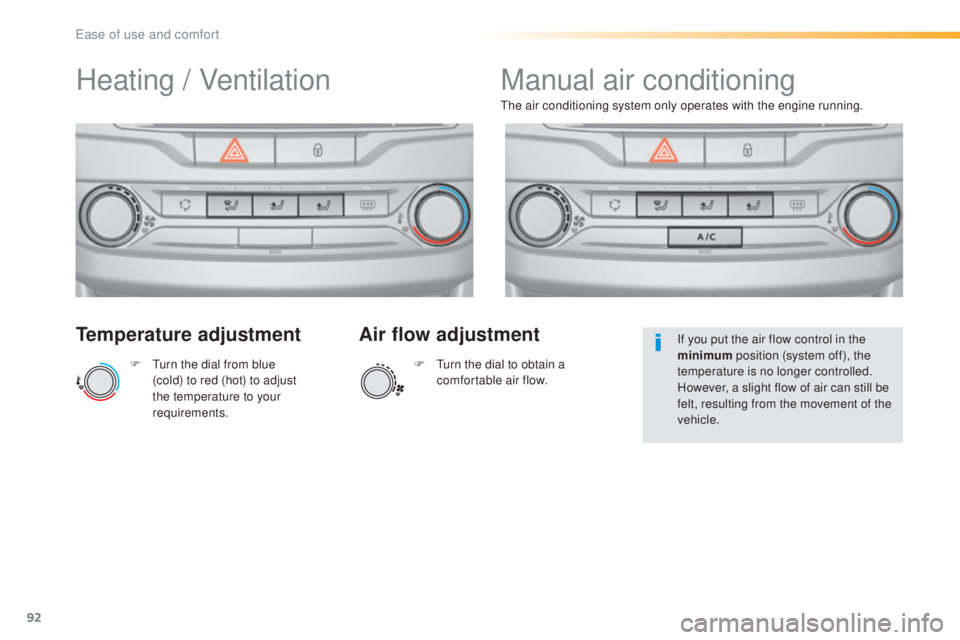
Temperature adjustment
F turn the dial from blue
( cold) to red (hot) to adjust
the temperature to your
requirements.
the a
ir conditioning system only operates with the engine running.
Air flow adjustment
F turn the dial to obtain a
c omfortable air flow. If you put the air flow control in the
minimum
position ( system off), the
temperature is no longer controlled.
However, a slight flow of air can still be
felt, resulting from the movement of the
vehicle.
Manual air conditioning
Heating / Ventilation
ease of use and comfort
Page 96 of 398
94
308_en_Chap03_ergonomie-et-confort_ed02-2015
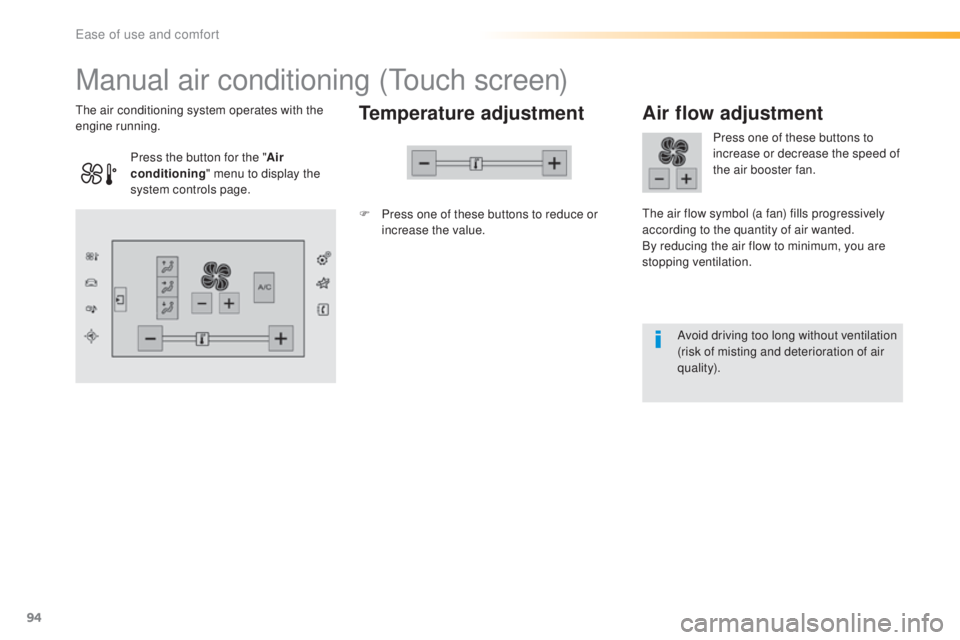
Manual air conditioning (touch screen)
Temperature adjustment
F Press one of these buttons to reduce or
inc
rease the value.
the a
ir conditioning system operates with the
engine running.
Air flow adjustment
Press one of these buttons to
increase or decrease the speed of
the air booster fan.
the a
ir flow symbol (a fan) fills progressively
according to the quantity of air wanted.
By reducing the air flow to minimum, you are
stopping ventilation.
Avoid driving too long without ventilation
(risk of misting and deterioration of air
quality).
Press the button for the "
Air
conditioning " menu to display the
system controls page.
ease of use and comfort
Page 98 of 398
96
308_en_Chap03_ergonomie-et-confort_ed02-2015
Dual-zone digital air conditioning (touch screen)
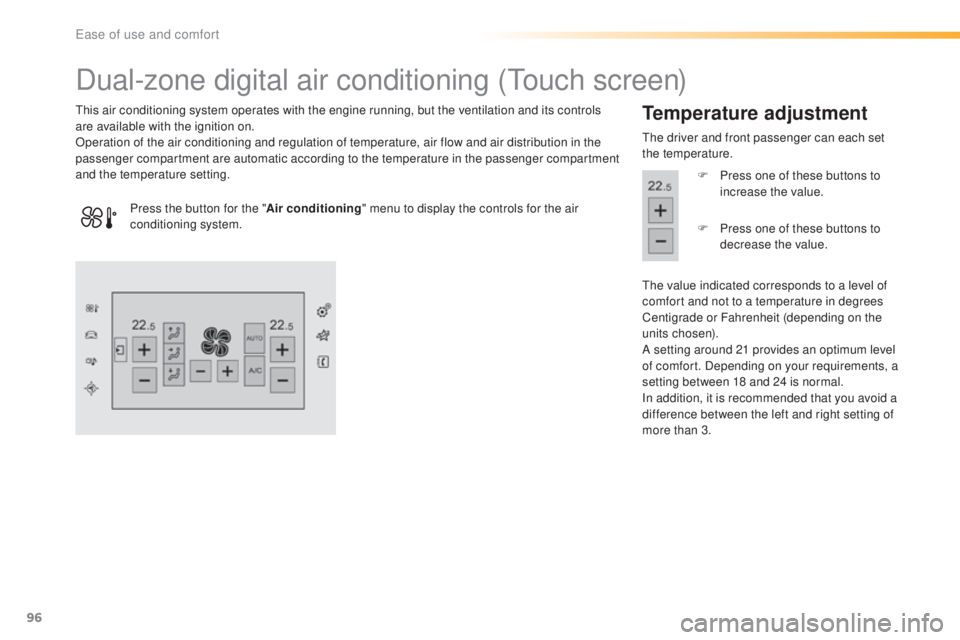
this air conditioning system operates with the engine running, but the ventilation and its controls
a re available with the ignition on.
Operation of the air conditioning and regulation of temperature, air flow and air distribution in the
passenger compartment are automatic according to the temperature in the passenger compartment
and the temperature setting.Temperature adjustment
the driver and front passenger can each set
t he temperature.
F
Pr
ess one of these buttons to
increase the value.
the v
alue indicated corresponds to a level of
comfort and not to a temperature in degrees
Centigrade or Fahrenheit (depending on the
units chosen).
A setting around 21 provides an optimum level
of comfort. Depending on your requirements, a
setting between 18 and 24 is normal.
In addition, it is recommended that you avoid a
difference between the left and right setting of
more than 3.
Press the button for the "
Air conditioning" menu to display the controls for the air
conditioning system. F
Pr
ess one of these buttons to
decrease the value.
ease of use and comfort
Page 99 of 398
97
308_en_Chap03_ergonomie-et-confort_ed02-2015
In cold conditions and when the engine
is cold, to limit distribution of cold air
in the passenger compartment, the
air flow will change gradually until the
comfort setting is reached.
On entering the vehicle, if the interior
temperature is much colder or warmer
than the comfort value setting, there
is no need to alter the value displayed
in order to reach more quickly the
required level of comfort.
the s
ystem
compensates automatically and
corrects the temperature difference as
quickly as possible.
thi
s setting is associated with A
utO mo
de
only. However, on deactivation of A
utO mo
de,
the indicator for the last setting remains on.
Changing the setting does not reactivate A
utO
m
ode if deactivated.
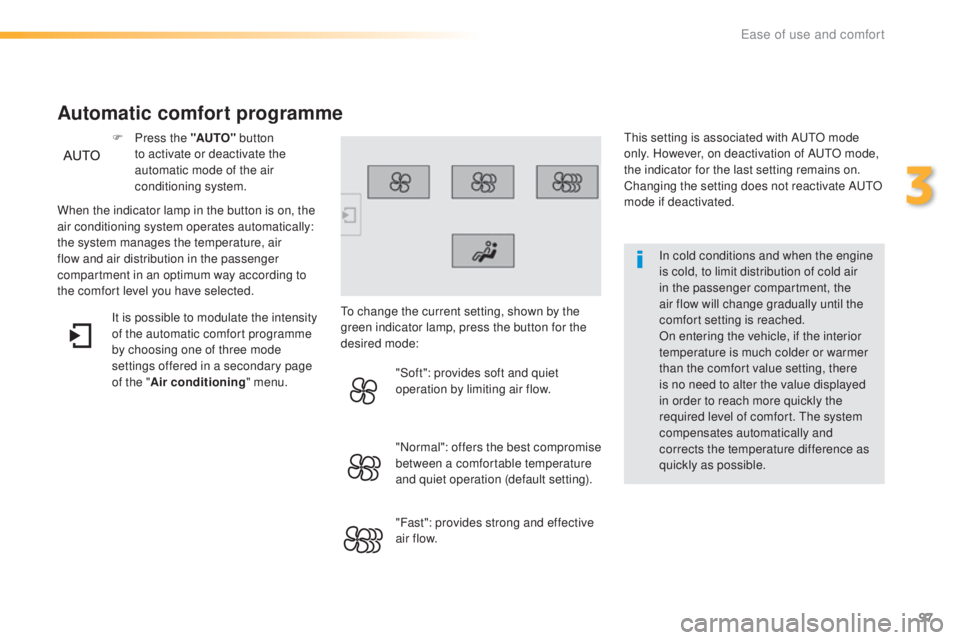
When the indicator lamp in the button is on, the
air conditioning system operates automatically:
the system manages the temperature, air
flow and air distribution in the passenger
compartment in an optimum way according to
the comfort level you have selected. F
Pr
ess the "AUTO"
button
to activate or deactivate the
automatic mode of the air
conditioning system.
Automatic comfort programme
to change the current setting, shown by the
g reen indicator lamp, press the button for the
desired mode:
"Soft": provides soft and quiet
operation by limiting air flow.
"Normal": offers the best compromise
between a comfortable temperature
and quiet operation (default setting).
"Fast": provides strong and effective
air f low.
It is possible to modulate the intensity
of the automatic comfort programme
by choosing one of three mode
settings offered in a secondary page
of the "
Air conditioning " menu.
3
ease of use and comfort
Page 101 of 398
99
308_en_Chap03_ergonomie-et-confort_ed02-2015
"Mono" function
the comfort setting for the passenger's side
c an be indexed to the driver's comfort setting
(mono-zone).
From the secondary page of the " Air
conditioning " menu:
F
Pr
ess this button to activate /
deactivate the "Mono" function.
the i
ndicator lamp in the button
is on when the function is
activated.
the f
unction is deactivated automatically when
the passenger uses their temperature setting
buttons.
It allows you:
-
in s
ummer, to lower the temperature,
-
in w
inter, above 3 °C, to improve demisting.
Switching off Switching on
Air conditioning On/Off
the air conditioning is designed to
o perate efficiently in all seasons, with
the windows closed.
Ventilation with "ignition
on" function
With the ignition on, you can use the
ventilation system and have access to the
" Air conditioning " menu to adjust the air
flow and air distribution in the passenger
compartment.
thi
s function is available for a few minutes,
depending on the state of charge of the battery
of your vehicle.
thi
s function does not activate the air
conditioning.
You can make use of the residual heat in the
engine to warm the passenger compartment
using the temperature setting buttons.
F
Pr
ess the " A/C" button to activate the air
conditioning.
When the indicator lamp under the button is on,
the air conditioning function is activated.
the a
ir conditioning cannot operate when the
air flow is set to off.
F
Pr
ess the "A /C " button again to deactivate
the air conditioning.
When the indicator lamp under the button is off,
the air conditioning function is deactivated.
3
ease of use and comfort
Page 104 of 398
102
308_en_Chap03_ergonomie-et-confort_ed02-2015
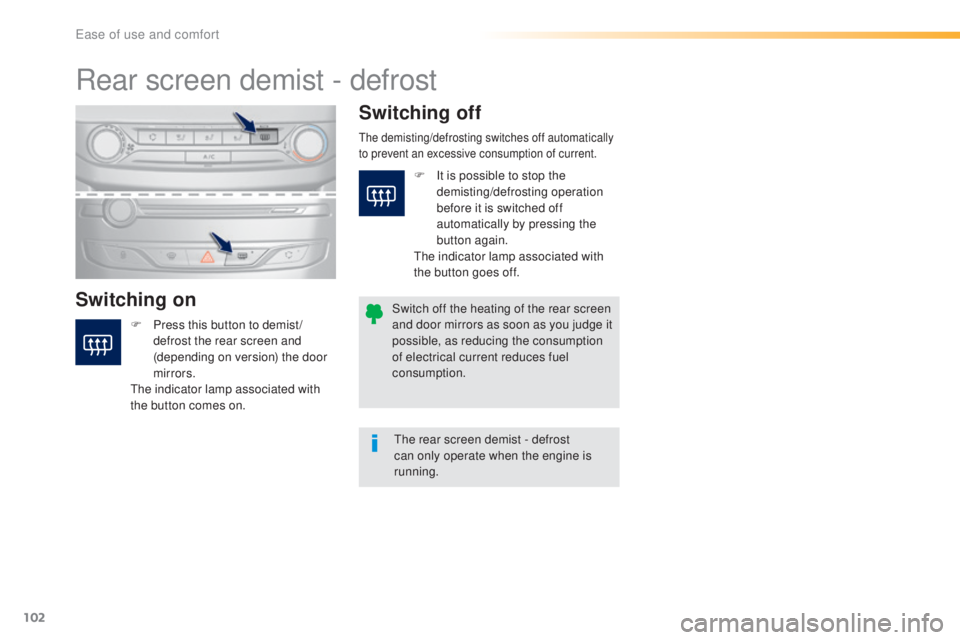
Rear screen demist - defrost
Switching onSwitching off
F Press this button to demist /
d
efrost the rear screen and
(depending on version) the door
mirrors.
the i
ndicator lamp associated with
the button comes on.
the demisting/defrosting switches off automatically
t o prevent an excessive consumption of current.
the rear screen demist - defrost
c an only operate when the engine is
running.
Switch off the heating of the rear screen
and door mirrors as soon as you judge it
possible, as reducing the consumption
of electrical current reduces fuel
consumption. F
It i
s possible to stop the
demisting/defrosting operation
before it is switched off
automatically by pressing the
button again.
the i
ndicator lamp associated with
the button goes off.
ease of use and comfort
Page 106 of 398
104
308_en_Chap03_ergonomie-et-confort_ed02-2015
Courtesy lamps
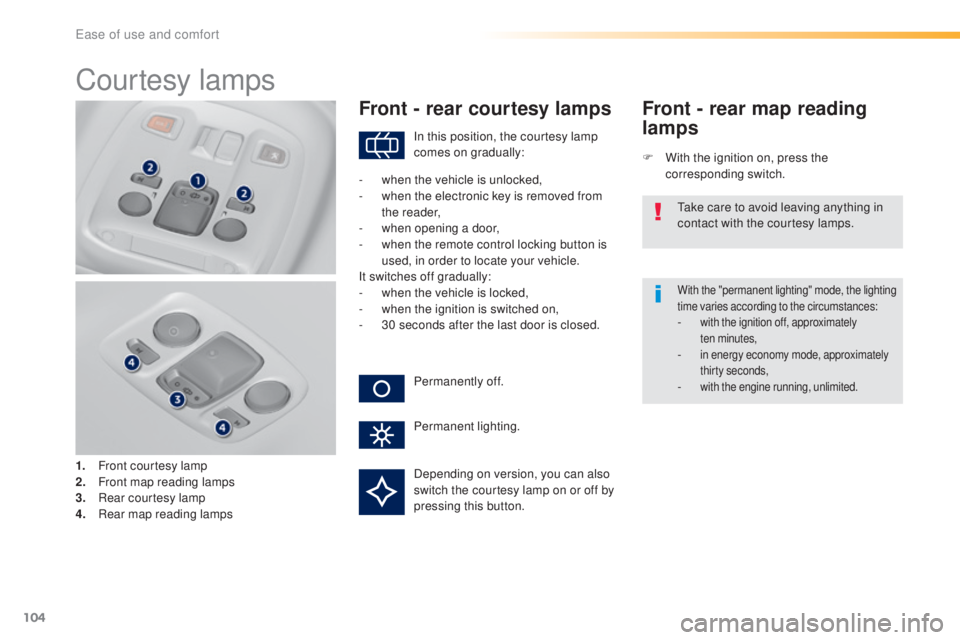
1. Front courtesy lamp
2. Fr ont map reading lamps
3.
Re
ar courtesy lamp
4.
Re
ar map reading lamps
Front - rear courtesy lamps
F With the ignition on, press the
corresponding switch.
Front - rear map reading
lamps
With the "permanent lighting" mode, the lighting
time varies according to the circumstances:
- with the ignition off, approximately
ten m inutes,
- in energy economy mode, approximately
thirty seconds,
- with the engine running, unlimited.
In this position, the courtesy lamp
comes on gradually:
Permanently off.
Permanent lighting.
-
wh
en the vehicle is unlocked,
-
wh
en the electronic key is removed from
the reader,
-
when
opening a door,
-
wh
en the remote control locking button is
used, in order to locate your vehicle.
It switches off gradually:
-
wh
en the vehicle is locked,
-
wh
en the ignition is switched on,
-
30 s
econds after the last door is closed.
tak
e care to avoid leaving anything in
contact with the courtesy lamps.
Depending on version, you can also
switch the courtesy lamp on or off by
pressing this button.
ease of use and comfort