2016 Peugeot 308 heating
[x] Cancel search: heatingPage 104 of 398
102
308_en_Chap03_ergonomie-et-confort_ed02-2015
Rear screen demist - defrost
Switching onSwitching off
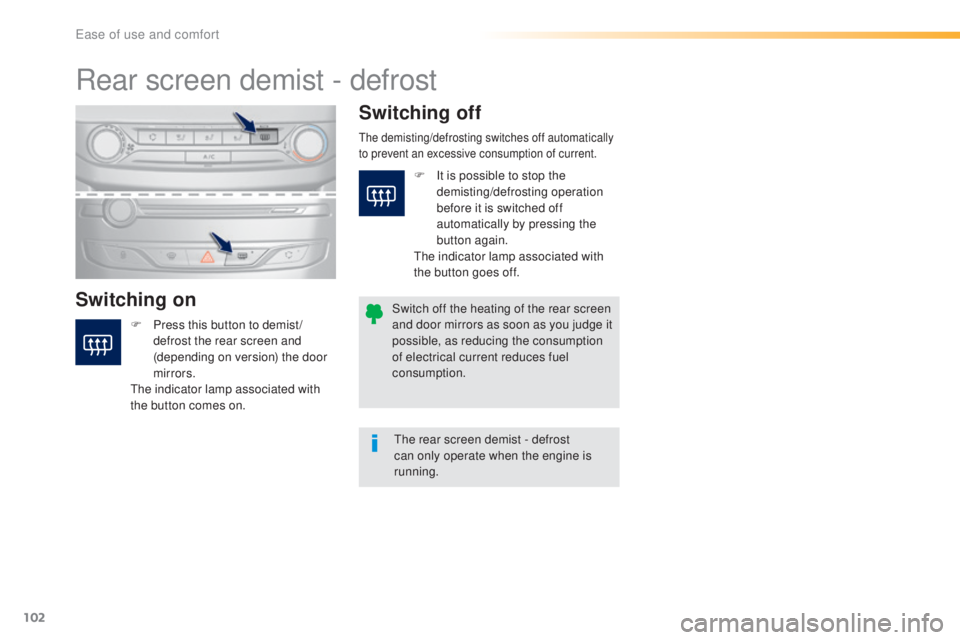
F Press this button to demist /
d
efrost the rear screen and
(depending on version) the door
mirrors.
the i
ndicator lamp associated with
the button comes on.
the demisting/defrosting switches off automatically
t o prevent an excessive consumption of current.
the rear screen demist - defrost
c an only operate when the engine is
running.
Switch off the heating of the rear screen
and door mirrors as soon as you judge it
possible, as reducing the consumption
of electrical current reduces fuel
consumption. F
It i
s possible to stop the
demisting/defrosting operation
before it is switched off
automatically by pressing the
button again.
the i
ndicator lamp associated with
the button goes off.
ease of use and comfort
Page 148 of 398
146
308_en_Chap06_conduite_ed02-2015
A few driving recommendations
Observe the driving regulations at all times and
remain vigilant whatever the traffic conditions.
Pay close attention to the traffic and keep your
hands on the wheel so that you are ready to
react at any time to any eventuality.
On a long journey, a break every two hours is
strongly recommended.
In difficult weather, drive smoothly, anticipate
the need to brake and increase the distance
from other vehicles.Never drive with the parking brake
applied - Risk of overheating and
damage to the braking system!
Do not park or run the engine when
stationary in areas where inflammable
substances and materials (dry grass,
dead leaves...) might come into contact
with the hot exhaust system - Risk of
fire!
Never leave a vehicle unsupervised
with the engine running. If you have
to leave your vehicle with the engine
running, apply the parking brake
and put the gearbox into neutral or
position
N
or P, depending on the type
of gearbox.
Driving on flooded
roads
We strongly advise against driving on flooded
roads, as this could cause serious damage
to the engine or gearbox, as well as to the
electrical systems of your vehicle.
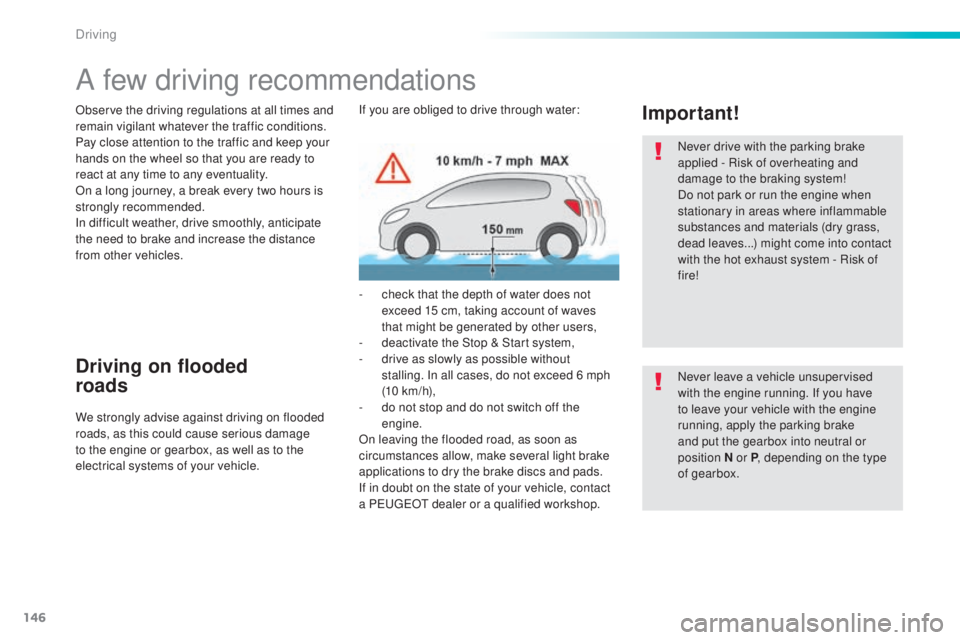
Important!If you are obliged to drive through water:
-
ch
eck that the depth of water does not
exceed 15 cm, taking account of waves
that might be generated by other users,
-
de
activate the Stop & Start system,
-
dr
ive as slowly as possible without
stalling. In all cases, do not exceed 6 mph
(10
k
m/h),
-
do n
ot stop and do not switch off the
engine.
On leaving the flooded road, as soon as
circumstances allow, make several light brake
applications to dry the brake discs and pads.
If in doubt on the state of your vehicle, contact
a P
eu
ge
Ot d
ealer or a qualified workshop.
Driving
Page 149 of 398
147
308_en_Chap06_conduite_ed02-2015
When towing
Distribution of loads
F Distribute the load in the trailer so that the
heaviest items are as close as possible to
the axle and the nose weight approaches
the maximum permitted without
exceeding
it
.
Air density decreases with altitude, thus
reducing engine performance. Above
1
0
00
m
etres, the maximum towed load must
be reduced by 10
% f
or every 1
0
00 metres of
altitude.
Side wind
F take into account the increased sensitivity
t o side wind.
Cooling
towing a trailer on a slope increases the
t emperature of the coolant.
As the fan is electrically controlled, its cooling
capacity is not dependent on the engine speed.
F
t
o lo
wer the engine speed, reduce your
speed.
the m
aximum towed load on a long incline
depends on the gradient and the ambient
temperature.
In all cases, keep a check on the coolant
temperature.
F
If t
he warning lamp and the
STOP warning lamp come on,
stop the vehicle and switch off
the engine as soon as possible.
Braking
towing a trailer increases the braking distance.to av oid overheating of the brakes, the use of
engine braking is recommended.
Ty r e s
F Check the tyre pressures of the towing
v ehicle and of the trailer, observing the
recommended pressures.
Lighting
F Check the electrical lighting and signalling
o n the trailer and the hadlamp beam height
of your vehicle.
For more information on adjusting the
headlamp beam height, refer to the
corresponding section.
For more information on weights (and
the towed loads which apply to your
vehicle) refer to the corresponding
section.
the r
ear parking sensors will be
deactivated automatically if a genuine
P
eu
ge
Ot t
owbar is used.
6
Driving
Page 151 of 398

149
308_en_Chap06_conduite_ed02-2015
F With a petrol engine, operate the starter
motor by turning the key to position 3
until the engine starts, without pressing
the accelerator. Once the engine starts,
release the key. F Wi
th a Diesel engine, turn the key to
position 2 , ignition on, to operates the
engine pre-heating.
F
Wa
it until this warning lamp
goes off in the instrument panel
then operate the starter motor
by turning the key to position 3
until the engine starts, without
pressing the accelerator. Once
the engine starts, release
t h e
k
ey.
In wintry conditions, the pre-heater warning
lamp will stay on for a longer period.
When the engine is hot, the warning lamp
does not come on.
In temperate conditions, do not leave
the engine running to warm up, but set
off straight away and drive at moderate
speed. If the engine does not start straight
away, switch off the ignition.
Wait a few moments before trying
again. If the engine does not start after
a few attempts, do not keep trying: you
risk damaging the starter motor and the
engine.
Call on a P
eu
ge
Ot d
ealer or a
qualified workshop.
6
Driving
Page 273 of 398

271
308_en_Chap08_en-cas-de-panne_ed02-2015
Fuesbox 2
FuseN° Rating
(A) Functions
F8 30Diesel emissions control system (AdBlue
®).
F10 5Automatic gearbox.
F12 15Automatic gearbox.
Version 2 (Eco)
Fuse
N° Rating
(A) Functions
F13 5Built-in systems inter face.
F16 15Front foglamps.
F18 10Right hand main beam headlamp.
F19 10Left hand main beam headlamp.
F25 40Headlamp wash relay (aftermarket fitment).
F27 25Built-in systems inter face.
F28 30Diesel emissions control system (AdBlue
®).
F29 30Front wiper motor.
F30 80Pre-heater plugs (Diesel), additional programmable heating
(aftermarket fitment), headlamp wash pump.
8
In the event of a breakdown
Page 387 of 398
385
308_en_Chap11_index-alpha_ed02-2015
gear lever, manual gearbox .........................16 3gear
shift indicator ....................................... 16
4
glov
e box, refrigerated
................................... 80gui
de-me-home
...............................
.............113
Jack
.............................................................
..250
Hazard warning lamps
..........................
11
9 , 2 4 3
Hazard warning lamps, automatic operation
.................................... 11
9
Headlamp adjustment
................................... 11
4
Headlamps, automatic illumination
...............................
...1 0 9 , 112 , 113
Headlamps, dipped beam
............ 1
08, 256, 258
Headlamps, halogen
............................ 25
6, 258
Headlamps, main beam
....... 10
8, 256, 258, 260
Headlamp wash
............................................ 11
6
Head restraints, front
...................................... 75
H
ead restraints, rear
................................. 7
8, 79
Heating
................
.........................90, 92, 94, 96
Hill start assist
............................................... 162I
dentification, vehicle ....................................
295
I gnition on........................................ 9 9, 150, 152
Immobiliser, electronic
...................... 5
1, 63, 154
I n d i c a t o r, coolant temperature
..................................... 28
I
ndicator, engine oil level
................................31
I
ndicator lamps, operation
.........................1
3 -17
Indicators, direction
...................................... 111
I
nflating tyres
..............................
............10, 295
Inflating tyres and accessories (using the kit)
.............................................. 24
9
Instrument panel
............................................. 12
I
ntelligent
trac
tion Control
............................121
I
nteractive help
........................................41
, 3 41
Inter-vehicle time
........................................... 187
I
SOFIX seats
.................................................1
41
I
SO
FIX
mou
ntings................................. 13 9, 14 0
J
H
Key ............................................................ 48-63
Keyless ent ry
and Starting
...................... 5
6 -58, 63, 151, 154
Key with remote control
.............. 4
9, 51, 57, 154
Kit, hands-free
...................................... 3
5 0 , 374
Kit, temporary puncture repair
.......... 8
6, 87, 244
Labels, identification
..................................... 295
LeDs
- light-emitting diodes
......... 2
56, 261, 263
Level, AdBlue
® additive ................................. 23 5
Level, brake fluid ........................................... 231
L
evel, Diesel additive
............................ 23
2, 233
Level, engine coolant
.............................. 2
8, 231
Level, engine oil
...................................... 3
1, 2 29
Level, headlamp wash
........................... 1
17, 2 3 1
Levels and checks
................ 2
27-229, 231, 232
Level, screenwash fluid
......................... 1
17, 2 3 1
Light-emitting diodes - L
eDs ........ 2
56, 261, 263
Lighting
.......................................................... 10
8
Lighting dimmer
.............................................. 33
L
ighting, guide-me home
........................ 5
1, 113
Lighting, interior
.................................... 10
4, 105
Lighting, mood
..............................
................105
Lighting, welcome
......................................... 11
3
Loading
..............................
..................... 10, 223
Load reduction mode
.................................... 2
19
Locating your vehicle
................................ 51,
5 5
Locking
............................................................ 63
KI
L
.
Alphabetical index
Page 397 of 398
106
Lighting and visibility
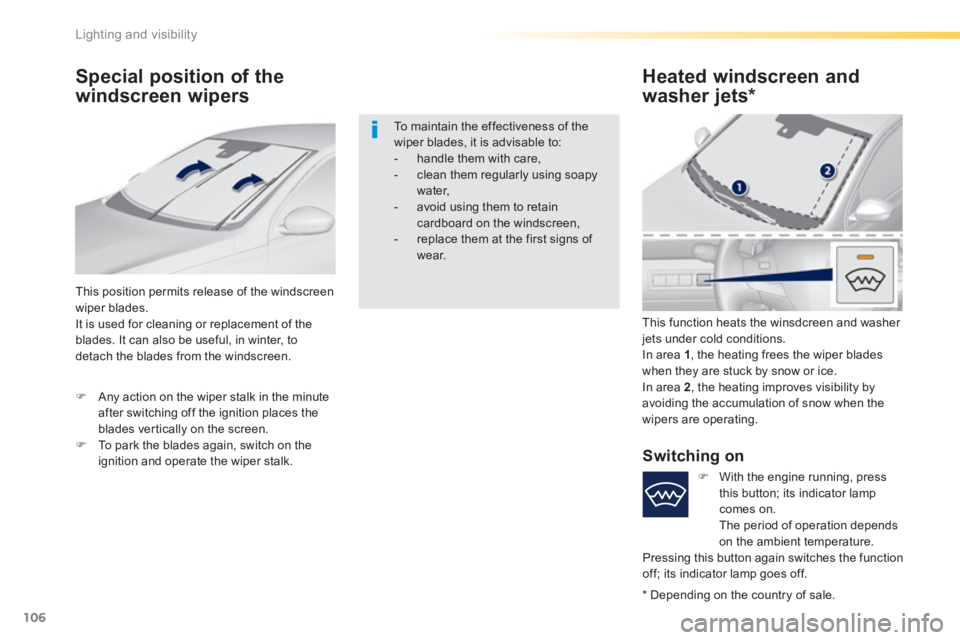
Special position of the
windscreen wipers
Heated windscreen and
washer jets *
This position permits release of the windscreen
wiper blades.
It is used for cleaning or replacement of the
blades. It can also be useful, in winter, to
detach the blades from the windscreen.
This function heats the winsdcreen and washer
jets under cold conditions.
In area 1
, the heating frees the wiper blades
when they are stuck by snow or ice.
In area 2
, the heating improves visibility by
avoiding the accumulation of snow when the
wipers are operating.
To maintain the effectiveness of the
wiper blades, it is advisable to:
- handle them with care,
- clean them regularly using soapy
water,
- avoid using them to retain
cardboard on the windscreen,
- replace them at the first signs of
wear.
)
Any action on the wiper stalk in the minute
after switching off the ignition places the
blades vertically on the screen.
)
To park the blades again, switch on the
ignition and operate the wiper stalk.
Switching on
*
Depending on the country of sale.
)
With the engine running, press
this button; its indicator lamp
comes on.
The period of operation depends
on the ambient temperature.
Pressing this button again switches the function
off; its indicator lamp goes off.