Page 109 of 398
107
308_en_Chap04_eclairage-et-visibilite_ed02-2015
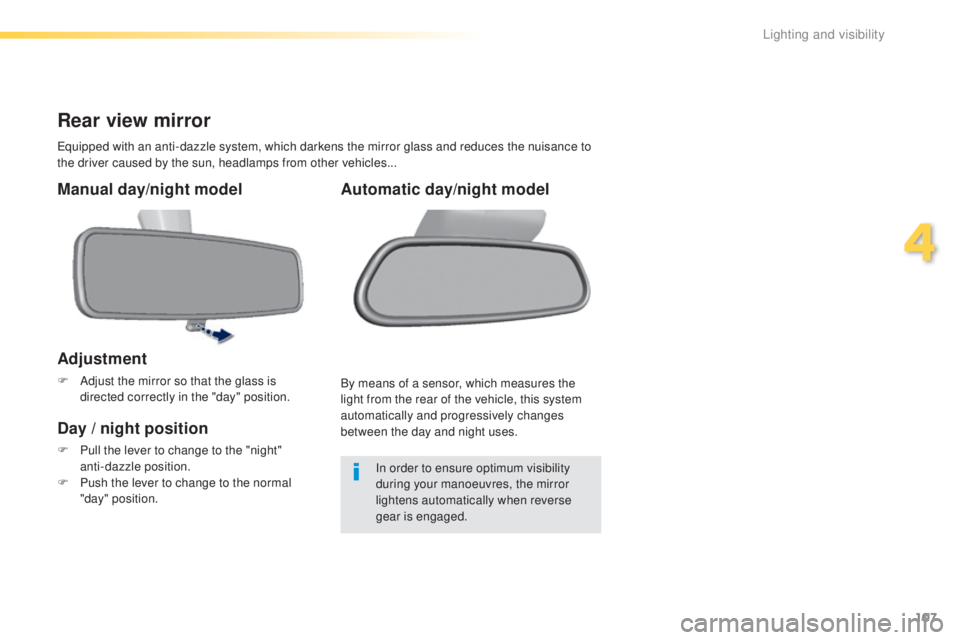
Rear view mirror
equipped with an anti-dazzle system, which darkens the mirror glass and reduces the nuisance to
t he driver caused by the sun, headlamps from other vehicles...
Manual day/night model
Adjustment
F Adjust the mirror so that the glass is
d irected correctly in the "day" position.
In order to ensure optimum visibility
during your manoeuvres, the mirror
lightens automatically when reverse
gear is engaged.
Day / night position
F Pull the lever to change to the "night"
anti-dazzle position.
F
Pu
sh the lever to change to the normal
"day" position.
Automatic day/night model
By means of a sensor, which measures the
light from the rear of the vehicle, this system
automatically and progressively changes
between the day and night uses.
4
Lighting and visibility
Page 117 of 398
115
308_en_Chap04_eclairage-et-visibilite_ed02-2015
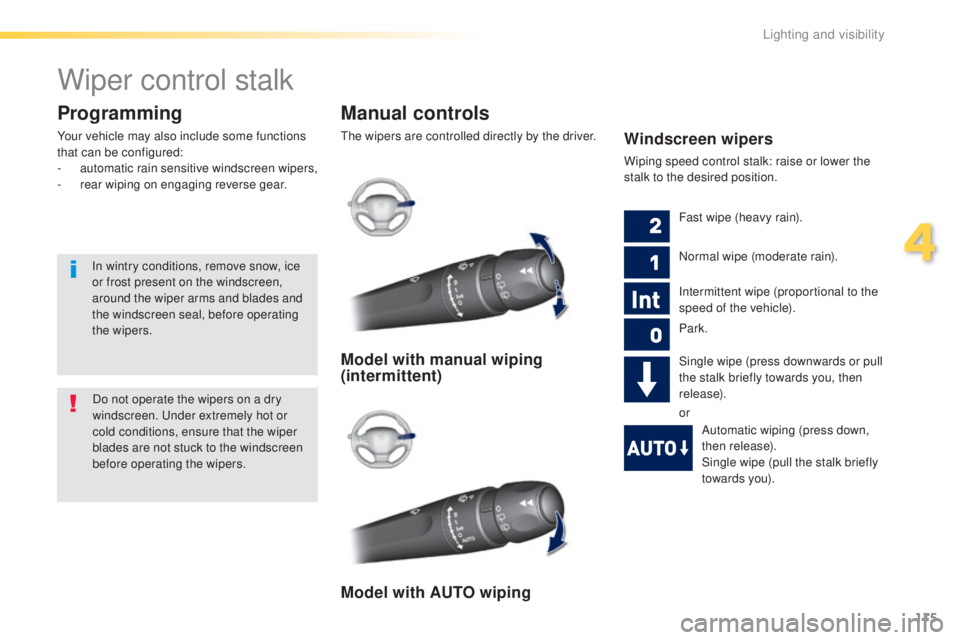
Wiper control stalk
Manual controls
the wipers are controlled directly by the driver.
Programming
Your vehicle may also include some functions
that can be configured:
-
au
tomatic rain sensitive windscreen wipers,
-
rea
r wiping on engaging reverse gear.Windscreen wipers
Wiping speed control stalk: raise or lower the
stalk to the desired position.
Model with manual wiping
(intermittent)
Model with AUTO wiping
Fast wipe (heavy rain).
Normal wipe (moderate rain).
Intermittent wipe (proportional to the
speed of the vehicle).
Park.
Single wipe (press downwards or pull
the stalk briefly towards you, then
release).
orAutomatic wiping (press down,
then release).
Single wipe (pull the stalk briefly
towards you).
Do not operate the wipers on a dry
windscreen.
und
er extremely hot or
cold conditions, ensure that the wiper
blades are not stuck to the windscreen
before operating the wipers.
In wintry conditions, remove snow, ice
or frost present on the windscreen,
around the wiper arms and blades and
the windscreen seal, before operating
the wipers.
4
Lighting and visibility
Page 118 of 398
116
308_en_Chap04_eclairage-et-visibilite_ed02-2015
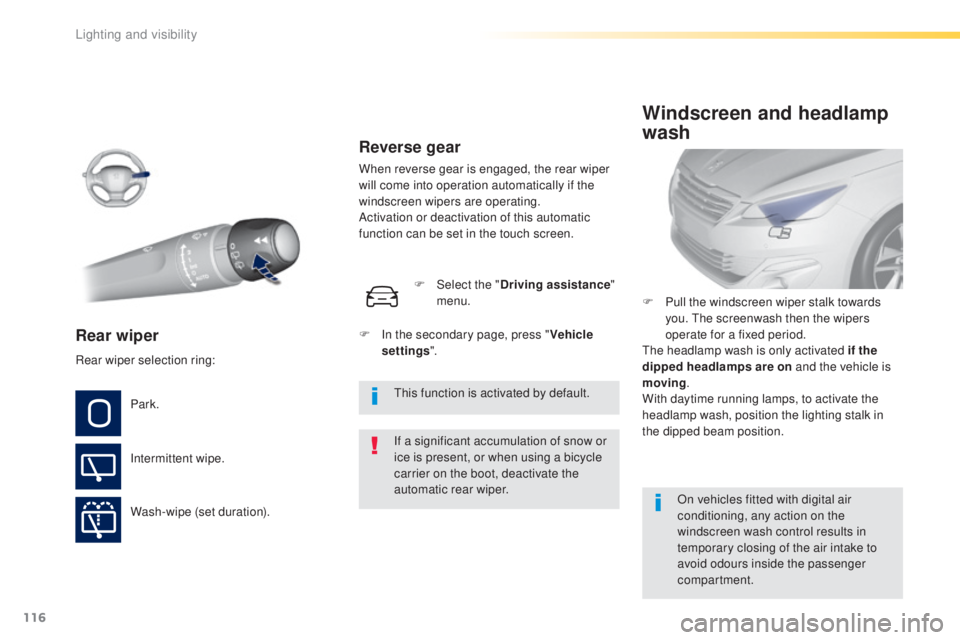
Rear wiper
If a significant accumulation of snow or
ice is present, or when using a bicycle
carrier on the boot, deactivate the
automatic rear wiper.
Park.
Intermittent wipe.
Wash-wipe (set duration). F
Pu
ll the windscreen wiper stalk towards
you.
the s
creenwash then the wipers
operate for a fixed period.
the h
eadlamp wash is only activated if the
dipped headlamps are on and the vehicle is
moving .
With daytime running lamps, to activate the
headlamp wash, position the lighting stalk in
the dipped beam position.
Windscreen and headlamp
wash
On vehicles fitted with digital air
conditioning, any action on the
windscreen wash control results in
temporary closing of the air intake to
avoid odours inside the passenger
compartment.
Rear wiper selection ring:
thi
s function is activated by default.
F
In t
he secondary page, press "
Vehicle
settings ".
F
Selec
t the "
Driving assistance "
menu.
Reverse gear
When reverse gear is engaged, the rear wiper
will come into operation automatically if the
windscreen wipers are operating.
Activation or deactivation of this automatic
function can be set in the touch screen.
Lighting and visibility
Page 148 of 398
146
308_en_Chap06_conduite_ed02-2015
A few driving recommendations
Observe the driving regulations at all times and
remain vigilant whatever the traffic conditions.
Pay close attention to the traffic and keep your
hands on the wheel so that you are ready to
react at any time to any eventuality.
On a long journey, a break every two hours is
strongly recommended.
In difficult weather, drive smoothly, anticipate
the need to brake and increase the distance
from other vehicles.Never drive with the parking brake
applied - Risk of overheating and
damage to the braking system!
Do not park or run the engine when
stationary in areas where inflammable
substances and materials (dry grass,
dead leaves...) might come into contact
with the hot exhaust system - Risk of
fire!
Never leave a vehicle unsupervised
with the engine running. If you have
to leave your vehicle with the engine
running, apply the parking brake
and put the gearbox into neutral or
position
N
or P, depending on the type
of gearbox.
Driving on flooded
roads
We strongly advise against driving on flooded
roads, as this could cause serious damage
to the engine or gearbox, as well as to the
electrical systems of your vehicle.
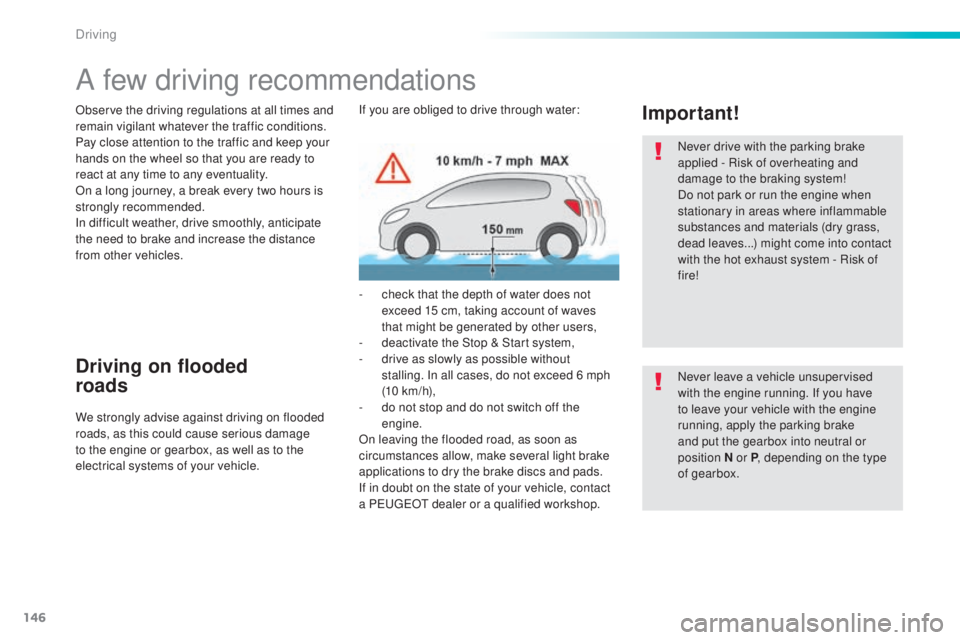
Important!If you are obliged to drive through water:
-
ch
eck that the depth of water does not
exceed 15 cm, taking account of waves
that might be generated by other users,
-
de
activate the Stop & Start system,
-
dr
ive as slowly as possible without
stalling. In all cases, do not exceed 6 mph
(10
k
m/h),
-
do n
ot stop and do not switch off the
engine.
On leaving the flooded road, as soon as
circumstances allow, make several light brake
applications to dry the brake discs and pads.
If in doubt on the state of your vehicle, contact
a P
eu
ge
Ot d
ealer or a qualified workshop.
Driving
Page 150 of 398
148
308_en_Chap06_conduite_ed02-2015
Starting-switching off the engine, remote control
Put the gear lever into neutral.
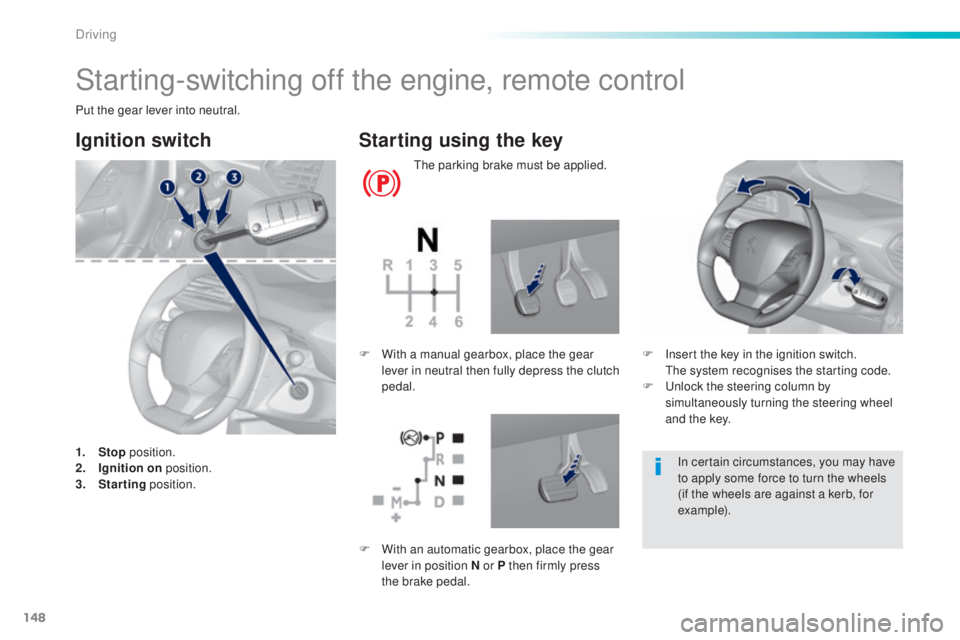
Ignition switch
1. Stop p osition.
2. Ig nition on position.
3.
Sta
rting position.
Starting using the key
the parking brake must be applied.
F
In
sert the key in the ignition switch.
the s
ystem recognises the starting code.
F
u
nl
ock the steering column by
simultaneously turning the steering wheel
and the key.
F
Wi
th a manual gearbox, place the gear
lever in neutral then fully depress the clutch
pedal.
In certain circumstances, you may have
to apply some force to turn the wheels
(if the wheels are against a kerb, for
example).
F
Wi
th an automatic gearbox, place the gear
lever in position N or P then firmly press
the brake pedal.
Driving
Page 152 of 398
150
308_en_Chap06_conduite_ed02-2015
Avoid attaching heavy objects to the
key, which would weigh down on its
blade in the ignition switch and could
cause a malfunction.
Switching off the engine leads to a loss
of braking assistance.
Key left in the "Ignition on"
position
If the key has been left in the ignition switch
at position 2 (Ignition on)
, the ignition will
be switched off automatically after one hour.
to sw
itch the ignition back on, turn the
key to position 1 (Stop) , then back to
position
2 (
Ignition on) .
Never leave the engine running in
an enclosed area without adequate
ventilation: internal combustion
engines emit toxic exhaust gases,
such as carbon monoxide. Danger of
intoxication and death.
In very severe wintry conditions
(temperatures below -23°C), to ensure
the correct operation and the durability
of the mechanical components of your
vehicle, the engine and gearbox, it is
necessary to leave the engine running
for 4 minutes before moving off. F Immo
bilise the vehicle.
F tur n the key fully towards you to
position
1 (
Stop).
F
Re
move the key from the ignition switch.
F
t
o lo
ck the steering column, turn the
steering wheel until it locks.
Switching off using the key
to facilitate unlocking of the steering
w heel, it is recommended that you
place the wheels in the straight ahead
position before switching off the engine.
F
Ch
eck that the parking brake is
correctly applied, particularly
when parking on a slope.
●
Wi
th a manual parking brake,
the lever must be pulled up.
●
Wi
th an electric parking brake,
the indicator lamp in the
control lever must be on. When leaving the vehicle, remove the
key and lock the doors.
Never switch off the ignition until the vehicle
has been brought to a complete stop.
Driving
Page 156 of 398
154
308_en_Chap06_conduite_ed02-2015
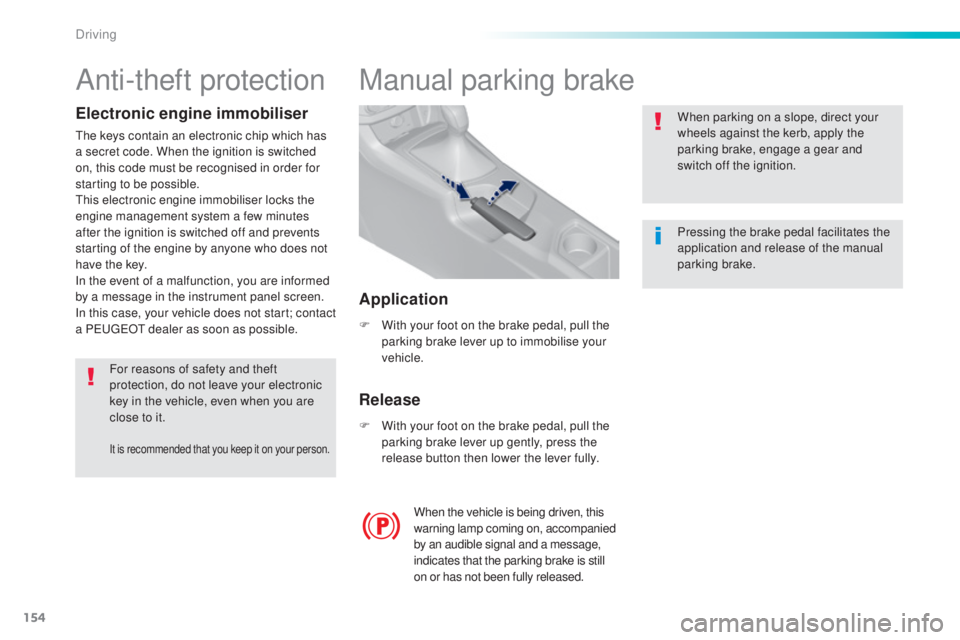
Manual parking brake
F With your foot on the brake pedal, pull the
parking brake lever up to immobilise your
vehicle.
F
Wi
th your foot on the brake pedal, pull the
parking brake lever up gently, press the
release button then lower the lever fully. When parking on a slope, direct your
wheels against the kerb, apply the
parking brake, engage a gear and
switch off the ignition.
When the vehicle is being driven, this
warning lamp coming on, accompanied
by an audible signal and a message,
indicates that the parking brake is still
on or has not been fully released. Pressing the brake pedal facilitates the
application and release of the manual
parking brake.
Release Application
Anti-theft protection
Electronic engine immobiliser
the keys contain an electronic chip which has
a s ecret code. When the ignition is switched
on, this code must be recognised in order for
starting to be possible.
thi
s electronic engine immobiliser locks the
engine management system a few minutes
after the ignition is switched off and prevents
starting of the engine by anyone who does not
have the key.
In the event of a malfunction, you are informed
by a message in the instrument panel screen.
In this case, your vehicle does not start; contact
a P
eu
ge
Ot d
ealer as soon as possible.
For reasons of safety and theft
protection, do not leave your electronic
key in the vehicle, even when you are
close to it.
It is recommended that you keep it on your person.
Driving
Page 157 of 398
155
308_en_Chap06_conduite_ed02-2015
electric parking brake
Never leave a child alone inside the
vehicle with the ignition on, as they
could release the parking brake.
Indicator lamp
this indicator lamp comes on in the
i nstrument panel and in the control
lever to confirm the application of the
parking brake.
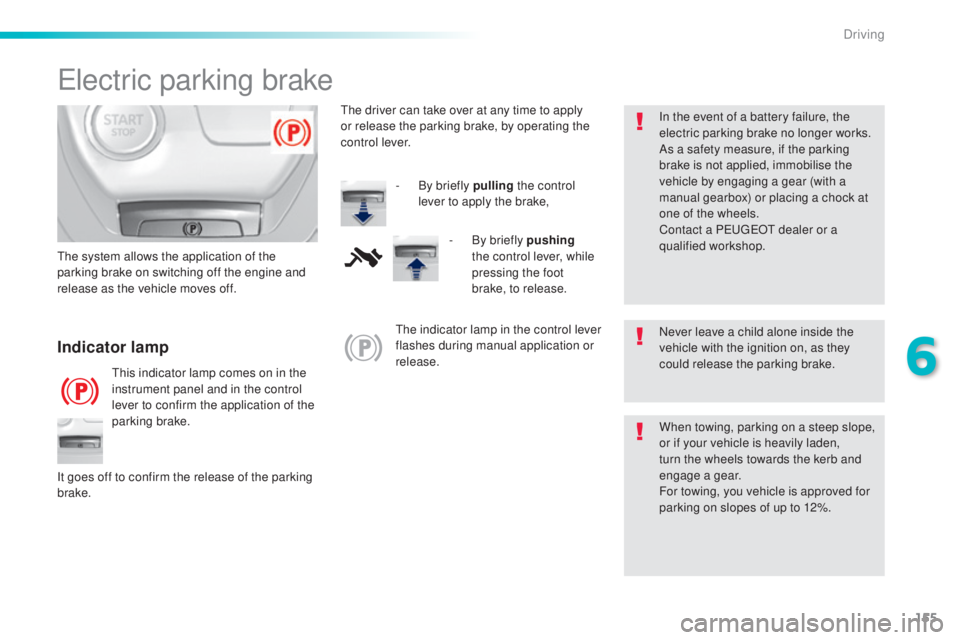
the s
ystem allows the application of the
parking brake on switching off the engine and
release as the vehicle moves off.
When towing, parking on a steep slope,
or if your vehicle is heavily laden,
turn the wheels towards the kerb and
engage a gear.
For towing, you vehicle is approved for
parking on slopes of up to 12%.
It goes off to confirm the release of the parking
brake.
the i
ndicator lamp in the control lever
flashes during manual application or
release. In the event of a battery failure, the
electric parking brake no longer works.
As a safety measure, if the parking
brake is not applied, immobilise the
vehicle by engaging a gear (with a
manual gearbox) or placing a chock at
one of the wheels.
Contact a P
eu
ge
Ot d
ealer or a
qualified workshop.
the d
river can take over at any time to apply
or release the parking brake, by operating the
control lever.
-
By b
riefly pulling
the control
lever to apply the brake,
-
By b
riefly pushing
the control lever, while
pressing the foot
brake, to release.
6
Driving