Page 136 of 344
134
3008_en_Chap07_securite_ed01-2015
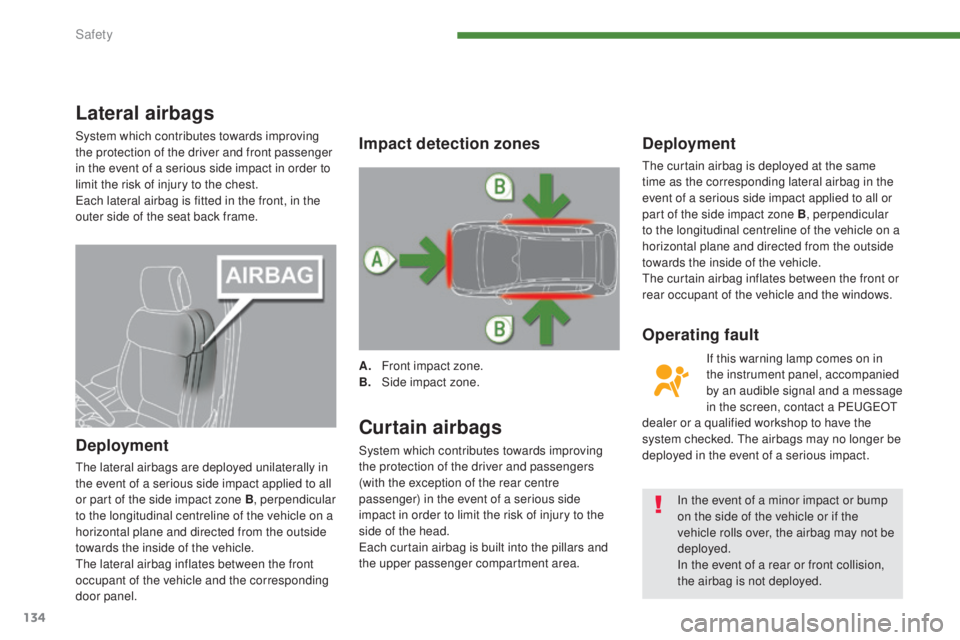
Lateral airbags
System which contributes towards improving
the protection of the driver and front passenger
in the event of a serious side impact in order to
limit the risk of injury to the chest.
Each lateral airbag is fitted in the front, in the
outer side of the seat back frame.
Deployment
The lateral airbags are deployed unilaterally in
the event of a serious side impact applied to all
or part of the side impact zone B, perpendicular
to the longitudinal centreline of the vehicle on a
horizontal plane and directed from the outside
towards the inside of the vehicle.
The lateral airbag inflates between the front
occupant of the vehicle and the corresponding
door panel.
Curtain airbags
System which contributes towards improving
the protection of the driver and passengers
(with the exception of the rear centre
passenger) in the event of a serious side
impact in order to limit the risk of injury to the
side of the head.
Each curtain airbag is built into the pillars and
the upper passenger compartment area.
Deployment
The curtain airbag is deployed at the same
time as the corresponding lateral airbag in the
event of a serious side impact applied to all or
part of the side impact zone B, perpendicular
to the longitudinal centreline of the vehicle on a
horizontal plane and directed from the outside
towards the inside of the vehicle.
The curtain airbag inflates between the front or
rear occupant of the vehicle and the windows.
Impact detection zones
A. Front impact zone.
B. S ide impact zone.
Operating fault
If this warning lamp comes on in
the instrument panel, accompanied
by an audible signal and a message
in the screen, contact a PEUGEOT
dealer or a qualified workshop to have the
system checked. The airbags may no longer be
deployed in the event of a serious impact.
In the event of a minor impact or bump
on the side of the vehicle or if the
vehicle rolls over, the airbag may not be
deployed.
In the event of a rear or front collision,
the airbag is not deployed.
Safety
Page 137 of 344
135
3008_en_Chap07_securite_ed01-2015
Guidelines to follow:
Sit in a normal upright position.
Wear a correctly adjusted seat belt.
Do not allow anything to come between
the occupants and the airbags (a child, pet,
object...), do not attach or fix anything near to
the airbags or their trajectories when inflating
as this could cause injuries when the airbags
are deployed.
Never modify the original definition of your
vehicle, particularly in the area directly
around the airbags.
After an accident or if the vehicle has been
stolen or broken into, have the airbag systems
checked.
All work on the airbag system must be carried
out by a PEUGEOT dealer or a qualified
workshop.
Even if all of the precautions mentioned
are observed, a risk of injury or of minor
burns to the head, chest or arms when an
airbag is deployed cannot be ruled out. The
bag inflates almost instantly (within a few
milliseconds) then deflates within the same
time discharging the hot gas via openings
provided for this purpose.
Lateral airbags
Use only approved covers on the seats,
compatible with the deployment the lateral
airbags. For information on the range of seat
covers suitable for your vehicle, you can
contact a PEUGEOT dealer.
Refer to the "Accessories" section.
Do not fix or attach anything to the seat backs
(clothing...). This could cause injury to the
chest or arms if the lateral airbag is deployed.
Do not sit with the upper part of the body any
nearer to the door than necessary.
Front airbags
Do not drive holding the steering wheel by its
spokes or resting your hands on the centre
part of the wheel.
Passengers must not place their feet on the
dashboard.
Do not smoke as deployment of the airbags
can cause burns or the risk of injury from a
cigarette or pipe.
Never remove or pierce the steering wheel or
hit it violently.
Do not fit or attach anything to the steering
wheel or dashboard, this could cause injuries
with deployment of the airbags.
Curtain airbags
Do not fix or attach anything to the roof. This
could cause injury to the head if the curtain
airbag is deployed.
If fitted on your vehicle, do not remove the
grab handles installed on the roof, they play a
part in securing the curtain airbags.
7
Safety
Page 183 of 344
181
3008_en_Chap09_verifications_ed01-2015
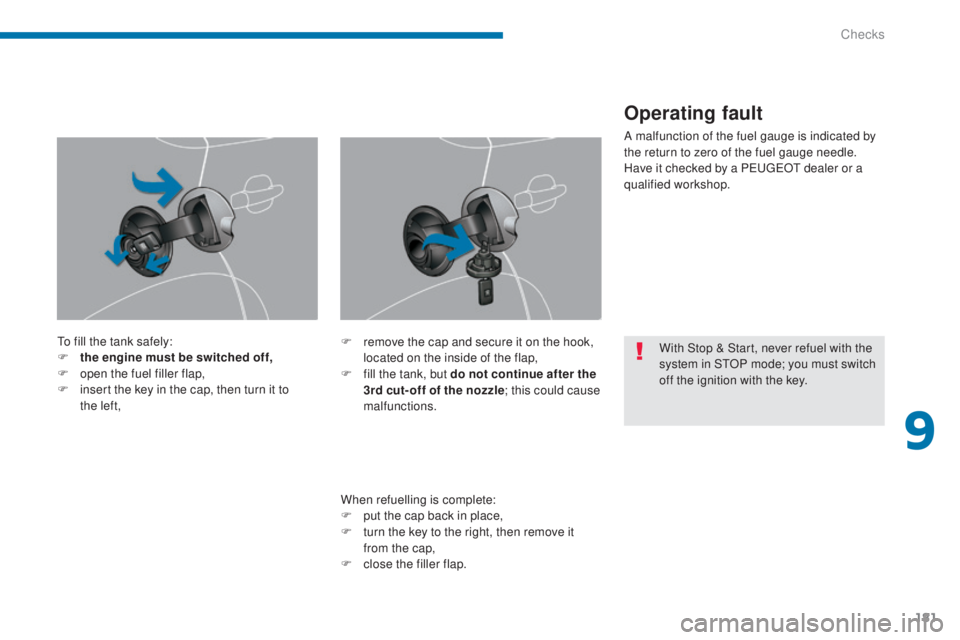
To fill the tank safely:
F t he engine must be switched off,
F
o
pen the fuel filler flap,
F
i
nsert the key in the cap, then turn it to
the
left,
When refuelling is complete:
F
p
ut the cap back in place,
F
t
urn the key to the right, then remove it
from the cap,
F
c
lose the filler flap.
F
r emove the cap and secure it on the hook,
located on the inside of the flap,
F
f
ill the tank, but do not continue after the
3rd cut- off of the nozzle ; this could cause
malfunctions.
Operating fault
A malfunction of the fuel gauge is indicated by
the return to zero of the fuel gauge needle.
Have it checked by a PEUGEOT
dealer or a
qualified workshop.
With Stop & Start, never refuel with the
system in STOP mode; you must switch
off the ignition with the key.
9
Checks
Page 187 of 344
185
3008_en_Chap09_verifications_ed01-2015
Bonnet
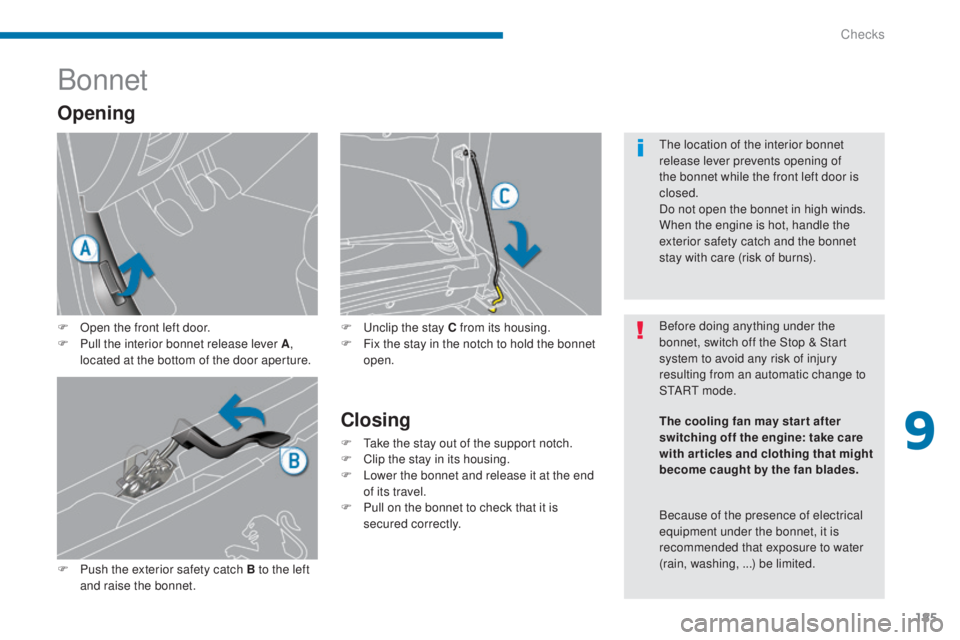
F Open the front left door.
F P ull the interior bonnet release lever A ,
located at the bottom of the door aperture.
F
P
ush the exterior safety catch B to the left
and raise the bonnet.
Closing
F Take the stay out of the support notch.
F C lip the stay in its housing.
F
L
ower the bonnet and release it at the end
of its travel.
F
P
ull on the bonnet to check that it is
secured correctly.
Opening
F Unclip the stay C from its housing.
F F ix the stay in the notch to hold the bonnet
open. Before doing anything under the
bonnet, switch off the Stop & Start
system to avoid any risk of injury
resulting from an automatic change to
S TA R T m o d e . The location of the interior bonnet
release lever prevents opening of
the bonnet while the front left door is
closed.
Do not open the bonnet in high winds.
When the engine is hot, handle the
exterior safety catch and the bonnet
stay with care (risk of burns).
Because of the presence of electrical
equipment under the bonnet, it is
recommended that exposure to water
(rain, washing, ...) be limited. The cooling fan may star t after
switching off the engine: take care
with articles and clothing that might
become caught by the fan blades.
9
Checks
Page 201 of 344
199
3008_en_Chap09_verifications_ed01-2015
Never store bottles of AdBlue® in your
vehicle.
Recommendations on storage
AdBlue® freezes at about -11°C and
deteriorates above 25°C. It is recommended
that bottles be stored in a cool area and
protected from direct sunlight.
Under these conditions, the additive can be
kept for at least a year.
If the additive has frozen, it can be used once it
has completely thawed out.
Procedure
Before topping-up, ensure that the vehicle is
parked on a flat and level sur face.
In wintry conditions, ensure that the
temperature of the vehicle is above -11°C.
Otherwise, by freezing, the AdBlue
® cannot
be poured into its tank. Park your vehicle in a
warmer area for a few hours to allow the top-up
to be carried out.
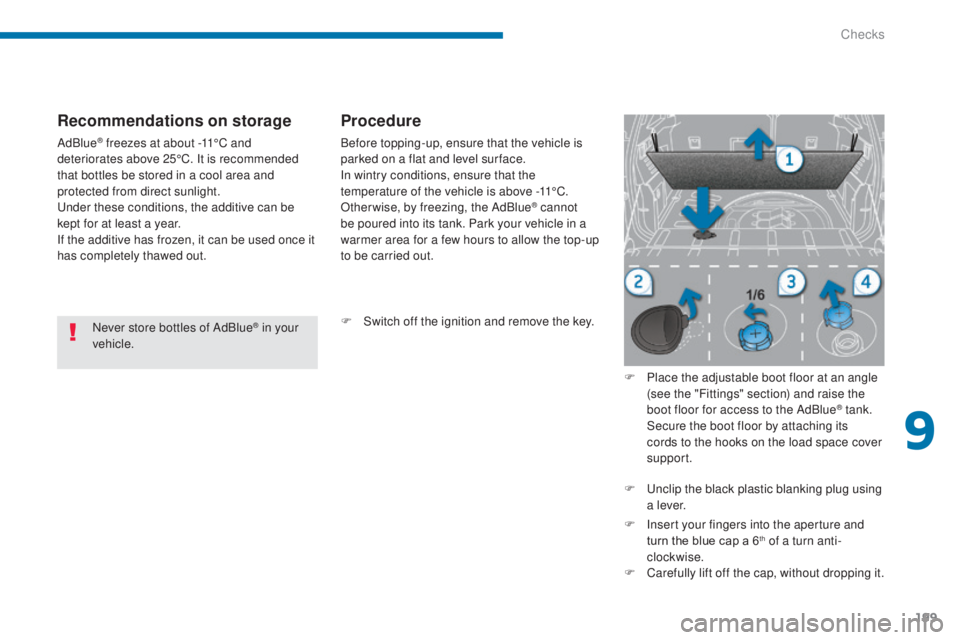
F
S
witch off the ignition and remove the key. F
P
lace the adjustable boot floor at an angle
(see the "Fittings" section) and raise the
boot floor for access to the AdBlue
® tank. S
ecure the boot floor by attaching its
cords to the hooks on the load space cover
support.
F
U
nclip the black plastic blanking plug using
a l eve r.
F
I
nsert your fingers into the aperture and
turn the blue cap a 6
th of a turn anti-
clockwise.
F
C
arefully lift off the cap, without dropping it.
9
Checks
Page 203 of 344
201
3008_en_Chap10_infos-pratiques_ed01-2015
Tool kit
This is a set of tools provided with the vehicle. The content depends on your vehicle's equipment (temporary puncture repair kit or spare wheel).
Access to the tools
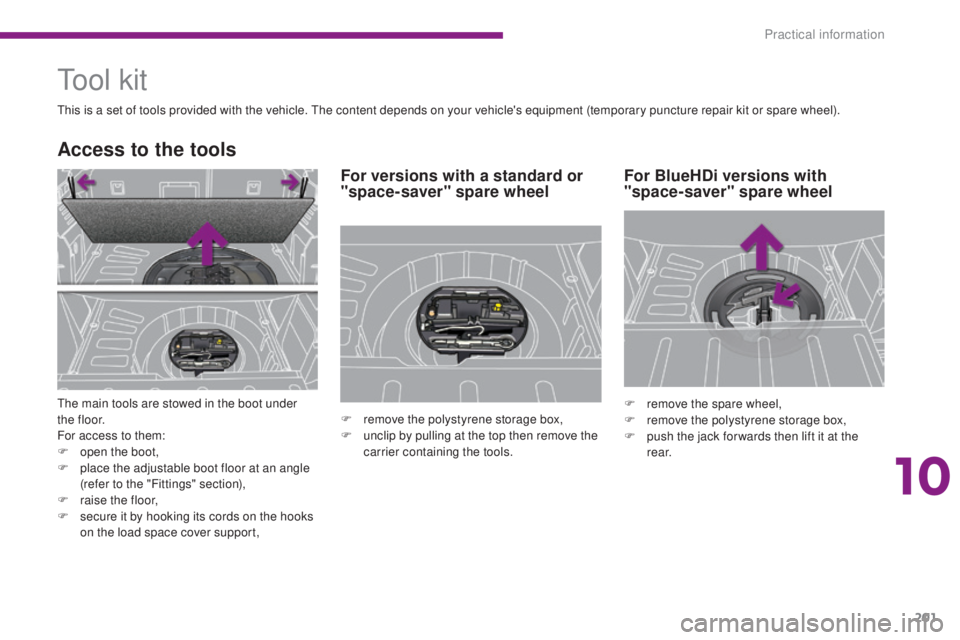
The main tools are stowed in the boot under
t h e f l o o r.
For access to them:
F
o
pen the boot,
F
p
lace the adjustable boot floor at an angle
(refer to the "Fittings" section),
F
r
aise the floor,
F
s
ecure it by hooking its cords on the hooks
on the load space cover support,
For versions with a standard or
"space-saver" spare wheel
F remove the polystyrene storage box,
F u nclip by pulling at the top then remove the
carrier containing the tools.
For BlueHDi versions with
"space-saver" spare wheel
F remove the spare wheel,
F r emove the polystyrene storage box,
F
p
ush the jack for wards then lift it at the
r e a r.
10
Practical information
Page 204 of 344
202
3008_en_Chap10_infos-pratiques_ed01-2015
List of tools
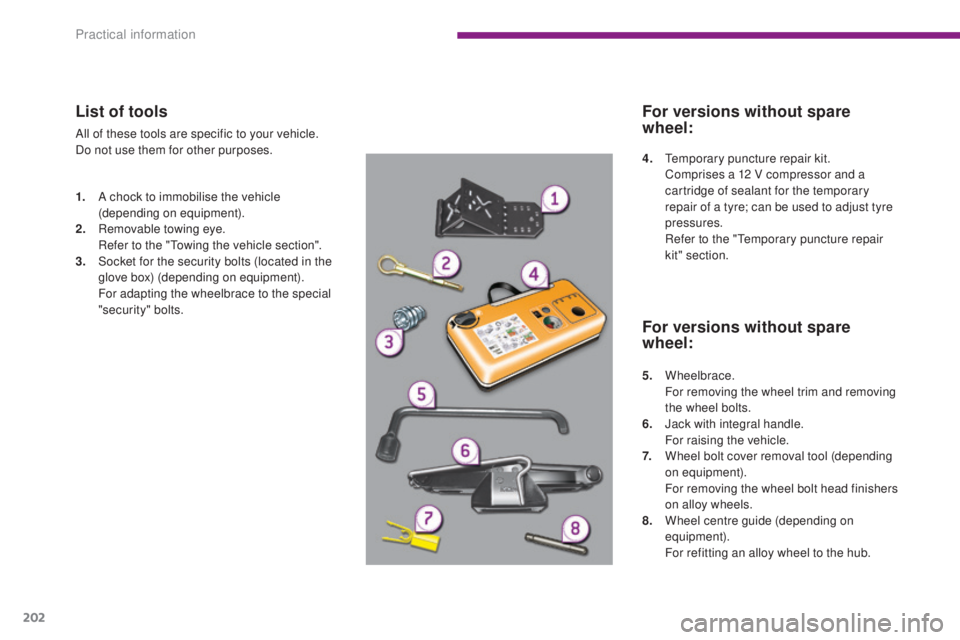
All of these tools are specific to your vehicle.
Do not use them for other purposes.
1.
A c
hock to immobilise the vehicle
(depending on equipment).
2.
R
emovable towing eye.
R
efer to the "Towing the vehicle section".
3.
S
ocket for the security bolts (located in the
glove box) (depending on equipment).
F
or adapting the wheelbrace to the special
"security" bolts. 4.
T
emporary puncture repair kit.
C
omprises a 12 V compressor and a
cartridge of sealant for the temporary
repair of a tyre; can be used to adjust tyre
pressures.
R
efer to the "Temporary puncture repair
kit" section.
5.
Wheelbrace.
F
or removing the wheel trim and removing
the wheel bolts.
6.
J
ack with integral handle.
F
or raising the vehicle.
7.
W
heel bolt cover removal tool (depending
on equipment).
F
or removing the wheel bolt head finishers
on alloy wheels.
8.
W
heel centre guide (depending on
equipment).
F
or refitting an alloy wheel to the hub.
For versions without spare
wheel:
For versions without spare
wheel:
Practical information
Page 211 of 344
209
3008_en_Chap10_infos-pratiques_ed01-2015
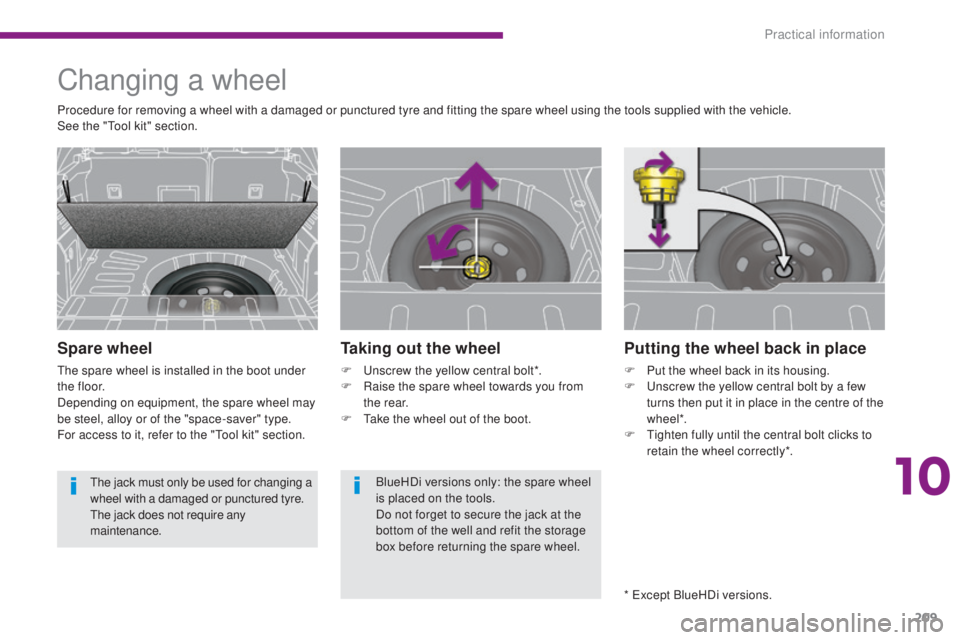
Putting the wheel back in place
F Put the wheel back in its housing.
F U nscrew the yellow central bolt by a few
turns then put it in place in the centre of the
w h e e l*.
F
T
ighten fully until the central bolt clicks to
retain the wheel correctly*.
Changing a wheel
Spare wheel
The spare wheel is installed in the boot under
t h e f l o o r.
Depending on equipment, the spare wheel may
be steel, alloy or of the "space-saver" type.
For access to it, refer to the "Tool kit" section.
Taking out the wheel
F Unscrew the yellow central bolt*.
F R aise the spare wheel towards you from
the rear.
F
T
ake the wheel out of the boot.
Procedure for removing a wheel with a damaged or punctured tyre and fitting the spare wheel using the tools supplied with the vehicle.
See the "Tool kit" section.
* Except BlueHDi versions.
BlueHDi versions only: the spare wheel
is placed on the tools.
Do not forget to secure the jack at the
bottom of the well and refit the storage
box before returning the spare wheel.
The jack must only be used for changing a
wheel with a damaged or punctured tyre.
The jack does not require any
maintenance.
10
Practical information