2016 PEUGEOT 3008 ECU
[x] Cancel search: ECUPage 120 of 344
118
3008_en_Chap06_securite-enfants_ed01-2015
"ISOFIX" mountings
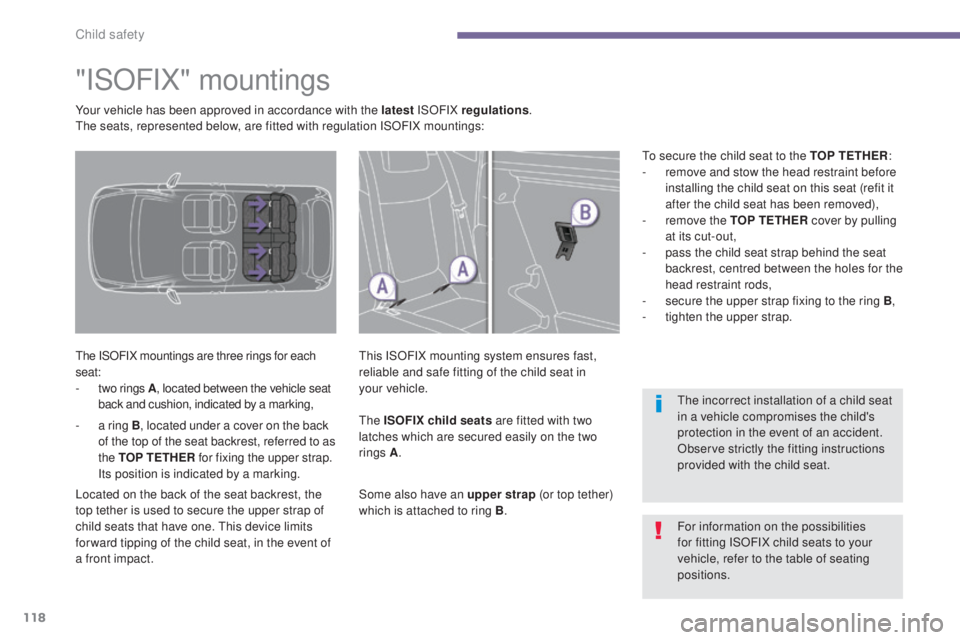
The ISOFIX mountings are three rings for each
seat:
-
t
wo rings A, located between the vehicle seat
back and cushion, indicated by a marking, This ISOFIX mounting system ensures fast,
reliable and safe fitting of the child seat in
your
vehicle.
The ISOFIX child seats are fitted with two
latches which are secured easily on the two
rings A .
Some also have an upper strap (or top tether)
which is attached to ring B .To secure the child seat to the TOP TETHER
:
-
r
emove and stow the head restraint before
installing the child seat on this seat (refit it
after the child seat has been removed),
-
r
emove the TOP TETHER cover by pulling
at its cut-out,
-
p
ass the child seat strap behind the seat
backrest, centred between the holes for the
head restraint rods,
-
s
ecure the upper strap fixing to the ring B
,
-
t
ighten the upper strap.
Your vehicle has been approved in accordance with the latest ISOFIX
regulations.
The seats, represented below, are fitted with regulation ISOFIX mountings:
-
a r
ing B, located under a cover on the back
of the top of the seat backrest, referred to as
the TOP TETHER for fixing the upper strap.
I
ts position is indicated by a marking. For information on the possibilities
for fitting ISOFIX child seats to your
vehicle, refer to the table of seating
positions. The incorrect installation of a child seat
in a vehicle compromises the child's
protection in the event of an accident.
Observe strictly the fitting instructions
provided with the child seat.
Located on the back of the seat backrest, the
top tether is used to secure the upper strap of
child seats that have one. This device limits
for ward tipping of the child seat, in the event of
a front impact.
Child safety
Page 121 of 344
119
3008_en_Chap06_securite-enfants_ed01-2015
ISOFIX child seat
This child seat can also be used on seats which are not fitted with ISOFIX mountings.
In this case, it must be attached to the vehicle seat using the three point seat belt.
Adjust the front seat of the vehicle so that the child's feet do not touch the backrest.
Follow the instructions for fitting the child seat given in the seat manufacturer's installation guide.
Recommended by PEUGEOT and approved for your vehicle
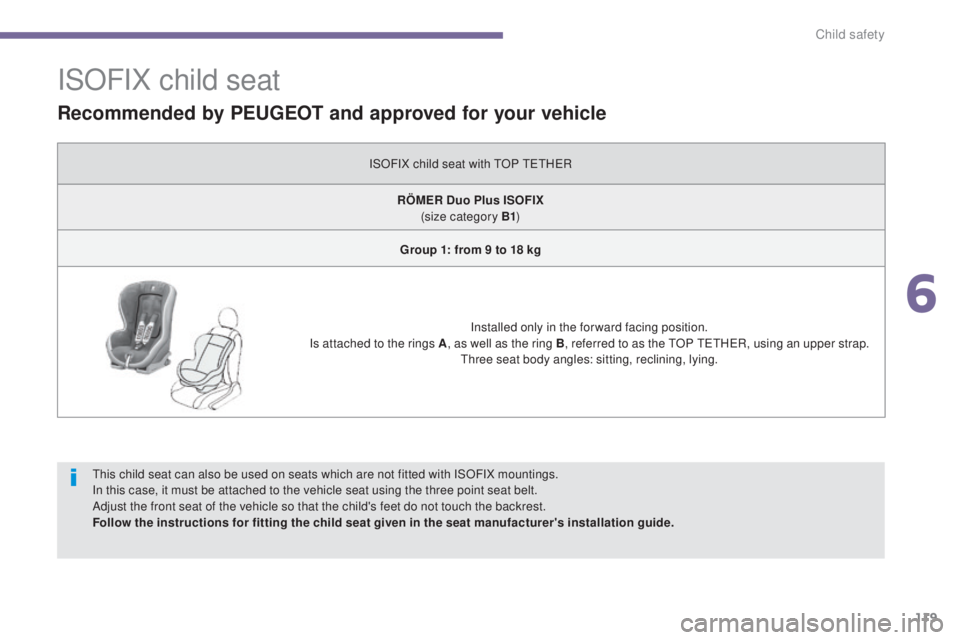
ISOFIX child seat with TOP TETHERRÖMER Duo Plus ISOFIX
(size category B1 )
Group 1: from 9 to 18 kg
Installed only in the forward facing position.
Is attached to the rings A , as well as the ring B, referred to as the TOP TETHER, using an upper strap.
Three seat body angles: sitting, reclining, lying.
6
Child safety
Page 122 of 344
120
3008_en_Chap06_securite-enfants_ed01-2015
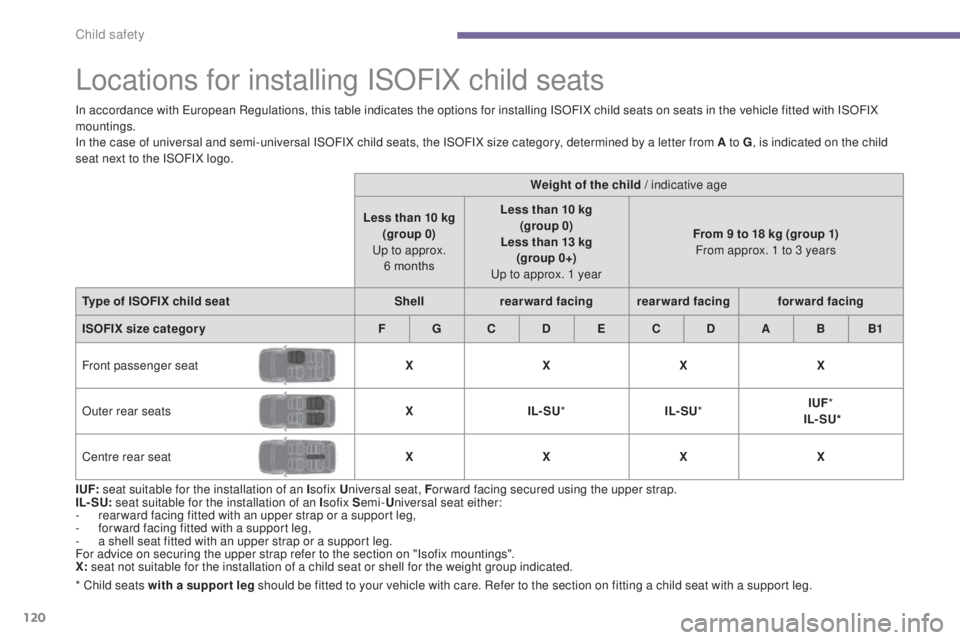
Locations for installing ISOFIX child seats
I UF: seat suitable for the installation of an I sofix Universal seat, F or ward facing secured using the upper strap.
IL- SU: seat suitable for the installation of an I sofix Semi-Universal seat either:
-
r
ear ward facing fitted with an upper strap or a support leg,
-
f
or ward facing fitted with a support leg,
-
a s
hell seat fitted with an upper strap or a support leg.
For advice on securing the upper strap refer to the section on "Isofix mountings".
X: seat not suitable for the installation of a child seat or shell for the weight group indicated.
In accordance with European Regulations, this table indicates the options for installing ISOFIX child seats on seats in the vehicle fitted with ISOFIX
mountings.
In the case of universal and semi-universal ISOFIX child seats, the ISOFIX size category, determined by a letter from A to G
, is indicated on the child
seat next to the ISOFIX logo.
* Child seats with a support leg should be fitted to your vehicle with care. Refer to the section on fitting a child seat with a support leg. Weight of the child / indicative age
Less than 10 kg (group 0)
Up to approx. 6 months Less than 10 kg
(group 0)
Less than 13 kg (group 0+)
Up to approx. 1 year From 9 to 18 kg (group 1)
From approx. 1 to 3 years
Type of ISOFIX child seat Shellrearward facing rearward facing forward facing
ISOFIX size categor y F G C D E C D A B B1
Front passenger seat XXXX
Outer rear seats XIL- SU* IL- SU* IUF
*
IL- SU*
Centre rear seat XXXX
Child safety
Page 123 of 344
121
3008_en_Chap06_securite-enfants_ed01-2015
Recommendations
The incorrect installation of a child seat in a
vehicle compromises the child's protection in
the event of an accident.
Check that there is no seat belt or seat belt
buckle under the child seat as this could
destabilise it.
Remember to fasten the seat belts or the
child seat harnesses keeping the slack in
relation to the child's body to a minimum,
even for short journeys.
For the installation of a child seat using a seat
belt, ensure that this is well tensioned on the
child seat and that it is holding the child seat
firmly against the seat of your vehicle. If your
front passenger seat is adjustable, move it
forward if necessary.
At the rear seats, always leave sufficient
space between the front seat and:
-
a r
ear ward facing child seat,
-
t
he feet of a child seated in a for ward
facing child seat.
For this, move the front seat for ward and if
necessary straighten its backrest. For optimum installation of the forward facing
child seat, ensure that the back of the child
seat is as close as possible to the backrest of
the vehicle's seat, or in contact if possible.
The head restraint must be removed before
installing a child seat with a backrest on the
passenger seat.
Ensure that the head restraint is stowed or
attached securely so that it is not thrown around
the vehicle in the event of sharp braking.
Refit the head restraint as soon as the child
seat is removed.
Children at the front
The legislation on carrying a child on the front
passenger seat is specific to each country.
Refer to the legislation in force in the country
in which you are driving.
Deactivate the passenger's front airbag when
a rear ward facing child seat is installed on
the front passenger seat. Otherwise, the child
would risk being seriously injured or killed if
the airbag were deployed.
Installing a booster
cushion
Child seats
The chest part of the seat belt must be
positioned on the child's shoulder without
touching the neck.
Ensure that the lap part of the seat belt
passes correctly over the child's thighs.
PEUGEOT recommends the use of a booster
seat which has a back, fitted with a seat belt
guide at shoulder level.
As a safety precaution, do not leave:
-
o
ne or more children alone and
unsupervised in a vehicle,
-
a c
hild or an animal in a vehicle which
is exposed to the sun, with the windows
closed,
-
t
he keys within reach of children inside
the vehicle.
To prevent accidental opening of the doors,
use the child lock.
Take care not to open the rear windows by
more than one third.
To protect young children from the rays of the
sun, fit side blinds on the rear windows.
6
Child safety
Page 124 of 344
122
3008_en_Chap06_securite-enfants_ed01-2015
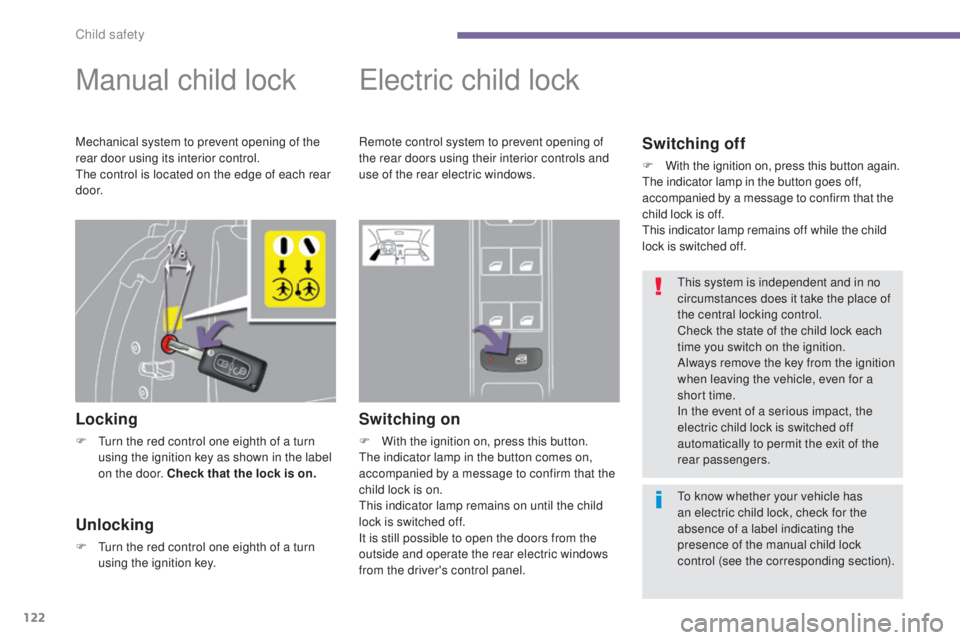
Manual child lock
Locking
F Turn the red control one eighth of a turn using the ignition key as shown in the label
on the door. Check that the lock is on.
Electric child lock
Switching on
F With the ignition on, press this button.
The indicator lamp in the button comes on,
accompanied by a message to confirm that the
child lock is on.
This indicator lamp remains on until the child
lock is switched off.
It is still possible to open the doors from the
outside and operate the rear electric windows
from the driver's control panel.
Unlocking
F Turn the red control one eighth of a turn using the ignition key.
Switching off
F With the ignition on, press this button again.
The indicator lamp in the button goes off,
accompanied by a message to confirm that the
child lock is off.
This indicator lamp remains off while the child
lock is switched off.
Mechanical system to prevent opening of the
rear door using its interior control.
The control is located on the edge of each rear
d o o r.
Remote control system to prevent opening of
the rear doors using their interior controls and
use of the rear electric windows.
This system is independent and in no
circumstances does it take the place of
the central locking control.
Check the state of the child lock each
time you switch on the ignition.
Always remove the key from the ignition
when leaving the vehicle, even for a
short time.
In the event of a serious impact, the
electric child lock is switched off
automatically to permit the exit of the
rear passengers.
To know whether your vehicle has
an electric child lock, check for the
absence of a label indicating the
presence of the manual child lock
control (see the corresponding section).
Child safety
Page 125 of 344
123
3008_en_Chap07_securite_ed01-2015
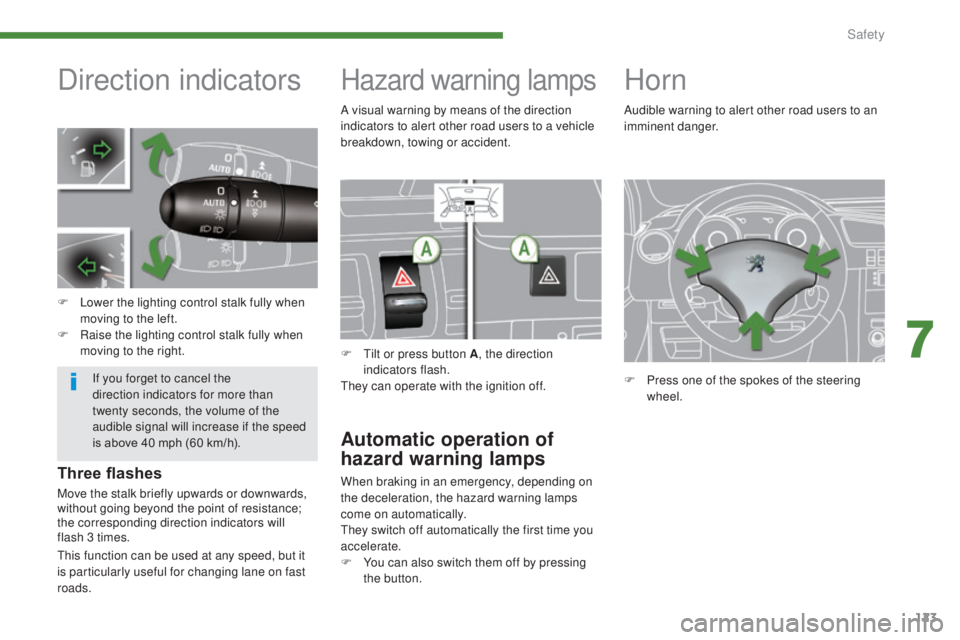
Direction indicators
F Lower the lighting control stalk fully when moving to the left.
F
R
aise the lighting control stalk fully when
moving to the right.
Hazard warning lamps
F Tilt or press button A , the direction
indicators flash.
They can operate with the ignition off.
Automatic operation of
hazard warning lamps
When braking in an emergency, depending on
the deceleration, the hazard warning lamps
come on automatically.
They switch off automatically the first time you
accelerate.
F
Y
ou can also switch them off by pressing
the button.
Horn
F Press one of the spokes of the steering wheel.
Audible warning to alert other road users to an
imminent danger.
Three flashes
Move the stalk briefly upwards or downwards,
without going beyond the point of resistance;
the corresponding direction indicators will
flash
3 times.If you forget to cancel the
direction indicators for more than
twenty
seconds, the volume of the
audible signal will increase if the speed
is above 40 mph (60 km/h). A visual warning by means of the direction
indicators to alert other road users to a vehicle
breakdown, towing or accident.
This function can be used at any speed, but it
is particularly useful for changing lane on fast
roads.
7
Safety
Page 126 of 344
124
3008_en_Chap07_securite_ed01-2015
Electronic stability control (ESC)
Definitions
Anti-slip regulation (ASR)
The ASR system (also known as Traction
Control) optimises traction in order to limit
wheel slip by acting on the brakes of the driving
wheels and on the engine. It also improves
the directional stability of the vehicle on
acceleration.
Dynamic stability control (DSC)
If there is a difference between the path
followed by the vehicle and that required by
the driver, the DSC monitors each wheel and
automatically acts on the brake of one or more
wheels and on the engine to return the vehicle
to the required path, within the limits of the laws
of physics.
Emergency braking assistance
(EBA)
In an emergency, this system enables you to
reach the optimum braking pressure more
quickly and therefore reduce the stopping
distance.
It is triggered according to the speed at which
the brake pedal is pressed. This is felt by a
reduction in the resistance of the pedal and an
increase in the effectiveness of the braking.
Anti-lock braking system (ABS)
and electronic brake force
distribution (EBFD)
This system improves the stability and
manoeuvrability of your vehicle when braking
and contributes towards improved control in
corners, in particular on poor or slippery road
surfaces.
The ABS prevents wheel lock in the event of
emergency braking.
The electronic brake force distribution system
manages the braking pressure wheel by wheel. Electronic Stability Control (ESC) incorporating the following systems:
-
a
nti-lock braking system (ABS) and the electronic brake force distribution (EBFD),
-
em
ergency braking assistance (EBA),
-
w
heel anti-slip regulation (ASR) or traction control,
-
d
ynamic stability control (DSC).
Safety
Page 127 of 344
125
3008_en_Chap07_securite_ed01-2015
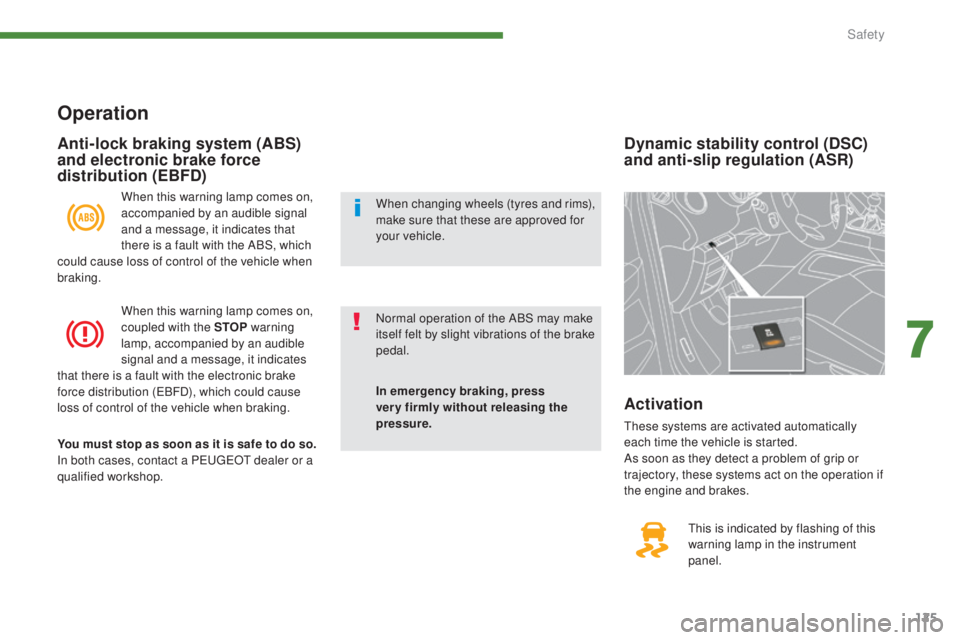
Dynamic stability control (DSC)
and anti-slip regulation (ASR)
This is indicated by flashing of this
warning lamp in the instrument
panel.
Activation
These systems are activated automatically
each time the vehicle is started.
As soon as they detect a problem of grip or
trajectory, these systems act on the operation if
the engine and brakes.
Operation
When this warning lamp comes on,
accompanied by an audible signal
and a message, it indicates that
there is a fault with the ABS, which
could cause loss of control of the vehicle when
braking.
When this warning lamp comes on,
coupled with the STOP warning
lamp, accompanied by an audible
signal and a message, it indicates
that there is a fault with the electronic brake
force distribution (EBFD), which could cause
loss of control of the vehicle when braking.
You must stop as soon as it is safe to do so.
In both cases, contact a PEUGEOT dealer or a
qualified workshop.
Anti-lock braking system (ABS)
and electronic brake force
distribution (EBFD)
In emergency braking, press
very firmly without releasing the
pressure. Normal operation of the ABS may make
itself felt by slight vibrations of the brake
pedal. When changing wheels (tyres and rims),
make sure that these are approved for
your vehicle.
7
Safety