2016 PEUGEOT 3008 ESP
[x] Cancel search: ESPPage 124 of 344
122
3008_en_Chap06_securite-enfants_ed01-2015
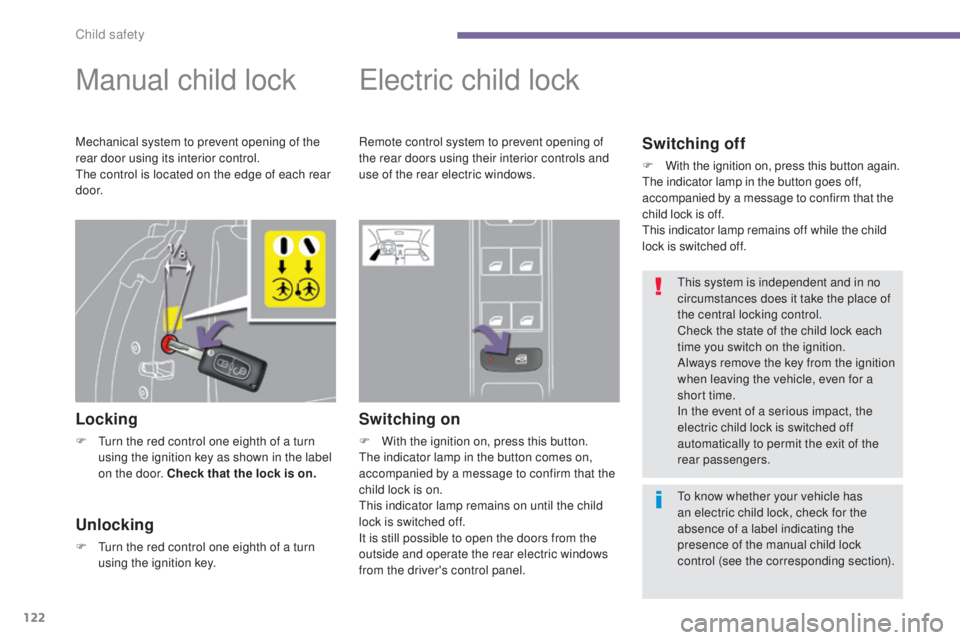
Manual child lock
Locking
F Turn the red control one eighth of a turn using the ignition key as shown in the label
on the door. Check that the lock is on.
Electric child lock
Switching on
F With the ignition on, press this button.
The indicator lamp in the button comes on,
accompanied by a message to confirm that the
child lock is on.
This indicator lamp remains on until the child
lock is switched off.
It is still possible to open the doors from the
outside and operate the rear electric windows
from the driver's control panel.
Unlocking
F Turn the red control one eighth of a turn using the ignition key.
Switching off
F With the ignition on, press this button again.
The indicator lamp in the button goes off,
accompanied by a message to confirm that the
child lock is off.
This indicator lamp remains off while the child
lock is switched off.
Mechanical system to prevent opening of the
rear door using its interior control.
The control is located on the edge of each rear
d o o r.
Remote control system to prevent opening of
the rear doors using their interior controls and
use of the rear electric windows.
This system is independent and in no
circumstances does it take the place of
the central locking control.
Check the state of the child lock each
time you switch on the ignition.
Always remove the key from the ignition
when leaving the vehicle, even for a
short time.
In the event of a serious impact, the
electric child lock is switched off
automatically to permit the exit of the
rear passengers.
To know whether your vehicle has
an electric child lock, check for the
absence of a label indicating the
presence of the manual child lock
control (see the corresponding section).
Child safety
Page 125 of 344
123
3008_en_Chap07_securite_ed01-2015
Direction indicators
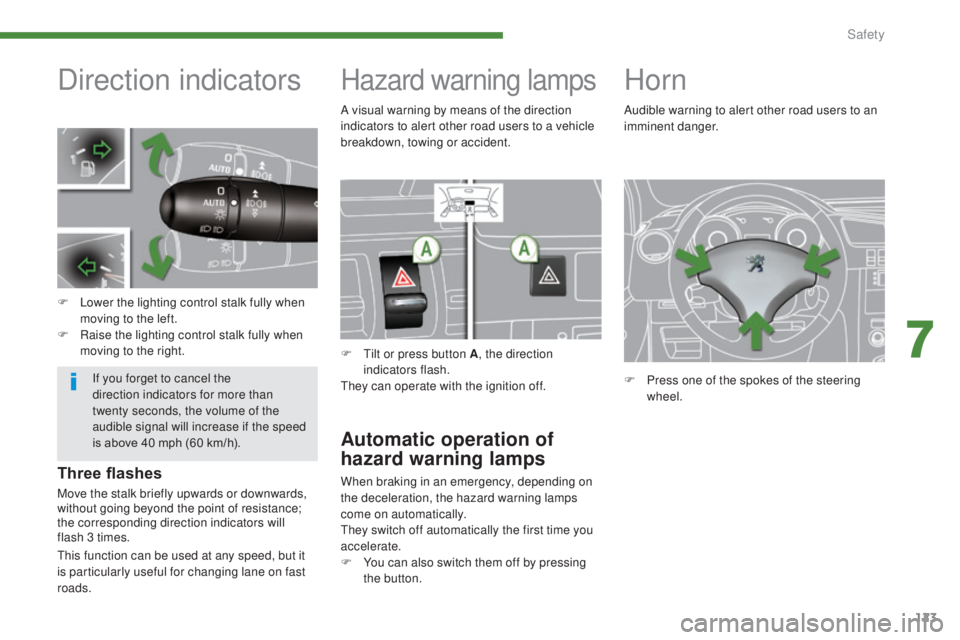
F Lower the lighting control stalk fully when moving to the left.
F
R
aise the lighting control stalk fully when
moving to the right.
Hazard warning lamps
F Tilt or press button A , the direction
indicators flash.
They can operate with the ignition off.
Automatic operation of
hazard warning lamps
When braking in an emergency, depending on
the deceleration, the hazard warning lamps
come on automatically.
They switch off automatically the first time you
accelerate.
F
Y
ou can also switch them off by pressing
the button.
Horn
F Press one of the spokes of the steering wheel.
Audible warning to alert other road users to an
imminent danger.
Three flashes
Move the stalk briefly upwards or downwards,
without going beyond the point of resistance;
the corresponding direction indicators will
flash
3 times.If you forget to cancel the
direction indicators for more than
twenty
seconds, the volume of the
audible signal will increase if the speed
is above 40 mph (60 km/h). A visual warning by means of the direction
indicators to alert other road users to a vehicle
breakdown, towing or accident.
This function can be used at any speed, but it
is particularly useful for changing lane on fast
roads.
7
Safety
Page 130 of 344
128
3008_en_Chap07_securite_ed01-2015
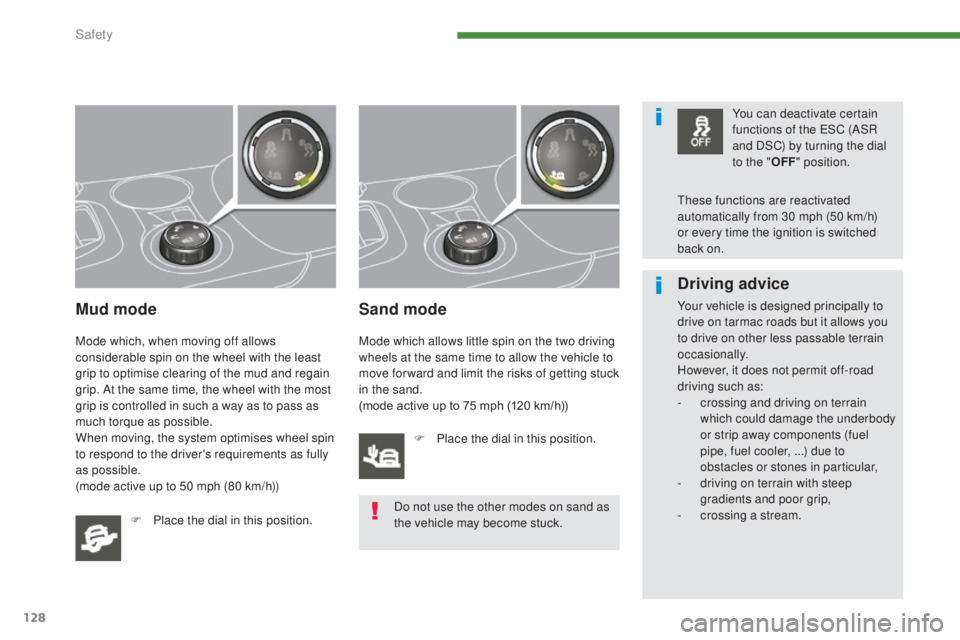
Mud mode
Mode which, when moving off allows
considerable spin on the wheel with the least
grip to optimise clearing of the mud and regain
grip. At the same time, the wheel with the most
grip is controlled in such a way as to pass as
much torque as possible.
When moving, the system optimises wheel spin
to respond to the driver's requirements as fully
as possible.
(mode active up to 50 mph (80 km/h))F
P
lace the dial in this position.
Sand mode
Mode which allows little spin on the two driving
wheels at the same time to allow the vehicle to
move for ward and limit the risks of getting stuck
in the sand.
(mode active up to 75 mph (120 km/h))F
P
lace the dial in this position. You can deactivate certain
functions of the ESC (ASR
and DSC) by turning the dial
to the "
OFF" position.
Driving advice
Your vehicle is designed principally to
drive on tarmac roads but it allows you
to drive on other less passable terrain
occasionally.
However, it does not permit off-road
driving such as:
-
c
rossing and driving on terrain
which could damage the underbody
or strip away components (fuel
pipe, fuel cooler,
...) due to
obstacles or stones in particular,
-
d
riving on terrain with steep
gradients and poor grip,
-
c
rossing a stream.
Do not use the other modes on sand as
the vehicle may become stuck. These functions are reactivated
automatically from 30 mph (50 km/h)
or every time the ignition is switched
back on.
Safety
Page 132 of 344
130
3008_en_Chap07_securite_ed01-2015
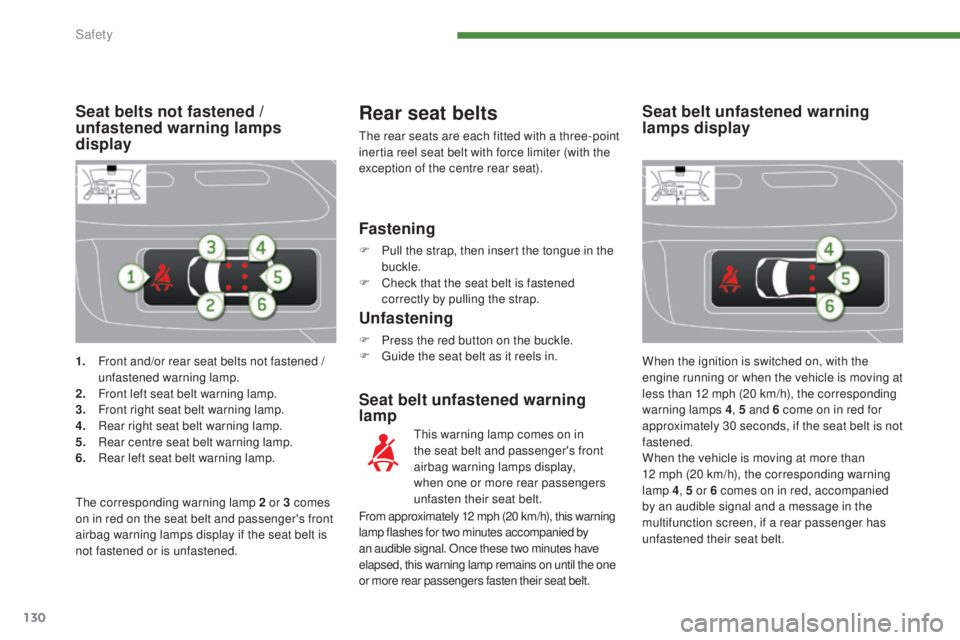
1. Front and/or rear seat belts not fastened / unfastened warning lamp.
2.
F
ront left seat belt warning lamp.
3.
F
ront right seat belt warning lamp.
4.
R
ear right seat belt warning lamp.
5.
R
ear centre seat belt warning lamp.
6.
R
ear left seat belt warning lamp.
Seat belts not fastened /
unfastened warning lamps
displayRear seat belts
The rear seats are each fitted with a three-point
inertia reel seat belt with force limiter (with the
exception of the centre rear seat).
Seat belt unfastened warning
lamp
This warning lamp comes on in
the seat belt and passenger's front
airbag warning lamps display,
when one or more rear passengers
unfasten their seat belt.
Fastening
F Pull the strap, then insert the tongue in the buckle.
F
C
heck that the seat belt is fastened
correctly by pulling the strap.
Unfastening
F Press the red button on the buckle.
F G uide the seat belt as it reels in.
The corresponding warning lamp 2 or 3 comes
on in red on the seat belt and passenger's front
airbag warning lamps display if the seat belt is
not fastened or is unfastened. When the ignition is switched on, with the
engine running or when the vehicle is moving at
less than 12 mph (20 km/h), the corresponding
warning lamps 4
, 5 and 6 come on in red for
approximately 30 seconds, if the seat belt is not
fastened.
When the vehicle is moving at more than
12
mph (20 km/h), the corresponding warning
lamp 4 , 5 or 6 comes on in red, accompanied
by an audible signal and a message in the
multifunction screen, if a rear passenger has
unfastened their seat belt.
Seat belt unfastened warning
lamps display
From approximately 12 mph (20 km/h), this warning
lamp flashes for two minutes accompanied by
an audible signal. Once these two minutes have
elapsed, this warning lamp remains on until the one
or more rear passengers fasten their seat belt.
Safety
Page 133 of 344
131
3008_en_Chap07_securite_ed01-2015
The driver must ensure that passengers use
the seat belts correctly and that they are all
fastened before setting off.
Wherever you are seated in the vehicle,
always fasten your seat belt, even for short
journeys.
Do not interchange the seat belt buckles as
they will not fulfil their role fully.
The seat belts are fitted with an inertia reel
permitting automatic adjustment of the length
of the strap to your size. The seat belt is
stowed automatically when not in use.
Before and after use, ensure that the seat belt
is reeled in correctly.
The lower part of the strap must be positioned
as low as possible on the pelvis.
The upper part must be positioned in the
hollow of the shoulder.
The inertia reels are fitted with an automatic
locking device which comes into operation in
the event of a collision, emergency braking
or if the vehicle rolls over. You can release
the device by pulling the strap firmly and then
releasing it so that it reels in slightly.In order to be effective, a seat belt must:
-
b
e tightened as close to the body as
possible,
-
b
e pulled in front of you with a smooth
movement, checking that it does not
twist,
-
b
e used to restrain only one person,
-
n
ot bear any trace of cuts or fraying,
-
n
ot be converted or modified to avoid
affecting its performance.
In the event of an impact
Depending on the nature and seriousness
of the impact , the pretensioning device may
be deployed before and independently of the
airbags. Deployment of the pretensioners
is accompanied by a slight discharge of
harmless smoke and a noise, due to the
activation of the pyrotechnic cartridge
incorporated in the system.
In all cases, the airbag warning lamp comes
on.
Following an impact, have the seat belts
system checked, and if necessary replaced,
by a PEUGEOT dealer or a qualified
workshop.
Recommendations for children
Use a suitable child seat if the passenger is
less than 12 years old or shorter than one and
a half metres.
Never use the same seat belt to secure more
than one person.
Never allow a child to travel on your lap.
For more information on child seats, refer to
the corresponding section.
In accordance with current safety regulations,
for all repairs on your vehicle's seat belts, go
to a qualified workshop with the skills and
equipment needed, which a PEUGEOT dealer
is able to provide.
Have your seat belts checked regularly by a
PEUGEOT dealer or a qualified workshop,
particularly if the straps show signs of
damage.
Clean the seat belt straps with soapy water or
a textile cleaning product, sold by PEUGEOT
dealers.
After folding or moving a seat or rear bench
seat, ensure that the seat belt is positioned
and reeled in correctly.
Advice
7
Safety
Page 136 of 344
134
3008_en_Chap07_securite_ed01-2015
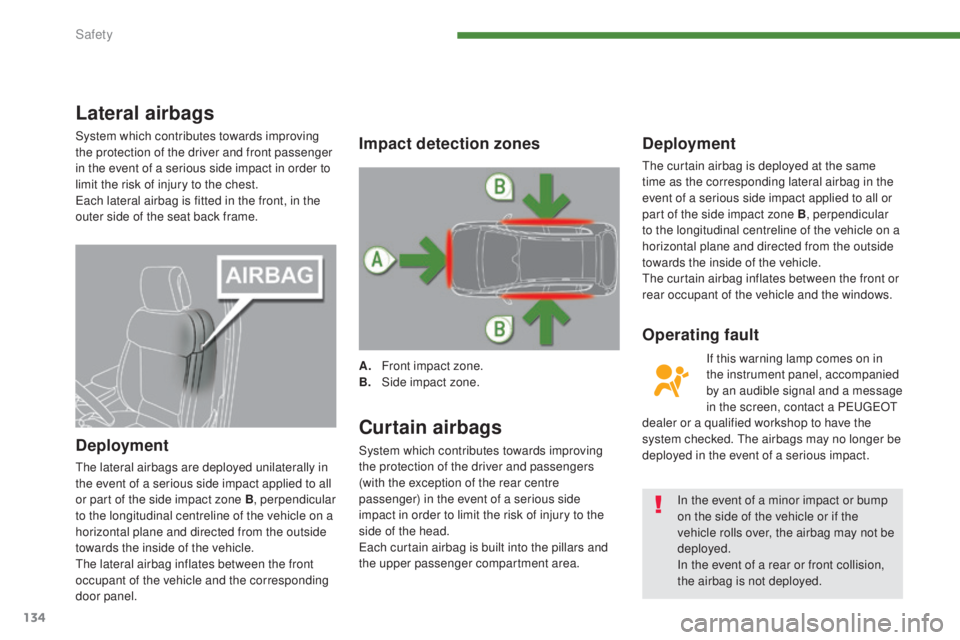
Lateral airbags
System which contributes towards improving
the protection of the driver and front passenger
in the event of a serious side impact in order to
limit the risk of injury to the chest.
Each lateral airbag is fitted in the front, in the
outer side of the seat back frame.
Deployment
The lateral airbags are deployed unilaterally in
the event of a serious side impact applied to all
or part of the side impact zone B, perpendicular
to the longitudinal centreline of the vehicle on a
horizontal plane and directed from the outside
towards the inside of the vehicle.
The lateral airbag inflates between the front
occupant of the vehicle and the corresponding
door panel.
Curtain airbags
System which contributes towards improving
the protection of the driver and passengers
(with the exception of the rear centre
passenger) in the event of a serious side
impact in order to limit the risk of injury to the
side of the head.
Each curtain airbag is built into the pillars and
the upper passenger compartment area.
Deployment
The curtain airbag is deployed at the same
time as the corresponding lateral airbag in the
event of a serious side impact applied to all or
part of the side impact zone B, perpendicular
to the longitudinal centreline of the vehicle on a
horizontal plane and directed from the outside
towards the inside of the vehicle.
The curtain airbag inflates between the front or
rear occupant of the vehicle and the windows.
Impact detection zones
A. Front impact zone.
B. S ide impact zone.
Operating fault
If this warning lamp comes on in
the instrument panel, accompanied
by an audible signal and a message
in the screen, contact a PEUGEOT
dealer or a qualified workshop to have the
system checked. The airbags may no longer be
deployed in the event of a serious impact.
In the event of a minor impact or bump
on the side of the vehicle or if the
vehicle rolls over, the airbag may not be
deployed.
In the event of a rear or front collision,
the airbag is not deployed.
Safety
Page 162 of 344
160
3008_en_Chap08_conduite_ed01-2015
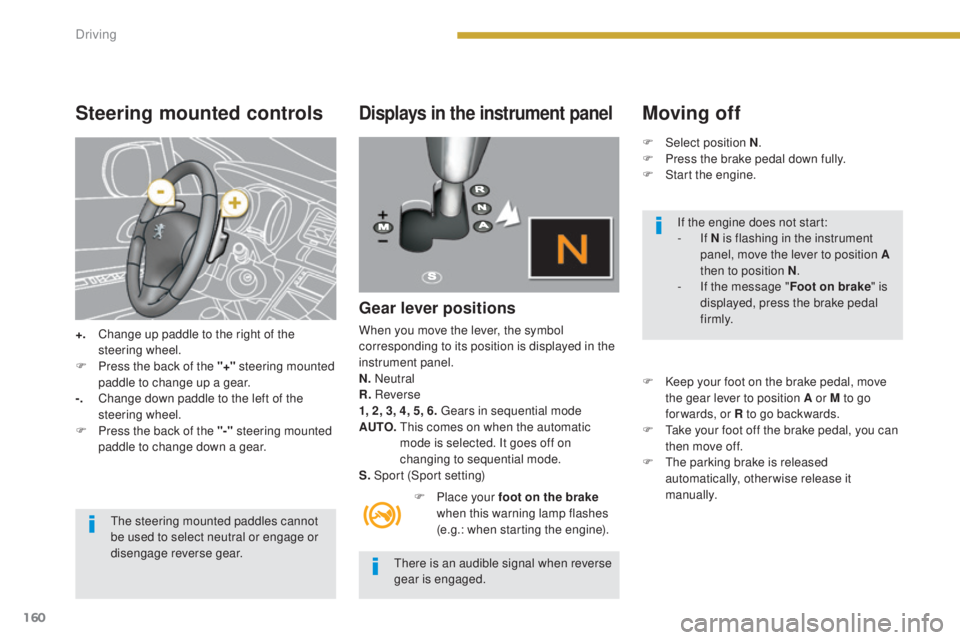
Steering mounted controls
+. Change up paddle to the right of the steering wheel.
F
P
ress the back of the "+" steering mounted
paddle to change up a gear.
-.
C
hange down paddle to the left of the
steering wheel.
F
P
ress the back of the "-" steering mounted
paddle to change down a gear.
The steering mounted paddles cannot
be used to select neutral or engage or
disengage reverse gear.
Displays in the instrument panel
Gear lever positions
When you move the lever, the symbol
corresponding to its position is displayed in the
instrument panel.
N. Neutral
R. Reverse
1, 2, 3, 4, 5, 6. Gears in sequential mode
AUTO.
T
his comes on when the automatic
mode is selected. It goes off on
changing to sequential mode.
S. Sport (Sport setting)
F
P
lace your foot on the brake
when this warning lamp flashes
(e.g.: when starting the engine).
There is an audible signal when reverse
gear is engaged.
Moving off
F Select position N .
F P ress the brake pedal down fully.
F
S
tart the engine.
F
K
eep your foot on the brake pedal, move
the gear lever to position A or M to go
for wards, or R to go backwards.
F
T
ake your foot off the brake pedal, you can
then move off.
F
T
he parking brake is released
automatically, otherwise release it
manually. If the engine does not start:
-
If N is flashing in the instrument
panel, move the lever to position A
then to position N .
-
I
f the message " Foot on brake" is
displayed, press the brake pedal
f i r m l y.
Driving
Page 166 of 344
164
3008_en_Chap08_conduite_ed01-2015
"Porsche Tiptronic System" automatic gearbox
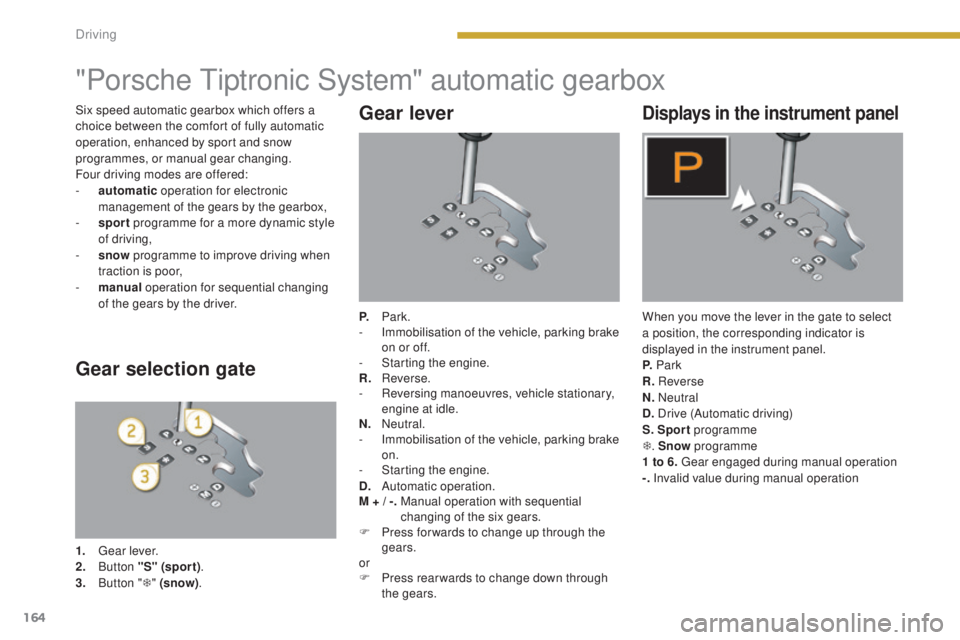
Gear lever
P. Park.
- I mmobilisation of the vehicle, parking brake
on or off.
-
S
tarting the engine.
R.
R
everse.
-
R
eversing manoeuvres, vehicle stationary,
engine at idle.
N.
N
eutral.
-
I
mmobilisation of the vehicle, parking brake
on.
-
S
tarting the engine.
D.
Aut
omatic operation.
M +
/ -.
M
anual operation with sequential
changing of the six gears.
F
P
ress for wards to change up through the
gears.
or
F
P
ress rear wards to change down through
the gears.
Displays in the instrument panel
When you move the lever in the gate to select
a position, the corresponding indicator is
displayed in the instrument panel.
P. Park
R. Reverse
N. Neutral
D. Drive (Automatic driving)
S. Sport programme
T . Snow programme
1 to 6. Gear engaged during manual operation
-. Invalid value during manual operation
Gear selection gate
1. Gear lever.
2. B
utton "S" (spor t) .
3.
B
utton " T" (snow) .
Six speed automatic gearbox which offers a
choice between the comfort of fully automatic
operation, enhanced by sport and snow
programmes, or manual gear changing.
Four driving modes are offered:
-
a
utomatic
operation for electronic
management of the gears by the gearbox,
-
sp
ort
programme for a more dynamic style
of driving,
-
s
now
programme to improve driving when
traction is poor,
-
m
anual
operation for sequential changing
of the gears by the driver.
Driving