Page 62 of 344
60
3008_en_Chap03_confort_ed01-2015
Recommendations for ventilation and air conditioning
In order for these systems to be fully effective, follow the operation and maintenance
guidelines below:
F
I
f the interior temperature remains very high after the vehicle has been parked in the sun for
a considerable time, first ventilate the passenger compartment for a few minutes.
P
lace the air flow control at a sufficient level to provide an adequate renewal of air in the
passenger compartment.
F
T
o obtain an even air distribution, take care not to obstruct the exterior air intake grilles
located at the base of the windscreen, the nozzles, the vents and the air outlets, as well
as the air extractor located in the boot.
F
U
se in preference the intake of exterior air as prolonged use of the air recirculation may
cause misting of the windows and side windows.
F
D
o not cover the sunshine sensor, located on the dashboard; this is used for regulation
of the automatic air conditioning system.
F
O
perate the air conditioning system for 5 to 10 minutes, once or twice a month to keep it
in good working order.
F
E
nsure that the passenger compartment filter is in good condition and have the filter
elements replaced regularly (refer to the "Checks" section).
W
e recommend the use of a combined passenger compartment filter. Thanks to its
second special active filter, it contributes to the purification of the air breathed by the
occupants and the cleanliness of the passenger compartment (reduction of allergic
symptoms, bad odours and greasy deposits).
F
T
he air conditioning uses power from the engine while operating. This results in an
increase in the vehicle's fuel consumption.
W
hen towing at or near maximum capacity or on steep slopes in high ambient
temperatures, switching off the air conditioning saves engine power and so improves
towing capacity.
C
ondensation created by the air conditioning results in a discharge of water under the
vehicle when stationary, which is per fectly normal.
F
T
o ensure correct operation of the air conditioning system, you are also advised to have
it checked regularly.
F
I
f the system does not produce cold air, do not use it and contact a PEUGEOT dealer or
a qualified workshop. The air conditioning system does not
contain chlorine and does not present
any danger to the ozone layer.
Comfort
Page 74 of 344
72
3008_en_Chap03_confort_ed01-2015
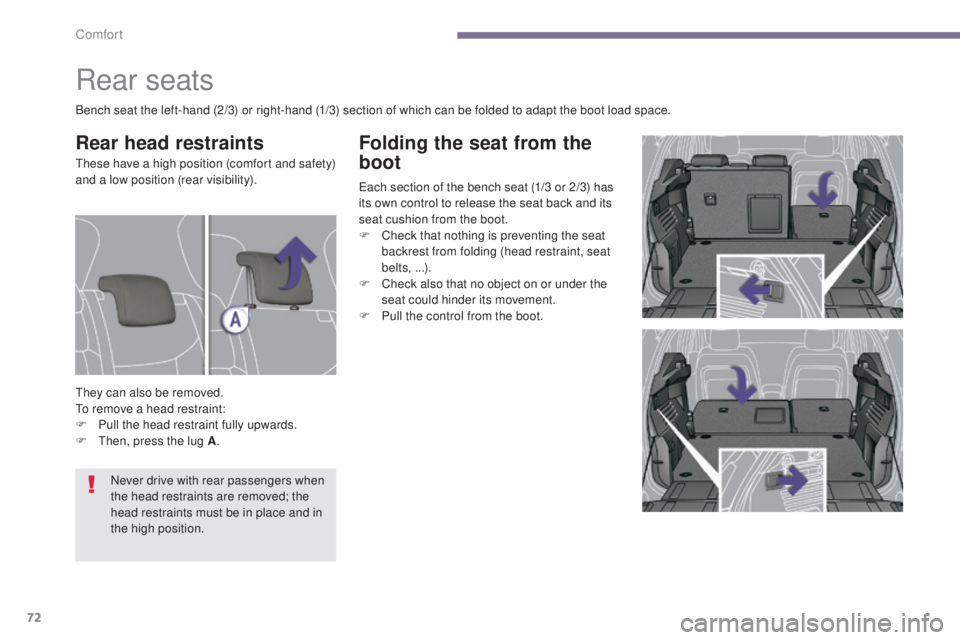
Folding the seat from the
boot
Each section of the bench seat (1/3 or 2/3) has
its own control to release the seat back and its
seat cushion from the boot.
F
C
heck that nothing is preventing the seat
backrest from folding (head restraint, seat
belts, ...).
F
C
heck also that no object on or under the
seat could hinder its movement.
F
P
ull the control from the boot.
Rear seats
Rear head restraints
They can also be removed.
To remove a head restraint:
F
P
ull the head restraint fully upwards.
F
T
hen, press the lug A .
Bench seat the left-hand (2/3) or right-hand (1/3) section of which can be folded to adapt the boot load space.
These have a high position (comfort and safety)
and a low position (rear visibility).
Never drive with rear passengers when
the head restraints are removed; the
head restraints must be in place and in
the high position.
Comfort
Page 75 of 344
73
3008_en_Chap03_confort_ed01-2015
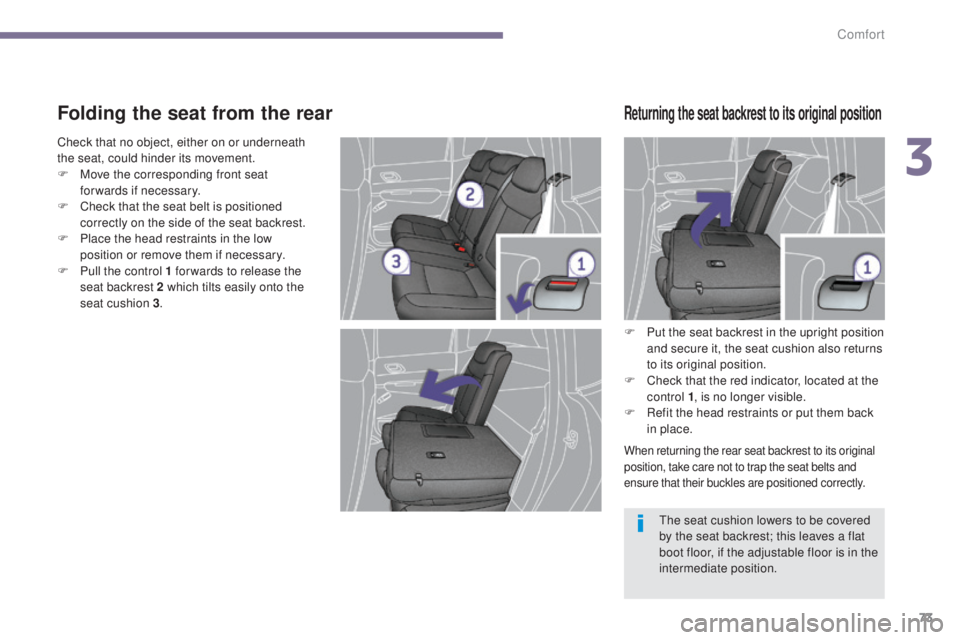
Folding the seat from the rear
F Put the seat backrest in the upright position and secure it, the seat cushion also returns
to its original position.
F
C
heck that the red indicator, located at the
control 1 , is no longer visible.
F
R
efit the head restraints or put them back
in place.
When returning the rear seat backrest to its original
position, take care not to trap the seat belts and
ensure that their buckles are positioned correctly.
The seat cushion lowers to be covered
by the seat backrest; this leaves a flat
boot floor, if the adjustable floor is in the
intermediate position.
Returning the seat backrest to its original position
Check that no object, either on or underneath
the seat, could hinder its movement.
F
M
ove the corresponding front seat
forwards if necessary.
F
C
heck that the seat belt is positioned
correctly on the side of the seat backrest.
F
P
lace the head restraints in the low
position or remove them if necessary.
F
P
ull the control 1 for wards to release the
seat backrest 2 which tilts easily onto the
seat cushion 3 .
3
Comfort
Page 89 of 344
87
3008_en_Chap04_visibilite_ed01-2015
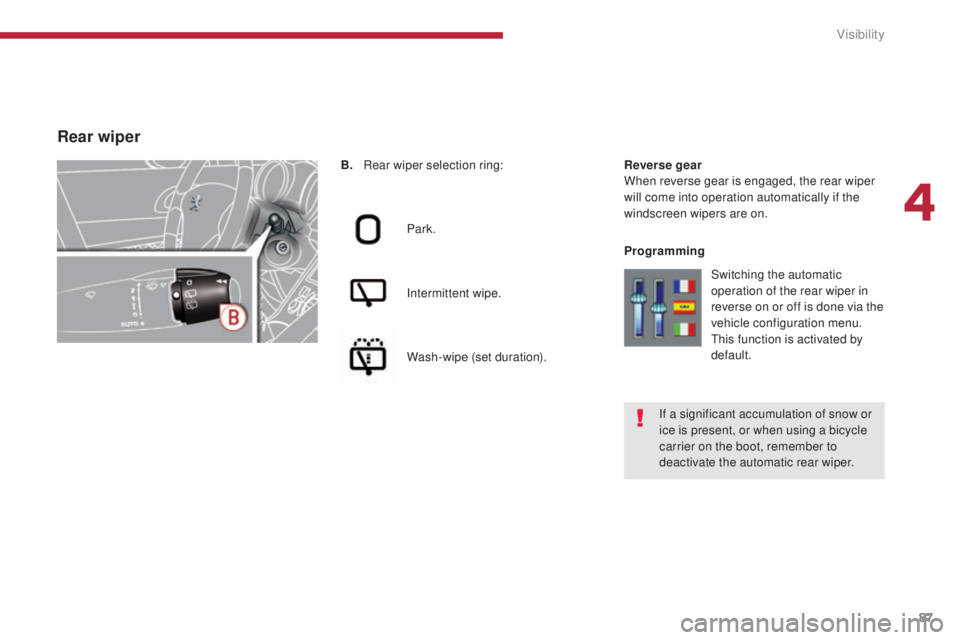
B. Rear wiper selection ring:Park.
Intermittent wipe.
Wash-wipe (set duration). Reverse gear
When reverse gear is engaged, the rear wiper
will come into operation automatically if the
windscreen wipers are on.
Programming
Rear wiper
Switching the automatic
operation of the rear wiper in
reverse on or off is done via the
vehicle configuration menu.
This function is activated by
default.
If a significant accumulation of snow or
ice is present, or when using a bicycle
carrier on the boot, remember to
deactivate the automatic rear wiper.
4
Visibility
Page 95 of 344
93
3008_en_Chap04_visibilite_ed01-2015
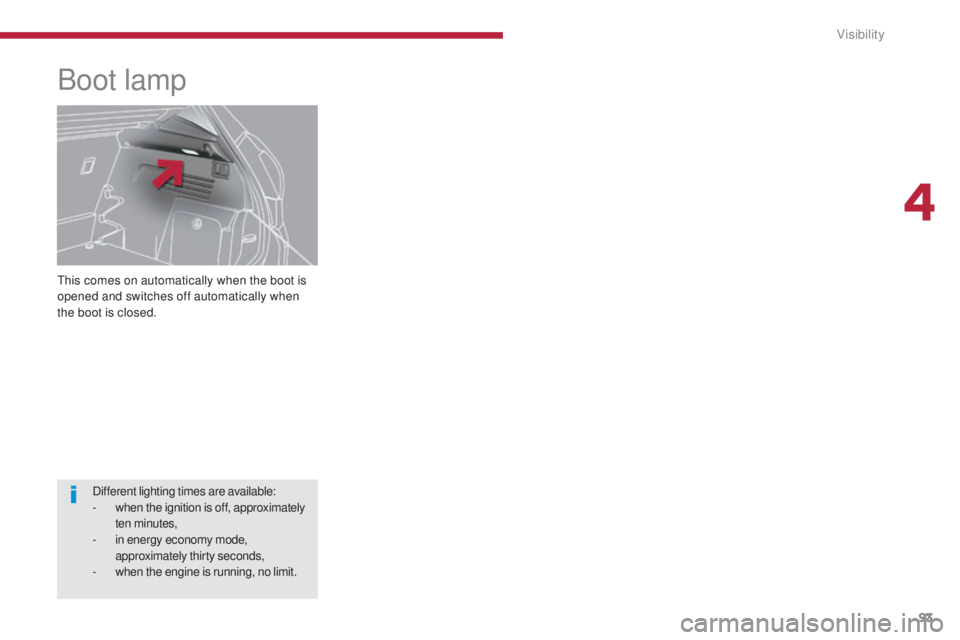
This comes on automatically when the boot is
opened and switches off automatically when
the boot is closed.
Boot lamp
Different lighting times are available:
- when the ignition is off, approximately
ten minutes,
-
i
n energy economy mode,
approximately thirty seconds,
-
w
hen the engine is running, no limit.
4
Visibility
Page 102 of 344
100
3008_en_Chap05_amenagements_ed01-2015
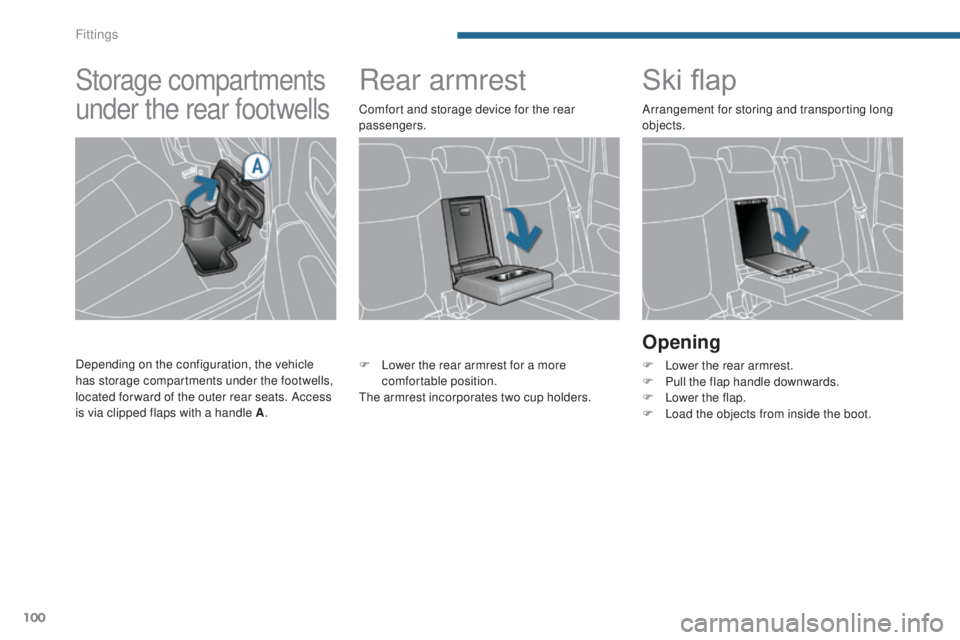
Rear armrestSki flap
Opening
F Lower the rear armrest.
F
P ull the flap handle downwards.
F
L
ower the flap.
F
L
oad the objects from inside the boot.
F
L
ower the rear armrest for a more
comfortable position.
The armrest incorporates two cup holders. Comfort and storage device for the rear
passengers. Arrangement for storing and transporting long
objects.
Storage compartments
under the rear footwells
Depending on the configuration, the vehicle
has storage compartments under the footwells,
located for ward of the outer rear seats. Access
is via clipped flaps with a handle A
.
Fittings
Page 105 of 344
103
3008_en_Chap05_amenagements_ed01-2015
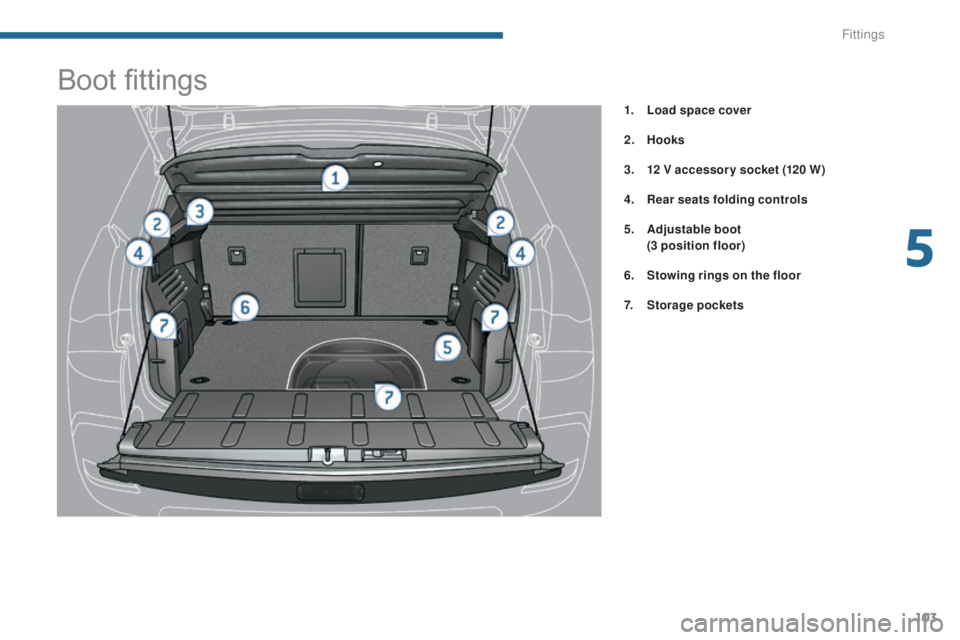
Boot fittings
1. Load space cover
2.
Hoo
ks
3.
1
2 V accessor y socket (120 W)
4.
R
ear seats folding controls
5.
A
djustable boot
(
3 position floor )
6.
S
towing rings on the floor
7.
Sto
rage pockets
5
Fittings
Page 107 of 344
105
3008_en_Chap05_amenagements_ed01-2015
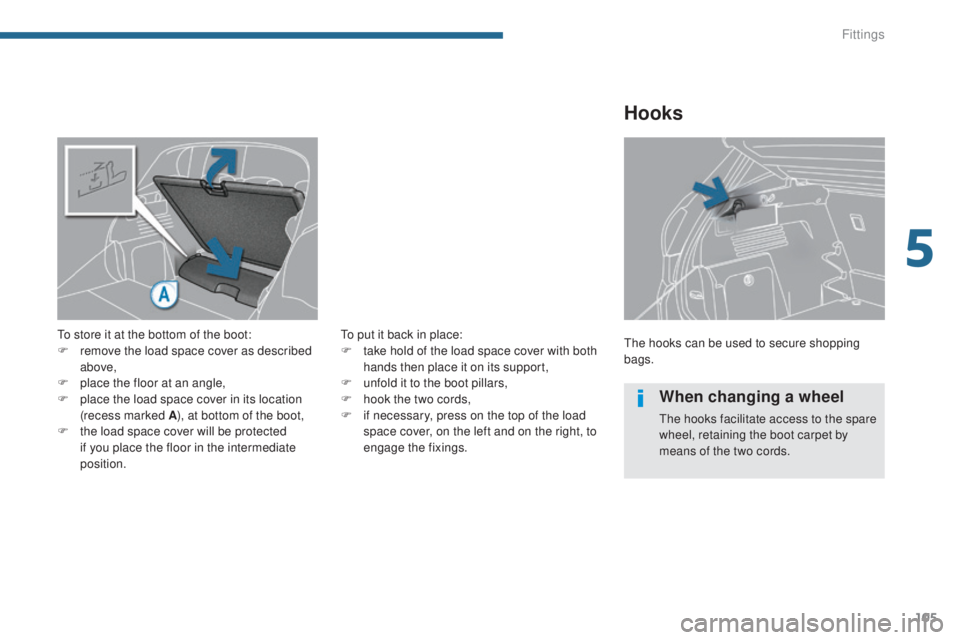
The hooks can be used to secure shopping
bags.
Hooks
To store it at the bottom of the boot:
F r emove the load space cover as described
above,
F
p
lace the floor at an angle,
F
p
lace the load space cover in its location
(recess marked A ), at bottom of the boot,
F
t
he load space cover will be protected
if you place the floor in the intermediate
position. To put it back in place:
F
t ake hold of the load space cover with both
hands then place it on its support,
F
u
nfold it to the boot pillars,
F
h
ook the two cords,
F
i
f necessary, press on the top of the load
space cover, on the left and on the right, to
engage the fixings.
When changing a wheel
The hooks facilitate access to the spare
wheel, retaining the boot carpet by
means of the two cords.
5
Fittings