2016 PEUGEOT 108 key
[x] Cancel search: keyPage 74 of 268

72
108_en_Chap04_conduite_ed01-2016
If you use the ancillaries for a prolonged
period, the vehicle will automatically
switch to "
oFF" m
ode after about
20
minutes.
Be aware in order to avoid discharging
the battery.
Starting - switching off the engine
with the Keyless e
n
try and Starting
system
Changing the mode of the
vehicle
With the electronic key inside the
vehicle; each press on the " St
A Rt/
StoP " b
utton, with no action on the
pedals, changes the vehicle's mode:
F
F
irst press (" ACC" m o d e).
t
h
e ancillaries (radio, 12V socket...) can be
used.
F
Sec
ond press ("
oN "
m o d e).
I
gnition on.
F
t
h
ird press ("
oFF "
m o d e).
Avoid attaching heavy objects to the
key, which would weigh down on its
blade in the ignition switch and could
cause a malfunction.
F
Imm
obilise the vehicle.
Switching off
F With a manual gearbox: put the gear lever
into neutral.
F
W
ith an etg gearbox: place the selector at
position N .
F
t
u
rn the key towards you to position 2 (ACC) .
F
Press in and turn the key to position 1 (LoC K).F Remove the key from the ignition switch.
F
tu rn the steering until the steering column
locks.
Driving
Page 75 of 268

73
108_en_Chap04_conduite_ed01-2016
Starting using the
electronic key
With the first press on the "St A Rt/
StoP " b
utton, this indicator lamp
flashes slowly in the instrument panel. Depending on the ambient temperature,
each attempt at starting can take up to
around 30 seconds. During this period,
do not press the "
S
t
A
R
t/
S to
P" b
utton
again, or release the clutch pedal or
brake pedal (depending on the type of
gearbox).
After this period, if the engine has not
started, press the " S
t
A
R
t/
S to
P"
b
utton again for another attempt at
starting. If one of the starting conditions is
not met, the "Keyless
e
n
try and
Starting" system indicator lamp flashes
in the instrument panel. In some
circumstances, it is necessary to
turn the steering wheel slightly while
pressing the " S t
A
R
t/
S to
P
" b
utton to
assist unlocking of the steering.
For vehicles fitted with a manual gearbox:
F
W
ith the electronic key inside the vehicle,
put the gear lever into neutral and fully
depress the clutch pedal.th e presence of the electronic key in
the vehicle is essential for switching
on the ignition and starting only. Once
the engine has started, make sure that
the electronic key remains with the
vehicle until the end of the journey:
other wise you would not be able to lock
the
vehicle.
F
P
ress and release the " S
t
A R
t/
StoP " b
utton.
th
is indicator lamp comes on in the
instrument panel. For vehicles fitted with an
etg gearbox:
F
W
ith the electronic key inside the vehicle,
put the gear selector at N and press the
brake pedal.
th
is indicator lamp comes on in the
instrument panel.
F
P
ress and release the "
S
t
A R
t/
StoP " b
utton.
4
Driving
Page 76 of 268

74
108_en_Chap04_conduite_ed01-2016
there is an audible signal when the driver's door
is opened and the vehicle is in "ACC" mode.
If the vehicle is not immobilised, the
engine will not stop.
Switching off using the
electronic key
F Immobilise the vehicle.
F
W ith a manual gearbox: put the gear lever
into neutral.
F
W
ith an etg gearbox: place the gear
selector at N .
F
W
ith the electronic key inside
the vehicle, press the " S
t
A R
t/
StoP " b
utton.
the
engine stops.
th
e steering locks when a door is opened or on
locking the vehicle.
F
P
ress the "S
t
A
R
t/
S to
P" b
utton
again to change to "
oFF " m
ode.
emergency starting
When the electronic key is in the
recognition zone and your vehicle
does not start after pressing the
"S
t
A
R
t/
S to
P" b
utton, this warning
lamp flashes in the instrument panel.
F
W
ith a manual gearbox: put the gear lever
into neutral.
F
W
ith an etg gearbox: place the selector
lever at N . F
P
ut the corner of the electronic key, where
the indicator lamp is located, in contact
with the " S t
A
R
t/
S to
P
" b
utton.
t
h
ere is an audible signal when the
electronic key is recognised; the vehicle
changes to "
oN " m
ode.
F
W
ith a manual gearbox: press the clutch
pedal fully down.
F
W
ith an etg gearbox: press the brake
pedal.
F
C
heck that the "Keyless e
n
try and
Starting" indicator lamp comes on in green
in the instrument panel.
F
P
ress the "S
t
A
R
t/
S to
P" b
utton.
t
h
e engine starts.
If the engine does not start, contact a
P
e
uge
Ot
dealer or a qualified workshop.
Driving
Page 77 of 268

75
108_en_Chap04_conduite_ed01-2016
emergency switch-off
In the event of an emergency only, the engine
can be switched of without conditions. to d o
this, press for more than 2 seconds, or make
a minimum of 3 successive presses on the
" S
t
A
R
t/
S to
P" b
utton.
In this case the steering column locks as soon
as the vehicle stops.
electronic key not
recognised
If the electronic key is no longer in the
recognition zone when driving or when you
(later) request switching off the engine, there is
an audible signal to warn you.
F
P
ress for more than 2 seconds,
or make a minimum of
3
successive presses on the
" S
t
A
R
t/
S to
P" b
utton if you
want to force switching off of the
engine ( note that restarting
will not be possible without
the
key).
electronic engine
immobiliser
this locks the engine management system as
soon as the ignition has been switched off and
therefore prevents starting of the vehicle by
anyone who does not have the key.
th
e ignition key has an electronic chip which
has a special code. When the ignition is
switched on, the code must be recognised for
starting to be possible.
In the event of a malfunction, your vehicle will
not start.
Contact a P
e
uge
Ot
dealer or a qualified
workshop.
Do not make any modifications to the
electronic immobiliser system.
4
Driving
Page 114 of 268
112
108_en_Chap06_securite_ed01-2016
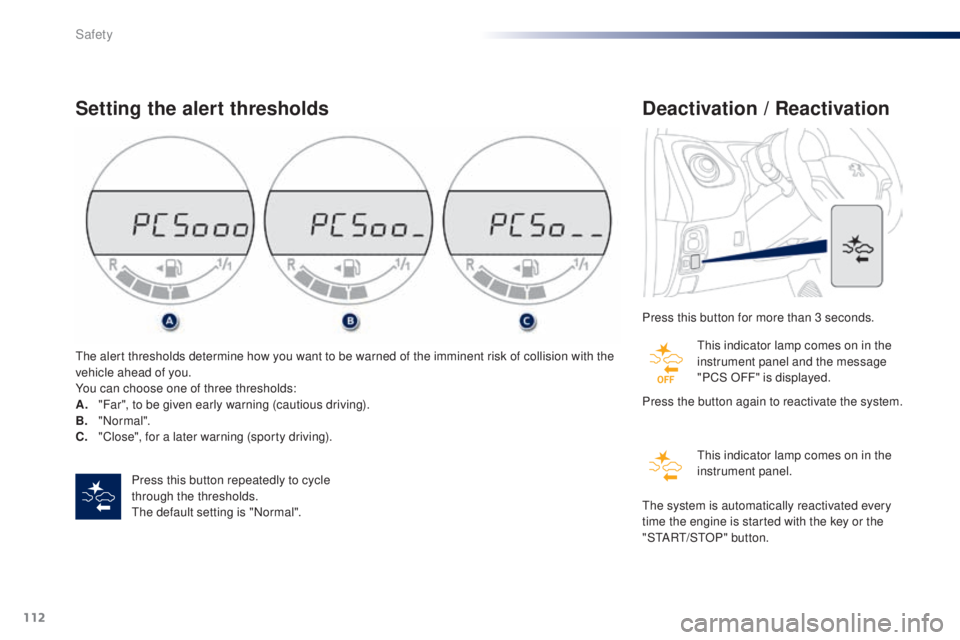
Setting the alert thresholds
Press this button repeatedly to cycle
through the thresholds.
the
default setting is "Normal".
th
e alert thresholds determine how you want to be warned of the imminent risk of collision with the
vehicle ahead of you.
You can choose one of three thresholds:
A.
"
Far", to be given early warning (cautious driving).
B.
"Normal".
C.
"
Close", for a later warning (sporty driving).
Deactivation / Reactivation
Press this button for more than 3 seconds.
Press the button again to reactivate the system.
th
e system is automatically reactivated every
time the engine is started with the key or the
"S
t
A
R
t/
S t
O
P" button.
th
is indicator lamp comes on in the
instrument panel.
th
is indicator lamp comes on in the
instrument panel and the message
"PCS OFF" is displayed.
Safety
Page 121 of 268

119
108_en_Chap06_securite_ed01-2016
Deactivating the passenger's
front airbag
Only the passenger's front airbag can be
deactivated.
F
W
ith the ignition off , insert the key in the
passenger airbag deactivation switch.
F
t
u
rn it to the "
oFF
" position.
F
R
emove the key keeping the switch in the
new position.
When the ignition is on, this warning
lamp comes in the seat belt and
passenger's front airbag display
screen. It stays on while the airbag is
deactivated.
to a
ssure the safety of your child,
the passenger's front airbag must be
deactivated when you install a rear ward
facing child seat on the front passenger
seat.
Otherwise, the child would risk being
seriously injured or killed if the airbag
were deployed.
Reactivating the passenger's
front airbag
When you remove a rear ward facing child
seat, with the ignition off , turn the switch to
the
" o
N
" position to reactivate the airbag and
so assure the safety of your front passenger in
the event of an impact.
When the ignition is switched on, this
warning lamp comes on in the seat
belt and passenger's front airbag
display screen. It stays on while the
front airbag is activated.
operating fault
Illumination of this warning lamp in
the instrument panel indicates a fault
with the airbags.
Contact a P
e
uge
Ot
dealer or a qualified
workshop without delay to have the system
checked.
t
h
e airbags may no longer be
deployed in the event of a serious impact.
In this case, do not install a child seat or seat
an adult on the front passenger seat.
6
Safety
Page 138 of 268
136
108_en_Chap06_securite_ed01-2016
the incorrect installation of a child seat in a
vehicle compromises the child's protection in
the event of an accident.
Check that there is no seat belt or seat belt
buckle under the child seat as this could
destabilise it.
Remember to fasten the seat belts or the
child seat harnesses keeping the slack in
relation to the child's body to a minimum,
even for short journeys.
For the installation of a child seat using a
seat belt, ensure that this is well tensioned
on the child seat and that it is holding the
child seat firmly against the seat of your
vehicle. If your front passenger seat is
adjustable, move it forward if necessary.
At the rear seats, always leave sufficient
space between the front seat and:
-
a r
ear ward facing child seat,
-
t
he feet of a child seated in a for ward
facing child seat.
For this, move the front seat for ward and if
necessary straighten its backrest.
Recommendations on child seats
the chest part of the seat belt must be
positioned on the child's shoulder without
touching the neck.
en
sure that the lap part of the seat belt
passes correctly over the child's thighs.
P
e
uge
Ot
recommends the use of a booster
seat which has a back, fitted with a seat belt
guide at shoulder level.
As a safety precaution, never leave:
-
o
ne or more children alone and
unsupervised in a vehicle,
-
a c
hild or an animal in a vehicle which
is exposed to the sun, with the windows
closed,
-
t
he keys within reach of children inside
the vehicle.
to p
revent accidental opening of the doors,
use the "Child lock".
ta
ke care not to open the rear windows by
more than one third.
to p
rotect young children from the rays of
the sun, fit side blinds on the rear windows.
th
e legislation on carrying a child on the
front passenger seat is specific to each
country. Refer to the legislation in force in
your country.
Deactivate the passenger's front airbag
when a rear ward facing child seat is installed
on the front seat. Otherwise, the child would
risk being seriously injured or killed if the
airbag were deployed. For optimum installation of the forward facing
child seat, ensure that the back of the child
seat is as close as possible to the backrest
of the vehicle's seat, or in contact if possible.
th
e head restraint must be removed before
installing a child seat with a backrest on the
passenger seat.
en
sure that the head restraint is stowed or
attached securely so that it is not thrown
around the vehicle in the event of sharp
braking.
Refit the head restraint as soon as the child
seat is removed.
Installing a booster
cushion
Children at the front
Safety
Page 143 of 268

141
108_en_Chap07_info-pratiques_ed01-2016
electrical energy economy mode*
System which manages the duration of use of certain functions to conserve a sufficient level of
charge in the battery.
After the engine has stopped, you can still use functions such as the audio system, windscreen
wipers, dipped beam headlamps,
courtesy lamps, etc. for a maximum combined duration of
twenty
minutes.
th
is period may be greatly reduced if the battery is not fully charged. Let the engine run for the duration
specified to ensure that the battery
charge is sufficient.
Do not repeatedly and continuously
restart the engine in order to charge the
battery.
A flat battery prevents the engine from
starting.
Refer to the "Battery" section.
Switching to economy mode
Once this time has elapsed the active functions
are put on standby.
exiting economy mode
these functions are reactivated automatically
next time the vehicle is driven.
to r
estore the use of these functions
immediately, start the engine and let it run for at
least 5 minutes.
*
O
nly on vehicles with the "Keyless e
n
try and
Starting" system.
7
Practical information