2016 PEUGEOT 108 roof
[x] Cancel search: roofPage 46 of 268

44
108_en_Chap02_ouvertures_ed01-2016
An aero-acoustic deflector is available to
improve the acoustic comfort of occupants
of the vehicle in certain driving conditions
(high speed), by reducing the turbulence in
the passenger compartment resulting from the
displacement of air.
On opening the roof, the aero-acoustic
deflector is deployed.
On closing the roof, the deflector folds away
automatically.
Aero-acoustic deflector Precautions for use
Never place objects on the roof,
whether open or closed.
Never sit on or place objects on the
transverse roof support when the roof
is open. In the event of prolonged storage of the
vehicle outside, it is recommended that
the roof be protected with a cover.
to a
void damaging the roof, do
not open it under snowy or frosty
conditions.
Never use sharp tools to remove ice or
accumulations of snow on the roof.
to l
imit the creation of folds in the roof
fabric, it is recommended that the roof
not be left open for long periods.
th
e vehicle's air conditioning system
should not be operated while the roof
is open. It is recommended that the roof be
closed when the vehicle is left parked.
ev
en if the roof is closed, it is prudent
not to leave any valuable objects inside
the vehicle.
When you leave the vehicle, switch off
the ignition and remove the key (take
the electronic key with you) to avoid any
unwanted operation of the roof.
Access
Page 47 of 268

45
108_en_Chap02_ouvertures_ed01-2016
Recommendations on care of your vehicle
the general recommendations on the care of your vehicle are given in the warranty and maintenance record.
Fabric roof
to avoid damaging the roof.
- n ever use a high pressure jet wash,
-
n
ever wash your vehicle in an
automatic roller-brush car wash. Remove bird droppings or tree resins as
their acidity may damage the roof. Never use chemical products,
detergents, stain removers, solvents,
alcohol, petrol,
wdt. to clean the roof.
We recommend that you clean the
aero-acoustic defector with care using
a soft brush.
Before washing the fabric roof, first
remove as much dirt as possible from
the sur face using a soft brush or a
vacuum cleaner.to w
aterproof the roof, use only special
waterproofing products for fabric roofs.
to r
emove marks, sponge them (but
never rub them) using soapy water, then
immediately rinse with clean water.
Allow the vehicle to dry in a shaded
area and avoid direct exposure to
the
sun. For the regular maintenance of the
fabric roof and to conserve its original
appearance, we recommend an
ecological "Fly remover - Fabric roof
cleaner" from the "
t
e
C
HNA
t
u
Re"
r
ange. t
o o
btain this product go to a
P
e
uge
Ot d
ealer.
Aero-acoustic deflector
2
Access
Page 59 of 268

57
108_en_Chap03_ergonomie-confort_ed01-2016
Manual override
It is possible to adjust one or more functions
manually while leaving the other functions in
automatic mode.
th
e "A
u
to
" s
ymbol switches off.
to r
eturn to automatic mode, press the "A
u
to
"
b
utton.
Switching to manual mode may not be suitable
(temperature, humidity, odour, condensation)
and does not provide optimum comfort.
Automatic air conditioning
F Press the "Au to" b utton. th
e "Au
to" s
ymbol comes on.
th
e air conditioning system only operates with the engine running.
By pressing the "A
u
to
" b
utton again, you can
choose from one of the following settings in
turn:Automatic programme
Allows optimum operation of the
system.
Offers temperature control while
restricting air flow.
Dynamic air distribution mainly
towards the side air vents.
We recommend that you use this mode.
It provides optimised automatic control of
all of the following functions: passenger
compartment temperature, air flow, air
distribution and air intake, in accordance with
the comfort value that you have chosen.th
is system is designed to operate effectively
in all seasons, with the windows and fabric roof
closed.
For your comfort, when the engine is switched
off, the settings are retained until the engine is
switched on again.
to p
revent too great a distribution of cold air
when the engine is cold, the air flow will only
reach its optimum level gradually.
3
ease of use and comfort
Page 115 of 268
113
108_en_Chap06_securite_ed01-2016
Never leave accumulations of snow or
any object projecting above the bonnet
or in front of the roof: this might fall into
the field of vision of the sensor and
generate a detection.
operating limits
the system only detects vehicles (cars, lorries)
that are stationary or moving in the same
direction as your vehicle. In difficult weather conditions (very
heavy rain, snow, fog, hail...), braking
distances increase, which can reduce
the ability of the system to avoid a
collision.
the
driver must therefore remain
particularly vigilant.
th
e system is not triggered or is interrupted if
the driver:
-
a
ccelerates strongly (even if the speed
limiter is on),
-
o
r turns the steering wheel suddenly
(avoiding manoeuvre).
Detection capability is less effective if:
-
y
ou are driving on roads with pronounced
bends and/or on roads in poor condition,
-
y
our vehicle is excessively loaded, as
this changes the horizontal attitude of the
vehicle.
-
y
our vehicle skids.It does not detect small vehicles
(bicycles, motorcycles), pedestrians or
animals, nor non-reflective stationary
objects.unwanted triggering of the system
It is possible for the system to detect a risk of
imminent collision and start working, in the
following conditions in particular:
-
d
etection of an object located close to the
edge of the road entering a corner (safety
barrier, lamp post or road sign),
-
d
etection of a structure located at the top
or bottom of a steep slope (advertising
hoarding, steet lighting),
-
d
etection of reflective objects (central
reservation...) in the road,
-
d
etection of the upper bar of a bridge or a
traffic light gantry,
-
p
assing a vehicle travelling in the other
direction in a corner,
-
p
assing a vehicle traveling in the other
direction, at a crossroads, when your
vehicle is turning left or right,
-
i
f the vehicle ahead of you sends up water
or snow,
-
i
f your vehicle stops very close to an
overhanging wall or other vehicles,
-
w
hen your vehicle closes rapidly on the
vehicle ahead,
-
i
f the vehicle is raised or lowered,
-
i
f the vehicle passes through a plastic curtain,
-
i
f driving through mist or smoke,
-
i
f the sensor is misaligned (following
replacement after a collision).
6
Safety
Page 124 of 268

122
108_en_Chap06_securite_ed01-2016
Sit in a normal upright position.
Wear a correctly adjusted seat belt.
Do not leave anything between the
occupants and the airbags (a child, pet,
object...), nor fix or attach anything close to
the inflation trajectory of the airbags; this
could cause injuries during their deployment.
Never modify the original definition of your
vehicle, particularly in the area directly
around the airbags.
After an accident or if the vehicle has been
stolen or broken into, have the airbag
systems checked.
All work on the airbag system must be
carried out by a P
e
uge
Ot
dealer or a
qualified workshop.
ev
en if all of the precautions mentioned
are observed, a risk of injury or of minor
burns to the head, chest or arms when an
airbag is deployed cannot be ruled out.
t
h
e
bag inflates almost instantly (within a few
milliseconds) then deflates within the same
time discharging the hot gas via openings
provided for this purpose.Front airbags
Do not drive holding the steering wheel by its
spokes or resting your hands on the centre
part of the wheel.
Passengers must not place their feet on the
dashboard.
Do not smoke as deployment of the airbags
can cause burns or the risk of injury from a
cigarette or pipe.
Never remove or pierce the steering wheel or
hit it violently.
Do not fit or attach anything to the steering
wheel or dashboard, this could cause
injuries with deployment of the airbags.
Advice
Lateral airbags
use only approved covers on the seats,
compatible with the deployment the lateral
airbags. For information on the range of seat
covers suitable for your vehicle, you can
contact a P
e
uge
Ot
dealer.
For more information on accessories, refer
to the corresponding section.
Do not fix or attach anything to the seat
backs (clothing...).
t
h
is could cause injury
to the chest or arms if the lateral airbag is
deployed.
Do not sit with the upper part of the body any
nearer to the door than necessary.
Curtain airbags
Do not fix or attach anything to the roof. th is
could cause injury to the head if the curtain
airbag is deployed.
If fitted on your vehicle, do not remove the
grab handles installed on the roof, they play
a part in securing the curtain airbags.
For the airbags to be fully effective, observe the safety recommendations below:
Safety
Page 144 of 268
142
108_en_Chap07_info-pratiques_ed01-2016
Accessories
A wide range of accessories and genuine parts is available from the PeugeOt dealer network.th
ese accessories and parts are all suitable for your vehicle and benefit from Pe ugeOt' s recommendation and warranty.
"
tr
ansport solutions":
boot carpet, boot liner,
transverse roof bars, bicycle carrier, ski carrier,
roof boxes, boot dividers, ...
"Style":
ligne S body kit, ligne S personalised
mats, aluminium gear lever knob, alloy wheels,
exterior and interior personalisation stickers,
chrome side mouldings, chrome mirror shells,
door sill finishers, personalised remote control
shells, ... "Comfort":
air deflectors, insulated module,
sun blinds, scented air freshener, portable
ashtray, reading lamp, front and rear parking
sensors, centre armrest, cigarette lighter... "Security and safety":
anti-theft alarm,
vehicle tracking system, snow chains, wheel
non-slip covers, wheel security bolts, child
seats, first aid kit, warning triangle, high
visibility vest, breathalyzer, fire extinguisher,
pet seat belt, foglamp kit, seat belt cutter/glass
hammer, ...
"Protection": mats, mud flaps, vehicle cover,
seat covers, bumper protectors, black grained
side mouldings, ...
to p
revent the mat from becoming caught
under the pedals:
-
e
nsure that the mat is secured correctly,
-
n
ever fit one mat on top of another."Multimedia":
audio system, speaker, semi-
integral navigation systems, hands-free kit,
driving assistance systems, 230 V socket,
portable satellite navigation system, telephone/
smartphone support, digital radio, ...
Practical information
Page 146 of 268
144
108_en_Chap07_info-pratiques_ed01-2016
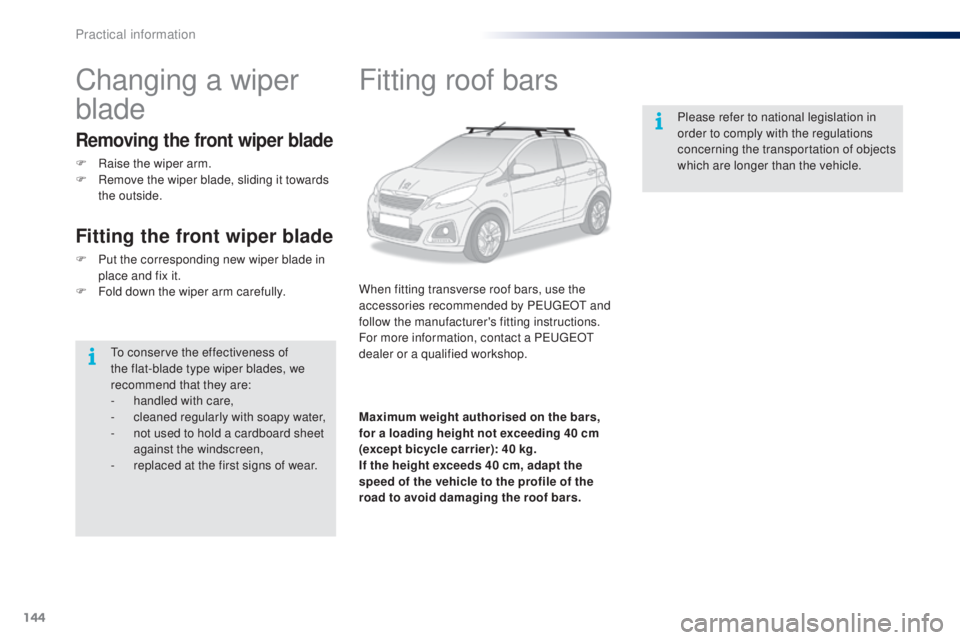
Fitting roof bars
When fitting transverse roof bars, use the
accessories recommended by PeugeOt and
follow the manufacturer's fitting instructions.
For more information, contact a P
e
uge
Ot
dealer or a qualified workshop. Please refer to national legislation in
order to comply with the regulations
concerning the transportation of objects
which are longer than the vehicle.
Maximum weight authorised on the bars,
for a loading height not exceeding 40 cm
(except bicycle carrier): 40 kg.
If the height exceeds 40 cm, adapt the
speed of the vehicle to the profile of the
road to avoid damaging the roof bars.
Changing a wiper
blade
Removing the front wiper blade
F Raise the wiper arm.
F R emove the wiper blade, sliding it towards
the outside.
Fitting the front wiper blade
F Put the corresponding new wiper blade in place and fix it.
F
F
old down the wiper arm carefully.
to c
onserve the effectiveness of
the flat-blade type wiper blades, we
recommend that they are:
-
han
dled with care,
-
c
leaned regularly with soapy water,
-
n
ot used to hold a cardboard sheet
against the windscreen,
-
r
eplaced at the first signs of wear.
Practical information
Page 172 of 268

170
108_en_Chap08_en-cas-pannes_ed01-2016
Dashboard fuses
the fusebox is located below the dashboard
(driver's side).
F u
n
clip the plastic cover for access to the
fuses.
When you have finished, carefully refit the
c ove r. Fuse
N° Rating
(A) Functions
1 5Reversing lamp - Fuel injection system - Audio system -
VSC system
2 15Front and rear screenwash
3 5Main distribution unit - Instrument panel - Display screen -
Air conditioning - Heated rear screen and door mirror heating -
Heated seats - e
l
ectric fabric roof - Audio system
4 5el ectric power steering - Stop & Start
5 15Rear wiper
6 5Cooling fan - ABS system - VSC system
7 25Front wiper
8 10Heated door mirrors
9 1512 V socket (120 W max)
10 7. 5Door mirrors - Audio system - Stop & Start - Instrument panel -
Display screen
In the event of a breakdown