2016 NISSAN NV200 sensor
[x] Cancel search: sensorPage 78 of 312
●If you need to dispose of a supplemen-
tal air bag or pretensioners or scrap the
vehicle, contact a NISSAN dealer. Cor-
rect supplemental air bag and preten-
sioner system disposal procedures are
set forth in the appropriate NISSAN
Service Manual. Incorrect disposal pro-
cedures could cause personal injury.
● If there is an impact to your vehicle from
any direction, your Occupant Classifica-
tion Sensor (OCS) should be checked
by a NISSAN dealer to verify it is still
functioning correctly. The OCS should
be checked even if no air bags deploy as
a result of the impact. Failure to verify
proper OCS function may result in an
improper air bag deployment resulting
in injury or death.
Safety—Seats, seat belts and supplemental restraint system1-59
Page 90 of 312
CAUTION
Do not continue driving if the drive belt is
loose, broken or missing.
Door open warning light
This light comes on when any of the doors are not
closed securely while the ignition switch is
placed in the ON position.
Engine oil pressure warninglight
This light warns of low engine oil pressure. If the
light flickers or comes on during normal driving,
pull off the road in a safe area, stop the engine
immediately and call a NISSAN dealer or other
authorized repair shop.
The engine oil pressure warning light is not
designed to indicate a low oil level. Use the
dipstick to check the oil level. For additional in-
formation, refer to “Engine oil” in the “Mainte-
nance and do-it-yourself” section of this manual.
CAUTION
Running the engine with the engine oil
pressure warning light on could cause se-
rious damage to the engine almost imme-
diately. Such damage is not covered by
warranty. Turn off the engine as soon as it
is safe to do so.
High temperature warning light
(red)
When the ignition switch is placed in the ON
position, the high temperature warning light illu-
minates and then turns off. This indicates that the
high temperature sensor in the engine coolant
system is operational.
CAUTION
If the high temperature warning light illu-
minates while the engine is running, it
may indicate the engine temperature is
extremely high. Stop the vehicle safely as
soon as possible. If the vehicle is over-
heated, continuing vehicle operation may
seriously damage the engine. For addi-
tional information, refer to “If your vehicle
overheats” in the “In case of emergency”
section of this manual.
Low fuel warning light
This light comes on when the fuel level in the fuel
tank is getting low. Refuel as soon as it is conve-
nient, preferably before the fuel gauge reaches 0
(Empty) . There will be a small reserve of fuel
in the tank when the fuel gauge reaches 0
(Empty) .
Low tire pressure warning light
Your vehicle is equipped with a TPMS that moni-
tors the tire pressure of all tires except the spare.
The low tire pressure warning light warns of low
tire pressure or indicates that the TPMS is not
functioning properly.
After the ignition switch is placed in the ON
position, this light illuminates for about 1 second
and turns off.
Low tire pressure warning
If the vehicle is being driven with low tire
pressure, the warning light will illuminate.
A CHECK TIRE PRES (pressure) warning
message is also displayed in the odometer.
Instruments and controls2-11
Page 196 of 312
●If the low tire pressure warning light
illuminates while driving, avoid sudden
steering maneuvers or abrupt braking,
reduce vehicle speed, pull off the road
to a safe location and stop the vehicle
as soon as possible. Driving with under-
inflated tires may permanently damage
the tires and increase the likelihood of
tire failure. Serious vehicle damage
could occur and may lead to an accident
and could result in serious personal in-
jury. Check the tire pressure for all four
tires. Adjust the tire pressure to the
recommended COLD tire pressure
shown on the Tire and Loading Informa-
tion label to turn the low tire pressure
warning light OFF. If you have a flat tire,
replace it with a spare tire as soon as
possible. For additional information, re-
fer to “Flat tire” in the “In case of emer-
gency” section of this manual.
● When a spare tire is mounted or a wheel
is replaced, tire pressure will not be
indicated, the TPMS will not function
and the low tire pressure warning light
will flash for approximately 1 minute.
The light will remain on after 1 minute.
Contact your NISSAN dealer as soon as
possible for tire replacement and/or
system resetting. ●
Replacing tires with those not originally
specified by NISSAN could affect the
proper operation of the TPMS.
● Do not inject any tire liquid or aerosol
tire sealant into the tires, as this may
cause a malfunction of the tire pressure
sensors.
CAUTION
Do not place metalized film or any metal
parts (antenna, etc.) on the windows. This
may cause poor reception of the signals
from the tire pressure sensors, and the
TPMS will not function properly.
Some devices and transmitters may temporarily
interfere with the operation of the TPMS and
cause the low tire pressure warning light to illu-
minate.
Some examples are:
– Facilities or electric devices using similar radio frequencies are near the vehicle.
– If a transmitter set to similar frequencies is being used in or near the vehicle.
– If a computer (or similar equipment) or a DC/AC converter is being used in or near the
vehicle. FCC Notice
For USA
This device complies with Part 15 of the
FCC Rules. Operation is subject to the fol-
lowing two conditions: (1) This device may
not cause harmful interference, and (2) this
device must accept any interference re-
ceived, including interference that may
cause undesired operation.
NOTE:
Changes or modification not expressly ap-
proved by the party responsible for compli-
ance could void the user’s authority to op-
erate the equipment.
AVOIDING COLLISION AND
ROLLOVER
WARNING
Failure to operate this vehicle in a safe
and prudent manner may result in loss of
control or an accident.
Be alert and drive defensively at all times. Obey
all traffic regulations. Avoid excessive speed,
high speed cornering, or sudden steering ma-
neuvers, because these driving practices could
cause you to lose control of your vehicle.
Starting and driving5-5
Page 213 of 312
WARNING
Do not pump the brake pedal. Doing so
may result in increased stopping
distances.
Self-test feature
The ABS includes electronic sensors, electric
pumps, hydraulic solenoids and a computer. The
computer has a built-in diagnostic feature that
tests the system each time you start the engine
and move the vehicle at a low speed in forward or
reverse. When the self-test occurs, you may hear
a “clunk” noise and/or feel a pulsation in the brake
pedal. This is normal and does not indicate a
malfunction. If the computer senses a malfunc-
tion, it switches the ABS off and illuminates the
ABS warning light on the instrument panel. The
brake system then operates normally but without
anti-lock assistance.
If the ABS warning light illuminates during the
self-test or while driving, have the vehicle
checked. It is recommended that you visit a
NISSAN dealer for this service.
Normal operation
The ABS operates at speeds above3-6mph(5
- 10 km/h). The speed varies according to road
conditions.
When the ABS senses that one or more wheels
are close to locking up, the actuator rapidly ap-
plies and releases hydraulic pressure. This action
is similar to pumping the brakes very quickly. You
may feel a pulsation in the brake pedal and hear a
noise from under the hood or feel a vibration from
the actuator when it is operating. This is normal
and indicates that the ABS is operating properly.
However, the pulsation may indicate that road
conditions are hazardous and extra care is re-
quired while driving.The VDC system uses various sensors to monitor
driver inputs and vehicle motion. Under certain
driving conditions, the VDC system helps to per-
form the following functions:
● Controls brake pressure to reduce wheel
slip on one slipping drive wheel so power is
transferred to a non slipping drive wheel on
the same axle.
● Controls brake pressure and engine output
to reduce drive wheel slip based on vehicle
speed (traction control function) .
● Controls brake pressure at individual wheels
and engine output to help the driver maintain
control of the vehicle in the following condi-
tions:
– understeer (vehicle tends to not follow the steered path despite increased steer-
ing input)
– oversteer (vehicle tends to spin due to certain road or driving conditions)
The VDC system can help the driver to maintain
control of the vehicle, but it cannot prevent loss of
vehicle control in all driving situations.
VEHICLE DYNAMIC CONTROL (VDC)
SYSTEM
5-22Starting and driving
Page 220 of 312
WARNING
●If the low tire pressure warning light
illuminates while driving, avoid sudden
steering maneuvers or abrupt braking,
reduce vehicle speed, pull off the road
to a safe location and stop the vehicle
as soon as possible. Driving with under-
inflated tires may permanently damage
the tires and increase the likelihood of
tire failure. Serious vehicle damage
could occur and may lead to an accident
and could result in serious personal in-
jury. Check the tire pressure for all four
tires. Adjust the tire pressure to the
recommended COLD tire pressure
shown on the Tire and Loading Informa-
tion label to turn the low tire pressure
warning light OFF. If you have a flat tire,
replace it with a spare tire as soon as
possible. ●
Since the spare tire is not equipped with
the TPMS, when a spare tire is mounted
or a wheel is replaced, the TPMS will
not function and the low tire pressure
warning light will flash for approxi-
mately 1 minute. The light will remain
on after 1 minute. Have your tires re-
placed and/or TPMS system reset as
soon as possible. It is recommended
you visit a NISSAN dealer for these
services.
● Replacing tires with those not originally
specified by NISSAN could affect the
proper operation of the TPMS.
● Do not inject any tire liquid or aerosol
tire sealant into the tires, as this may
cause a malfunction of the tire pressure
sensors.
CHANGING A FLAT TIRE (if so
equipped)
If you have a flat tire, follow the instructions be-
low:
Stopping the vehicle
1. Safely move the vehicle off the road and
away from traffic.
2. Turn on the hazard warning flashers. 3. Park on a level surface and apply the parking
brake. Move the shift lever to P (Park) .
4. Place the Auto Step switch in the OFF po- sition.
5. Turn off the engine.
6. Raise the hood to warn other traffic and to signal professional road assistance person-
nel that you need assistance.
7. Have all passengers get out of the vehicle and stand in a safe place, away from traffic
and clear of the vehicle.
WARNING
●Make sure the parking brake is securely
applied and the CVT is shifted into P
(Park) .
● Never change tires when the vehicle is
on a slope, ice or slippery areas. This is
hazardous.
● Never change tires if oncoming traffic is
close to your vehicle. Wait for profes-
sional road assistance.
In case of emergency6-3
Page 222 of 312
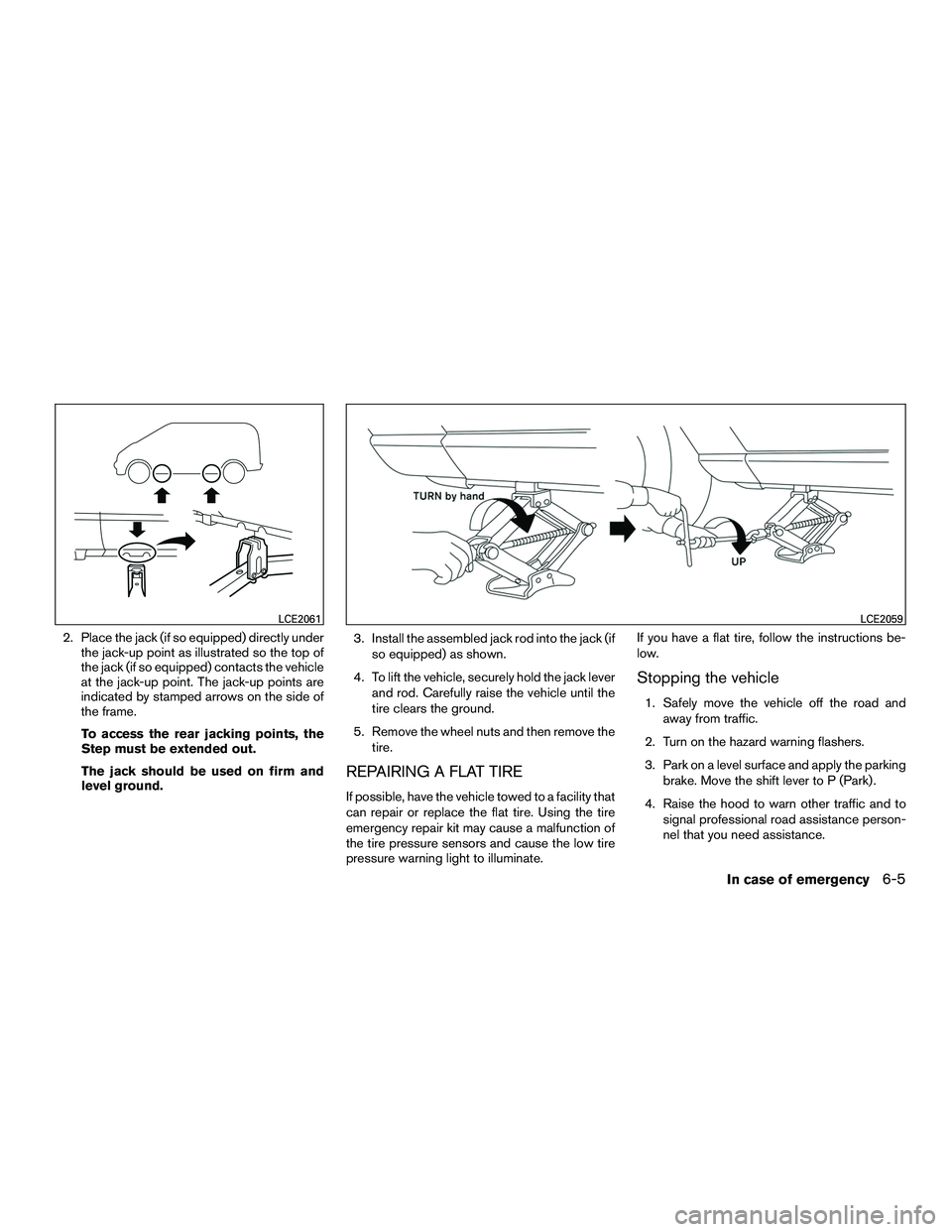
2. Place the jack (if so equipped) directly underthe jack-up point as illustrated so the top of
the jack (if so equipped) contacts the vehicle
at the jack-up point. The jack-up points are
indicated by stamped arrows on the side of
the frame.
To access the rear jacking points, the
Step must be extended out.
The jack should be used on firm and
level ground. 3. Install the assembled jack rod into the jack (if
so equipped) as shown.
4. To lift the vehicle, securely hold the jack lever and rod. Carefully raise the vehicle until the
tire clears the ground.
5. Remove the wheel nuts and then remove the tire.
REPAIRING A FLAT TIRE
If possible, have the vehicle towed to a facility that
can repair or replace the flat tire. Using the tire
emergency repair kit may cause a malfunction of
the tire pressure sensors and cause the low tire
pressure warning light to illuminate. If you have a flat tire, follow the instructions be-
low.
Stopping the vehicle
1. Safely move the vehicle off the road and
away from traffic.
2. Turn on the hazard warning flashers.
3. Park on a level surface and apply the parking brake. Move the shift lever to P (Park) .
4. Raise the hood to warn other traffic and to signal professional road assistance person-
nel that you need assistance.
LCE2061LCE2059
In case of emergency6-5
Page 223 of 312
5. Have all passengers get out of the vehicleand stand in a safe place, away from traffic
and clear of the vehicle.
WARNING
●Make sure the parking brake is securely
applied and the shift lever is shifted into
P (Park) .
● Never repair tires when the vehicle is on
a slope, ice or slippery areas. This is
hazardous.
● Never repair tires if oncoming traffic is
close to your vehicle. Wait for profes-
sional road assistance.
Locating the emergency tire repair kit
Take out the emergency tire puncture repair kit
located under the passenger seat. The repair kit
consists of the following items:
1. Tire sealant bottle
2. Air compressor
3. Speed restriction sticker NOTE:
For models with the emergency tire punc-
ture repair kit, a spare tire, jack and rod may
not be equipped as standard. These parts
may be dealer options. Contact a NISSAN
dealer about obtaining these parts. For ad-
ditional information, refer to “Changing a
flat tire” in the “In case of emergencies”
section of this manual.
Before using the emergency tire repair
kit
The emergency tire repair kit is not appropriate
for the following situations. It will be necessary to
contact a professional towing service in the fol-
lowing situations:
● The emergency repair kit’s shelf life has ex-
pired.
● Cuts or punctures exceed approximately
0.2 in (4 mm) .
● The tire sidewall is damaged.
● The tire is extremely low on air.
● The tire has come off of the inside or outside
of the wheel.
● The wheel is damaged.
● The tire is punctured more than once.
Performing emergency repairs
WARNING
Observe the following precautions when
using the tire repair compound.
●Swallowing the compound is danger-
ous. Immediately drink as much water
as possible and seek prompt medical
assistance.
● Rinse well with lots of water if com-
pound comes into contact with skin or
eyes. If irritation persists seek prompt
medical attention.
● Keep the repair compound out of reach
of children.
● The emergency repair compound may
cause a malfunction of the tire pressure
sensors and cause the low tire pressure
warning light to illuminate. Have the tire
pressure sensor replaced as soon as
possible.
6-6In case of emergency
Page 227 of 312
If the tire pressure does not increase to26 psi
(180 kPa) within 10 minutes, the tire may be
seriously damaged and the tire cannot be re-
paired with this tire repair kit. Under this
circumstance, contact a professional towing ser-
vice for assistance.
9. When the tire pressure is at the specified pressure, turn the air compressor off. If the
tire cannot be inflated to the specified pres-
sure, the air compressor can be turned of at
the minumum 26 psi (180 kPa) . Remove the
power plug from the outlet and quickly re-
move the hose from the tire valve. Attach the
protective cap and valve cap. Properly stow
the emergency tire repair kit in the cargo
area.
10. Immediately drive the vehicle for 10 minutes or 2 miles (3 km) at a speed below 50 mph
(80 km/h).
11. After driving, make sure that the air com- pressor switch is in the OFF position, then
screw the hose into the tire valve. Check the
pressure with the pressure gauge. Tempo-
rary repair is complete if the tire pressure
does not drop.
Make sure that the tire pressure is adjusted to the
pressure that is specified on the tire placard
before driving.CAUTION
If tire pressure falls below 18 psi (130 kPa)
and remains low, even after repeating
steps 5-11, the tire is not repairable using
the tire emergency repair kit. Stop driving
the vehicle and contact a professional
towing service.
● It is recommended to replace the repaired
tire with a new tire.
● Although the wheel can be reused by remov-
ing the repair compound, the tire valve must
be replaced.
● The remaining repair compound is not us-
able and must be replaced.
● When attempting to repair the punctured tire
at a later time the puncture may not be
detectable. It is important to carefully moni-
tor the tire pressure of the repaired tire. If the
tire should continually lose air pressure you
will need to have the tire replaced.
After tire repair
See a NISSAN dealer for tire repair or replace-
ment as soon as possible.
WARNING
● After using Emergency Tire Sealant to
repair a minor tire puncture, do not
drive the vehicle at speeds faster than
80 km/h (50 mph) .
● Immediately after using Emergency Tire
Sealant to repair a minor tire puncture,
take your vehicle to a NISSAN dealer to
inspect, and repair or replace the tire.
The Emergency Tire Sealant cannot per-
manently seal a punctured tire. Con-
tinuing operation of the vehicle without
a permanent tire repair can lead to a
crash.
● If you used Emergency Tire Sealant to
repair a minor tire puncture, a NISSAN
dealer will also need to replace the
TPMS sensor in addition to repairing or
replacing the tire.
6-10In case of emergency