2016 NISSAN NV200 CD player
[x] Cancel search: CD playerPage 201 of 312
●If the engine is very hard to start because
it is flooded, depress the accelerator
pedal all the way to the floor and hold it.
Crank the engine for 5–6 seconds. After
cranking the engine, release the accel-
erator pedal. Crank the engine with your
foot off the accelerator pedal by turn-
ing the ignition key to START. Release the
key when the engine starts. If the engine
starts, but fails to run, repeat the above
procedure.
CAUTION
Do not operate the starter for more than
15 seconds at a time. If the engine does
not start, turn the key off and wait 10 sec-
onds before cranking again, otherwise the
starter could be damaged.
4. Allow the engine to idle for at least 30 sec- onds after starting. Do not race the engine
while warming it up. Drive at moderate
speed for a short distance first, especially in
cold weather.
In cold weather, keep the engine running for
a minimum of 2–3 minutes before shutting it
off. Starting and stopping the engine over a
short period of time may make the vehicle
more difficult to start. NOTE:
Care should be taken to avoid situations
that can lead to potential battery discharge
and potential no-start conditions such as:
1. Installation or extended use of electronic accessories that consume battery power
when the engine is not running (Phone char-
gers, GPS, DVD players, etc.)
2. Vehicle is not driven regularly and/or only driven short distances. In these cases, the
battery may need to be charged to maintain
battery health.
CONTINUOUSLY VARIABLE
TRANSMISSION (CVT)
WARNING
●Do not depress the accelerator pedal
while shifting from P (Park) or N (Neu-
tral) to R (Reverse) , D (Drive) or L (Low) .
Always depress the brake pedal until
shifting is completed. Failure to do so
could cause you to lose control and
have an accident.
● Cold engine idle speed is high, so use
caution when shifting into a forward or
reverse gear before the engine has
warmed up.
● Do not downshift abruptly on slippery
roads. This may cause a loss of control.
● Never shift to either the P (Park) or R
(Reverse) position while the vehicle is
moving forward and P (Park) or D
(Drive) position while the vehicle is re-
versing. This could cause an accident or
damage the transmission.
● Except in an emergency, do not shift to
the N (Neutral) position while driving.
Coasting with the transmission in the N
(Neutral) position may cause serious
damage to the transmission.
DRIVING THE VEHICLE
5-10Starting and driving
Page 243 of 312
Steering wheelCheck for changes in the steer-
ing system, such as excessive freeplay, hard
steering or strange noises.
Warning lights and chimes Make sure all
warning lights and chimes are operating properly.
Windshield wiper and washer* Check that
the wipers and washer operate properly and that
the wipers do not streak.
Windshield defroster Check that the air
comes out of the defroster outlets properly and in
sufficient quantity when operating the heater or
air conditioner.
Under the hood and vehicle
The maintenance items listed here should be
checked periodically (for example, each time you
check the engine oil or refuel) .
Battery* Check the fluid level in each cell. It
should be between the MAX and MIN lines. Ve-
hicles operated in high temperatures or under
severe conditions require frequent checks of the
battery fluid level. NOTE:
Care should be taken to avoid situations
that can lead to potential battery discharge
and potential no-start conditions such as:
1. Installation or extended use of electronic accessories that consume battery power
when the engine is not running (Phone char-
gers, GPS, DVD players, etc.)
2. Vehicle is not driven regularly and/or only driven short distances. In these cases, the
battery may need to be charged to maintain
battery health.
Brake fluid levels* Make sure that the brake
fluid level is between the MIN and MAX lines on
the reservoir.
Engine coolant level* Check the coolant level
when the engine is cold.
Engine drive belts* Make sure the drive belts
are not frayed, worn, cracked or oily.
Engine oil level* Check the level after parking
the vehicle on a level surface with the engine off.
Wait more than 10 minutes for the oil to drain
back into the oil pan.
Exhaust system Make sure there are no loose
supports, cracks or holes. If the sound of the
exhaust seems unusual or there is a smell of
exhaust fumes, immediately have the exhaust system inspected by a NISSAN dealer. For addi-
tional information, refer to the “Exhaust gas (car-
bon monoxide)” in the “Starting and driving” sec-
tion of this manual.
Fluid leaks
Check under the vehicle for fuel, oil,
water or other fluid leaks after the vehicle has
been parked for a while. Water dripping from the
air conditioner after use is normal. If you should
notice any leaks or if gasoline fumes are evident,
check for the cause and have it corrected imme-
diately.
Radiator and hoses Check the front of the
radiator and clean off any dirt, insects, leaves,
etc., that may have accumulated. Make sure the
hoses have no cracks, deformation, rot or loose
connections.
Underbody The underbody is frequently ex-
posed to corrosive substances such as those
used on icy roads or to control dust. It is very
important to remove these substances from the
underbody, otherwise rust may form on the floor
pan, frame, fuel lines and exhaust system. At the
end of winter, the underbody should be thor-
oughly flushed with plain water, in those areas
where mud and dirt may have accumulated. For
additional information, refer to the “Appearance
and care” section of this manual.
Windshield-washer fluid* Check that there is
adequate fluid in the reservoir.
8-4Maintenance and do-it-yourself
Page 252 of 312
WINDSHIELD-WASHER FLUID
RESERVOIR
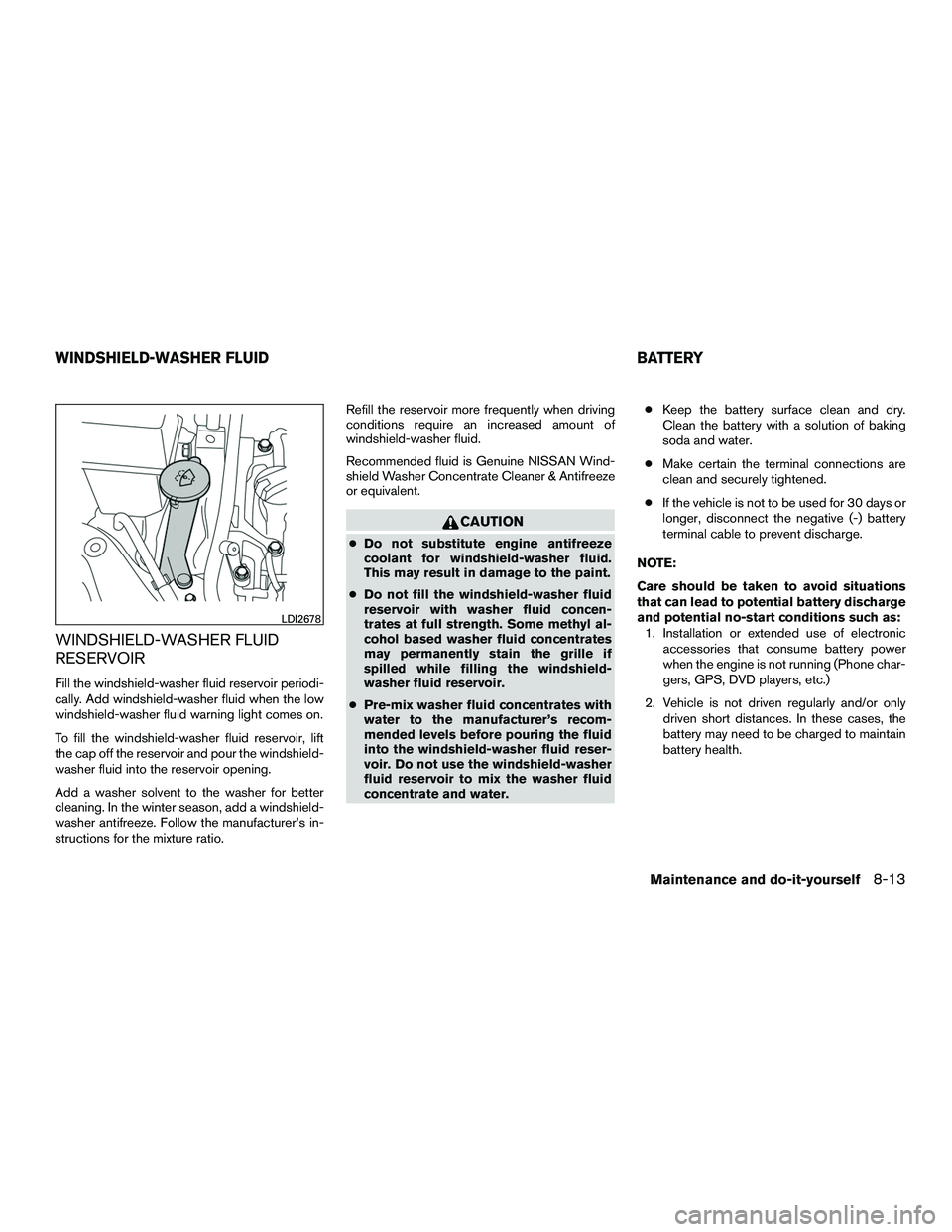
Fill the windshield-washer fluid reservoir periodi-
cally. Add windshield-washer fluid when the low
windshield-washer fluid warning light comes on.
To fill the windshield-washer fluid reservoir, lift
the cap off the reservoir and pour the windshield-
washer fluid into the reservoir opening.
Add a washer solvent to the washer for better
cleaning. In the winter season, add a windshield-
washer antifreeze. Follow the manufacturer’s in-
structions for the mixture ratio.Refill the reservoir more frequently when driving
conditions require an increased amount of
windshield-washer fluid.
Recommended fluid is Genuine NISSAN Wind-
shield Washer Concentrate Cleaner & Antifreeze
or equivalent.
CAUTION
●
Do not substitute engine antifreeze
coolant for windshield-washer fluid.
This may result in damage to the paint.
● Do not fill the windshield-washer fluid
reservoir with washer fluid concen-
trates at full strength. Some methyl al-
cohol based washer fluid concentrates
may permanently stain the grille if
spilled while filling the windshield-
washer fluid reservoir.
● Pre-mix washer fluid concentrates with
water to the manufacturer’s recom-
mended levels before pouring the fluid
into the windshield-washer fluid reser-
voir. Do not use the windshield-washer
fluid reservoir to mix the washer fluid
concentrate and water. ●
Keep the battery surface clean and dry.
Clean the battery with a solution of baking
soda and water.
● Make certain the terminal connections are
clean and securely tightened.
● If the vehicle is not to be used for 30 days or
longer, disconnect the negative (-) battery
terminal cable to prevent discharge.
NOTE:
Care should be taken to avoid situations
that can lead to potential battery discharge
and potential no-start conditions such as: 1. Installation or extended use of electronic accessories that consume battery power
when the engine is not running (Phone char-
gers, GPS, DVD players, etc.)
2. Vehicle is not driven regularly and/or only driven short distances. In these cases, the
battery may need to be charged to maintain
battery health.
LDI2678
WINDSHIELD-WASHER FLUID BATTERY
Maintenance and do-it-yourself8-13
Page 304 of 312
10 Index
A
ABS (Anti-lock Braking System) ........5-21
Air bag (See supplemental restraint
system) .....................1-40
Air bag system Front (See supplemental front impact
air bag system) ...............1-48
Airbagwarninglabels.............1-57
Airbagwarninglight...........1-58,2-14
Air bag warning light, supplemental . .1-58, 2-14
Air cleaner housing filter ............8-17
Air conditioner Air conditioner operation ..........4-17
Air conditioner specification label .....9-11
Air conditioner system refrigerant and
oil recommendations .............9-6
Air conditioner system refrigerant
recommendations ..............9-6
Heater and air conditioner (manual) ....4-14
Rear seat air conditioner ..........4-21
Servicing air conditioner ..........4-22
Airflowcharts..................4-18
Anchor point locations .............1-24
Antenna .....................4-45
Antifreeze ....................5-25
Anti-lock Braking System (ABS) ........5-21
Audible reminders ...............2-16
Audio system ..................4-22
AM radio reception .............4-23
Bluetooth® streaming audio ........4-42
Compact disc (CD) player .........4-35 FM/AM/SAT radio with compact disc (CD)
player ....................4-30
FMradioreception.............4-22
iPod® Player
................4-39
iPod® player operation ...........4-39
Radio ....................4-22
Steering wheel audio control switch . . .4-44
USB (Universal Serial Bus) Connection
Port .....................4-37
Automatic Automatic power window switch .....2-26
Automatic door locks ..............3-9
AUXjack ....................4-37
B
Back door .....................3-7
Battery ..................5-25,8-13
Chargewarninglight............2-10
Battery replacement ..............8-23
Keyfob................8-23,8-23
Before starting the engine ............5-9
Belt (See drive belt) ..............8-16
Bluetooth®audio................4-42
Bluetooth® Hands-Free Phone System with
NavigationSystem...............4-47
Boosterseats..................1-37
Brake Anti-lock Braking System (ABS) ......5-21
Brake fluid ..................8-12
Brake light (See stop light) .........8-29
Brake system ................5-20 Brakewarninglight.............2-10
Brakewearindicators........2-16,8-19
Parking brake operation
..........5-14
Self-adjusting brakes ............8-19
Brake fluid ....................8-12
Brakes ......................8-19
Brake system ..................5-20
Break-inschedule ...............5-16
Brightness/contrast button ...........4-7
Brightness control Instrument panel ..............2-20
Bulb check/instrument panel ..........2-9
Bulbreplacement................8-29
C
Capacities and recommended
fuel/lubricants ...................9-2
Cargolight ...................2-30
Cargo (See vehicle loading information) . . .9-12
Car
phone or CB radio .............4-46
CDcareandcleaning .............4-43
CD player (See audio system) .........4-35
Child restraints .......1-18,1-19,1-20,1-22
LATCH (Lower Anchors and Tethers for
CHildren) System ..............1-22
Precautions on child
restraints ........1-20,1-26,1-33,1-37
Top tether strap anchor point locations . .1-24
Child safety sliding door lock ..........3-9
Chimes, audible reminders ...........2-16
Cleaning exterior and interior .......7-2,7-4
Page 305 of 312

Clock setting
(models with Navigation System).....4-5,4-32
Cold weather driving ...............5-25
Compact disc (CD) player ...........4-35
Connect phone .................4-45
Continuously Variable Transmission (CVT) . . .5-10 Continuously Variable Transmission (CVT)
fluid ......................8-12
Driving with Continuously Variable
Transmission (CVT) .............5-10
Control panel buttons ...............4-2
Brightness/contrast button ..........4-7
Enterbutton..................4-2
Setting button .................4-5
Controls Audiocontrols(steeringwheel).......4-44
Rear seat air conditioner ..........4-21
Coolant Capacities and recommended
fuel/lubricants .................9-2
Changing engine coolant ...........8-8
Checking engine coolant level ........8-8
Corrosionprotection ...............7-5
Cruisecontrol..................5-15
Cupholders...................2-24
D
Defroster switch Rear window and outside mirror defroster
switch.....................2-19
Dimensionsandweights.............9-8
Dimmer switch for instrument panel ......2-20
Display controls (see control panel buttons) . .4-2
Door locks .....................3-3 Door open warning light
.............2-11
Doors ........................3-3
Drive belt .....................8-16
Driving Cold weather driving .............5-25
Driving with Continuously Variable
Transmission (CVT) .............5-10
Precautions when starting and driving ....5-2
Driving the vehicle ................5-10
E
Economy - fuel ..................5-18
Emission control information label .......9-11
Emission control system warranty .......9-17
Engine Before starting the engine ..........5-9
Capacities and recommended
fuel/lubricants .................9-2
Changingenginecoolant...........8-8
Changingengineoil.............8-10
Changing engine oil filter ..........8-11
Checking engine coolant level ........8-8
Checking engine oil level ...........8-9
Engine compartment check locations ....8-6
Engine cooling system ............8-7
Engineoil ...................8-9
Engine oil and oil filter recommendation . . .9-5
Engine oil pressure warning light ......2-11
Engine oil viscosity ..............9-5
Engine serial number ............9-10
Engine specifications .............9-7
Starting the engine ..............5-9
Enterbutton....................4-2
EventDatarecorders..............9-18 Exhaust gas (Carbon monoxide)
.........5-2
Explanation of maintenance items ........8-2
Extended storage switch ............8-22
F
Flashers (See hazard warning flasher switch) . .6-2
Flat tire .......................6-2
Floor mat positioning aid .............7-5
Fluid Brake fluid ..................8-12
Capacities
and recommended
fuel/lubricants.................9-2
Continuously Variable Transmission (CVT)
fluid......................8-12
Enginecoolant.................8-7
Engineoil ...................8-9
Windshield-washer fluid ...........8-13
F.M.V.S.S. certification label ...........9-10
Front air bag system
(See supplemental restraint system) ......1-48
Frontseats.....................1-2
Fuel Capacities and recommended
fuel/lubricants.................9-2
Fuel economy ................5-18
Fuel-filler cap .................3-14
Fuel-filler door lock opener lever ......3-14
Fuel-filler lid .................3-14
Fuelgauge...................2-6
Fuel octane rating ...............9-4
Loose fuel cap warning ............2-5
Fuel Cell Vehicle (FCV) System Tire pressure .................8-33
Fuel-filler door ..................3-14
10-2
Page 306 of 312
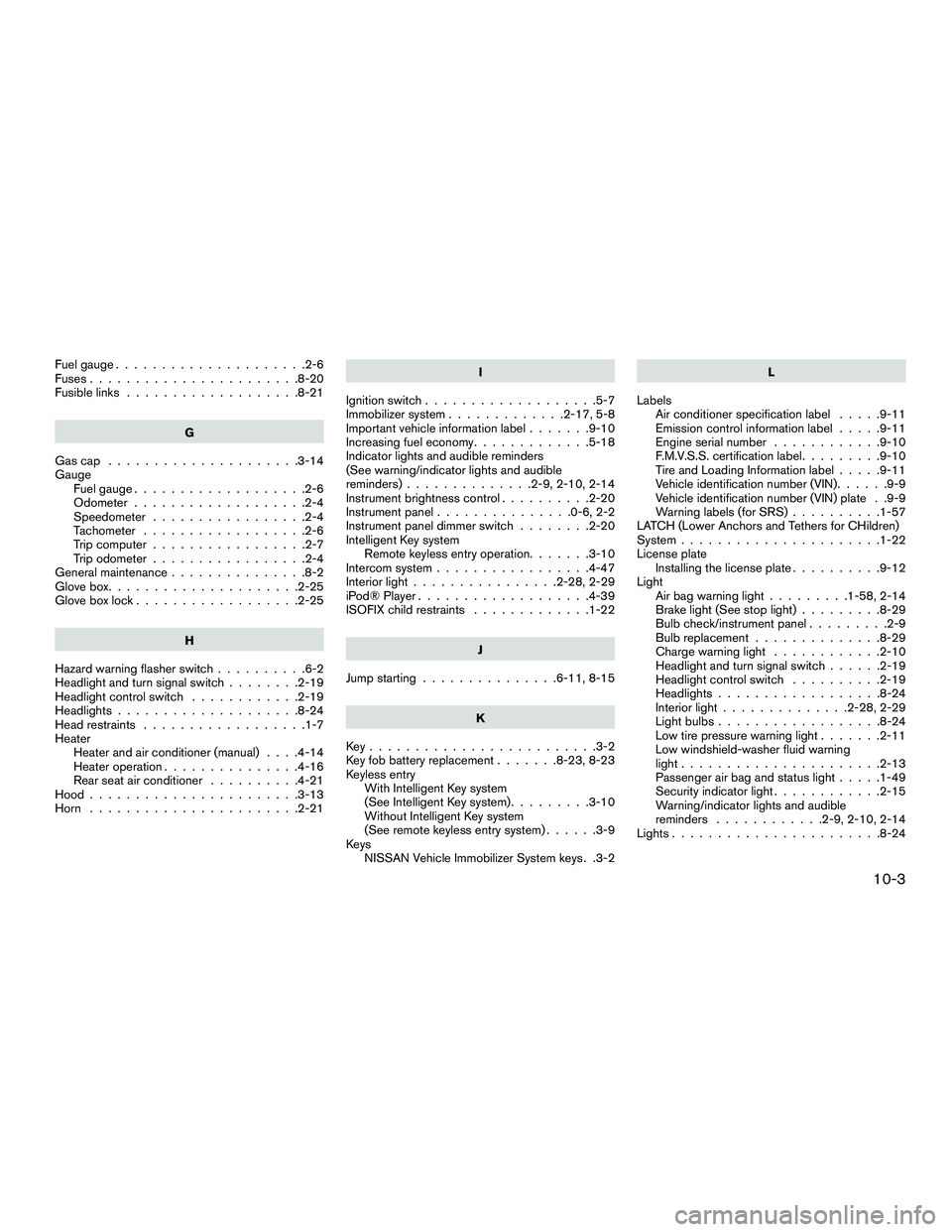
Fuel gauge.....................2-6
Fuses.......................8-20
Fusible links ...................8-21
G
Gascap .....................3-14
Gauge Fuel gauge ...................2-6
Odometer ...................2-4
Speedometer .................2-4
Tachometer ..................2-6
Trip computer .................2-7
Trip odometer .................2-4
General maintenance ...............8-2
Glovebox.....................2-25
Gloveboxlock..................2-25
H
Hazard warning flasher switch ..........6-2
Headlight and turn signal switch ........2-19
Headlightcontrolswitch ............2-19
Headlights....................8-24
Head restraints ..................1-7
Heater Heater and air conditioner (manual) ....4-14
Heater operation ...............4-16
Rear seat air conditioner ..........4-21
Hood .......................3-13
Horn .......................2-21 I
Ignition switch ...................5-7
Immobilizer system .............2-17,5-8
Important vehicle information label .......9-10
Increasing fuel economy .............5-18
Indicator lights and audible reminders
(See warning/indicator lights and audible
reminders) ..............2-9,2-10,2-14
Instrument brightness control ..........2-20
Instrument panel ...............0-6,2-2
Instrument panel dimmer switch ........2-20
Intelligent Key system Remote keyless entry operation.......3-10
Intercom system .................4-47
Interiorlight................2-28,2-29
iPod® Player ...................4-39
ISOFIX child restraints .............1-22
J
Jump starting ...............6-11,8-15
K
Key.........................3-2
Key fob battery replacement .......8-23,8-23
Keyless entry With Intelligent Key system
(See Intelligent Key system) .........3-10
Without Intelligent Key system
(See remote keyless entry system) ......3-9
Keys NISSAN Vehicle Immobilizer System keys . .3-2 L
Labels Air conditioner specification label .....9-11
Emission control information label .....9-11
Engine serial number ............9-10
F.M.V.S.S. certification label .........9-10
Tire and Loading Information label .....9-11
Vehicle identification number (VIN) ......9-9
Vehicle identification number (VIN) plate . .9-9
Warning labels (for SRS) ..........1-57
LATCH (Lower Anchors and Tethers for CHildren)
System ......................1-22
License plate Installing the license plate ..........9-12
Light A
irbagwarninglight.........1-58,2-14
Brake light (See stop light) .........8-29
Bulb check/instrument panel .........2-9
Bulb replacement ..............8-29
Charge warning light ............2-10
Headlightandturnsignalswitch......2-19
Headlight control switch ..........2-19
Headlights..................8-24
Interior light ..............2-28,2-29
Lightbulbs..................8-24
Low tire pressure warning light .......2-11
Low windshield-washer fluid warning
light......................2-13
Passenger air bag and status light .....1-49
Security indicator light ............2-15
Warning/indicator lights and audible
reminders ............2-9,2-10,2-14
Lights.......................8-24
10-3
Page 307 of 312
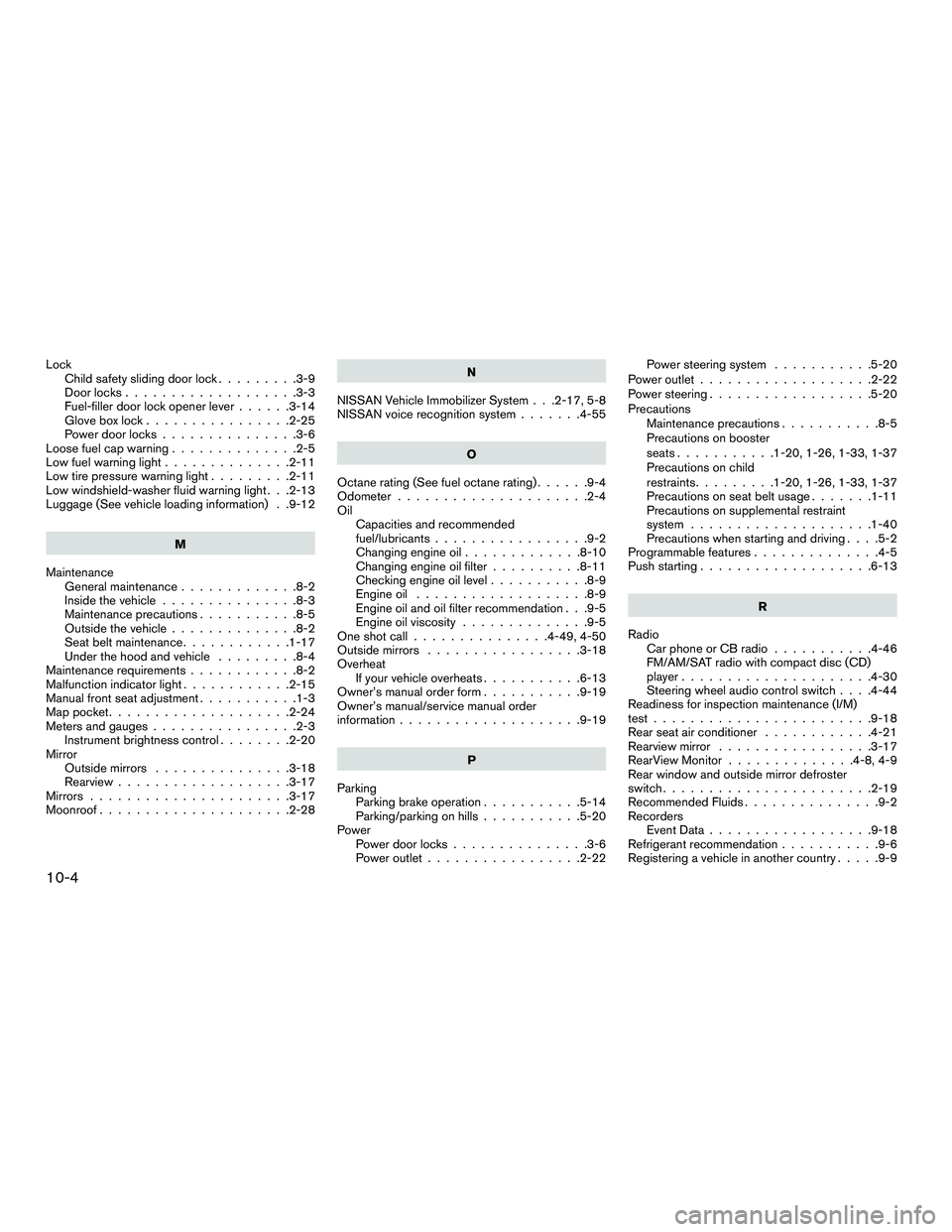
LockChild safety sliding door lock .........3-9
Door locks ...................3-3
Fuel-filler door lock opener lever ......3-14
Gloveboxlock................2-25
Power door locks ...............3-6
Loose fuel cap warning ..............2-5
Lowfuelwarninglight..............2-11
Low tire pressure warning light .........2-11
Low windshield-washer fluid warning light . . .2-13
Luggage (See vehicle loading information) . .9-12
M
Maintenance Generalmaintenance.............8-2
Insidethevehicle...............8-3
Maintenanceprecautions...........8-5
Outsidethevehicle..............8-2
Seat belt maintenance ............1-17
Under the hood and vehicle .........8-4
Maintenance requirements ............8-2
Malfunctionindicatorlight............2-15
Manual front seat adjustment ...........1-3
Map pocket ....................2-24
Meters and gauges ................2-3
Instrument brightness control ........2-20
Mirror Outside mirrors ...............3-18
Rearview ...................3-17
Mirrors ......................3-17
Moonroof.....................2-28 N
NISSAN Vehicle Immobilizer System . . .2-17, 5-8
NISSAN voice recognition system .......4-55
O
Octane rating (See fuel octane rating) ......9-4
Odometer .....................2-4
Oil Capacities and recommended
fuel/lubricants .................9-2
Changingengineoil.............8-10
Changing engine oil filter ..........8-11
Checking engine oil level ...........8-9
Engineoil ...................8-9
Engine oil and oil filter recommendation . . .9-5
Engine oil viscosity ..............9-5
Oneshotcall...............4-49,4-50
Outside mirrors .................3-18
Overheat If your vehicle overheats ...........6-13
Owner’s manual order form ...........9-19
Owner’s manual/service manual order
information ....................9-19
P
Parking Parking brake operation ...........5-14
Parking/parking on hills ...........5-20
Power Power door locks ...............3-6
Power outlet .................2-22 Power steering system
...........5-20
Poweroutlet...................2-22
Power steering ..................5-20
Precautions Maintenance precautions ...........8-5
Precautions on booster
seats...........1-20,1-26,1-33,1-37
Precautions on child
restraints .........1-20,1-26,1-33,1-37
Precautionsonseatbeltusage.......1-11
Precautions on supplemental restraint
system ....................1-40
Precautions when starting and driving ....5-2
Programmable features ..............4-5
Push starting ...................6-13
R
Radio CarphoneorCBradio ...........4-46
FM/AM/SAT radio with compact disc (CD)
player.....................4-30
Steering wheel audio control switch ....4-44
Readiness for inspection maintenance (I/M)
test........................9-18
Rear seat air conditioner ............4-21
Rearview mirror .................3-17
RearView
Monitor ..............4-8,4-9
Rear window and outside mirror defroster
switch.......................2-19
Recommended Fluids ...............9-2
Recorders EventData..................9-18
Refrigerant recommendation ...........9-6
Registering a vehicle in another country .....9-9
10-4