2016 NISSAN NV PASSENGER VAN reset
[x] Cancel search: resetPage 336 of 380
Wheel nut tightening torque:131 ft-lb (177 N·m)
The wheel nuts must be kept tight-
ened to specifications at all times. It
is recommended that wheel nuts be
tightened to specification at each
tire rotation interval.
Because the tire pressures are different
between the front and rear tires, the Tire
Pressure Monitoring System (TPMS)
must be reset after tire rotation. For addi-
tional information, refer to “TPMS sensor
reset” in this section.
WARNING
● After rotating the tires, check and
adjust the tire pressure.
● Retighten the wheel nuts when
the vehicle has been driven for
600 miles (1,000 km) (also in
cases of a flat tire, etc.) .
● Do not include the spare tire in
the tire rotation. ●
For additional information re-
garding tires, refer to “Important
Tire Safety Information” (US) or
“Tire Safety Information”
(Canada) in the Warranty Infor-
mation Booklet.
TPMS sensor reset
After rotating the tires, the TPMS sensor position
needs to be relearned. Contact the closest
NISSAN dealer or follow the steps below.
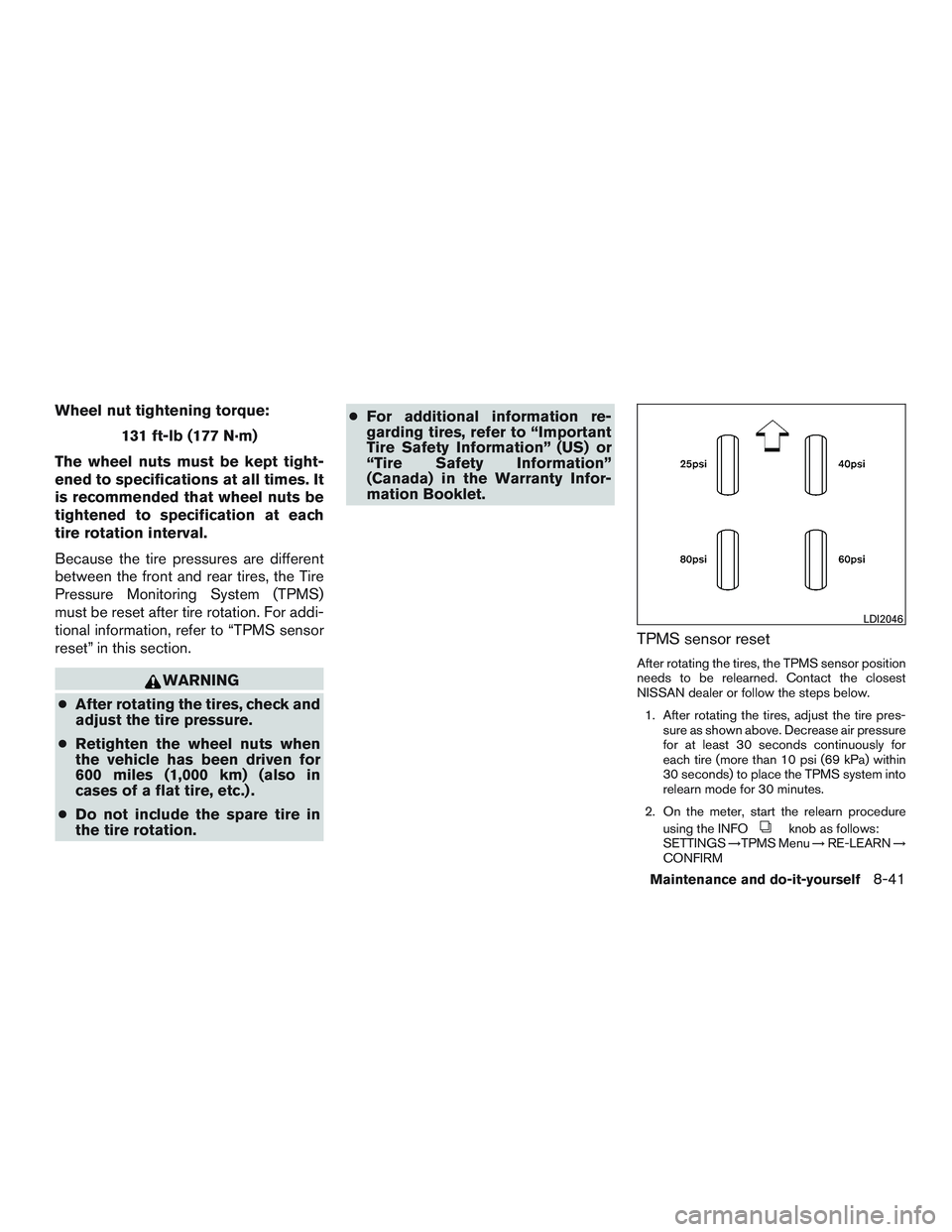
1. After rotating the tires, adjust the tire pres- sure as shown above. Decrease air pressure
for at least 30 seconds continuously for
each tire (more than 10 psi (69 kPa) within
30 seconds) to place the TPMS system into
relearn mode for 30 minutes.
2. On the meter, start the relearn procedure using the INFO
knob as follows:
SETTINGS →TPMS Menu →RE-LEARN →
CONFIRM
LDI2046
Maintenance and do-it-yourself8-41
Page 337 of 380
The TPMS warning lightflashes con-
tinuously when the system is relearning the
tire positions.
3. When the relearn procedure is successfully completed:
– The TPMS light
illuminates for
3 seconds
– A chime sounds three times
4. Adjust the tire pressures to the cold tire pressure specification shown on the tire and
loading information label. For additional in-
formation, refer to “Checking tire pressure”
in this section and “Tire and loading informa-
tion label” in the “Technical and consumer
information” section of this manual.
– If the tires pressures are correct, the TPMS light turns off.
– If the tires are not inflated to the correct cold tire pressure, the TPMS warning
light illuminates. Recheck the tire pres-
sures and adjust as necessary.
If the relearn procedure does not work,
check the following and retry the process:
● If the relearn procedure is stopped before
completion, the new tire positions are not
learned. Redo the complete relearn proce-
dure to reset the tire positions. ●
You must select “RESET TPMS →RE-
LEARN” from the “SETTINGS” menu to
complete the relearn procedure. Redo the
complete relearn procedure to reset the tire
positions. Select the TPMS resetting menu,
then continue the remaining registration pro-
cedure.
● Adjust the tire pressures to the relearn pres-
sures before selecting the TPMS resetting
menu on the display. Redo the complete
relearn procedure to reset the tire positions.
● If the tire pressure cannot be reduced at
least 10 psi (69 kPa) to adjust them to the
relearn pressures, inflate the tires to at least
10 psi (69 kPa) above the specified pres-
sures. Redo the complete relearn procedure
starting with step 1.
● Devices which emit electronic interference
should be turned off before starting the re-
learn procedure. The interference may pre-
vent the system from learning the new tire
positions. Turn off or remove sources of
electrical interference. If necessary, move
the vehicle to another location, then redo the
complete relearn procedure to reset the tire
positions. ●
If you have retried the procedure several
times and the relearn procedure is not suc-
cessfully completed, contact a NISSAN
dealer.
● Use an air pump that is capable of inflating
the tires to the required pressure specifica-
tions. The air pump must be capable of in-
flating a tire at least 10 psi (69 kPa) in
30 seconds.
● If the reset TPMS function is unintentionally
selected, place the ignition switch in the
OFF position then to the ON position to end
the relearn procedure.
● If the vehicle is not recognizing the new tire
pressure levels, move the vehicle forward
40 in (1 m) . Place the ignition switch in the
OFF position then to the ON position. Redo
the relearn procedure beginning at step 1.
Make sure that the tire pressures are in-
creased or decreased at least 10 psi
(69 kPa) .
● When vehicle is in the relearn mode, the
TPMS will not warn of low tire pressures or
detect malfunctions.
● If tire pressure is not set to the correct pres-
sure, restart the procedure again.
8-42Maintenance and do-it-yourself
Page 339 of 380
●If the wheels are changed for any rea-
son, always replace with wheels which
have the same off-set dimension.
Wheels of a different off-set could
cause premature tire wear, degrade ve-
hicle handling characteristics, affect the
VDC system and/or interference with
the brake discs. Such interference can
lead to decreased braking efficiency
and/or early brake pad wear. For addi-
tional information on wheel off-set di-
mensions, refer to “Wheels and tires” in
the “Technical and consumer informa-
tion” section of this manual.
● Since the spare tire is not equipped with
the TPMS, when a spare tire is mounted
or a wheel is replaced, tire pressure will
not be indicated, the TPMS will not
function and the low tire pressure warn-
ing light will flash for approximately
1 minute. The light will remain on after
1 minute. Contact a NISSAN dealer as
soon as possible for tire replacement
and/or system resetting.
● Replacing tires with those not originally
specified by NISSAN could affect the
proper operation of the TPMS.
● The TPMS sensor may be damaged if it
is not handled correctly. Be careful
when handling the TPMS sensor. ●
When replacing the TPMS sensor, the
ID registration may be required. Contact
a NISSAN dealer for ID registration.
● Do not use a valve stem cap that is not
specified by NISSAN. The valve stem
cap may become stuck.
● Be sure that the valve stem caps are
correctly fitted. Otherwise the valve may
be clogged up with dirt and cause a
malfunction or loss of pressure.
● Do not install a damaged or deformed
wheel or tire even if it has been re-
paired. Such wheels or tires could have
structural damage and could fail with-
out warning.
● The use of retread tires is not
recommended.
● For additional information regarding
tires, refer to “Important Tire Safety In-
formation” (US) or “Tire Safety Informa-
tion” (Canada) in the Warranty Informa-
tion Booklet.
Wheel balance
Unbalanced wheels may affect vehicle handling
and tire life. Even with regular use, wheels can get
out of balance. Therefore, they should be bal-
anced as required. Wheel balance service should be per-
formed with the wheels off the vehicle.
Spin balancing the wheels on the vehicle
could lead to mechanical damage.
● For additional information regarding
tires, refer to “Important Tire Safety
Information” (US) or “Tire Safety Infor-
mation” (Canada) in the Warranty In-
formation Booklet.
Care of wheels
● Wash the wheels when washing the vehicle
to maintain their appearance.
● Clean the inner side of the wheels when the
wheel is changed or the underside of the
vehicle is washed.
● Do not use abrasive cleaners when washing
the wheels.
● Inspect wheel rims regularly for dents or
corrosion. Such damage may cause loss of
pressure or poor seal at the tire bead.
● NISSAN recommends waxing the road
wheels to protect against road salt in areas
where it is used during winter.
8-44Maintenance and do-it-yourself
Page 370 of 380
Due to legal requirements in some states and
Canadian Provinces, your vehicle may be re-
quired to be in what is called the “ready condi-
tion” for an Inspection/Maintenance (I/M) test of
the emission control system.
The vehicle is set to the “ready condition” when it
is driven through certain driving patterns. Usually,
the ready condition can be obtained by ordinary
usage of the vehicle.
If a powertrain system component is repaired or
the battery is disconnected, the vehicle may be
reset to a “not ready” condition. Before taking the
I/M test, check the vehicle’s
inspection/maintenance test readiness condi-
tion. Place the ignition switch in the ON position
without starting the engine. If the Malfunction
Indicator Light (MIL) comes on steady for 20 sec-
onds and then blinks for 10 seconds , the I/M test
condition is “not ready”. If the MIL does not blink
after 20 seconds, the I/M test condition is
“ready”. Contact a NISSAN dealer to set the
“ready condition” or to prepare the vehicle for
testing.This vehicle is equipped with an Event Data Re-
corder (EDR) . The main purpose of an EDR is to
record, in certain crash or near crash-like situa-
tions, such as an air bag deployment or hitting a
road obstacle, data that will assist in understand-
ing how a vehicle’s systems performed. The EDR
is designed to record data related to vehicle
dynamics and safety systems for a short period of
time, typically 30 seconds or less. The EDR in this
vehicle is designed to record such data as:
● How various systems in your vehicle were
operating;
● Whether or not the driver and passenger
safety belts were buckled/fastened;
● How far (if at all) the driver was depressing
the accelerator and/or brake pedal; and,
● How fast the vehicle was traveling.
● Sounds are not recorded.
These data can help provide a better understand-
ing of the circumstances in which crashes and
injuries occur. NOTE: EDR data are recorded by
your vehicle only if a nontrivial crash situation
occurs; no data are recorded by the EDR under
normal driving conditions and no personal data
(e.g. name, gender, age and crash location) are
recorded. However, other parties, such as law
enforcement, could combine the EDR data with the type of personally identifying data routinely
acquired during a crash investigation.
To read data recorded by an EDR, special equip-
ment is required and access to the vehicle or the
EDR is needed. In addition to the vehicle manu-
facturer and NISSAN dealer, other parties, such
as law enforcement, that have the special equip-
ment, can read the information if they have ac-
cess to the vehicle or the EDR. EDR data will only
be accessed with the consent of the vehicle
owner or lessee or as otherwise required or per-
mitted by law.
READINESS FOR INSPECTION/
MAINTENANCE (I/M) TEST
EVENT DATA RECORDERS (EDR)
Technical and consumer information9-31
Page 376 of 380
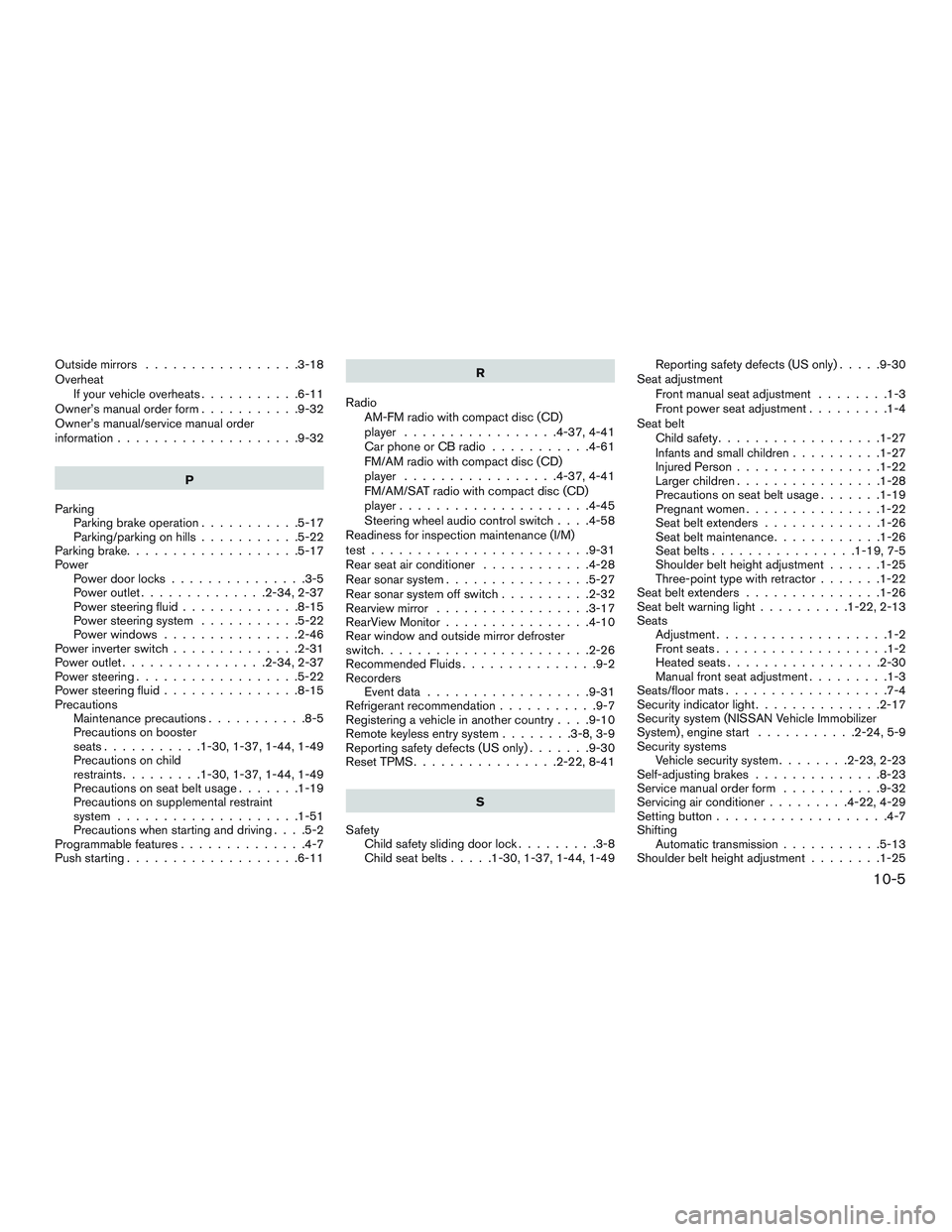
Outside mirrors.................3-18
Overheat Ifyourvehicleoverheats...........6-11
Owner’s manual order form ...........9-32
Owner’s manual/service manual order
information ....................9-32
P
Parking Parking brake operation ...........5-17
Parking/parking on hills ...........5-22
Parking brake ...................5-17
Power Power door locks ...............3-5
Power outlet ..............2-34,2-37
Power steering fluid .............8-15
Power steering system ...........5-22
Power windows ...............2-46
Power inverter switch ..............2-31
Power outlet ................2-34,2-37
Power steering ..................5-22
Power steering fluid ...............8-15
Precautions Maintenance precautions ...........8-5
Precautions on booster
seats...........1-30,1-37,1-44,1-49
Precautions on child
restraints .........1-30,1-37,1-44,1-49
Precautionsonseatbeltusage.......1-19
Precautions on supplemental restraint
system ....................1-51
Precautions when starting and driving ....5-2
Programmable features ..............4-7
Push starting ...................6-11 R
Radio AM-FM radio with compact disc (CD)
player .................4-37,4-41
Car phone or CB radio ...........4-61
FM/AM radio with compact disc (CD)
player .................4-37,4-41
FM/AM/SAT radio with compact disc (CD)
player .....................4-45
Steering wheel audio control switch ....4-58
Readiness for inspection maintenance (I/M)
test........................9-31
Rear seat air conditioner ............4-28
Rear sonar system ................5-27
Rear sonar system off switch ..........2-32
Rearview mirror .................3-17
RearView Monitor ................4-10
Rear window and outside mirror defroster
switch .......................2-26
Recommended Fluids ...............9-2
Recorders Eventdata..................9-31
Refrigerant recommendation ...........9-7
Registering a vehicle in another country ....9-10
Remote keyless entry system ........3-8,3-9
Reporting safety defects (US only) .......9-30
Reset TPMS ................2-22,8-41
S
Safety Child safety sliding door lock .........3-8
Child seat belts .....1-30,1-37,1-44,1-49 Reporting safety defects (US only)
.....9-30
Seat adjustment Front manual seat adjustment ........1-3
Front power seat adjustment .........1-4
Seat belt Child safety ..................1-27
Infants and small children ..........1-27
Injured
Person ................1-22
Largerchildren................1-28
Precautions on seat belt usage .......1-19
Pregnant women ...............1-22
Seatbeltextenders .............1-26
Seatbeltmaintenance............1-26
Seatbelts................1-19,7-5
Shoulder belt height adjustment ......1-25
Three-point type with retractor .......1-22
Seat belt extenders ...............1-26
Seatbeltwarninglight..........1-22,2-13
Seats Adjustment ...................1-2
Frontseats...................1-2
Heatedseats.................2-30
Manualfrontseatadjustment.........1-3
Seats/floor mats ..................7-4
Security indicator light ..............2-17
Security system (NISSAN Vehicle Immobilizer
System) , engine start ...........2-24,5-9
Security systems Vehicle security system ........2-23,2-23
Self-adjusting brakes ..............8-23
Service manual order form ...........9-32
Servicing air conditioner .........4-22,4-29
Setting button ...................4-7
Shifting Automatic transmission ...........5-13
Shoulder belt height adjustment ........1-25
10-5
Page 377 of 380
Sliding doorManual sliding door ..............3-6
Sliding door locks Child safety sliding door locks ........3-8
Smartphone connectivity ............4-60
Sonar Rear system .................5-27
Spark plug replacement .............8-20
Spark plugs ...................8-20
Specifications ...................9-8
Speedometer ...................2-4
Speedometer and odometer ...........2-4
SRS warning label ................1-62
Stability control .................5-25
Starting Before starting the engine ..........5-10
Jump starting ..............6-9,8-19
Precautions when starting and driving ....5-2
Push starting .................6-11
Starting the engine .............5-10
Starting the engine ...............5-10
Steering Power steering fluid .............8-15
Power steering system ...........5-22
Tilting steering wheel ............3-15
Steering wheel ..................3-15
Steering wheel audio control switch ......4-58
Stoplight.....................8-31
Storage......................2-38
Storagebin....................2-45
Storage tray ................2-38,2-39
Sunglassescase.................2-39
Sun visors ....................3-16
Supplemental air bag warning labels ......1-62
Supplemental air bag warning light . . .1-62, 2-15
Supplemental front impact air bag system . . .1-58 Supplemental restraint system
Information and warning labels .......1-62
Precautions on supplemental restraint
system ....................1-51
Supplemental restraint system
(Supplemental air bag system) .........1-51
Switch Automatic power window switch ......2-47
Foglightswitch ...............2-29
Hazard warning flasher switch ........6-2
Headlight and turn signal switch ......2-27
Headlight control switch ..........2-27
Ignition switch .................5-8
Instrument brightness control ........2-29
Power door lock switch ............3-5
Power inverter switch ............2-31
Rear sonar system off switch ........2-32
Rear window and outside mirror defroster
switch.....................2-26
Steering wheel switch for audio
control/Bluetooth® Hands-Free Phone
System ....................4-58
Tow mode switch ..............2-33
Turn signal switch ..............2-29
Vehicle dynamic control (VDC) off
switch.....................2-31
T
Tachometer ....................2-5
Temperature gauge Engine coolant temperature gauge .....2-5
Engine oil pressure low/engine coolant
temperature high warning light .......2-12Theft (NISSAN Vehicle Immobilizer System) ,
engine start
.................2-24,5-9
Three-way catalyst ................5-2
Tilting
steering wheel ..............3-15
Tire Flat tire .....................6-2
Spare tire ...................6-4
Tire and Loading Information label .....9-12
Tire chains ..................8-40
Tire pressure .................8-33
Tire rotation..................8-40
Types of tires .................8-39
Uniform tire quality grading .........9-28
Wheels and tires ............8-33,9-9
Wheel/tire size .................9-9
Tirepressure...................8-33 Low tire pressure warning light .......2-13
Tire Pressure Monitoring System (TPMS). .5-3, 6-2
Top tether strap child restraint .........1-34
Towing Flattowing..................9-28
Towing load/specification ..........9-20
Trailer towing .................9-17
Towing a trailer ..................9-17
Towingyourvehicle...............6-12
Tow mode switch ................2-33
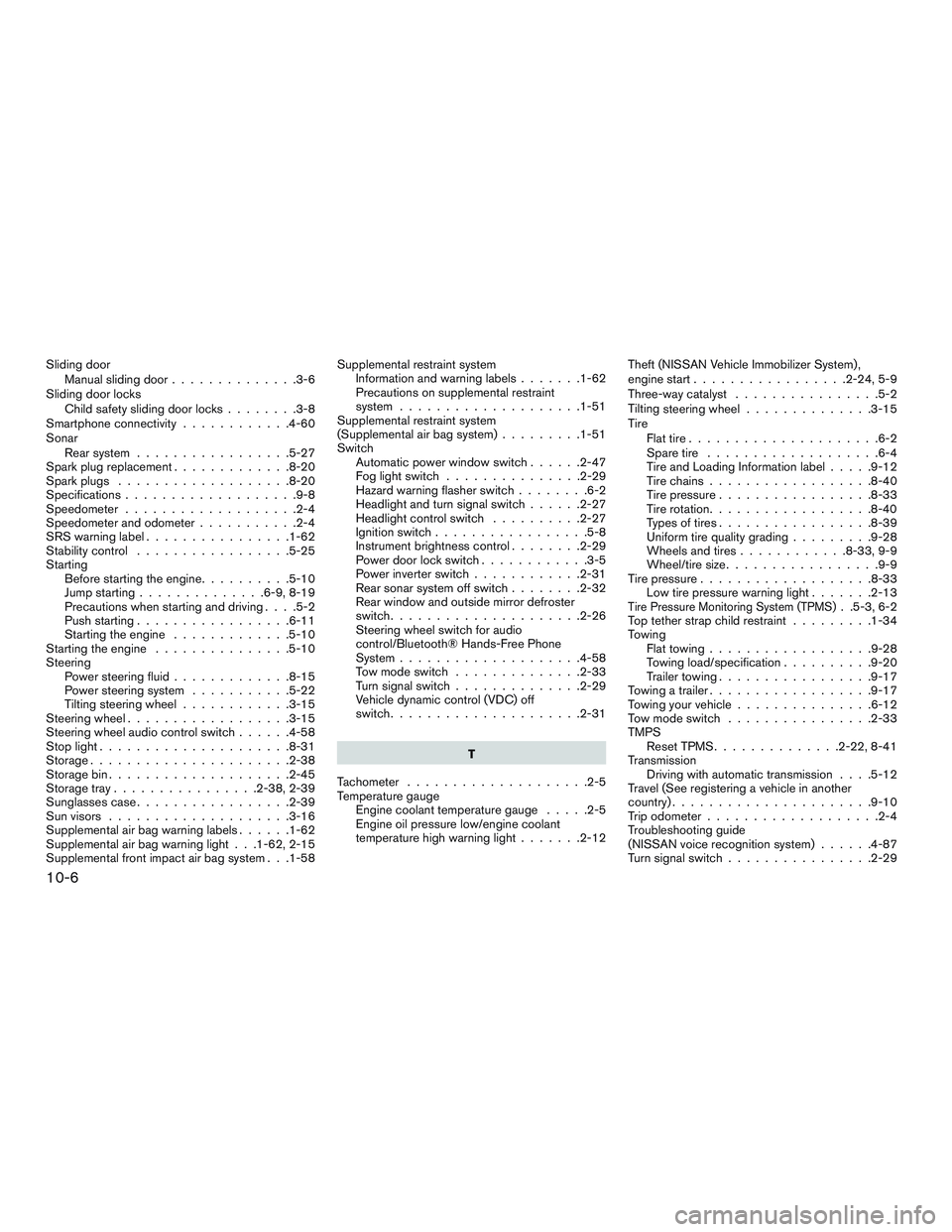
TMPS Reset TPMS ..............2-22,8-41
Transmission Driving with automatic transmission ....5-12
Travel (See registering a vehicle in another
country) ......................9-10
Trip odometer ...................2-4
Troubleshooting guide
(NISSAN voice recognition system) ......4-87
Turn signal switch ................2-29
10-6