2016 NISSAN MURANO fuel pressure
[x] Cancel search: fuel pressurePage 258 of 465
WARNING
●The exhaust gas and the exhaust sys-
tem are very hot. Keep people, animals
or flammable materials away from the
exhaust system components.
●Do not stop or park the vehicle over
flammable materials such as dry grass,
waste paper or rags. They may ignite
and cause a fire.
CAUTION
●Do not use leaded gasoline. Deposits
from leaded gasoline will seriously re-
duce the three-way catalyst’s ability to
help reduce exhaust pollutants.
●Keep your engine tuned up. Malfunc-
tions in the ignition, fuel injection, or
electrical systems can cause overrich
fuel flow into the three-way catalyst,
causing it to overheat. Do not keep driv-
ing if the engine misfires, or if notice-
able loss of performance or other un-
usual operating conditions are
detected. Have the vehicle inspected
promptly. It is recommended that you
visit a NISSAN dealer for this service.●Avoid driving with an extremely low fuel
level. Running out of fuel could cause
the engine to misfire, damaging the
three-way catalyst.
●Do not race the engine while warming it
up.
●Do not push or tow your vehicle to start
the engine.
TIRE PRESSURE MONITORING
SYSTEM (TPMS)
Each tire, including the spare (if provided) ,
should be checked monthly when cold and in-
flated to the inflation pressure recommended by
the vehicle manufacturer on the vehicle placard
or tire inflation pressure label. (If your vehicle has
tires of a different size than the size indicated on
the vehicle placard or tire inflation pressure label,
you should determine the proper tire inflation
pressure for those tires.)
As an added safety feature, your vehicle has been
equipped with a TPMS that illuminates a low tire
pressure telltale when one or more of your tires is
significantly under-inflated. Accordingly, when
the low tire pressure telltale illuminates, you
should stop and check all four tires as soon as
possible, and inflate them to the proper pressure.
Driving on a significantly under-inflated tire
causes the tire to overheat and can lead to tirefailure. Under-inflation also reduces fuel effi-
ciency and tire tread life, and may affect the
vehicle’s handling and stopping ability.
Please note that the TPMS is not a substitute for
proper tire maintenance, and it is the driver’s
responsibility to maintain correct tire pressure,
even if under-inflation has not reached the level to
trigger illumination of the TPMS low tire pressure
telltale.
Your vehicle has also been equipped with a
TPMS malfunction indicator to indicate when the
system is not operating properly. The TPMS mal-
function indicator is combined with the low tire
pressure telltale. When the system detects a
malfunction, the telltale will flash for approxi-
mately one minute and then remain continuously
illuminated. This sequence will continue upon
subsequent vehicle start-ups as long as the mal-
function exists. When the malfunction indicator is
illuminated, the system may not be able to detect
or signal low tire pressure as intended. TPMS
malfunctions may occur for a variety of reasons,
including the installation of replacement or alter-
nate tires or wheels on the vehicle that prevent
the TPMS from functioning properly. Always
check the TPMS malfunction telltale after replac-
ing one or more tires or wheels on your vehicle to
ensure that the replacement or alternate tires and
wheels allow the TPMS to continue to function
properly.
Starting and driving5-3
Page 333 of 465
10.Keeping your Vehicle Cool
●Park your vehicle in a covered parking
area or in the shade whenever possible.
●When entering a hot vehicle, opening the
windows will help to reduce the inside
temperature faster, resulting in reduced
demand on your A/C system.●Keep your engine tuned up.
●Follow the recommended scheduled main-
tenance.
●Keep the tires inflated to the correct pres-
sure. Low tire pressure increases tire wear
and lowers fuel economy.
●Keep all the wheels in correct alignment.
Improper alignment increases tire wear and
lowers fuel economy.
●Use the recommended viscosity engine oil.
For additional information, refer to “Engine
oil and oil filter recommendations” in the
“Technical and consumer information” sec-
tion of this manual.If any malfunction occurs in the AWD system
while the engine is running, messages are dis-
played in the meter.
INCREASING FUEL ECONOMY ALL-WHEEL DRIVE (AWD) (if so
equipped)
5-78Starting and driving
Page 374 of 465
where mud and dirt may have accumulated. For
additional information, refer to the “Appearance
and care” section of this manual.
Windshield-washer fluid*Check that there is
adequate fluid in the reservoir.When performing any inspection or maintenance
work on your vehicle, always take care to prevent
serious accidental injury to yourself or damage to
the vehicle. The following are general precau-
tions which should be closely observed.
WARNING
●Park the vehicle on a level surface, ap-
ply the parking brake securely and
block the wheels to prevent the vehicle
from moving. Move the shift lever to P
(Park) .
●Be sure the ignition switch is in the OFF
or LOCK position when performing any
parts replacement or repairs.
●If you must work with the engine run-
ning, keep your hands, clothing, hair
and tools away from moving fans, belts
and any other moving parts.
●It is advisable to secure or remove any
loose clothing and remove any jewelry,
such as rings, watches, etc. before
working on your vehicle.
●Always wear eye protection whenever
you work on your vehicle.●Your vehicle is equipped with an auto-
matic engine cooling fan. It may come
on at any time without warning, even if
the ignition switch is in the OFF posi-
tion and the engine is not running. To
avoid injury, always disconnect the
negative battery cable before working
near the fan.
●If you must run the engine in an en-
closed space such as a garage, be sure
there is proper ventilation for exhaust
gases to escape.
●Never get under the vehicle while it is
supported only by a jack. If it is neces-
sary to work under the vehicle, support
it with safety stands.
●Keep smoking materials, flame and
sparks away from the fuel tank and
battery.
●Because the fuel lines on gasoline en-
gine models are under high pressure
even when the engine is off, it is recom-
mended you visit a NISSAN dealer for
service of the fuel filter or fuel lines.
MAINTENANCE PRECAUTIONS
Maintenance and do-it-yourself8-5
Page 443 of 465
Cargo(Seevehicleloadinginformation)....9-13
Car phone or CB radio.............4-51
CD care and cleaning..............4-48
CD player (See audio system).........4-41
Check tire pressure...............2-25
Child restraints.......1-25,1-25,1-27,1-29
LATCH (Lower Anchors and Tethers for
CHildren) System..............1-29
Precautions on child
restraints.........1-27,1-34,1-40,1-44
Top tether strap anchor point locations . .1-32
Child restraint with top tether strap.......1-31
Child safety rear door lock............3-7
Chimes, audible reminders...........2-15
Cleaningexteriorandinterior........7-2,7-4
Clock setting
(models without Navigation System)......4-39
C.M.V.S.S. certification label..........9-11
Cold weather driving...............5-88
Compact disc (CD) player...........4-41
Connect phone.................4-50
Consolebox...................2-45
Continuously Variable Transmission (CVT) . . .5-16
Continuously Variable Transmission (CVT)
fluid......................8-13
Driving with Continuously Variable
Transmission (CVT).............5-16
Controls
Heater and air conditioner controls.....4-27
Coolant
Capacities and recommended
fuel/lubricants.................9-2
Changing engine coolant...........8-9
Checking engine coolant level........8-9
Engine coolant temperature gauge.....2-6
Corrosionprotection ...............7-6Cruisecontrol..................5-39
Cupholders...................2-46
D
Daytime running light system (Canada only) . .2-34
Defroster switch
Rear window and outside mirror defroster
switch.....................2-32
Dimensionsandweights.............9-9
Dimmer switch for instrument panel......2-35
Door locks.....................3-5
Doors........................3-5
Drive belt.....................8-18
Drive positioner,
Automatic..........3-35,3-36,3-37,3-38
Driving
Cold weather driving.............5-88
Driving with Continuously Variable
Transmission (CVT).............5-16
Precautions when starting and
driving...................5-2,5-9
Driving the vehicle................5-16
E
Economy - fuel..................5-78
Emergency engine shutoff.........5-13,6-2
Emission control information label.......9-11
Emission control system warranty.......9-28
Engine
Before starting the engine..........5-14
Block heater.................5-89Capacities and recommended
fuel/lubricants.................9-2
Changing engine coolant...........8-9
Changingengineoil.............8-11
Changing engine oil filter..........8-12
Checking engine coolant level........8-9
Checking engine oil level..........8-10
Engine compartment check locations....8-7
Engine coolant temperature gauge.....2-6
Engine cooling system............8-8
Engineoil...................8-10
Engine oil and oil filter recommendation . . .9-6
Engine oil pressure warning light......2-10
Engine oil viscosity..............9-7
Engine serial number............9-11
Engine specifications.............9-8
Starting the engine.............5-15
Engine coolant temperature gauge.......2-6
Event Data recorders..............9-30
Exhaust gas (Carbon monoxide).........5-2
Explanation of maintenance items........8-2
Extended storage switch............2-42
F
Flashers (See hazard warning flasher switch) . .6-2
Flat tire.......................6-3
Floor mat positioning aid.............7-5
Fluid
Brake fluid..................8-14
Capacities and recommended
fuel/lubricants.................9-2
Continuously Variable Transmission (CVT)
fluid......................8-13
Enginecoolant.................8-8
10-2
Page 444 of 465
Engine oil...................8-10
Power steering fluid.............8-14
Windshield-washerfluid...........8-15
F.M.V.S.S. certification label...........9-11
Foglightswitch .................2-36
Forward Emergency Braking (FEB).......2-10
Front air bag system
(See supplemental restraint system)......1-55
Front power seat adjustment...........1-4
Frontseats.....................1-2
Fuel
Capacities and recommended
fuel/lubricants.................9-2
Fuel economy................5-78
Fuel-filler door and cap...........3-28
Fuel-filler door lock opener lever......3-27
Fuel gauge...................2-6
Fuel octane rating...............9-5
Fuel recommendation.............9-4
Loose fuel cap warning...........2-25
Fuel Cell Vehicle (FCV) System
Tirepressure.................8-31
Fuel efficient driving tips.............5-77
Fuel-filler door..................3-27
Fuel gauge.....................2-6
Fuses.......................8-22
Fusible links...................8-24
G
Garage door opener, HomeLink® Universal
Transceiver.............2-56,2-58,2-59
Gascap .....................3-28
Gauge
Engine coolant temperature gauge.....2-6Fuel gauge...................2-6
Odometer...................2-5
Speedometer.................2-4
Tachometer..................2-5
Trip odometer.................2-5
General maintenance...............8-2
Glovebox.....................2-45
H
Hazard warning flasher switch..........6-2
Headlight and turn signal switch........2-32
Headlight control switch............2-32
Headlights....................8-27
Head restraints..................1-10
Heated rear seats................2-38
Heated seats...............2-37,2-40
Heated steering wheel.............2-40
Heater
Heater and air conditioner (automatic)
(if so equipped)...............4-26
Heater and air conditioner controls.....4-27
Heater operation...............4-28
Heater and air conditioner (automatic).....4-26
Hill start assist system..............5-87
HomeLink® Universal Transceiver . . .2-56, 2-58,
2-59
Hood.......................3-21
Hook
Luggage hook................2-48
Horn .......................2-36I
Ignition Switch
Push-Button Ignition Switch........5-11
Immobilizer system............2-28,5-14
Important vehicle information label
.......9-11
In-cabin microfilter................8-20
Increasing fuel economy.............5-78
Indicator
NISSAN Intelligent Key® battery discharge
indicator ...................5-13
Indicator lights and audible reminders
(See warning/indicator lights and audible
reminders)..................2-8,2-13
Inside automatic anti-glare mirror........3-33
Instrument brightness control..........2-35
Instrumentpanel...............0-6,2-2
Instrument panel dimmer switch........2-35
Intelligent cruise control (ICC) system
Brake assist.................5-41
Intelligent Key system
Key operating range..............3-8
Key operation................3-10
Mechanical key................3-3
Remote keyless entry operation.......3-12
Troubleshooting guide............3-17
Warning signals...............3-17
Interior light....................2-54
iPod®Player...................4-45
ISOFIX child restraints.............1-29
J
Jump starting................6-9,8-17
10-3
Page 445 of 465
K
Key.........................3-2
Key fob battery replacement..........8-25
Keyless entry
With Intelligent Key system
(See Intelligent Key system).........3-12
Keys
NISSAN Intelligent Key®........3-2,3-7
NISSAN Vehicle Immobilizer System keys . .3-4
L
Labels
Air conditioner specification label.....9-12
C.M.V.S.S. certification label........9-11
Emissioncontrolinformationlabel.....9-11
Engine serial number............9-11
F.M.V.S.S. certification label.........9-11
Tire and Loading Information label.....9-12
Vehicle identification number (VIN).....9-10
Vehicle identification number (VIN) plate . .9-10
Warning labels (for SRS)..........1-66
LATCH (Lower Anchors and Tethers for CHildren)
System......................1-29
License plate
Installing the license plate..........9-12
Liftgate......................3-22
Liftgaterelease..................3-26
Light
Airbagwarninglight.........1-67,2-13
Brake light (See stop light).........8-29
Bulb check/instrument panel.........2-8
Bulb replacement..............8-29Charge warning light.............2-9
Exterior and Interior lights..........8-29
Foglights...................8-28
Foglightswitch ...............2-36
Headlight and turn signal switch......2-32
Headlight control switch..........2-32
Headlights..................8-27
Interiorlight..................2-54
Lightbulbs..................8-27
Low tire pressure warning light.......2-10
Low windshield-washer fluid warning
light......................2-25
Passenger air bag and status light.....1-57
Personal lights................2-55
Security indicator light............2-14
Spotlights(Seemaplight) .........2-55
Warning/indicator lights and audible
reminders................2-8,2-13
Lights.......................8-27
Maplights ..................2-55
Lock
Child safety rear door lock..........3-7
Door locks...................3-5
Fuel-filler door lock opener lever......3-27
Liftgate release................3-26
Power door locks...............3-6
Loose fuel cap warning.............2-25
Lowfuelwarninglight ..........2-12,2-25
Low tire pressure warning light.........2-10
Low windshield-washer fluid warning light . . .2-25
Luggage hook..................2-48
Luggage rack (see roof rack)..........2-48
Luggage (See vehicle loading information) . .9-13M
Maintenance
General maintenance.............8-2
Insidethevehicle...............8-3
Maintenance precautions...........8-5
Outside the vehicle..............8-2
Seat belt maintenance............1-24
Under the hood and vehicle.........8-4
Maintenance requirements............8-2
Malfunction indicator light............2-13
Manual front seat adjustment...........1-3
Maplights ....................2-55
Mappocket....................2-43
Memory Seat........3-35,3-36,3-37,3-38
Meters and gauges................2-4
Instrument brightness control........2-35
Mirror
Automatic anti-glare inside mirror......3-33
Outside mirrors...............3-34
Rearview...................3-33
Vanity mirror.................3-32
Mirrors......................3-33
Moonroof.....................2-52
Moving Object Detection (MOD)........4-21
N
NISSAN Intelligent Key®..........3-2,3-7
NISSAN Intelligent Key® battery discharge
indicator .....................5-13
NISSAN Vehicle Immobilizer System . .2-28, 5-14
10-4
Page 448 of 465
Transceiver
HomeLink® Universal
Transceiver...........2-56,2-58,2-59
Transmission
Continuously Variable Transmission (CVT)
fluid......................8-13
Driving with Continuously Variable
Transmission (CVT).............5-16
Travel (See registering a vehicle in another
country)......................9-10
Trip odometer...................2-5
Turn signal switch................2-35
U
Uniform tire quality grading...........9-27
USB interface..................4-42
Audio file operation.............4-43
V
Vanity mirror...................3-32
Vehicledimensionsandweights.........9-9
Vehicle dynamic control (VDC) off switch . . .2-40
Vehicle Dynamic Control (VDC) system....5-84
Vehicle identification...............9-10
Vehicle identification number (VIN).......9-10
Vehicle identification number (VIN)
(Chassis number)................9-10
Vehicle identification number (VIN) plate....9-10
Vehicle immobilizer system........2-28,5-14
Vehicleloadinginformation...........9-13
Vehicle recovery..............6-14,6-15
Vehicle security system.............2-27Vehicle security system (NISSAN Vehicle
Immobilizer System) , engine start....2-28,5-14
Vents.......................4-25
Visors.......................3-32
Voice Prompt Interrupt..............4-54
W
Warning
Airbagwarninglight.........1-67,2-13
Anti-lock brake warning light.........2-8
Battery charge warning light.........2-9
Blind Spot Warning (BSW) warning
light......................5-21
Brake warning light..............2-9
Engine oil pressure warning light......2-10
Hazard warning flasher switch........6-2
Loose fuel cap warning...........2-25
Lowfuelwarninglight ........2-12,2-25
Low tire pressure warning light.......2-10
Low windshield-washer fluid warning
light......................2-25
Passenger air bag and status light.....1-57
Seatbeltwarninglight........1-17,2-12
Supplemental air bag warning
light ..................1-67,2-13
TPMS......................2-4
Vehicle security system...........2-27
Warning/indicator lights and audible
reminders................2-8,2-13
Warning labels (for SRS)..........1-66
Warning/indicator lights and audible
reminders..................2-8,2-13
Audible reminders...........2-8,2-13
Indicatorlights.............2-8,2-13Warning lights.............2-8,2-13
Warning lights...............2-8,2-13
Washer switch
Rear window wiper and washer
switches...................2-31
Weights (See dimensions and weights).....9-9
Wheels and tires..............8-31,9-9
Wheel/tire size...................9-9
When traveling or registering in another
country......................9-10
Windows.....................2-49
Locking passengers’ windows.......2-50
Power rear windows.............2-51
Power windows...............2-49
Rear power windows............2-51
Windshield-washerfluid.............8-15
Windshieldwiperblades............8-20
Wiper
Rear window wiper and washer
switches...................2-31
Wiperblades.................8-20
Wiper and washer switch............2-30
10-7
Page 449 of 465
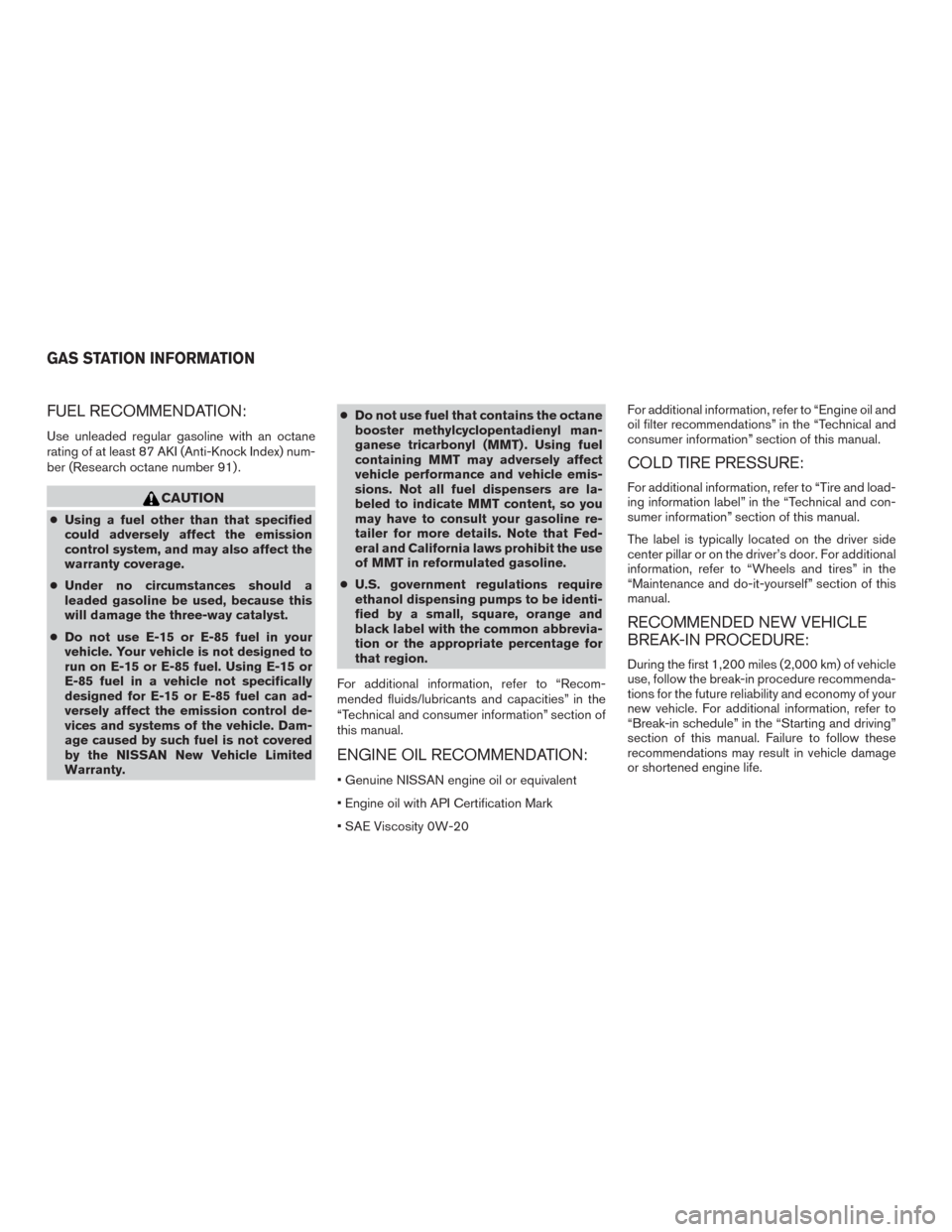
FUEL RECOMMENDATION:
Use unleaded regular gasoline with an octane
rating of at least 87 AKI (Anti-Knock Index) num-
ber (Research octane number 91) .
CAUTION
●Using a fuel other than that specified
could adversely affect the emission
control system, and may also affect the
warranty coverage.
●Under no circumstances should a
leaded gasoline be used, because this
will damage the three-way catalyst.
●Do not use E-15 or E-85 fuel in your
vehicle. Your vehicle is not designed to
run on E-15 or E-85 fuel. Using E-15 or
E-85 fuel in a vehicle not specifically
designed for E-15 or E-85 fuel can ad-
versely affect the emission control de-
vices and systems of the vehicle. Dam-
age caused by such fuel is not covered
by the NISSAN New Vehicle Limited
Warranty.●Do not use fuel that contains the octane
booster methylcyclopentadienyl man-
ganese tricarbonyl (MMT) . Using fuel
containing MMT may adversely affect
vehicle performance and vehicle emis-
sions. Not all fuel dispensers are la-
beled to indicate MMT content, so you
may have to consult your gasoline re-
tailer for more details. Note that Fed-
eral and California laws prohibit the use
of MMT in reformulated gasoline.
●U.S. government regulations require
ethanol dispensing pumps to be identi-
fied by a small, square, orange and
black label with the common abbrevia-
tion or the appropriate percentage for
that region.
For additional information, refer to “Recom-
mended fluids/lubricants and capacities” in the
“Technical and consumer information” section of
this manual.
ENGINE OIL RECOMMENDATION:
• Genuine NISSAN engine oil or equivalent
• Engine oil with API Certification Mark
• SAE Viscosity 0W-20For additional information, refer to “Engine oil and
oil filter recommendations” in the “Technical and
consumer information” section of this manual.
COLD TIRE PRESSURE:
For additional information, refer to “Tire and load-
ing information label” in the “Technical and con-
sumer information” section of this manual.
The label is typically located on the driver side
center pillar or on the driver’s door. For additional
information, refer to “Wheels and tires” in the
“Maintenance and do-it-yourself” section of this
manual.
RECOMMENDED NEW VEHICLE
BREAK-IN PROCEDURE:
During the first 1,200 miles (2,000 km) of vehicle
use, follow the break-in procedure recommenda-
tions for the future reliability and economy of your
new vehicle. For additional information, refer to
“Break-in schedule” in the “Starting and driving”
section of this manual. Failure to follow these
recommendations may result in vehicle damage
or shortened engine life.
GAS STATION INFORMATION