2016 NISSAN MURANO CD player
[x] Cancel search: CD playerPage 236 of 465
iPod®* PLAYER OPERATION
WITHOUT NAVIGATION SYSTEM (if
so equipped)
Connecting iPod®
WARNING
Do not connect, disconnect, or operate the
USB device while driving. Doing so can be
a distraction. If distracted you could lose
control of your vehicle and cause an acci-
dent or serious injury.
CAUTION
●Do not force the USB device into the
USB port. Inserting the USB device
tilted or up-side-down into the port may
damage the port. Make sure that the
USB device is connected correctly into
the USB port.
●Do not grab the USB port cover (if so
equipped) when pulling the USB device
out of the port. This could damage the
port and the cover.●Do not leave the USB cable in a place
where it can be pulled unintentionally.
Pulling the cable may damage the port.
Refer to your device manufacturer’s owner infor-
mation regarding the proper use and care of the
device.
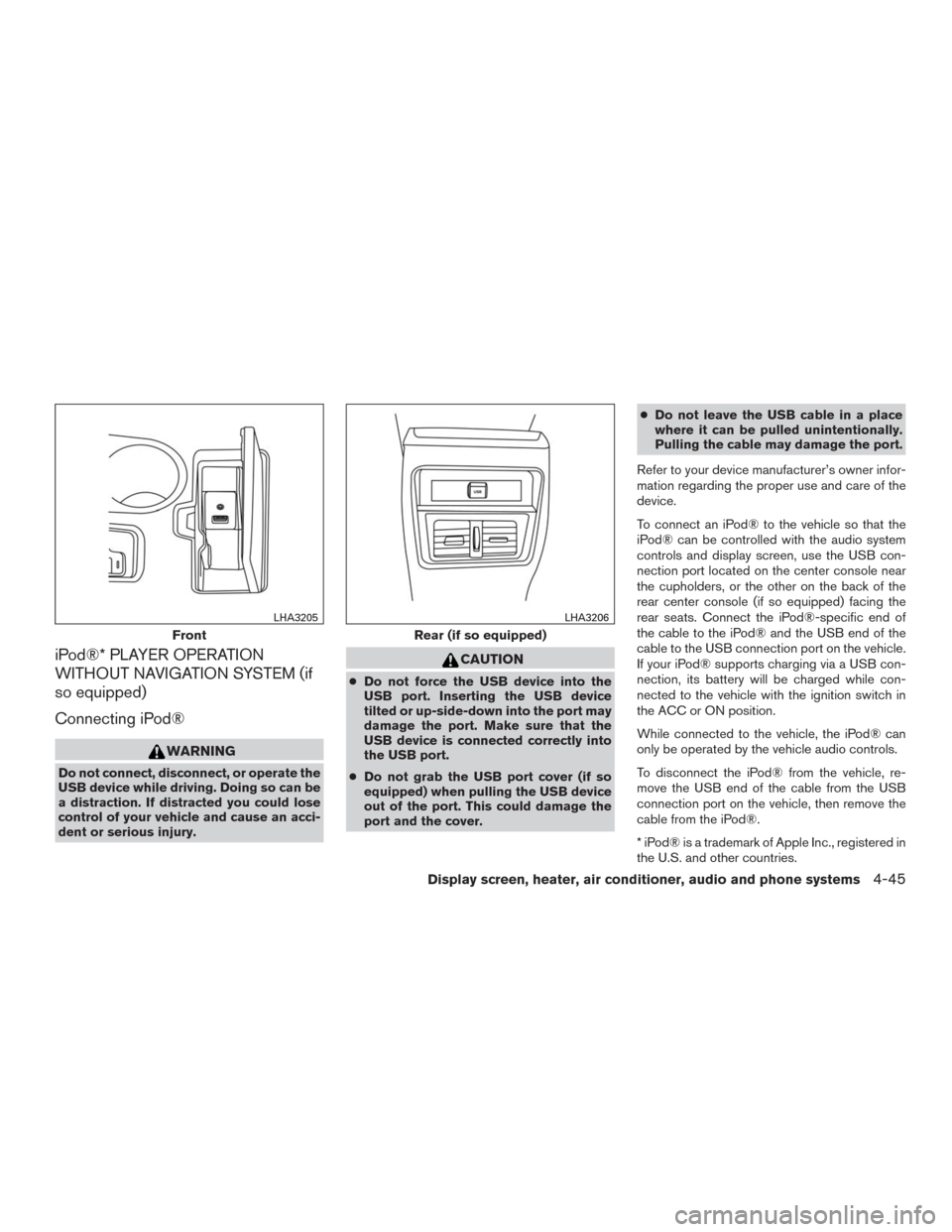
To connect an iPod® to the vehicle so that the
iPod® can be controlled with the audio system
controls and display screen, use the USB con-
nection port located on the center console near
the cupholders, or the other on the back of the
rear center console (if so equipped) facing the
rear seats. Connect the iPod®-specific end of
the cable to the iPod® and the USB end of the
cable to the USB connection port on the vehicle.
If your iPod® supports charging via a USB con-
nection, its battery will be charged while con-
nected to the vehicle with the ignition switch in
the ACC or ON position.
While connected to the vehicle, the iPod® can
only be operated by the vehicle audio controls.
To disconnect the iPod® from the vehicle, re-
move the USB end of the cable from the USB
connection port on the vehicle, then remove the
cable from the iPod®.
* iPod® is a trademark of Apple Inc., registered in
the U.S. and other countries.
Front
LHA3205
Rear (if so equipped)
LHA3206
Display screen, heater, air conditioner, audio and phone systems4-45
Page 270 of 465
1. Apply the parking brake.
2. Move the shift lever to P (Park) or N (Neu-
tral) . P (Park) is recommended.
The starter is designed not to operate
unless the shift lever is in either P
(Park) or N (Neutral) .
3. Push the ignition switch to the ON position.
Depress the brake pedal and push the igni-
tion switch to start the engine.
To start the engine immediately, push and
release the ignition switch while depressing
the brake pedal with the ignition switch in
any position.
●If the engine is very hard to start in ex-
tremely cold weather or when restarting,
depress the accelerator pedal a little (ap-
proximately 1/3 to the floor) and while
holding, crank the engine. Release the
accelerator pedal when the engine starts.
●If the engine is very hard to start because
it is flooded, depress the accelerator
pedal all the way to the floor and hold it.
Push the ignition switch to the ON posi-
tion to start cranking the engine. After five
or six seconds, stop cranking by pushing
the ignition switch to LOCK. After crank-
ing the engine, release the accelerator
pedal. Crank the engine with your foot offthe accelerator pedal by depressing the
brake pedal and pushing the push-button
ignition switch to start the engine. If the
engine starts, but fails to run, repeat the
above procedure.
CAUTION
Do not operate the starter for more than
15 seconds at a time. If the engine does
not start, push the ignition switch to the
OFF position and wait 10 seconds before
cranking again, otherwise the starter
could be damaged.
4.Warm-up
Allow the engine to idle for at least 30 sec-
onds after starting. Do not race the engine
while warming it up. Drive at moderate
speed for a short distance first, especially in
cold weather. In cold weather, keep the en-
gine running for a minimum of two to three
minutes before shutting it off. Starting and
stopping the engine over a short period of
time may make the vehicle more difficult to
start.
5. To stop the engine, shift the shift lever into
the P (Park) position and push the ignition
switch to the OFF position.NOTE:
Care should be taken to avoid situations
that can lead to potential battery discharge
and potential no-start conditions such as:
1. Installation or extended use of electronic
accessories that consume battery power
when the engine is not running (Phone char-
gers, GPS, DVD players, etc.)
2. Vehicle is not driven regularly and/or only
driven short distances.
In these cases, the battery may need to be
charged to maintain battery health.
REMOTE START (if so equipped)
Vehicles started with the remote start require the
ignition switch to be placed in the ON position
before the shift lever can be moved from the P
(Park) position. To place the ignition switch to the
ON position, follow these steps:
1. Make sure that the Intelligent Key is on you.
2. Apply the brake.
3. Push the ignition switch once to the ON
position.
For additional information, refer to “NISSAN In-
telligent Key®” in the “Pre-driving checks and
adjustments” section of this manual.
STARTING THE ENGINE
Starting and driving5-15
Page 373 of 465
Seat beltsCheck that all parts of the seat belt
system (for example, buckles, anchors, adjusters
and retractors) operate properly and smoothly,
and are installed securely. Check the belt web-
bing for cuts, fraying, wear or damage.
Steering wheelCheck for changes in the steer-
ing system, such as excessive freeplay, hard
steering or strange noises.
Warning lights and chimesMake sure all
warning lights and chimes are operating properly.
Windshield wiper and washer*Check that
the wipers and washer operate properly and that
the wipers do not streak.
Windshield defrosterCheck that the air
comes out of the defroster outlets properly and in
sufficient quantity when operating the heater or
air conditioner.
Under the hood and vehicle
The maintenance items listed here should be
checked periodically (for example, each time you
check the engine oil or refuel) .
Battery*Check the fluid level in each cell. It
should be between the MAX and MIN lines. Ve-
hicles operated in high temperatures or under
severe conditions require frequent checks of the
battery fluid level.NOTE:
Care should be taken to avoid situations
that can lead to potential battery discharge
and potential no-start conditions such as:
1. Installation or extended use of electronic
accessories that consume battery power
when the engine is not running (Phone char-
gers, GPS, DVD players, etc.)
2. Vehicle is not driven regularly and/or only
driven short distances. In these cases, the
battery may need to be charged to maintain
battery health.
Brake fluid level*Make sure that the brake fluid
level is between the MIN and MAX lines on the
reservoir.
Engine coolant level*Check the coolant level
when the engine is cold.
Engine drive belts*Make sure the drive belts
are not frayed, worn, cracked or oily.
Engine oil level*Check the level after parking
the vehicle on a level surface with the engine off.
Wait more than 10 minutes for the oil to drain
back into the oil pan.
Exhaust systemMake sure there are no loose
supports, cracks or holes. If the sound of the
exhaust seems unusual or there is a smell of
exhaust fumes, immediately have the exhaustsystem inspected. It is recommended you visit a
NISSAN dealer for this service. For additional
information, refer to “Exhaust gas (carbon mon-
oxide)” in the “Starting and driving” section of this
manual.
Fluid leaksCheck under the vehicle for fuel, oil,
water or other fluid leaks after the vehicle has
been parked for a while. Water dripping from the
air conditioner after use is normal. If you should
notice any leaks or if gasoline fumes are evident,
check for the cause and have it corrected imme-
diately.
Power steering fluid level* and linesCheck
the level when the fluid is cold, with the engine
off. Check the lines for proper attachment, leaks,
cracks, etc.
Radiator and hosesCheck the front of the
radiator and clean off any dirt, insects, leaves,
etc., that may have accumulated. Make sure the
hoses have no cracks, deformation, rot or loose
connections.
UnderbodyThe underbody is frequently ex-
posed to corrosive substances such as those
used on icy roads or to control dust. It is very
important to remove these substances from the
underbody, otherwise rust may form on the floor
pan, frame, fuel lines and exhaust system. At the
end of winter, the underbody should be thor-
oughly flushed with plain water, in those areas
8-4Maintenance and do-it-yourself
Page 385 of 465
●Keep the battery surface clean and dry.
Clean the battery with a solution of baking
soda and water.
●Make certain the terminal connections are
clean and securely tightened.
●If the vehicle is not to be used for 30 days or
longer, disconnect the negative (-) battery
terminal cable to prevent discharge.
NOTE:
Care should be taken to avoid situations
that can lead to potential battery discharge
and potential no-start conditions such as:
1. Installation or extended use of electronic
accessories that consume battery power
when the engine is not running (Phone char-
gers, GPS, DVD players, etc.)
2. Vehicle is not driven regularly and/or only
driven short distances. In these cases, the
battery may need to be charged to maintain
battery health.WARNING
●Do not expose the battery to flames, an
electrical spark or a cigarette. Hydrogen
gas generated by the battery is explo-
sive. Explosive gases can cause blind-
ness or injury. Do not allow battery fluid
to contact your skin, eyes, fabrics or
painted surfaces. Sulfuric acid can
cause blindness or injury. After touch-
ing a battery or battery cap, do not
touch or rub your eyes. Thoroughly
wash your hands. If the acid contacts
your eyes, skin or clothing, immediately
flush with water for at least 15 minutes
and seek medical attention.
●Do not operate the vehicle if the fluid in
the battery is low. Low battery fluid can
cause a higher load on the battery
which can generate heat, reduce battery
life, and in some cases lead to an
explosion.
●When working on or near a battery, al-
ways wear suitable eye protection and
remove all jewelry.
●Battery posts, terminals and related ac-
cessories contain lead and lead com-
pounds. Wash hands after handling.●Keep battery out of the reach of
children.
●Do not tip the battery. Keep the vent
caps tight and the battery level.
BATTERY
8-16Maintenance and do-it-yourself
Page 442 of 465
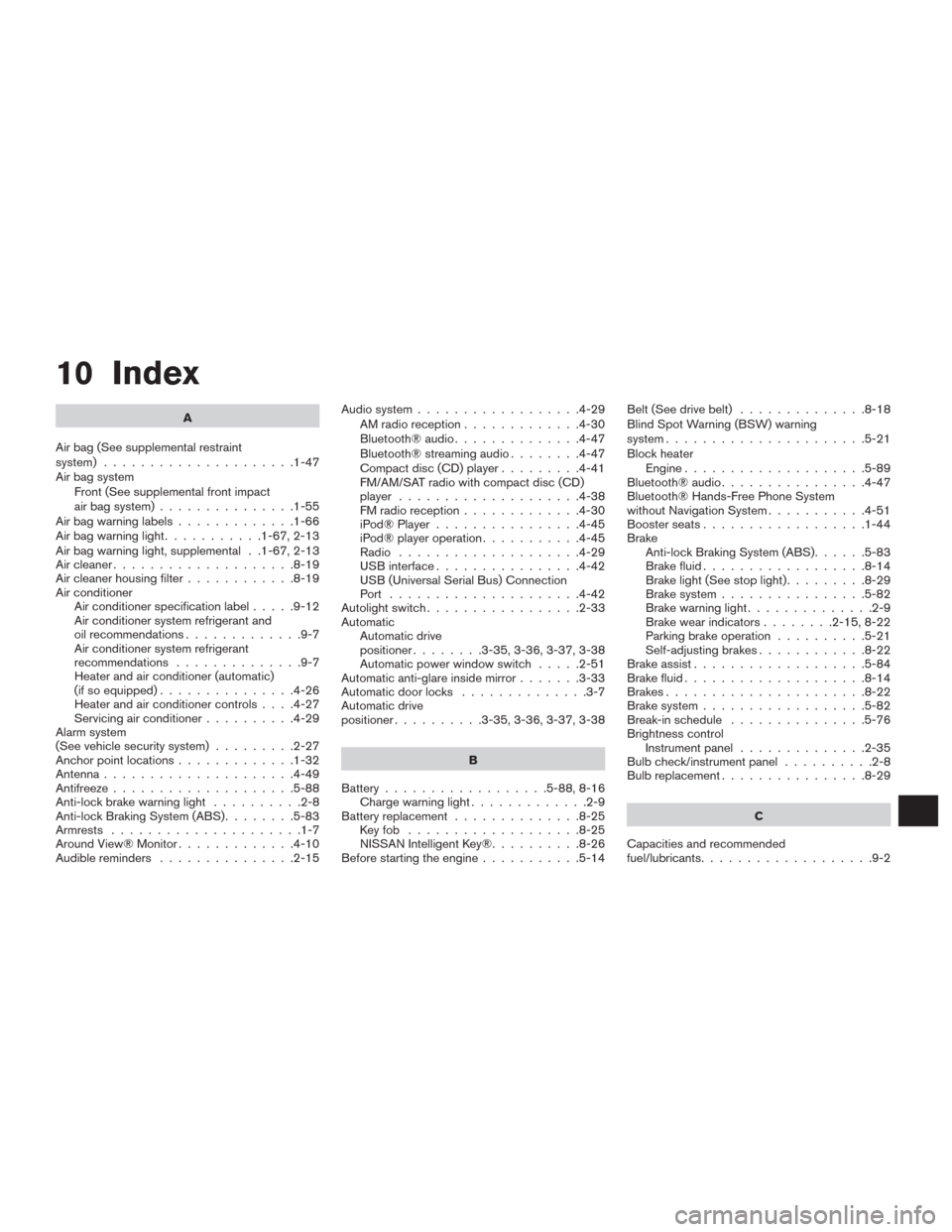
10 Index
A
Air bag (See supplemental restraint
system) .....................1-47
Air bag system
Front (See supplemental front impact
air bag system)...............1-55
Airbagwarninglabels.............1-66
Airbagwarninglight...........1-67,2-13
Air bag warning light, supplemental . .1-67, 2-13
Aircleaner....................8-19
Air cleaner housing filter............8-19
Air conditioner
Air conditioner specification label.....9-12
Air conditioner system refrigerant and
oil recommendations.............9-7
Air conditioner system refrigerant
recommendations..............9-7
Heater and air conditioner (automatic)
(if so equipped)...............4-26
Heater and air conditioner controls....4-27
Servicing air conditioner..........4-29
Alarm system
(See vehicle security system).........2-27
Anchor point locations.............1-32
Antenna.....................4-49
Antifreeze....................5-88
Anti-lock brake warning light..........2-8
Anti-lock Braking System (ABS)........5-83
Armrests .....................1-7
Around View® Monitor.............4-10
Audible reminders...............2-15Audio system..................4-29
AMradioreception.............4-30
Bluetooth®audio..............4-47
Bluetooth® streaming audio........4-47
Compact disc (CD) player.........4-41
FM/AM/SAT radio with compact disc (CD)
player ....................4-38
FMradioreception.............4-30
iPod® Player................4-45
iPod® player operation...........4-45
Radio ....................4-29
USB interface................4-42
USB (Universal Serial Bus) Connection
Port .....................4-42
Autolight switch.................2-33
Automatic
Automatic drive
positioner........3-35,3-36,3-37,3-38
Automatic power window switch.....2-51
Automatic anti-glare inside mirror.......3-33
Automatic door locks..............3-7
Automatic drive
positioner..........3-35,3-36,3-37,3-38
B
Battery..................5-88,8-16
Chargewarninglight.............2-9
Battery replacement..............8-25
Keyfob ...................8-25
NISSAN Intelligent Key®..........8-26
Before starting the engine...........5-14Belt (See drive belt)..............8-18
Blind Spot Warning (BSW) warning
system......................5-21
Block heater
Engine....................5-89
Bluetooth® audio................4-47
Bluetooth® Hands-Free Phone System
without Navigation System...........4-51
Boosterseats..................1-44
Brake
Anti-lock Braking System (ABS)......5-83
Brake fluid..................8-14
Brakelight(Seestoplight).........8-29
Brake system................5-82
Brakewarninglight..............2-9
Brakewearindicators........2-15,8-22
Parking brake operation..........5-21
Self-adjusting brakes............8-22
Brake assist...................5-84
Brake fluid....................8-14
Brakes......................8-22
Brake system..................5-82
Break-inschedule ...............5-76
Brightness control
Instrument panel..............2-35
Bulb check/instrument panel..........2-8
Bulbreplacement................8-29
C
Capacities and recommended
fuel/lubricants...................9-2
Page 443 of 465
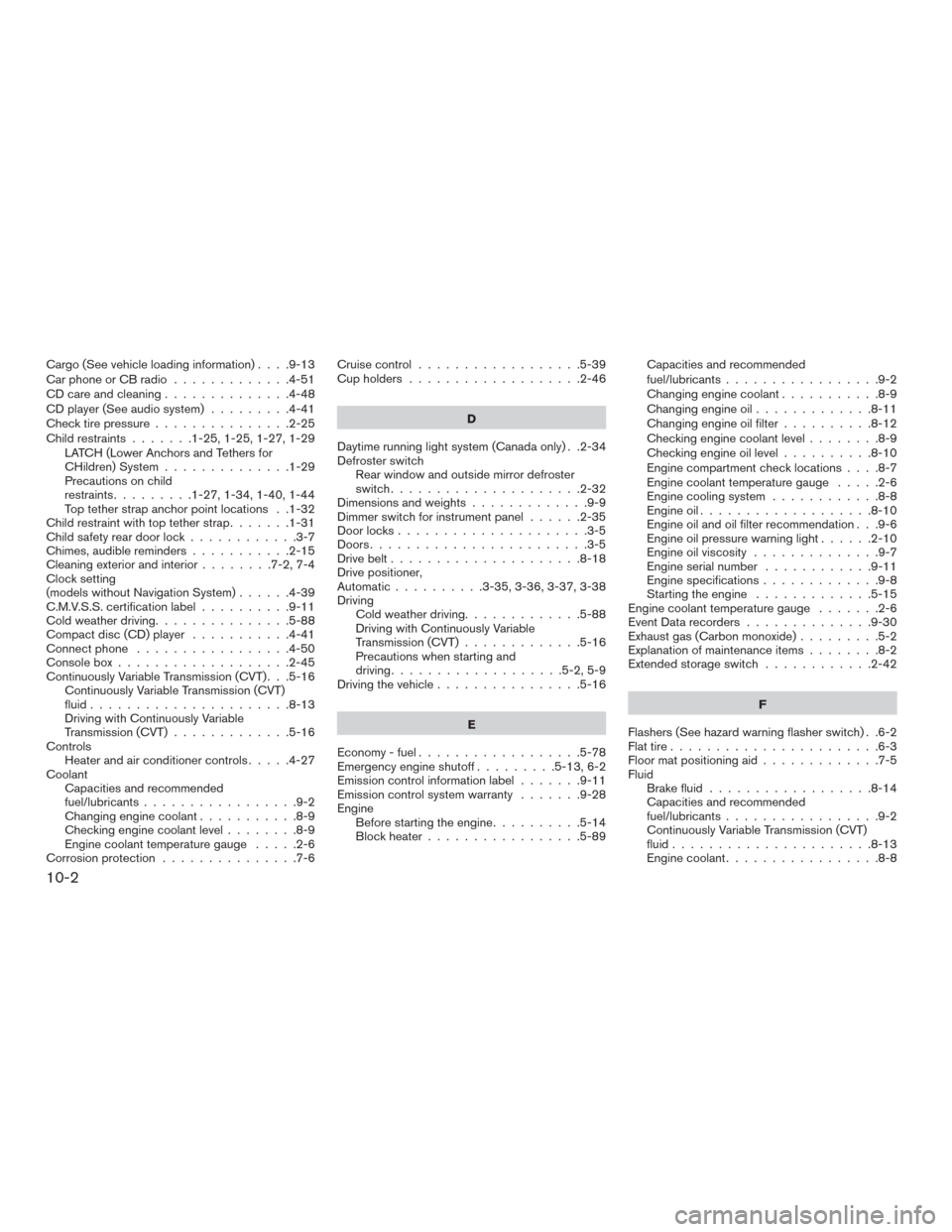
Cargo(Seevehicleloadinginformation)....9-13
Car phone or CB radio.............4-51
CD care and cleaning..............4-48
CD player (See audio system).........4-41
Check tire pressure...............2-25
Child restraints.......1-25,1-25,1-27,1-29
LATCH (Lower Anchors and Tethers for
CHildren) System..............1-29
Precautions on child
restraints.........1-27,1-34,1-40,1-44
Top tether strap anchor point locations . .1-32
Child restraint with top tether strap.......1-31
Child safety rear door lock............3-7
Chimes, audible reminders...........2-15
Cleaningexteriorandinterior........7-2,7-4
Clock setting
(models without Navigation System)......4-39
C.M.V.S.S. certification label..........9-11
Cold weather driving...............5-88
Compact disc (CD) player...........4-41
Connect phone.................4-50
Consolebox...................2-45
Continuously Variable Transmission (CVT) . . .5-16
Continuously Variable Transmission (CVT)
fluid......................8-13
Driving with Continuously Variable
Transmission (CVT).............5-16
Controls
Heater and air conditioner controls.....4-27
Coolant
Capacities and recommended
fuel/lubricants.................9-2
Changing engine coolant...........8-9
Checking engine coolant level........8-9
Engine coolant temperature gauge.....2-6
Corrosionprotection ...............7-6Cruisecontrol..................5-39
Cupholders...................2-46
D
Daytime running light system (Canada only) . .2-34
Defroster switch
Rear window and outside mirror defroster
switch.....................2-32
Dimensionsandweights.............9-9
Dimmer switch for instrument panel......2-35
Door locks.....................3-5
Doors........................3-5
Drive belt.....................8-18
Drive positioner,
Automatic..........3-35,3-36,3-37,3-38
Driving
Cold weather driving.............5-88
Driving with Continuously Variable
Transmission (CVT).............5-16
Precautions when starting and
driving...................5-2,5-9
Driving the vehicle................5-16
E
Economy - fuel..................5-78
Emergency engine shutoff.........5-13,6-2
Emission control information label.......9-11
Emission control system warranty.......9-28
Engine
Before starting the engine..........5-14
Block heater.................5-89Capacities and recommended
fuel/lubricants.................9-2
Changing engine coolant...........8-9
Changingengineoil.............8-11
Changing engine oil filter..........8-12
Checking engine coolant level........8-9
Checking engine oil level..........8-10
Engine compartment check locations....8-7
Engine coolant temperature gauge.....2-6
Engine cooling system............8-8
Engineoil...................8-10
Engine oil and oil filter recommendation . . .9-6
Engine oil pressure warning light......2-10
Engine oil viscosity..............9-7
Engine serial number............9-11
Engine specifications.............9-8
Starting the engine.............5-15
Engine coolant temperature gauge.......2-6
Event Data recorders..............9-30
Exhaust gas (Carbon monoxide).........5-2
Explanation of maintenance items........8-2
Extended storage switch............2-42
F
Flashers (See hazard warning flasher switch) . .6-2
Flat tire.......................6-3
Floor mat positioning aid.............7-5
Fluid
Brake fluid..................8-14
Capacities and recommended
fuel/lubricants.................9-2
Continuously Variable Transmission (CVT)
fluid......................8-13
Enginecoolant.................8-8
10-2
Page 444 of 465
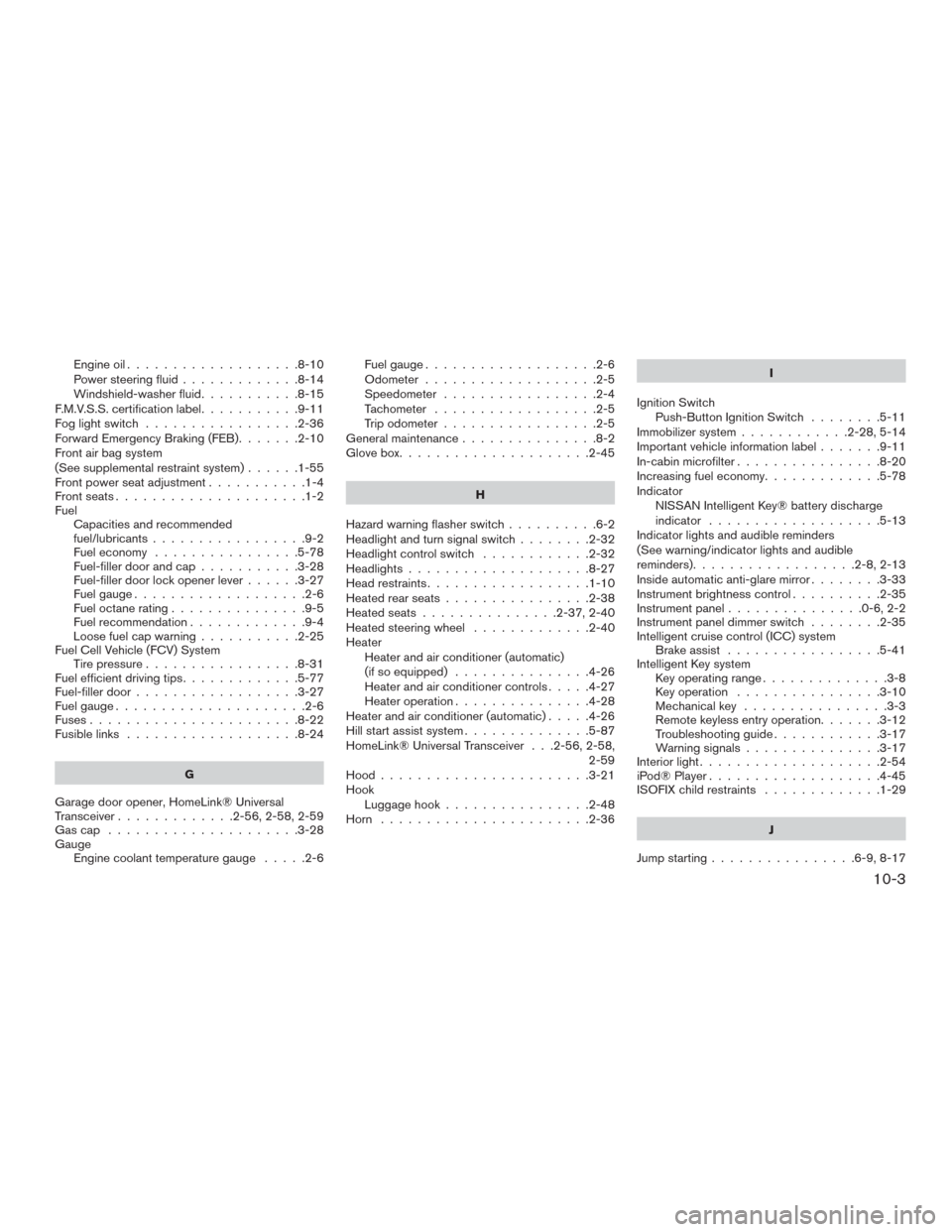
Engine oil...................8-10
Power steering fluid.............8-14
Windshield-washerfluid...........8-15
F.M.V.S.S. certification label...........9-11
Foglightswitch .................2-36
Forward Emergency Braking (FEB).......2-10
Front air bag system
(See supplemental restraint system)......1-55
Front power seat adjustment...........1-4
Frontseats.....................1-2
Fuel
Capacities and recommended
fuel/lubricants.................9-2
Fuel economy................5-78
Fuel-filler door and cap...........3-28
Fuel-filler door lock opener lever......3-27
Fuel gauge...................2-6
Fuel octane rating...............9-5
Fuel recommendation.............9-4
Loose fuel cap warning...........2-25
Fuel Cell Vehicle (FCV) System
Tirepressure.................8-31
Fuel efficient driving tips.............5-77
Fuel-filler door..................3-27
Fuel gauge.....................2-6
Fuses.......................8-22
Fusible links...................8-24
G
Garage door opener, HomeLink® Universal
Transceiver.............2-56,2-58,2-59
Gascap .....................3-28
Gauge
Engine coolant temperature gauge.....2-6Fuel gauge...................2-6
Odometer...................2-5
Speedometer.................2-4
Tachometer..................2-5
Trip odometer.................2-5
General maintenance...............8-2
Glovebox.....................2-45
H
Hazard warning flasher switch..........6-2
Headlight and turn signal switch........2-32
Headlight control switch............2-32
Headlights....................8-27
Head restraints..................1-10
Heated rear seats................2-38
Heated seats...............2-37,2-40
Heated steering wheel.............2-40
Heater
Heater and air conditioner (automatic)
(if so equipped)...............4-26
Heater and air conditioner controls.....4-27
Heater operation...............4-28
Heater and air conditioner (automatic).....4-26
Hill start assist system..............5-87
HomeLink® Universal Transceiver . . .2-56, 2-58,
2-59
Hood.......................3-21
Hook
Luggage hook................2-48
Horn .......................2-36I
Ignition Switch
Push-Button Ignition Switch........5-11
Immobilizer system............2-28,5-14
Important vehicle information label
.......9-11
In-cabin microfilter................8-20
Increasing fuel economy.............5-78
Indicator
NISSAN Intelligent Key® battery discharge
indicator ...................5-13
Indicator lights and audible reminders
(See warning/indicator lights and audible
reminders)..................2-8,2-13
Inside automatic anti-glare mirror........3-33
Instrument brightness control..........2-35
Instrumentpanel...............0-6,2-2
Instrument panel dimmer switch........2-35
Intelligent cruise control (ICC) system
Brake assist.................5-41
Intelligent Key system
Key operating range..............3-8
Key operation................3-10
Mechanical key................3-3
Remote keyless entry operation.......3-12
Troubleshooting guide............3-17
Warning signals...............3-17
Interior light....................2-54
iPod®Player...................4-45
ISOFIX child restraints.............1-29
J
Jump starting................6-9,8-17
10-3
Page 446 of 465
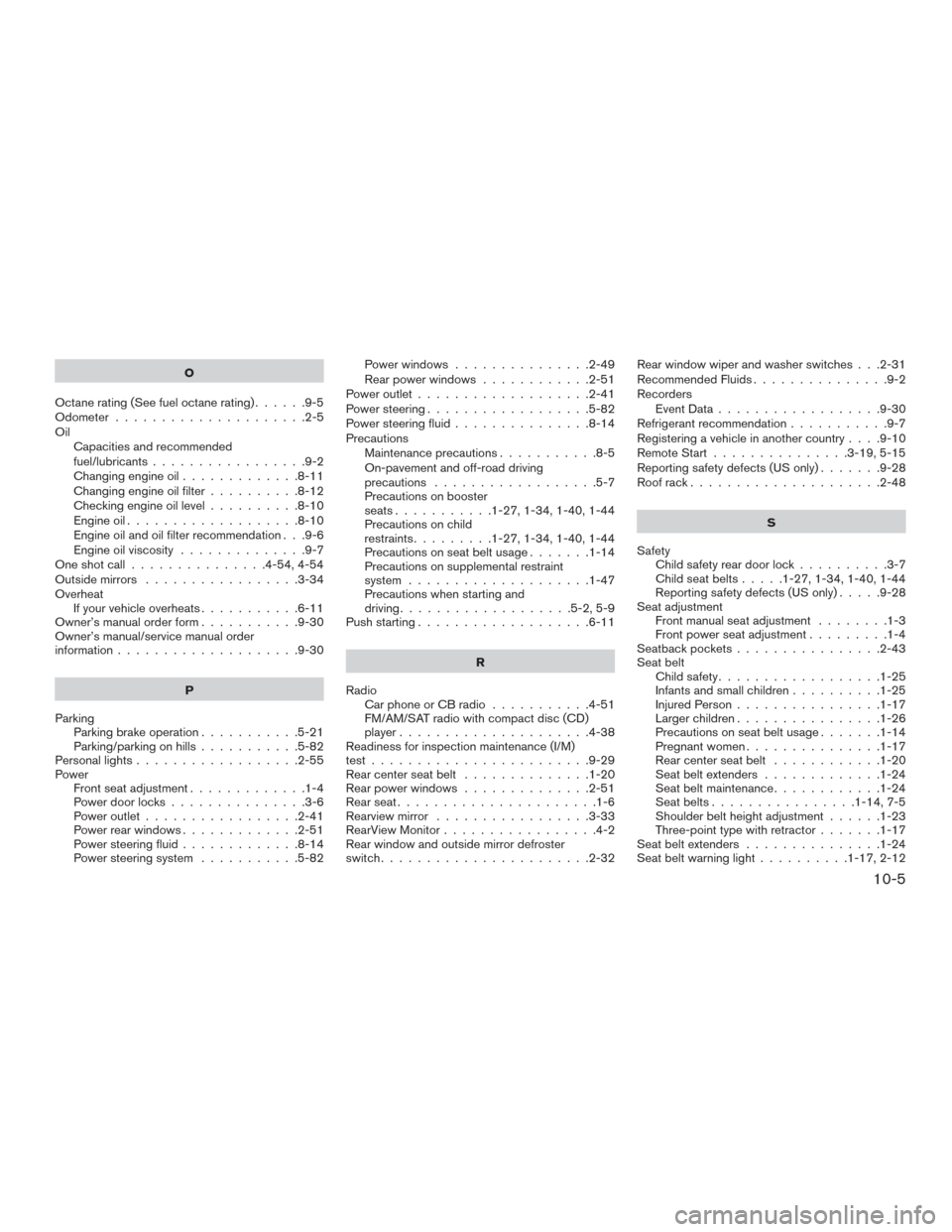
O
Octanerating(Seefueloctanerating)......9-5
Odometer.....................2-5
Oil
Capacities and recommended
fuel/lubricants.................9-2
Changing engine oil.............8-11
Changing engine oil filter..........8-12
Checking engine oil level..........8-10
Engine oil...................8-10
Engine oil and oil filter recommendation . . .9-6
Engine oil viscosity..............9-7
Oneshotcall...............4-54,4-54
Outside mirrors.................3-34
Overheat
Ifyourvehicleoverheats...........6-11
Owner’s manual order form...........9-30
Owner’s manual/service manual order
information....................9-30
P
Parking
Parking brake operation...........5-21
Parking/parking on hills...........5-82
Personallights..................2-55
Power
Front seat adjustment.............1-4
Power door locks...............3-6
Power outlet.................2-41
Power rear windows.............2-51
Power steering fluid.............8-14
Power steering system...........5-82Power windows...............2-49
Rear power windows............2-51
Power outlet...................2-41
Power steering..................5-82
Power steering fluid...............8-14
Precautions
Maintenance precautions...........8-5
On-pavement and off-road driving
precautions..................5-7
Precautions on booster
seats...........1-27,1-34,1-40,1-44
Precautions on child
restraints.........1-27,1-34,1-40,1-44
Precautions on seat belt usage.......1-14
Precautions on supplemental restraint
system....................1-47
Precautions when starting and
driving...................5-2,5-9
Push starting...................6-11
R
Radio
Car phone or CB radio...........4-51
FM/AM/SAT radio with compact disc (CD)
player.....................4-38
Readiness for inspection maintenance (I/M)
test........................9-29
Rear center seat belt..............1-20
Rear power windows..............2-51
Rearseat......................1-6
Rearview mirror.................3-33
RearView Monitor.................4-2
Rear window and outside mirror defroster
switch.......................2-32Rear window wiper and washer switches . . .2-31
Recommended Fluids...............9-2
Recorders
EventData..................9-30
Refrigerant recommendation...........9-7
Registering a vehicle in another country....9-10
Remote Start...............3-19,5-15
Reporting safety defects (US only).......9-28
Roof rack.....................2-48
S
Safety
Child safety rear door lock..........3-7
Child seat belts.....1-27,1-34,1-40,1-44
Reporting safety defects (US only).....9-28
Seat adjustment
Front manual seat adjustment........1-3
Front power seat adjustment.........1-4
Seatbackpockets................2-43
Seat belt
Child safety..................1-25
Infants and small children..........1-25
Injured Person................1-17
Largerchildren................1-26
Precautions on seat belt usage.......1-14
Pregnant women...............1-17
Rear center seat belt............1-20
Seatbeltextenders .............1-24
Seatbeltmaintenance............1-24
Seatbelts................1-14,7-5
Shoulder belt height adjustment......1-23
Three-point type with retractor.......1-17
Seat belt extenders...............1-24
Seatbeltwarninglight..........1-17,2-12
10-5