If you have a flat tire, refer to “Flat tire” in
the “In case of emergency” section of this
manual.
TIRE PRESSURE
Tire Pressure Monitoring System
(TPMS)
WARNING
Radio waves could adversely affect
electric medical equipment. Those
who use a pacemaker should con-
tact the electric medical equipment
manufacturer for the possible influ-
ences before use.
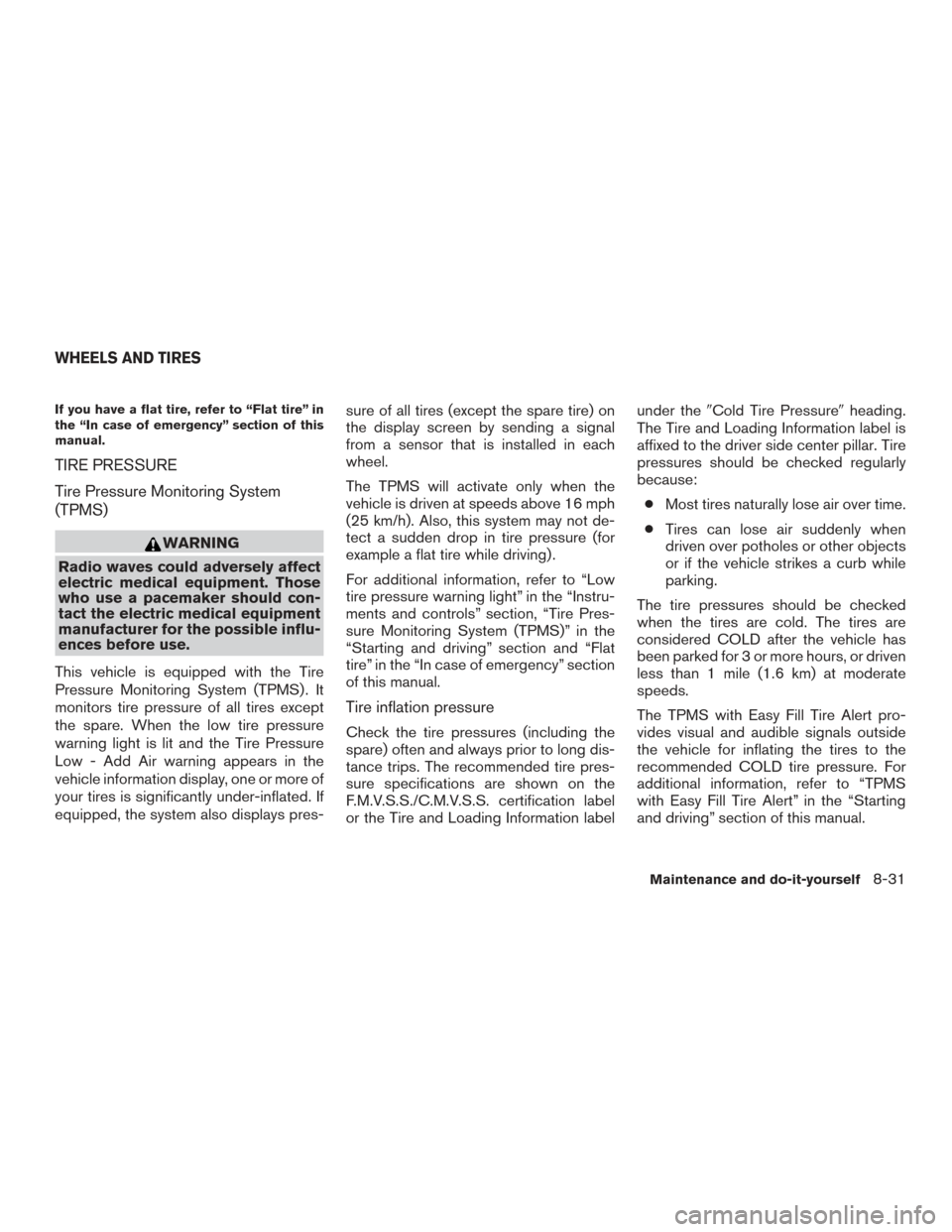
This vehicle is equipped with the Tire
Pressure Monitoring System (TPMS) . It
monitors tire pressure of all tires except
the spare. When the low tire pressure
warning light is lit and the Tire Pressure
Low - Add Air warning appears in the
vehicle information display, one or more of
your tires is significantly under-inflated. If
equipped, the system also displays pres- sure of all tires (except the spare tire) on
the display screen by sending a signal
from a sensor that is installed in each
wheel.
The TPMS will activate only when the
vehicle is driven at speeds above 16 mph
(25 km/h). Also, this system may not de-
tect a sudden drop in tire pressure (for
example a flat tire while driving) .
For additional information, refer to “Low
tire pressure warning light” in the “Instru-
ments and controls” section, “Tire Pres-
sure Monitoring System (TPMS)” in the
“Starting and driving” section and “Flat
tire” in the “In case of emergency” section
of this manual.
Tire inflation pressure
Check the tire pressures (including the
spare) often and always prior to long dis-
tance trips. The recommended tire pres-
sure specifications are shown on the
F.M.V.S.S./C.M.V.S.S. certification label
or the Tire and Loading Information labelunder the
�Cold Tire Pressure� heading.
The Tire and Loading Information label is
affixed to the driver side center pillar. Tire
pressures should be checked regularly
because:
● Most tires naturally lose air over time.
● Tires can lose air suddenly when
driven over potholes or other objects
or if the vehicle strikes a curb while
parking.
The tire pressures should be checked
when the tires are cold. The tires are
considered COLD after the vehicle has
been parked for 3 or more hours, or driven
less than 1 mile (1.6 km) at moderate
speeds.
The TPMS with Easy Fill Tire Alert pro-
vides visual and audible signals outside
the vehicle for inflating the tires to the
recommended COLD tire pressure. For
additional information, refer to “TPMS
with Easy Fill Tire Alert” in the “Starting
and driving” section of this manual.
WHEELS AND TIRES
Maintenance and do-it-yourself8-31
10 Index
A
Air bag (See supplemental restraint
system) .....................1-40
Air bag system Front (See supplemental front impact
air bag system) ...............1-47
Airbagwarninglight...........1-57,2-11
Air bag warning light, supplemental . .1-57, 2-11
AirCleaner ...................8-20
Air cleaner housing filter ............8-20
Air conditioner Air conditioner service ...........4-28
Air conditioner specification label .....9-13
Air conditioner system refrigerant and
oil recommendations ..........9-2,9-8
Air conditioner system refrigerant
recommendations ............9-2,9-8
Heater and air conditioner (automatic)
(if so equipped) ...............4-25
Heater and air conditioner controls ....4-26
Servicing air conditioner ..........4-28
Alarm system
(See vehicle security system) .........2-34
Anchor point locations .............1-25
Antenna .....................4-28
Antifreeze ....................5-86
Anti-lock brake warning light ..........2-7
Anti-lock Braking System (ABS) ........5-79
Armrests .....................1-6
Around View® Monitor .............4-9
Audible reminders ...............2-14 Audio system
..................4-28
Radio ....................4-28
Autolight switch .................2-39
Automatic Automatic drive positioner . .3-30, 3-31, 3-31
Automatic power window switch .....2-53
Automatic anti-glare inside mirror .......3-28
Automatic door locks ..............3-5
Automatic drive positioner ....3-30,3-31,3-31
B
Battery ..................5-86,8-16
Chargewarninglight.............2-8
Battery replacement Keyfob ...................8-25
NISSAN Intelligent Key® ..........8-25
Before starting the engine ...........5-14
Belt (See drive belt) ..............8-18
Blind Spot Warning (BSW) warning
system ......................5-22
Block heater Engine ....................5-87
Bluetooth® Hands-Free Phone System with
NavigationSystem...............4-29
Boosterseats..................1-37
Brake Anti-lock Braking System (ABS) ......5-79
Brake assist (for Intelligent cruise control
system) ...................5-80
Brake fluid ..................8-14
Brake light (See stop light) .........8-28 Brake system
................5-78
Brakewarninglight..............2-8
Brakewearindicators........2-14,8-22
Parking brake operation ..........5-21
Self-adjusting brakes ............8-22
Brake fluid ....................8-14
Brakes ......................8-22
Brake system ..................5-78
Break-inschedule ...............5-75
Brightness control Instrument panel ..............2-41
Bulb check/instrument panel ..........2-7
Bulbreplacement................8-28
C
Capacities and recommended
fuel/lubricants .................. .9-2
Cargo
(See vehicle loading information) . . .9-14
Car phone or CB radio .............4-29
Check tire pressure ...............2-25
Child restraints .......1-18,1-19,1-21,1-23
LATCH (Lower Anchors and Tethers for
CHildren) System ..............1-23
Precautions on child
restraints ........1-21,1-27,1-33,1-37
Top tether strap anchor point locations . .1-25
Child safety rear door lock ............3-6
Chimes, audible reminders ...........2-14
Cleaning exterior and interior .......7-2,7-4
Climate control seat switch ..........2-44
C.M.V.S.S. certification label ..........9-12