Page 239 of 437
• When washing the vehicle with highpressure water, be sure not to spray it
around the camera. Otherwise, water
may enter the camera unit causing wa-
ter condensation on the lens, a mal-
function, fire or an electric shock.
• Do not strike the camera. It is a preci- sion instrument. Otherwise, it may
malfunction or cause damage result-
ing in a fire or an electric shock.
The following are operating limitations and do not
represent a system malfunction:
• When the temperature is extremely high or low, the screen may not clearly display objects.
• When strong light directly shines on the cam- era, objects may not be displayed clearly.
• Vertical lines may be seen in objects on the screen. This is due to strong reflected light from
the bumper.
• The screen may flicker under fluorescent light.
• The colors of objects on the RearView Monitor may differ somewhat from the actual color of
objects.
• Objects on the monitor may not be clear in a dark environment. • There may be a delay when switching between
views.
• If dirt, rain or snow accumulate on the camera, RearView Monitor may not display objects
clearly. Clean the camera.
• Do not use wax on the camera lens. Wipe off any wax with a clean cloth dampened with a
diluted mild cleaning agent, then wipe with a dry
cloth.
SYSTEM MAINTENANCE
CAUTION
• Do not use alcohol, benzine or thinner to clean the camera. This will cause
discoloration.
• Do not damage the camera as the monitor screen may be adversely af-
fected.
If dirt, rain or snow accumulates on the camera
�1, the RearView Monitor may not display ob-
jects clearly. Clean the camera by wiping it with a
cloth dampened with a diluted mild cleaning
agent and the wiping it with a dry cloth.
4-10Display screen, heater, air conditioner, audio and phone systems
Page 240 of 437
1. CAMERA button
AROUND VIEW® MONITOR (IF SO
EQUIPPED)
Display screen, heater, air conditioner, audio and phone systems4-11
Page 241 of 437
WARNING
Failure to follow the warnings and in-
structions for proper use of the Around
View® Monitor system could result in
serious injury or death.
• The Around View® Monitor is a conve- nience feature and is not a substitute
for proper vehicle operation because it
has areas where objects cannot be
viewed. The four corners of the vehicle
in particular, are areas where objects
do not always appear in the bird’s-eye,
front, or rear views. Always check your
surroundings to be sure that it is safe
to move before operating the vehicle.
Always operate the vehicle slowly.
• The driver is always responsible for safety during parking and other ma-
neuvers.
CAUTION
Do not scratch the camera lens when
cleaning dirt or snow from the front of the
camera. The Around View® Monitor system is designed
as an aid to the driver in situations such as slot
parking or parallel parking. The monitor displays
various views of the position of the vehicle in a
split screen format. Not all views are available at
all times.
Available views:
• Front View
An approximately 150–degree view of the
front of the vehicle.
• Rear View An approximately 150–degree view of the rear
of the vehicle.
• Bird’s-Eye View The surrounding views of the vehicle from
above.
• Front-Side View The view around and ahead of the front pas-
senger’s side wheel. To display the multiple views, the Around View®
Monitor system uses cameras located in the front
grille, on the vehicle’s outside mirrors and one
just above the vehicle’s license plates
�1.
AROUND VIEW® MONITOR
SYSTEM OPERATION
With the ignition switch in the ON position, move
the shift lever to the R (Reverse) position or press
the CAMERA button to operate the Around
View® Monitor. The screen displayed on the
Around View® Monitor will automatically return
to the previous screen 3 minutes after the CAM-
ERA button has been pressed with the shift lever
in a position other than the R (Reverse) position.
4-12Display screen, heater, air conditioner, audio and phone systems
Page 242 of 437
Available views
WARNING
• The distance guide lines and the ve- hicle width lines should be used as a
reference only when the vehicle is on a
paved, level surface. The apparent dis-
tance viewed on the monitor may be
different than the actual distance be-
tween the vehicle and displayed ob-
jects.
• Use the displayed lines and the bird’s eye view as a reference. The lines and
the bird’s-eye view are greatly affected
by the number of occupants, cargo,
fuel level, vehicle position, road condi-
tion and road grade.
• If the tires are replaced with different sized tires, the predicted course lines
and the bird’s-eye view may be dis-
played incorrectly.
• When driving the vehicle up a hill, ob- jects viewed in the monitor are further
than they appear. When driving the ve-
hicle down a hill, objects viewed in the
monitor are closer than they appear. • Objects in the rear view will appear
visually opposite compared to when
viewed in the rear view and outside
mirrors.
• Use the mirrors or actually look to properly judge distances to other ob-
jects.
• On a snow-covered or slippery road, there may be a difference between the
predicted course lines and the actual
course line.
• The vehicle width and predicted course lines are wider than the actual width
and course.
• The displayed lines will appear slightly off to the right, because the rearview
camera is not installed in the rear cen-
ter of the vehicle.
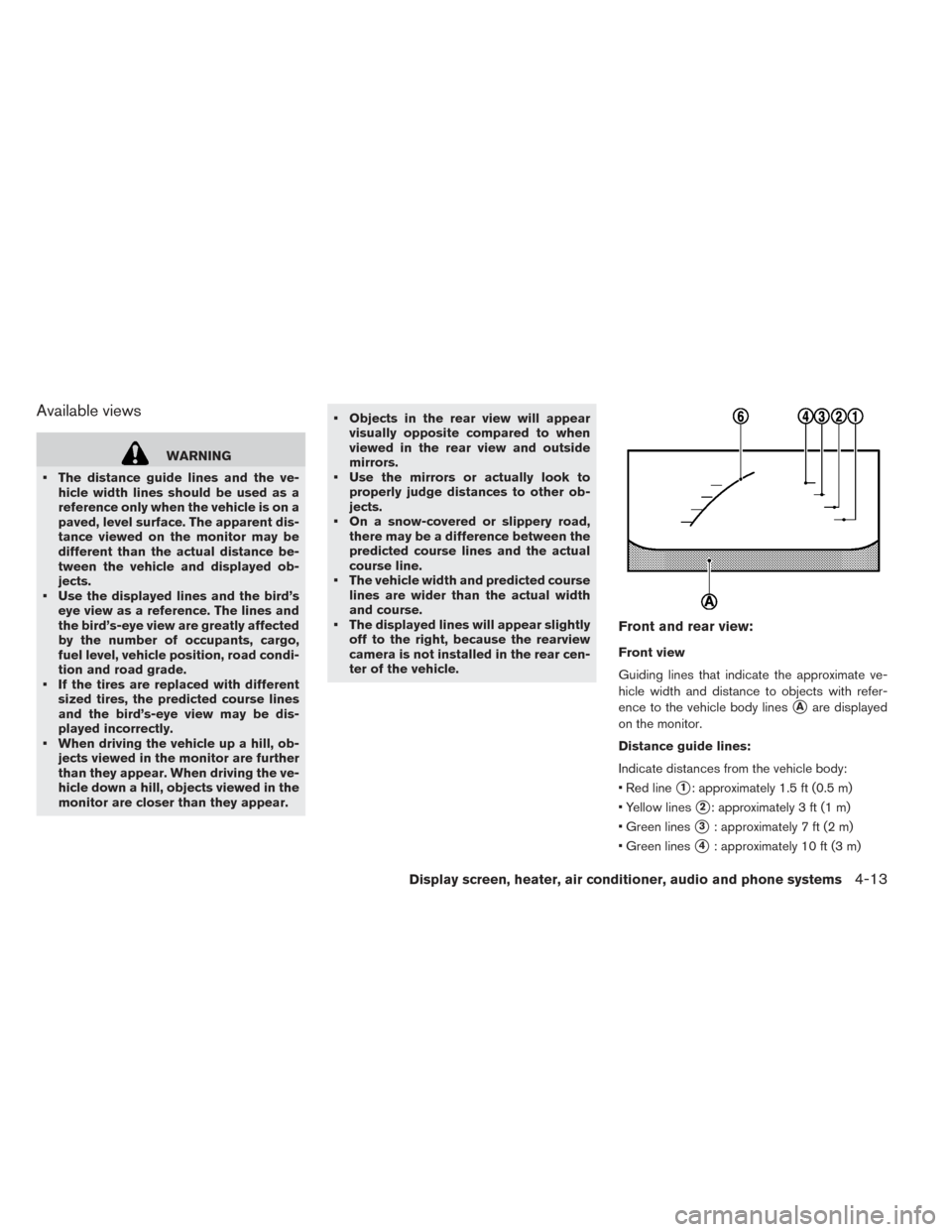
Front and rear view:
Front view
Guiding lines that indicate the approximate ve-
hicle width and distance to objects with refer-
ence to the vehicle body lines
�Aare displayed
on the monitor.
Distance guide lines:
Indicate distances from the vehicle body:
• Red line
�1: approximately 1.5 ft (0.5 m)
• Yellow lines
�2: approximately 3 ft (1 m)
• Green lines
�3: approximately 7 ft (2 m)
• Green lines
�4: approximately 10 ft (3 m)
Display screen, heater, air conditioner, audio and phone systems4-13
Page 243 of 437
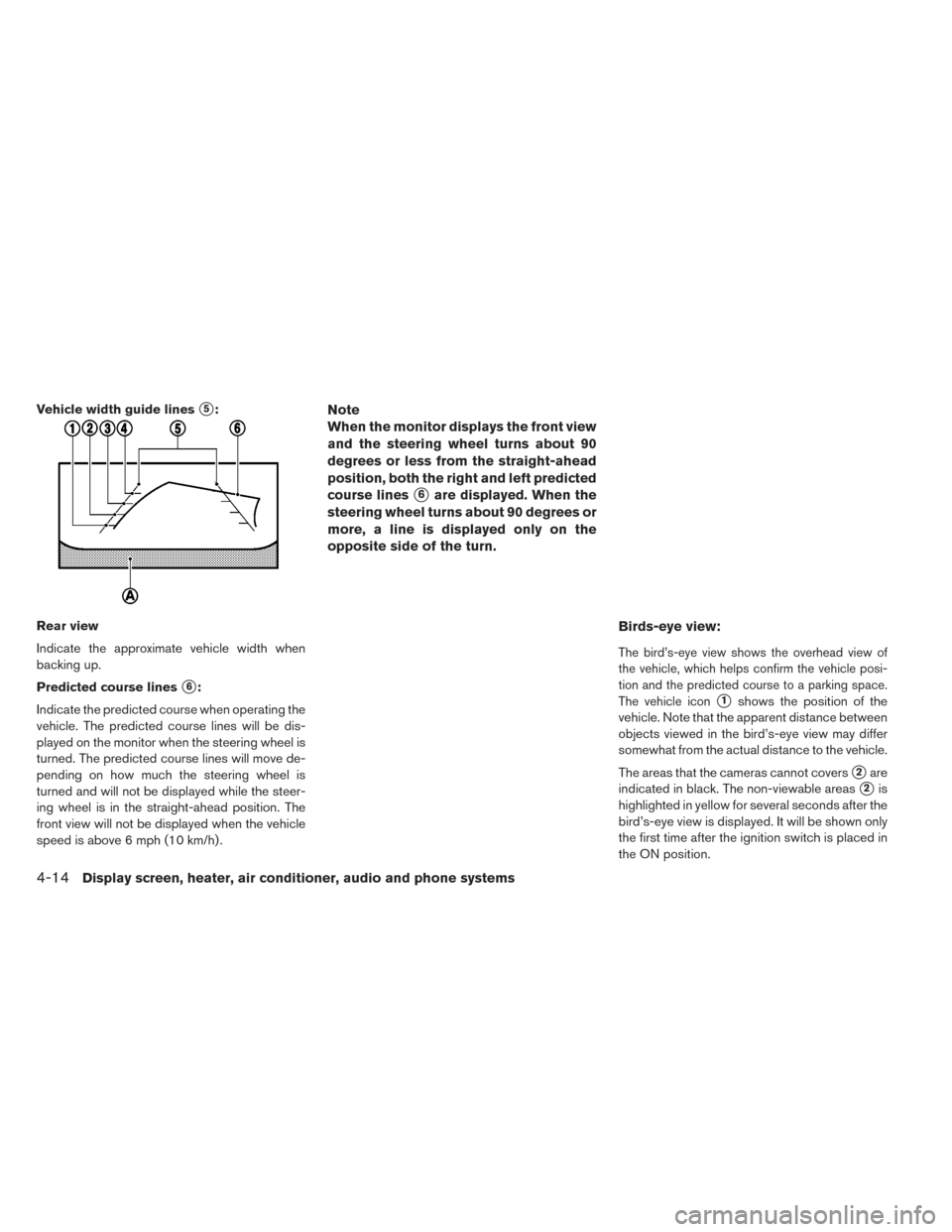
Vehicle width guide lines�5:
Rear view
Indicate the approximate vehicle width when
backing up.
Predicted course lines
�6:
Indicate the predicted course when operating the
vehicle. The predicted course lines will be dis-
played on the monitor when the steering wheel is
turned. The predicted course lines will move de-
pending on how much the steering wheel is
turned and will not be displayed while the steer-
ing wheel is in the straight-ahead position. The
front view will not be displayed when the vehicle
speed is above 6 mph (10 km/h) .
Note
When the monitor displays the front view
and the steering wheel turns about 90
degrees or less from the straight-ahead
position, both the right and left predicted
course lines
�6are displayed. When the
steering wheel turns about 90 degrees or
more, a line is displayed only on the
opposite side of the turn.
Birds-eye view:
The bird’s-eye view shows the overhead view of
the vehicle, which helps confirm the vehicle posi-
tion and the predicted course to a parking space.
The vehicle icon
�1shows the position of the
vehicle. Note that the apparent distance between
objects viewed in the bird’s-eye view may differ
somewhat from the actual distance to the vehicle.
The areas that the cameras cannot covers
�2are
indicated in black. The non-viewable areas
�2is
highlighted in yellow for several seconds after the
bird’s-eye view is displayed. It will be shown only
the first time after the ignition switch is placed in
the ON position.
4-14Display screen, heater, air conditioner, audio and phone systems
Page 244 of 437
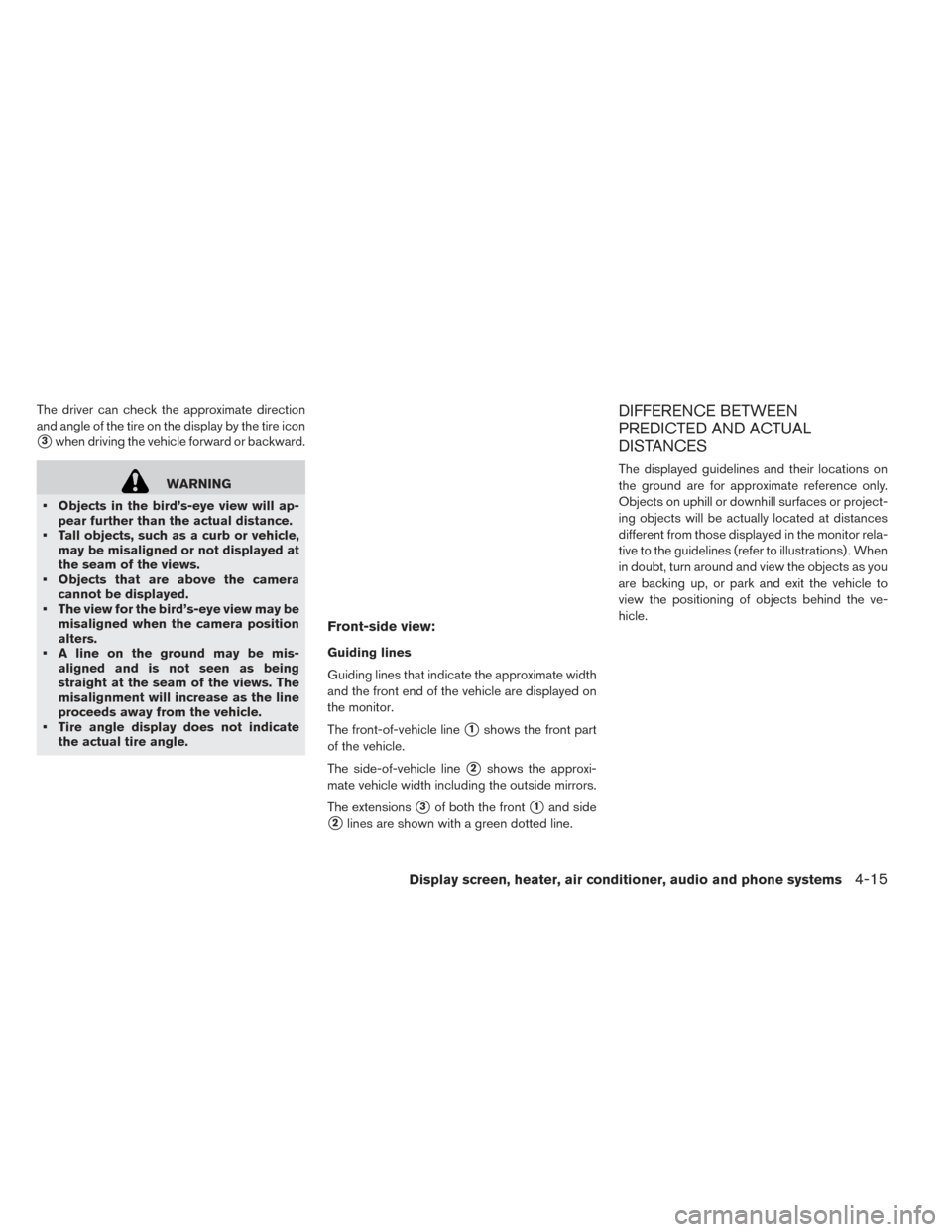
The driver can check the approximate direction
and angle of the tire on the display by the tire icon
�3when driving the vehicle forward or backward.
WARNING
• Objects in the bird’s-eye view will ap- pear further than the actual distance.
• Tall objects, such as a curb or vehicle, may be misaligned or not displayed at
the seam of the views.
• Objects that are above the camera cannot be displayed.
• The view for the bird’s-eye view may be misaligned when the camera position
alters.
• A line on the ground may be mis- aligned and is not seen as being
straight at the seam of the views. The
misalignment will increase as the line
proceeds away from the vehicle.
• Tire angle display does not indicate the actual tire angle.
Front-side view:
Guiding lines
Guiding lines that indicate the approximate width
and the front end of the vehicle are displayed on
the monitor.
The front-of-vehicle line
�1shows the front part
of the vehicle.
The side-of-vehicle line
�2shows the approxi-
mate vehicle width including the outside mirrors.
The extensions
�3of both the front�1and side
�2lines are shown with a green dotted line.
DIFFERENCE BETWEEN
PREDICTED AND ACTUAL
DISTANCES
The displayed guidelines and their locations on
the ground are for approximate reference only.
Objects on uphill or downhill surfaces or project-
ing objects will be actually located at distances
different from those displayed in the monitor rela-
tive to the guidelines (refer to illustrations) . When
in doubt, turn around and view the objects as you
are backing up, or park and exit the vehicle to
view the positioning of objects behind the ve-
hicle.
Display screen, heater, air conditioner, audio and phone systems4-15
Page 245 of 437
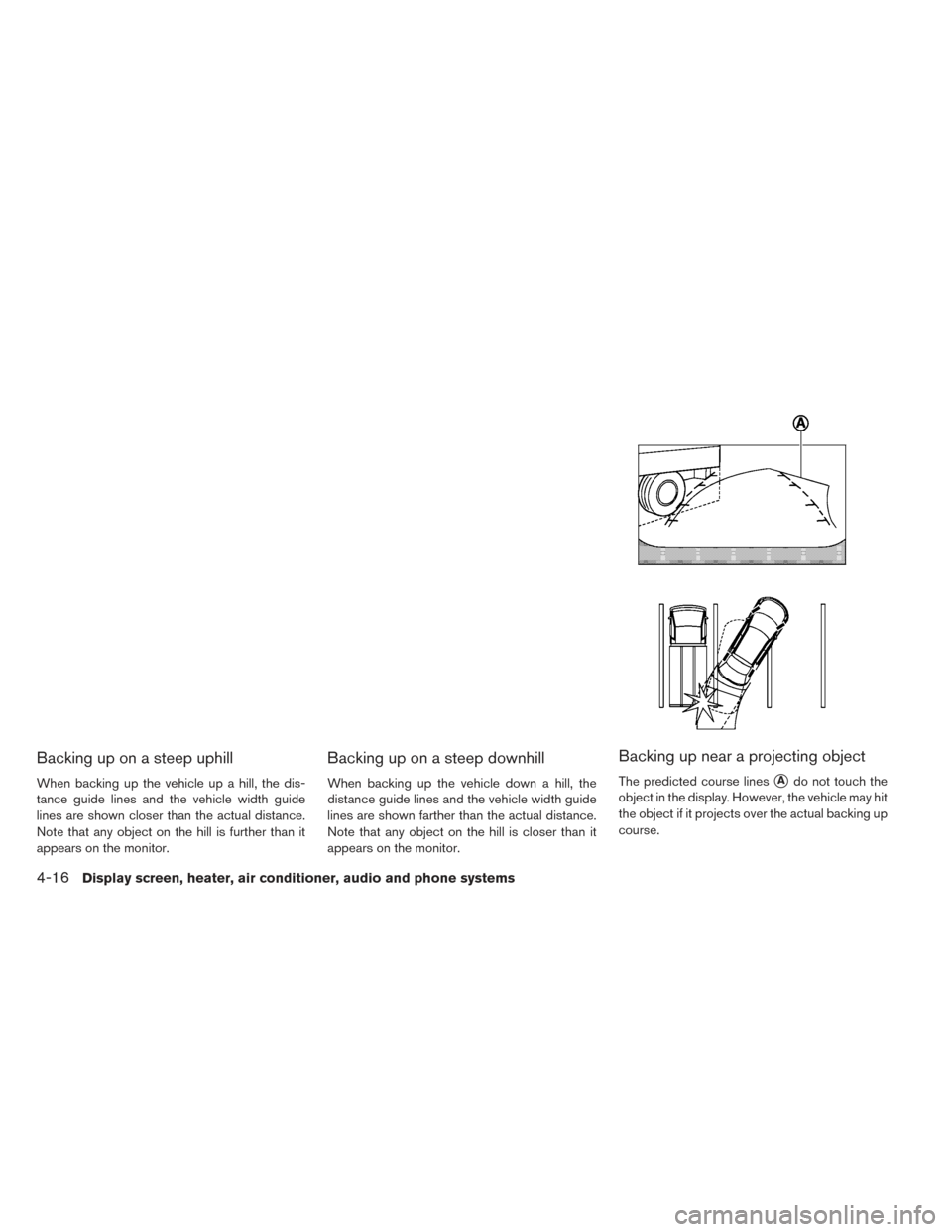
Backing up on a steep uphill
When backing up the vehicle up a hill, the dis-
tance guide lines and the vehicle width guide
lines are shown closer than the actual distance.
Note that any object on the hill is further than it
appears on the monitor.
Backing up on a steep downhill
When backing up the vehicle down a hill, the
distance guide lines and the vehicle width guide
lines are shown farther than the actual distance.
Note that any object on the hill is closer than it
appears on the monitor.
Backing up near a projecting object
The predicted course lines�Ado not touch the
object in the display. However, the vehicle may hit
the object if it projects over the actual backing up
course.
4-16Display screen, heater, air conditioner, audio and phone systems
Page 246 of 437
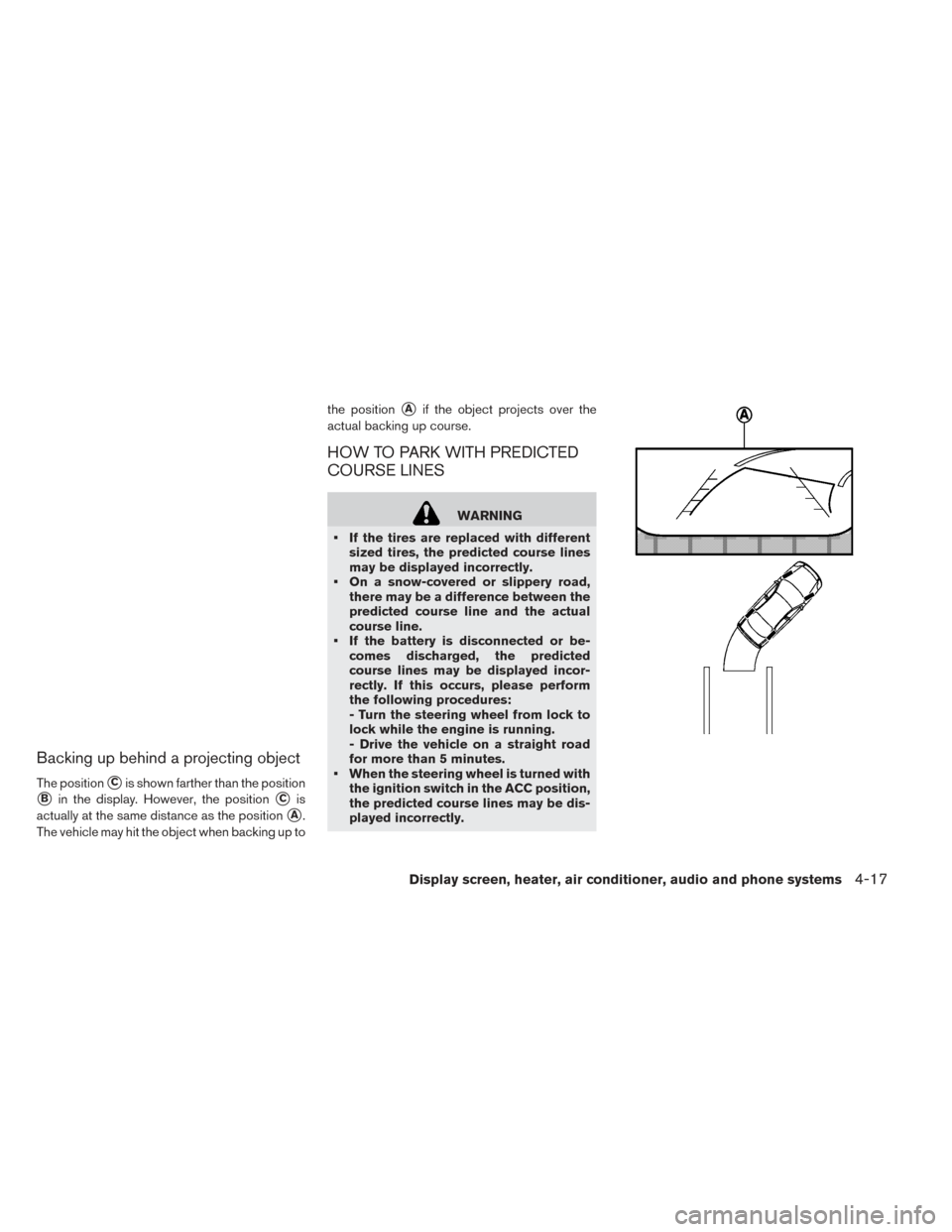
Backing up behind a projecting object
The position�Cis shown farther than the position
�Bin the display. However, the position�Cis
actually at the same distance as the position
�A.
The vehicle may hit the object when backing up to the position
�Aif the object projects over the
actual backing up course.
HOW TO PARK WITH PREDICTED
COURSE LINES
WARNING
• If the tires are replaced with different sized tires, the predicted course lines
may be displayed incorrectly.
• On a snow-covered or slippery road, there may be a difference between the
predicted course line and the actual
course line.
• If the battery is disconnected or be- comes discharged, the predicted
course lines may be displayed incor-
rectly. If this occurs, please perform
the following procedures:
- Turn the steering wheel from lock to
lock while the engine is running.
- Drive the vehicle on a straight road
for more than 5 minutes.
• When the steering wheel is turned with the ignition switch in the ACC position,
the predicted course lines may be dis-
played incorrectly.
Display screen, heater, air conditioner, audio and phone systems4-17