2016 NISSAN LEAF warning
[x] Cancel search: warningPage 402 of 437
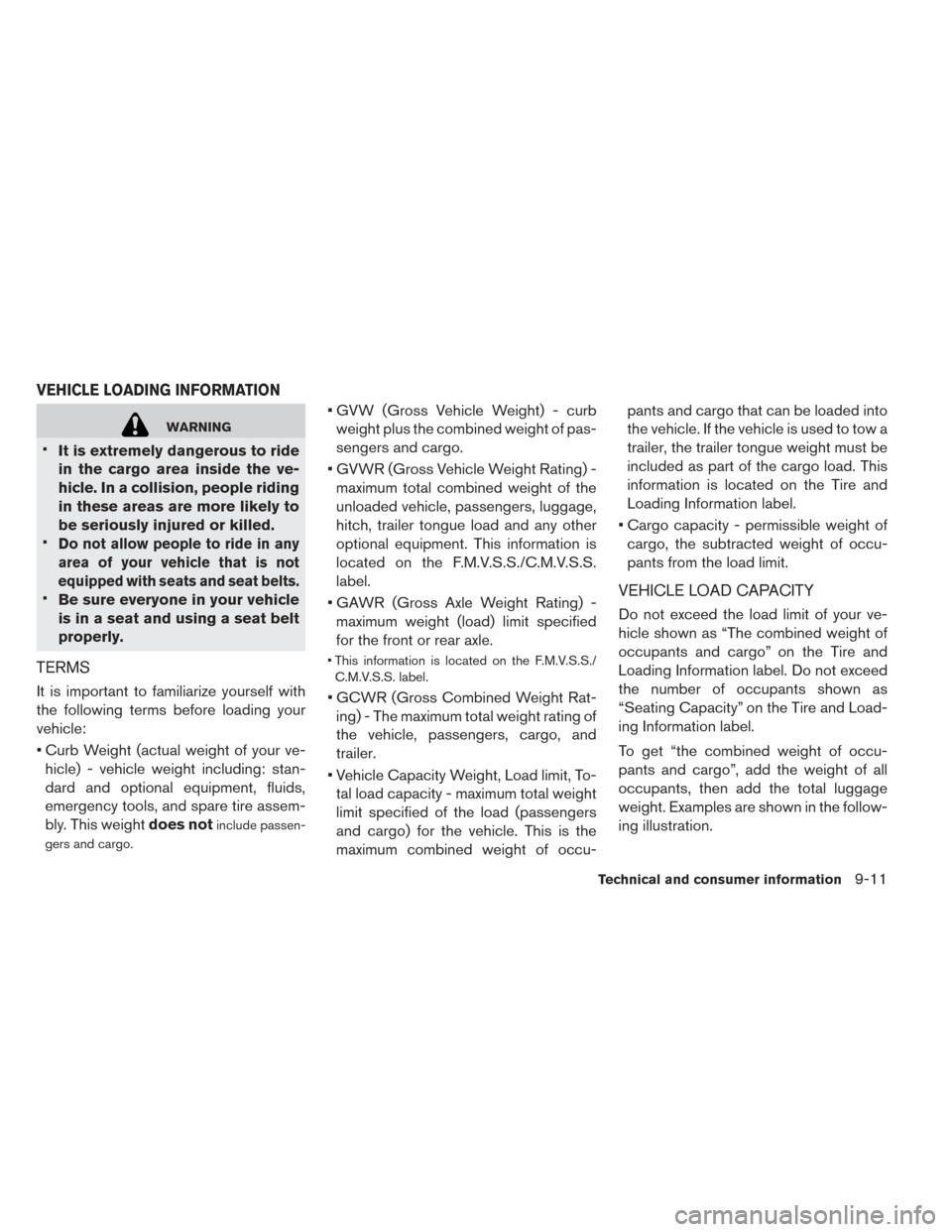
WARNING
•
It is extremely dangerous to ride
in the cargo area inside the ve-
hicle. In a collision, people riding
in these areas are more likely to
be seriously injured or killed.
•Do not allow people to ride in any
area of your vehicle that is not
equipped with seats and seat belts.
•Be sure everyone in your vehicle
is in a seat and using a seat belt
properly.
TERMS
It is important to familiarize yourself with
the following terms before loading your
vehicle:
• Curb Weight (actual weight of your ve- hicle) - vehicle weight including: stan-
dard and optional equipment, fluids,
emergency tools, and spare tire assem-
bly. This weight does not
include passen-
gers and cargo.
• GVW (Gross Vehicle Weight) - curb weight plus the combined weight of pas-
sengers and cargo.
• GVWR (Gross Vehicle Weight Rating) - maximum total combined weight of the
unloaded vehicle, passengers, luggage,
hitch, trailer tongue load and any other
optional equipment. This information is
located on the F.M.V.S.S./C.M.V.S.S.
label.
• GAWR (Gross Axle Weight Rating) - maximum weight (load) limit specified
for the front or rear axle.
• This information is located on the F.M.V.S.S./
C.M.V.S.S. label.
• GCWR (Gross Combined Weight Rat-ing) - The maximum total weight rating of
the vehicle, passengers, cargo, and
trailer.
• Vehicle Capacity Weight, Load limit, To- tal load capacity - maximum total weight
limit specified of the load (passengers
and cargo) for the vehicle. This is the
maximum combined weight of occu- pants and cargo that can be loaded into
the vehicle. If the vehicle is used to tow a
trailer, the trailer tongue weight must be
included as part of the cargo load. This
information is located on the Tire and
Loading Information label.
• Cargo capacity - permissible weight of cargo, the subtracted weight of occu-
pants from the load limit.
VEHICLE LOAD CAPACITY
Do not exceed the load limit of your ve-
hicle shown as “The combined weight of
occupants and cargo” on the Tire and
Loading Information label. Do not exceed
the number of occupants shown as
“Seating Capacity” on the Tire and Load-
ing Information label.
To get “the combined weight of occu-
pants and cargo”, add the weight of all
occupants, then add the total luggage
weight. Examples are shown in the follow-
ing illustration.
VEHICLE LOADING INFORMATION
Technical and consumer information9-11
Page 404 of 437
Also check tires for proper inflation pres-
sures. For additional information, refer to
the Tire and Loading Information label.
LOADING TIPS
• The GVW must not exceed the GVWRor GAWR as specified on the
F.M.V.S.S./C.M.V.S.S. certification label.
• Do not load the front and rear axle to the GAWR. Doing so will exceed the
GVWR.
WARNING
•
Properly secure all cargo with
ropes or straps to help prevent it
from sliding or shifting. Do not
place cargo higher than the seat-
backs. In a sudden stop or colli-
sion, unsecured cargo could
cause personal injury.
•Do not load your vehicle any
heavier than the GVWR or the
maximum front and rear GAWRs.
If you do, parts of your vehicle
can break, tire damage could oc-
cur, or it can change the way your
vehicle handles. This could result
in loss of control and cause per-
sonal injury.
•Overloading not only can
shorten the life of your vehicle
and the tire, but can cause un-
safe vehicle handling and longer
braking distances. This may
cause a premature tire failure,
which could result in a serious
accident and personal injury.
Failures caused by overloading
are not covered by the vehicle’s
warranty.
MEASUREMENT OF WEIGHTS
Secure loose items to prevent weight
shifts that could affect the balance of your
vehicle. When the vehicle is loaded, drive
to a scale and weigh the front and the rear
wheels separately to determine axle
loads. Individual axle loads should not ex-
ceed either of the Gross Axle Weight
Ratings (GAWR) . The total of the axle
loads should not exceed the Gross Ve-
hicle Weight Rating (GVWR) . These rat-
ings are given on the vehicle certification
label. If weight ratings are exceeded,
move or remove items to bring all weights
below the ratings.
Technical and consumer information9-13
Page 406 of 437
TRACTION AA, A, B AND C
The traction grades, from highest to lowest, are
AA, A, B and C. Those grades represent the tire’s
ability to stop on wet pavement as measured
under controlled conditions on specified govern-
ment test surfaces of asphalt and concrete. A tire
marked C may have poor traction performance.
WARNING
The traction grade assigned to this tire is
based on straight-ahead braking traction
tests, and does not include acceleration,
cornering, hydroplaning, or peak traction
characteristics.
TEMPERATURE A, B AND C
The temperature grades A (the highest) , B, and
C, representing the tire’s resistance to the gen-
eration of heat and its ability to dissipate heat
when tested under controlled conditions on a
specified indoor laboratory test wheel. Sustained
high temperature can cause the material of the
tire to degenerate and reduce tire life, and exces-
sive temperature can lead to sudden tire failure.
The grade C corresponds to a level of perfor-
mance which all passenger car tires must meet
under the Federal Motor Vehicle Safety Standard No. 109. Grades B and A represent higher levels
of performance on the laboratory test wheel than
the minimum required by law.
WARNING
The temperature grade for this tire is es-
tablished for a tire that is properly in-
flated and not overloaded. Excessive
speed, under-inflation, or excessive load-
ing, either separately or in combination,
can cause heat build-up and possible tire
failure. For USA
If you believe that your vehicle has a de-
fect which could cause a crash or could
cause injury or death, you should immedi-
ately inform the National Highway Traffic
Safety Administration (NHTSA) in addi-
tion to notifying NISSAN.
If NHTSA receives similar complaints, it
may open an investigation, and if it finds
that a safety defect exists in a group of
vehicles, it may order a recall and remedy
campaign. However, NHTSA cannot be-
come involved in individual problems be-
tween you, your dealer, or NISSAN.
To contact NHTSA, you may call the Vehicle
Safety Hotline toll-free at 1-888-327-4236
(TTY: 1-800-424-9153); go to
http://www.safercar.gov; or write to: Admin-
istrator, NHTSA, 400 Seventh Street, SW.,
Washington, D.C. 20590. You can also ob-
tain other information about motor vehicle
safety from http://www.safercar.gov.
REPORTING SAFETY DEFECTS
Technical and consumer information9-15
Page 414 of 437
10 Index
A
ABS (Anti-lock Braking System)........5-22
Advanced air bag system ...........1-44
Air bag system .................1-44
Advanced air bag system ..........1-44
Front passenger air bag and status light. .1-45
Front-seat mounted side-impact
supplemental air bag system ........1-51
Roof-mounted curtain side-impact
supplemental air bag system ........1-51
Airbagwarninglabels.............1-54
Airbagwarninglight...........1-54,2-19
Air conditioner .................9-10
Air conditioner specification label .....9-10
Air conditioning system refrigerant and
lubricant recommendations .........9-4
Alarm, How to stop alarm
(refer to, vehicle security system) .......2-37
Alcohol, drugs and driving ............5-7
Anti-lock Braking System (ABS) ........5-22
Anti-lock Braking System (ABS) warning
light .......................2-14
Appearance care .................7-2
Exterior appearance care ...........7-2
Interior appearance care ...........7-4
Audible reminders ...............2-21
Autolight system ................2-42 Automatic.....................3-6
Door locks ...................3-6
Automatic climate control
(models with Navigation System) .......4-33
Automatic climate control
(models without Navigation System) .....4-26
Avoiding collision and rollover ..........5-5
B
Battery......................8-12
12-volt battery ................8-12
Battery saver system ............2-44
Intelligent Key battery ............8-20
Li-ion battery .................EV-2
Li-ion battery temperature gauge ......2-6
Before starting system .............5-11
Boosterseats..................1-35
Brake ......................5-15 Anti-lock Braking System (ABS) ......5-22
Brakefluid..................8-10
Brakes....................8-16
Brake system ................5-20
BRAKE system warning light (yellow) . . .2-14
BRAKE warning light (red) .........2-15
BRAKE system warning light (yellow) .....2-14
BRAKE warning light (red) ...........2-15
Bulb replacement ................8-22
C
Ceiling light...................2-58
Charge .....................2-50
Charge timer OFF switch ..........2-50
Charge connector lock switch .........2-49
Charge port lid switch .............2-49
Charging ....................3-19
Chargeportlid................3-19
Charging related indicator light .....CH-27
Chargingtimer ..............CH-21
Normalcharge ...............CH-9
Precautions on charging ..........CH-2
Quickcharge...............CH-15
Specifications .................9-5
Trickle charge ...............CH-11
Charging methods ..............CH-21
Charging related indicator light .......CH-27
Charging related remote function ......CH-26
Charging status indicator light .......CH-27
Charging timer ................CH-21
Charging troubleshooting guide .......CH-32
Checking ....................2-13
Checkingbulbs...............2-13
Checking coolant level ............8-9
Child restraints .................1-18
Boosterseats................1-35
Precautions on child restraints .......1-18
Page 415 of 437
Top tether strap................1-22
Childsafety....................1-16
Child safety rear door lock ............3-6
Circuit breaker, Fusible link ...........8-18
Cleaning exterior and interior ........7-2,7-4
Climatecontrol..................4-38 Climate control service ............4-38
Climate control system refrigerant and
lubricant recommendations .........4-38
Climate control system .............4-22
Climate control operation ..........4-22
Climate Ctrl. Timer ................4-29
Clock.......................2-11
Clock setting (models without Navigation
System) ......................4-47
Cold weather driving ...............5-25
Consolebox...................2-53
Coolant.......................8-9 Changingcoolant ...............8-9
Checkingcoolantlevel.............8-9
Recommended fluids/lubricants and
capacities ....................9-2
Cooling system ..................8-8
Corrosionprotection ...............7-6
Cruisecontrol..................5-16
Cupholders...................2-51D
Defroster switch, Rear window and outside mirror
defroster switch .................2-41
Dimensionsandweights.............9-6
Display, vehicle information ...........2-22
Doors ........................3-4
Driving ......................5-25
Cold weather driving .............5-25
Driving vehicle ................5-12
Precautions when starting and driving ....5-2
Driving range ....................2-8
Driving vehicle ..................5-12
E
ECO .......................2-47
ECO switch ..................2-47
ECOindicator..................2-10
Efficient use of your vehicle ..........EV-23
Emergency charge ..............CH-11
Emergency EV (Electric Vehicle) shut off . .5-10, 6-3
Emergency shutoff system ...........EV-9
Emission control information label ........9-9
EV Characteristics ...............EV-9
Event Data Recorder (EDR) ...........9-18
EVSE (Electric Vehicle Supply Equipment) . .CH-11
EV system....................EV-2
EV unique information .............EV-25
F
Flashers (Refer to hazard warning flasher
switch).......................6-2
Flat tire .......................6-3
Flattowing....................9-14
Floormatcleaning.................7-5
Fluid ........................8-10
Brake fluid ...................8-10
coolant.....................8-8
Recommended fluids/lubricants and
capacities ....................9-2
Reduction gear fluid .............8-10
Windshield-washer fluid ...........8-11
F.M.V.S.S./C.M.V.S.S. certification label .....9-9
Foglightswitch .................2-45
Frontmanualseatadjustment ..........1-3
Front passenger air bag and status light ....1-45
Front seat, Front seat adjustment ........1-3
Fuses.......................8-17
Fusiblelinks ...................8-18
G
Garage door open, HomeLink® Universal . . .2-59 Transceiver ..................2-59
Gauge.......................2-8 Driving range ..................2-8
ECO indicator ................2-10
Li-ion battery available charge gauge .....2-9
10-2Index
Page 416 of 437
Li-ion battery capacity level gauge.....2-10
Li-ion battery temperature gauge .......2-6
Odometer ....................2-6
Power meter ..................2-7
Speedometer ..................2-6
Generalmaintenance...............8-2
Glovebox.....................2-53
H
Hazard warning flasher switch ..........6-2
Headlights ....................8-23
Bulb replacement ...............8-23
Headlightswitch...............2-42
Heatedseatswitch ...............2-47
Heated steering wheel switch .........2-45
High voltage precautions ............EV-7
HillStart .....................5-24
Hill Start Assist ..................5-24
HomeLink® universal transceiver ........2-59
Hood release ...................3-17
Horn .......................2-46
Howtonormalcharge.............CH-9
Howtoquickcharge.............CH-15
How to trickle charge (if so equipped) ....CH-11
I
If the Li-ion battery becomes completely
discharged....................6-12 Immediate charge
...............CH-25
Immobilizer system ................2-37
Indicatorlights..................2-19
Indicators for operation .............2-23
Inside rearview mirror ..............3-23
Instrument brightness control ..........2-41
Intelligent Key system ..............3-13
Remote keyless operation ..........3-13
Interior light replacement ............8-24
Interior lights ...................2-58
ISOFIX child restraint ..............1-20
J
Jump starting...................6-10
K
Keylessentry...................3-13
With Intelligent Key system
(Refer to Intelligent Key system) .......3-13
Keys ........................3-2 For Intelligent Key system ...........3-6
L
Labels.......................1-54
Airbagwarninglabels............1-54
Air conditioner specification label ......9-10
Emission control information label ......9-9F.M.V.S.S./C.M.V.S.S. certification label . . .9-9
Motor serial number
..............9-8
Tire and Loading information label . . .8-29, 9-9
Vehicle identification number (VIN) ......9-7
LATCH system ..................1-20
License plate, Installing front license plate . . .9-10
Light .......................1-54 Airbagwarninglight.............1-54
Bulb replacement ...............8-22
Ceiling light ..................2-58
Fog light switch ................2-45
Headlightsbulbreplacement ........8-23
Headlightswitch...............2-42
Indicatorlights ................2-19
Interiorlights .................2-58
Maplights...................2-58
Replacement.................8-22
Warning lights ................2-13
Lightreminderwarning .............2-24
Lights, Exterior and interior light
replacement ...................8-24
Li-ion battery ...................EV-2
Li-ion battery available charge gauge ......2-9
Li-ion battery capacity level gauge .......2-10
Li-ion battery status check ..........CH-26
Li-ion battery temperature gauge .........2-6
Li-ion battery warmer ..............EV-5
Limited power ..................2-33
Loading information
(Refer to vehicle loading information) .....9-11
Lock ........................3-6
Index10-3
Page 417 of 437
Automatic door locks.............3-6
Door locks ...................3-4
Power door lock ................3-4
Rearhatchlock................3-18
Low tire pressure warning light .........2-16
Low tire pressure warning system (Refer to Tire
Pressure Monitoring System (TPMS)) ......5-2
M
Maintenance...................8-12
12-volt battery ................8-12
Generalmaintenance .............8-2
Indicatorsformaintenance..........2-34
Inside vehicle ..................8-3
Maintenance precautions ...........8-5
Maintenance requirements ..........8-2
Outside vehicle .................8-2
Seatbeltmaintenance............1-15
Manual front seat adjustment ...........1-3
Maplights ....................2-58
Mechanical key (Intelligent Key system) .....3-3
Mirror .......................3-23
Inside rearview mirror.............3-23
Outside mirrors ................3-24
Vanity mirror ..................3-22
Motor....................5-11,9-6 Before starting system ............5-11
Motor compartment ................8-7
N
NISSAN Intelligent Key® system ......3-6,5-7
Key operating range of the door lock/unlock
function.....................3-8
Key operation ..................3-9
NISSAN Vehicle Immobilizer System ......2-37
Normalcharge..................CH-9 Home charge ................CH-9
Occasional charge .............CH-9
Publiccharge ................CH-9
O
Odometer .....................2-6
Off-road recovery .................5-6
Oil .........................9-2 Recommended fluids/lubricants and
capacities ....................9-2
Opening rear hatch ...............3-11
Outside air temperature .............2-10
Outside mirrors .................3-24
Owner’s Manual/Service Manual order
information ....................9-19
P
Panic alarm....................3-15
Parking ......................5-15
Parking on hills ................5-18 Parking brake break-in
..............5-21
Power .......................3-4 Power door lock ................3-4
Power steering system ............5-19
Power windows ................2-55
Powereconomy.................5-18
Powermeter....................2-7
Power outlet ...................2-50
Power steering system .............5-19
Powerswitch.................5-7,5-9
Precautions ....................5-20
Brake precautions ..............5-20
Charging ...................CH-2
Child restraints ................1-18
Cruise control .................5-16
High voltage precautions ..........EV-7
Maintenance..................8-5
Road accident precautions .........EV-8
Seatbeltusage ................1-8
Supplemental restraint system ........1-38
When starting and driving ...........5-2
Push starting ...................6-13
Q
Quickcharge .................CH-15
R
Rapid air pressure loss ..............5-6
10-4Index
Page 418 of 437
Rearcenterseatbelt ..............1-14
Rear door lock, Child safety rear door lock . . .3-6
Rear hatch....................3-18
Rearseats.....................1-4
RearView Monitor .................4-3
Rear window and outside mirror defroster
switch .......................2-41
Rear window wiper and washer switch ....2-40
Recommended fluids/lubricants and
capacities .....................9-2
Reductiongearfluid...............8-10
Remotecharge ................CH-26
Remoteclimatecontrol.............4-36
Remote keyless entry function, For Intelligent
Keysystem....................3-13
Repairing flat tire .................6-4
Repairing tire ...................6-6
Reporting safety defects ............9-15
Road accident precautions ...........EV-8
Roadside assistance program ..........6-2
Rollover ......................5-5
S
Safety .......................1-16
Childseatbelts................1-16
Reporting safety defects ...........9-15
Sceneguide..................EV-22 At home after driving ............EV-22 Before driving your vehicle
(models with navigation system)
......EV-13
Charging the Li-ion battery .........EV-10
Driving the vehicle .............EV-18
Parking the vehicle .............EV-21
Starting your vehicle ............EV-17
Seat adjustment ..................1-3
Front manual seat adjustment .........1-3
Frontseats...................1-3
Seat belt(s) ....................1-16
Child safety ..................1-16
Infants.....................1-17
Injuredpersons................1-11
Largerchildren................1-17
Precautions on seat belt usage ........1-8
Pregnant women ...............1-11
Rear center seat belt .............1-14
Seatbeltcleaning...............7-6
Seatbeltextenders..............1-15
Seat belt hooks ................1-15
Seat belt maintenance ............1-15
Seatbelts....................1-8
Seat belts with pretensioners ........1-53
Seatbeltwarninglight............2-18
Shoulder belt height adjustment .......1-14
Smallchildren.................1-17
Three-point type ...............1-11
Seat(s) , Seats ...................1-2
Heatedseats.................2-47
Security system (NISSAN Vehicle Immobilizer
System) , EV system start ............2-37 Servicing climate control
............4-38
Shifting ......................5-12
Electric shift control system .........5-12
Shoulder belt height adjustment, For front
seats .......................1-14
Solar cell module (if so equipped) ........7-3
Speedometer ...................2-6
Starting ......................5-11
Before starting system ............5-11
Jump starting .................6-10
Precautions when starting and driving ....5-2
Push starting .................6-13
Status light, Front passenger air bag ......1-45
Steering .....................2-45 Heated steering wheel ............2-45
Power steering system ............5-19
Tilting steering column ............3-21
Stopping the vehicle ...............6-5
Storage......................2-51
Stowing golf bags ................2-55
Sun visors ....................3-22
Supplemental air bag warning labels ......1-54
Supplemental air bag warning light . . .1-54, 2-19
Supplemental restraint system .........1-38
Precautions on supplemental restraint
system .....................1-38
Switch ......................2-42 Autolight switch ................2-42
Charge timer OFF switch ..........2-50
ECO switch ..................2-47
Fog light switch ................2-45
Index10-5