2016 NISSAN LEAF air condition
[x] Cancel search: air conditionPage 6 of 437
Table of
contentsIllustrated table of contents
EV Overview
Charging
Safety–Seats, seat belts and supplemental restraint system
Instruments and controls
Pre-driving checks and adjustments
Display screen, heater, air conditioner, audio and phone systems
Starting and driving
In case of emergency
Appearance and care
Maintenance and do-it yourself
Technical and consumer information
Index
0
EV
CH 1
2
3
4
5
6
7
8
9
10
Page 15 of 437
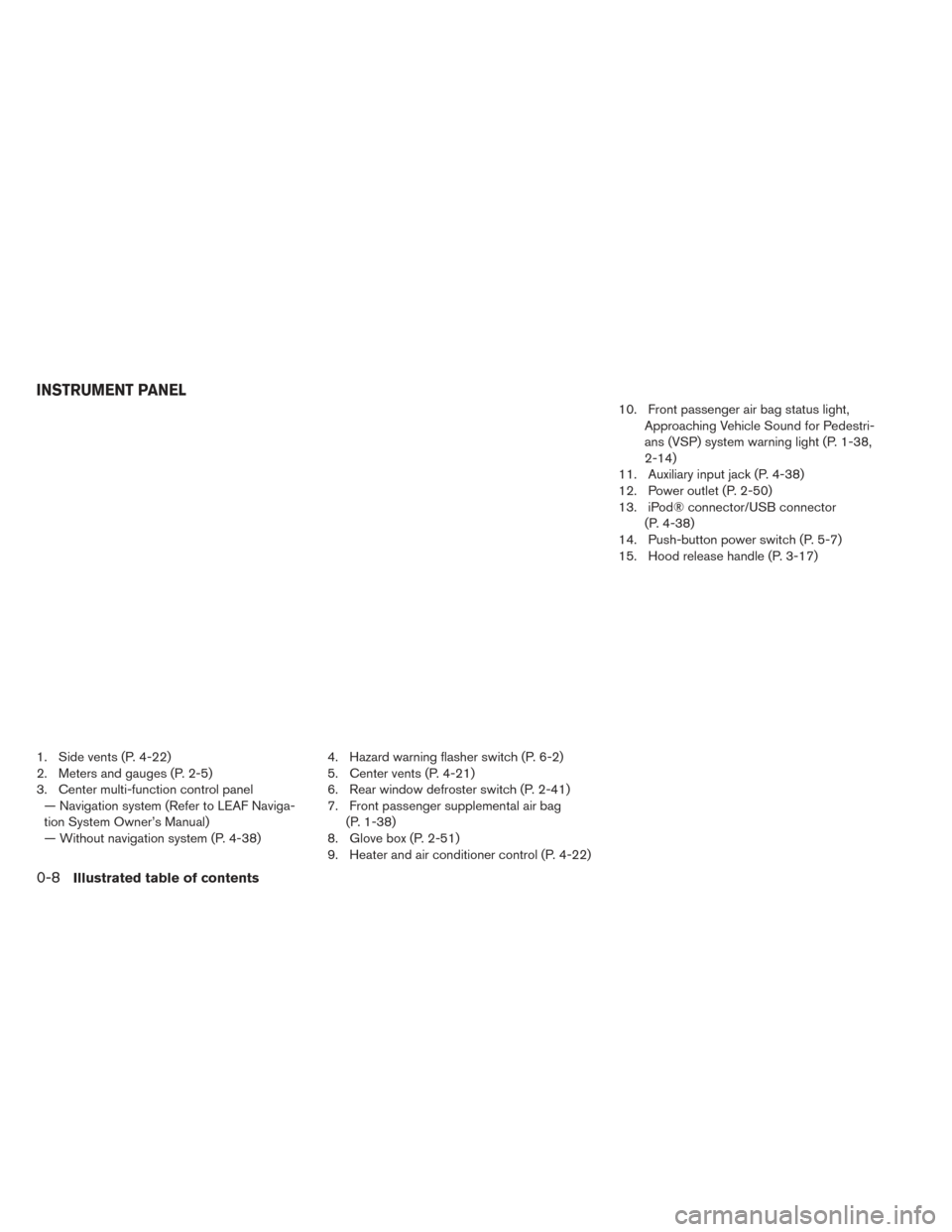
1. Side vents (P. 4-22)
2. Meters and gauges (P. 2-5)
3. Center multi-function control panel— Navigation system (Refer to LEAF Naviga-
tion System Owner’s Manual)
— Without navigation system (P. 4-38) 4. Hazard warning flasher switch (P. 6-2)
5. Center vents (P. 4-21)
6. Rear window defroster switch (P. 2-41)
7. Front passenger supplemental air bag
(P. 1-38)
8. Glove box (P. 2-51)
9. Heater and air conditioner control (P. 4-22) 10. Front passenger air bag status light,
Approaching Vehicle Sound for Pedestri-
ans (VSP) system warning light (P. 1-38,
2-14)
11. Auxiliary input jack (P. 4-38)
12. Power outlet (P. 2-50)
13. iPod® connector/USB connector (P. 4-38)
14. Push-button power switch (P. 5-7)
15. Hood release handle (P. 3-17)
INSTRUMENT PANEL
0-8Illustrated table of contents
Page 28 of 437
EMERGENCY SHUT-OFF SYSTEM
The emergency shut-off system is activated and
the high-voltage system automatically turns off in
the following conditions:
- Front and side collisions in which the air bags
are deployed.
- Certain rear collisions.
- Certain EV (Electric Vehicle) system malfunc-
tions
For the above collisions and certain other EV
system malfunctions, the READY to drive indica-
tor light will turn off. For additional information,
refer to “Warning lights, indicator lights and au-
dible reminders” in the “Instruments and con-
trols” section of this manual.
The emergency shut-off activates for the above
collisions to minimize risk of an event that could
cause injury or an accident. If the emergency shut-
off system activates, the EV system may not be
switched to the READY to drive position; contact a
NISSAN certified LEAF dealer. Even if the power
switch is switched to the READY to drive position,
the system may shut-off suddenly. Therefore, drive
cautiously to the nearest NISSAN certified LEAF
dealer or contact a NISSAN certified LEAF dealer
as soon as possible.
WARNING
• Pay special attention to pedestrians. Because there is no engine noise, pe-
destrians may not know the vehicle is
approaching, moving or about to
move, and may step into the path of
vehicle travel.
• When leaving the vehicle, be sure to turn off the EV (Electric Vehicle) sys-
tem.
• Be sure to push the P (Park) position switch on the shift lever and apply the
parking brake when parking because
the vehicle can move when the READY
to drive indicator light is ON. When the
READY to drive indicator light is ON,
do not leave your vehicle in a shift
position other than the P (Park) posi-
tion.
• Keep the brake pedal depressed until you are ready to drive. When the ve-
hicle is in the D (Drive) position, B or R
(Reverse) position, if you release the
brake pedal and do not depress the
accelerator, the vehicle will creep and
may start abruptly. This may cause se-
rious injury or death.
NOTE:
•The vehicle cannot run with a discharged
Li-ion battery. Repeated acceleration con-
sumes more power from the Li-ion battery
than driving at a steady speed.
•
This vehicle is equipped with a regenerative
brake system. The primary purpose of the
regenerative brake system is to provide
some power to recharge the Li-ion battery
and extend driving range. A secondary ben-
efit is “engine braking” that operates based
on Li-ion battery conditions.
•In the D (Drive) position, when the accelera-
tor pedal is released, the regenerative
brake system provides some deceleration.
• When you put the shift lever in the B
position and take your foot off the accel-
erator pedal, more regenerative brake is
applied than in the D (Drive) position.
EV (ELECTRIC VEHICLE)
CHARACTERISTICS
EV OverviewEV-9
Page 32 of 437
BEFORE DRIVING YOUR VEHICLE
(MODELS WITH NAVIGATION
SYSTEM)
The Li-ion battery charging status and the Li-ion
battery warmer (if so equipped) operation can be
checked using an internet enabled smart phone or
personal computer at home. You may also choose to
have SMS messages (text messages) sent to a cel-
lular phone. Additionally, the heater and air condi-
tioner of the vehicle can be set to operate using the
Climate Ctrl. Timer function or A/C-heater remote
function, if necessary. For additional information, re-
fer to “Remote climate control” in the “Displayscreen, heater, air conditioner, audio and phone sys-
tems” section of this manual.
NOTE:
•
To check the Li-ion battery charging status
or to use the remote heater and air condi-
tioner using an internet enabled smart
phone or personal computer, the follow-
ing conditions must be met: – The vehicle must be located in a cellu- lar phone or smart phone coverage
area. – The internet enabled cellular phone or
smart phone must be located in a cel-
lular phone or smart phone coverage
area.
– The computer must be connected to the internet.
– A cellular phone must be used to com- municate with the vehicle.
– A cellular phone capable of text mes- saging must be used to receive text
message regarding vehicle charge sta-
tus.
• The remote heater and cooler can adjust
the in-cabin temperature.
• When the charge connector is discon-
nected from the vehicle, the heater and air
conditioner operates using vehicle Li-ion
battery electric power.
• If the remote heater and air conditioner
function and Li-ion battery charging are
performed at the same time, Li-ion battery
charging will take longer than usual due
to the power used to heat or cool the
vehicle.
EV OverviewEV-13
Page 34 of 437
Operating the climate control system
before driving
The vehicle heating and air conditioning system
can be turned on via remote control with an
internet enabled smart phone or personal com-
puter.This allows the interior of the vehicle to be heated
or cooled while the vehicle is charging. This re-
duces the load on the Li-ion battery while the
vehicle is being driven and can help increase the
vehicle driving range. For additional information,
refer to “Remote climate control” in the “Display
screen, heater, air conditioner, audio and phone
systems” section of this manual.
EV OverviewEV-15
Page 42 of 437
RANGE
The distance you can drive the vehicle (range)
varies considerably depending upon available
charge, weather, temperature, usage, battery
age, topography, and driving style.
Refer to the Monroney label (window sticker) for
the official EPA range. Your actual range can vary,
either initially or as the battery ages and with use
over time. For additional information, refer to “Im-
prove driving range” in this section for information
of the factors that affect vehicle range an how to
use the vehicle to maximize vehicle range.
IMPROVE DRIVING RANGE
Vehicle range depends on a number of factors.
Actual vehicle range will vary depending upon:
• Speed,
• Vehicle load,
• Electrical load from vehicle accessories,
• Traffic and road conditions.NISSAN recommends the following driving
habits to help maximize vehicle range:
Before driving:
• Follow recommended periodic maintenance.
• Keep tires inflated to correct pressure.
• Keep wheels in correct alignment.
• Pre-heat or pre-cool the interior cabin while the
vehicle is charging.
• Remove unnecessary cargo from the vehicle.
While driving:
• Drive in ECO mode – The ECO mode helps reduce power con-sumption by reducing acceleration when
compared to the same accelerator pedal
position in the D (Drive) position.
• Drive at a constant speed. Maintain cruising speeds with constant accelerator positions or
by using cruise control when appropriate.
• Accelerate slowly and smoothly. Gently press and release the accelerator pedal for accelera-
tion and deceleration.
• Drive at moderate speeds on the highway. • Avoid frequent stopping and braking. Maintain a
safe distance behind other vehicles.
• Turn off the air conditioner/heater when it is not necessary.
• Select a moderate temperature setting for heat- ing or cooling to help reduce power
consumption.
• Use the air conditioner/heater and close win- dows to reduce drag when cruising at highway
speed.
• Vehicle range may be substantially reduced in extremely cold conditions (for example -4°F
(-20°C) .
• Using the climate control system to heat the cabin when outside temperature is below 32°F
(0°C) uses more electricity and affects vehicle
range more than when using the heater when
the temperature is above 32°F (0°C) .
EFFICIENT USE OF YOUR VEHICLE
EV OverviewEV-23
Page 123 of 437
WARNING
•
The front air bags ordinarily will not in-
flate in the event of a side impact, rear
impact, rollover or lower severity frontal
collision. Always wear your seat belts to
help reduce the risk or severity of injury
in various kinds of accidents.
• The front passenger air bag will not inflate if the passenger air bag status
light is lit or if the front passenger seat
is unoccupied. For additional informa-
tion, refer to “Front passenger air bag
and status light” in this section.
•
The seat belts and the front air bags are
most effective when you are sitting well
back and upright in the seat with both
feet on the floor. The front air bags in-
flate with great force. Even with the
NISSAN Advanced Air Bag System, if you
are unrestrained, leaning forward, sit-
ting sideways or out of position in any
way, you are at greater risk of injury or
death in a crash. You may also receive
serious or fatal injuries from the front air
bag if you are up against it when it in-
flates. Always sit back against the seat-
back and as far away as practical from
the steering wheel or instrument panel.
Always properly use the seat belts.
• The driver and front passenger seat belt buckles are equipped with sen-
sors that detect if the seat belts are
fastened. The NISSAN Advanced Air
Bag System monitors the severity of a
collision and seat belt usage then in-
flates the air bags as needed. Failure
to properly wear seat belts can in-
crease the risk or severity of injury in
an accident.
• The front passenger seat is equipped with occupant classification sensor
(weight sensor) that turns the front
passenger air bag OFF under some
conditions. This sensor is only used in
this seat. Failure to be properly seated
and wearing the seat belt can increase
the risk or severity of injury in an acci-
dent. For additional information, refer
to “Front passenger air bag and status
light” in this section.
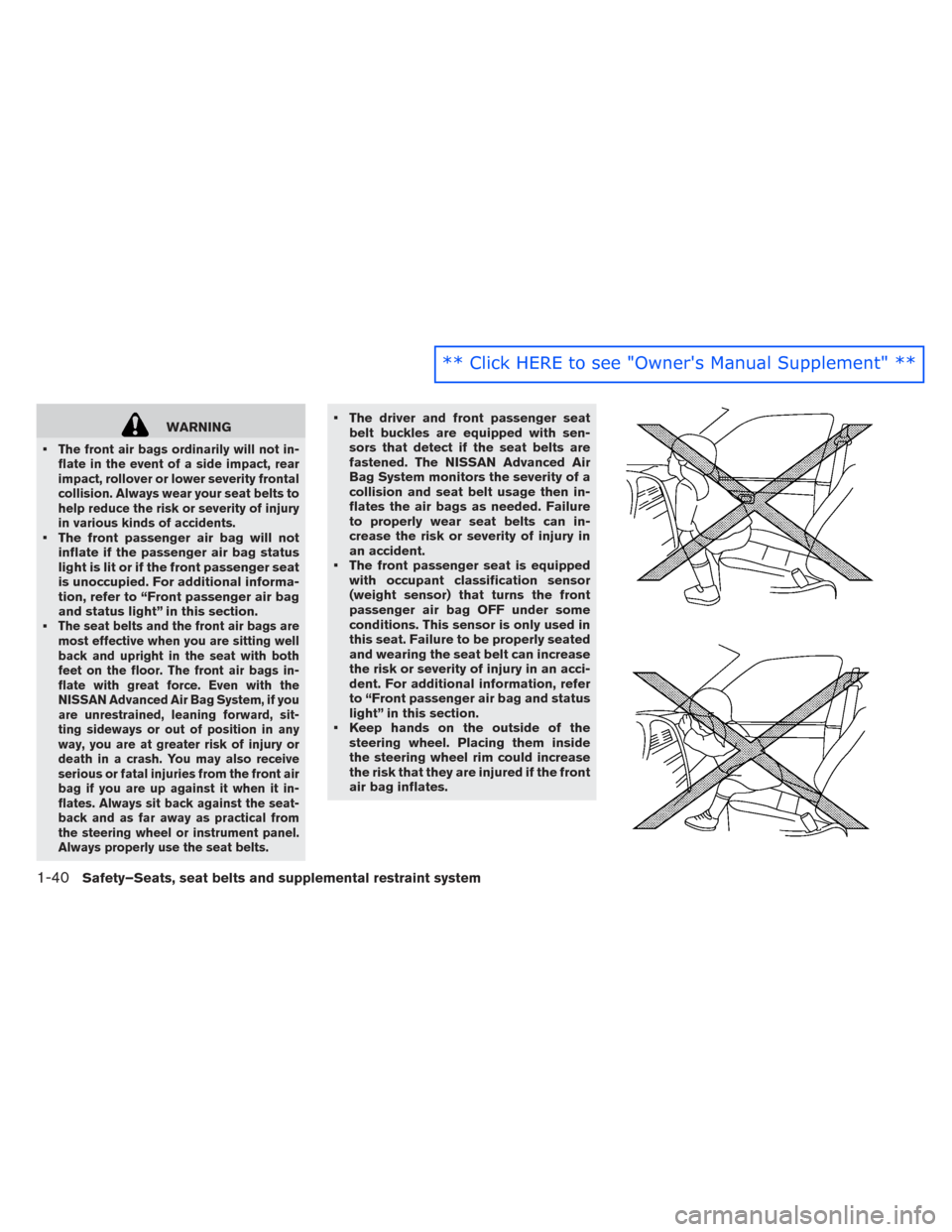
• Keep hands on the outside of the steering wheel. Placing them inside
the steering wheel rim could increase
the risk that they are injured if the front
air bag inflates.
1-40Safety–Seats, seat belts and supplemental restraint system
** Click HERE to see "Owner's Manual Supplement" **
Page 127 of 437
NISSAN ADVANCED AIR BAG
SYSTEM (FRONT SEATS)
WARNING
To ensure proper operation of the front
passenger’s NISSAN Advanced Air Bag
System, please observe the following
items.
• Do not allow a passenger in the rear seat to push or pull on the seatback
pocket.
• Do not place heavy loads heavier than 9 lb (4 kg) on the seatback, head
restraint/headrest or in the seatback
pocket.
• Do not store luggage behind the seat that can press into the seatback.
• Do not position the front passenger seat so it contacts the rear bench
seats. If the front seat does contact the
rear bench seats, the air bag system
may determine a sensor malfunction
has occurred and the front passenger
air bag status light may illuminate and
the supplemental air bag warning light
may flash. • If a forward-facing child restraint is
installed in the front passenger seat,
do not position the front passenger
seat, so the child restraint contacts the
instrument panel. If the child restraint
does contact the instrument panel, the
system may determine the seat as oc-
cupied and the passenger air bag may
deploy in a collision. Also the front
passenger air bag status light may not
illuminate. For additional information
about installing and using child re-
straints, refer to “Child restraints” in
this section.
• Confirm the operating condition with the front passenger air bag status
light.
• If you notice that the front passenger air bag status light is not operating as
described in this section, please take
your vehicle to a NISSAN certified
LEAF dealer to check the occupant
classification system.
• Until you have confirmed with a dealer that your passenger seat occupant
classification system is working prop-
erly, position the occupants in the rear
seating positions. This vehicle is equipped with the NISSAN Ad-
vanced Air Bag System for the driver and front
passenger seats. This system is designed to
meet certification requirements under U.S. regu-
lations. It is also permitted in Canada.
All of the
information, cautions and warnings in this
manual apply and must be followed.
The driver supplemental front-impact air bag is
located in the center of the steering wheel. The
front passenger supplemental front-impact air
bag is mounted in the instrument panel above the
glove box. The front air bags are designed to
inflate in higher severity frontal collisions, al-
though they may inflate if the forces in another
type of collision are similar to those of a higher
severity frontal impact. They may not inflate in
certain frontal collisions. Vehicle damage (or lack
of it) is not always an indication of proper front air
bag operation.
The NISSAN Advanced Air Bag System monitors
information from the crash zone sensor and the
Air bag Control Unit (ACU) . Inflator operation is
based on the severity of a collision and seat belt
usage for the driver. For the front passenger, the
occupant classification sensor is also monitored.
Based on information from the sensor, only one
front air bag may inflate in a crash, depending on
1-44Safety–Seats, seat belts and supplemental restraint system
** Click HERE to see "Owner's Manual Supplement" **