Page 28 of 40
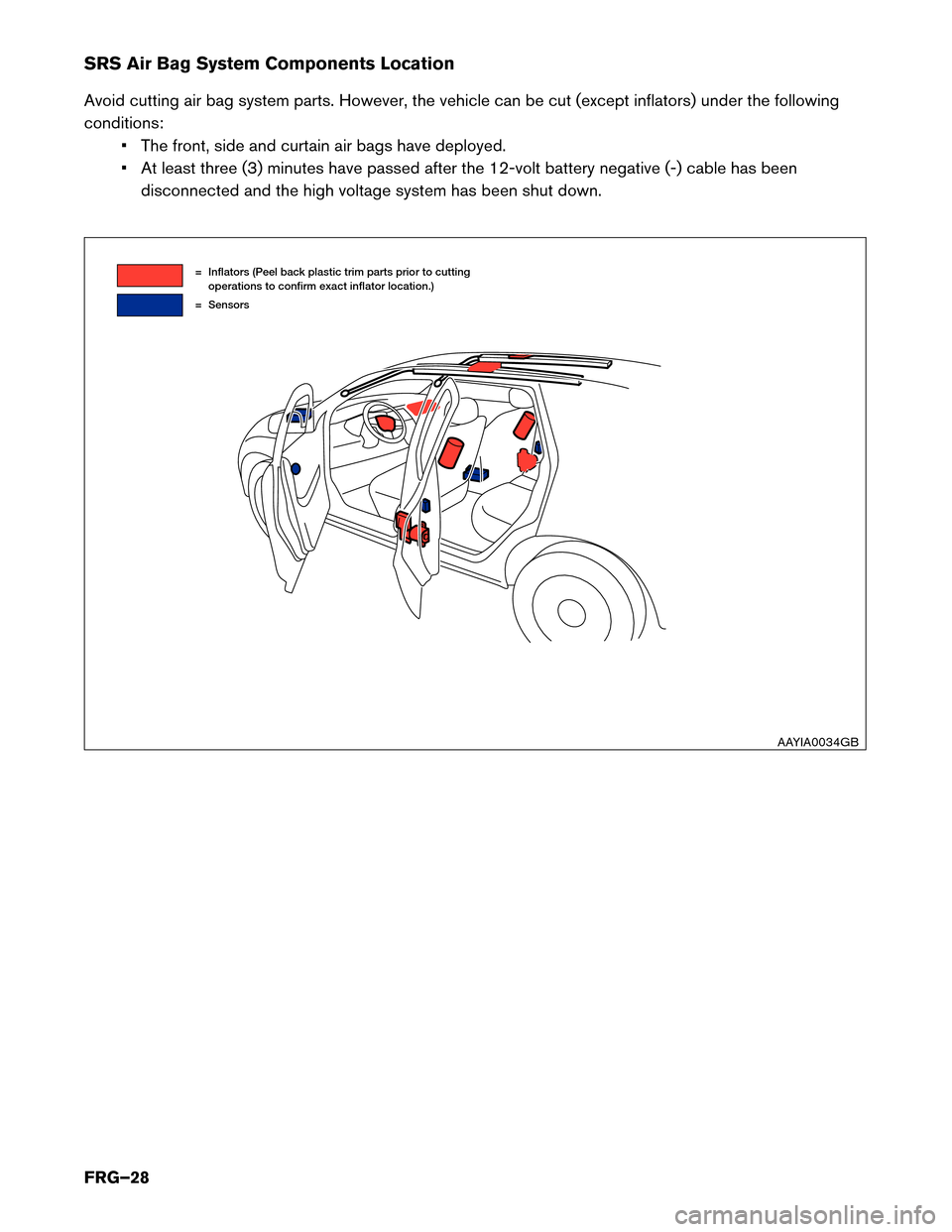
SRS Air Bag System Components Location
Avoid
cutting air bag system parts. However, the vehicle can be cut (except inflators) under the following
conditions: • The front, side and curtain air bags have deployed.
• At least three (3) minutes have passed after the 12-volt battery negative (-) cable has beendisconnected and the high voltage system has been shut down. = Inflators (Peel back plastic trim parts prior to cutting�
operations to confirm exact inflator location.)
= Sensors
AAYIA0034GB
FRG–28
Page 30 of 40
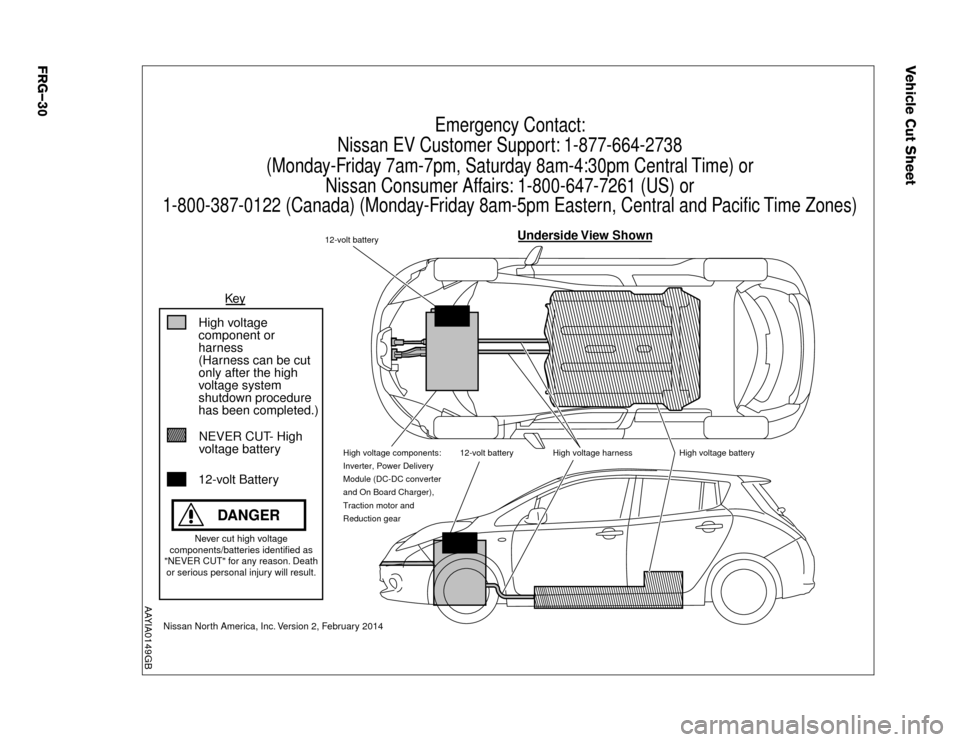
Vehicle Cut Sheet12-volt Battery
Nissan North America, Inc. Version 2, February 2014 DANGER
High voltage battery
High voltage harness
12-volt battery
12-volt battery
1-800-387-0122 (Canada) (Monday-Friday 8am-5pm Eastern, Central and Pacific Time Zones) Nissan Consumer Affairs: 1-800-647-7261 (US) or
(Monday-Friday 7am-7pm, Saturday 8am-4:30pm Central Time) or Nissan EV Customer Support: 1-877-664-2738
Emergency Contact:
NEVER CUT- High
voltage battery
High voltage
component or
harness
(Harness can be cut
only after the high
voltage system
shutdown procedure
has been completed.)
Never cut high voltage
components/batteries identified as
"NEVER CUT" for any reason. Death or serious personal injury will result. High voltage components:
Inverter, Power Delivery
Module (DC-DC converter
and On Board Charger),
Traction motor and
Reduction gear
Key
Under
side View Shown
AAYIA0149GB
FRG–30
Page 32 of 40
3-3.5 High Voltage Battery Damage and Fluid Leaks
The high voltage battery contains electrolyte solution. To avoid exposure to electrolyte
solution
and serious personal injury, always wear appropriate solvent resistant Personal
Protective Equipment (PPE) and read the following precautions:
• Electrolyte solution is a skin irritant.
• Electrolyte solution is an eye irritant – If contact with eyes, rinse with plenty of water and see a doctor immediately.
• If electrolyte leak occurs, wear appropriate solvent resistant PPE and use a dry cloth to clean up the spilled electrolyte. Be sure to adequately ventilate the area.
• Electrolyte solution is highly flammable
• Electrolyte liquid or fumes that have come into contact with water vapors in the air will create an oxidized substance. This substance may irritate skin and eyes. In these
cases, rinse with plenty of water and see a doctor immediately.
• Electrolyte fumes (when inhaled) can cause respiratory irritation and acute intoxication. Move to fresh air and wash mouth with water. See a doctor immediately.
If electrolyte solution leakage, or damage such as any problem with the high voltage battery casing are
observed, first responders should attempt to neutralize the battery by applying a large volume of water to the
battery pack while wearing appropriate Personal Protective Equipment (PPE) . The neutralization process
helps stabilize the thermal condition of the battery pack but does not discharge the battery.
High voltage Battery Electrolyte Solution Characteristics: • Clear in color
• Sweet odor
• Similar viscosity to water
• Since the high voltage battery is made up of many small sealed battery modules, electrolyte solutionleakage should be minimal.
NOTE:
Other fluids in the vehicle are the same as those in a conventional internal combustion
vehicle.
3-3.6 Accessing the Occupants 1. Remove windowsa. Perform window removal the same as a normal vehicle.
2. Remove doors a. The doors are removable with hand tools or basic rescue tools such as electrical/hydraulicrescue tools. It may be easier to remove the doors by cutting door hinges.
3. Adjust steering wheel and front seat position (if necessary)
FRG–32
Page:
< prev 1-8 9-16 17-24