2016 NISSAN LEAF battery
[x] Cancel search: batteryPage 15 of 40
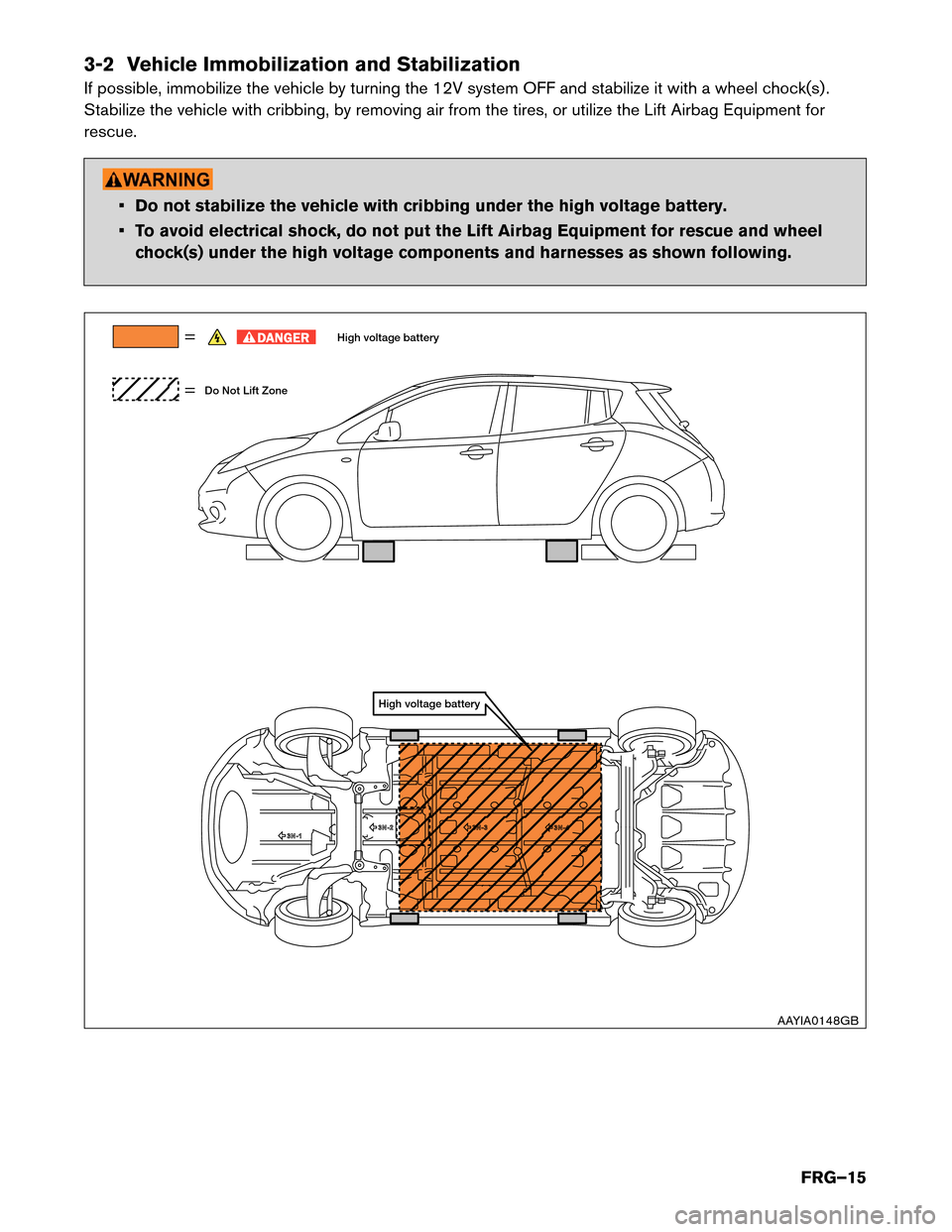
3-2 Vehicle Immobilization and Stabilization
If
possible, immobilize the vehicle by turning the 12V system OFF and stabilize it with a wheel chock(s) .
Stabilize the vehicle with cribbing, by removing air from the tires, or utilize the Lift Airbag Equipment for
rescue. • Do not stabilize the vehicle with cribbing under the high voltage battery.
•
To avoid electrical shock, do not put the Lift Airbag Equipment for rescue and wheel
chock(s) under the high voltage components and harnesses as shown following. =
=
3 N - 3
3 N - 4
3 N - 1 3 N - 2
DANGER High voltage battery
Do Not Lift Zone
High voltage battery
AAYIA0148GBFRG–15
Page 16 of 40
3-3 How to Handle a Damaged Vehicle at an Accident Scene
NO
TE:
If any air bags have deployed in the following 3 situations, the high-voltage (HV) system has
been designed to automatically shut off at the time of deployment.
The Nissan LEAF high-voltage system incorporates capacitors which are energized whenever the high-
voltage system is on. If the high-voltage system is shut down (either through one of the built-in automatic
mechanisms or manually through one of the procedures explained in this FRG) , the capacitors will begin to
gradually discharge. After 5 minutes, the voltage level will have dropped below 60V, and complete
discharge requires approximately 10 minutes after high-voltage system shut down. It is within
this period of time that responders must be most cautious.
When arriving to an incident involving a Nissan LEAF, the vehicle should be approached with caution and
inspected for the level of damage. In addition to overall vehicle condition (location and severity of body
damage, air bag deployment, etc.) , the high-voltage system should be assessed specifically. The locations
of the high-voltage component parts are illustrated in this FRG. Refer to 2-1 High Voltage-Related and
12-volt-Related
Component Locations and Descriptions (FRG–8) . Appropriate Personal Protective
Equipment
(PPE) must always be worn when approaching a vehicle of unknown condition, as described in
this FRG.
Situation 1) High voltage system intact, occupants can be accessed without extrication tools
The HV system can be shut down by following the procedures in this guide, while wearing appropriate PPE.
After HV system shut down, occupant assistance can begin immediately, and no wait period is necessary.
Situation 2) High voltage system intact, occupants cannot be accessed without extrication tools
The HV system can be shut down by following the procedure in this guide, while wearing appropriate PPE.
After HV system shut down, absolute care must be taken not to cut through or damage any HV system
wiring, battery or components within ten (10) minutes of HV system shut down, but occupant
assistance operations using extrication equipment can begin immediately. The locations of the HV
components are illustrated in this guide.
Situation 3) High-voltage (HV) system damaged
If there is any evidence that the HV system has been compromised (such as arcing/sparking, orange wiring
harnesses cut or damaged, HV component casings damaged, etc.) , the responder may still be at risk of
high voltage exposure. The vehicle must be approached with extreme caution prior to initiating any system
shut down procedures or rendering assistance to occupants. Appropriate PPE must always be worn as
described in this guide, and the ten (10) minute wait time must be observed after HV system shut
down in order to ensure the system is de-energized.
In rare situations where vehicle damage is very severe, HV system shut down procedures as described in
this guide may not work. In these instances extreme caution and appropriate risk management must be
followed to prevent shock or electrocution to the responder or occupant.
3-3.1 High Voltage System Shut-Down Procedures
Any of the following procedures can shut down and isolate the high voltage system. The first response
operation should only begin after shutting down the high voltage system. If the vehicle is heavily damaged,
for example the high voltage battery is deformed, broken or cracked, appropriate Personal Protective
Equipment (PPE) must always be used and the high voltage battery and high voltage components must not
be touched.
FRG–16
Page 17 of 40
• Failure to properly shut down the high voltage system before the Emergency
Response Procedures are performed will result in serious injury or death from
electrical shock. To prevent serious injury or death, NEVER touch high voltage
harnesses or components without always wearing appropriate Personal Protective
Equipment (PPE) . PPE must always be worn when touching or working on high
voltage components
•
When contact with high voltage components or high voltage harnesses is
unavoidable, or when there is risk of such contact, you must always wear appropriate
PPE. PPE must always be worn when touching or working on high voltage components. • If the charge connector is connected to the vehicle, remove it. Refer to
Removing the
Charge
Connector (FRG–18) .
• The vehicle contains parts that contain powerful magnets. If a person who is wearing a
pacemaker
or other medical device is close to these parts, the medical device may be
affected by the magnets. Such persons must not perform work on the vehicle.
• Be sure to verify that the READY indicator is off and the high voltage system is
stopped.
•
After the high voltage system is shut down, please wait at least ten (10) minutes for
complete discharge of the high voltage capacitor. While waiting, do not operate any
vehicle functions.
NOTE:
The high voltage full discharge takes ten (10) minutes, but after five (5) minutes the
voltage has dropped below 60V.
• After shutting down the high voltage system and removing the 12-volt battery negative (-) terminal, wait at least three (3) minutes to discharge the air bag capacitor. Even though
the 12-volt battery negative (-) is disconnected, the Supplemental Restraint System (SRS)
air bag maintains voltage at least three (3) minutes. During this time, there is a possibility
of sudden SRS air bag inflation due to harness short circuit or damage and it may cause
serious injuries.
• Always shut down the high voltage system before disconnecting the 12-volt battery. Not doing so may result in serious injury or death from electrical shock.
• The 12V system will remain active even after the 12-volt battery negative (-) terminal is removed while the high voltage system is active. The high voltage system is active
during any of the following conditions:
– charging indicator is turned ON
– READY indicator is turned ON
Refer to 1-1.2 Interior Component Location (FRG–6)
for location of these indicators.
This
is because DC/DC converter will not shut down and power will be supplied to the
12V system and high voltage system continuously.
FRG–17
Page 20 of 40
Indications the High Voltage System is ON
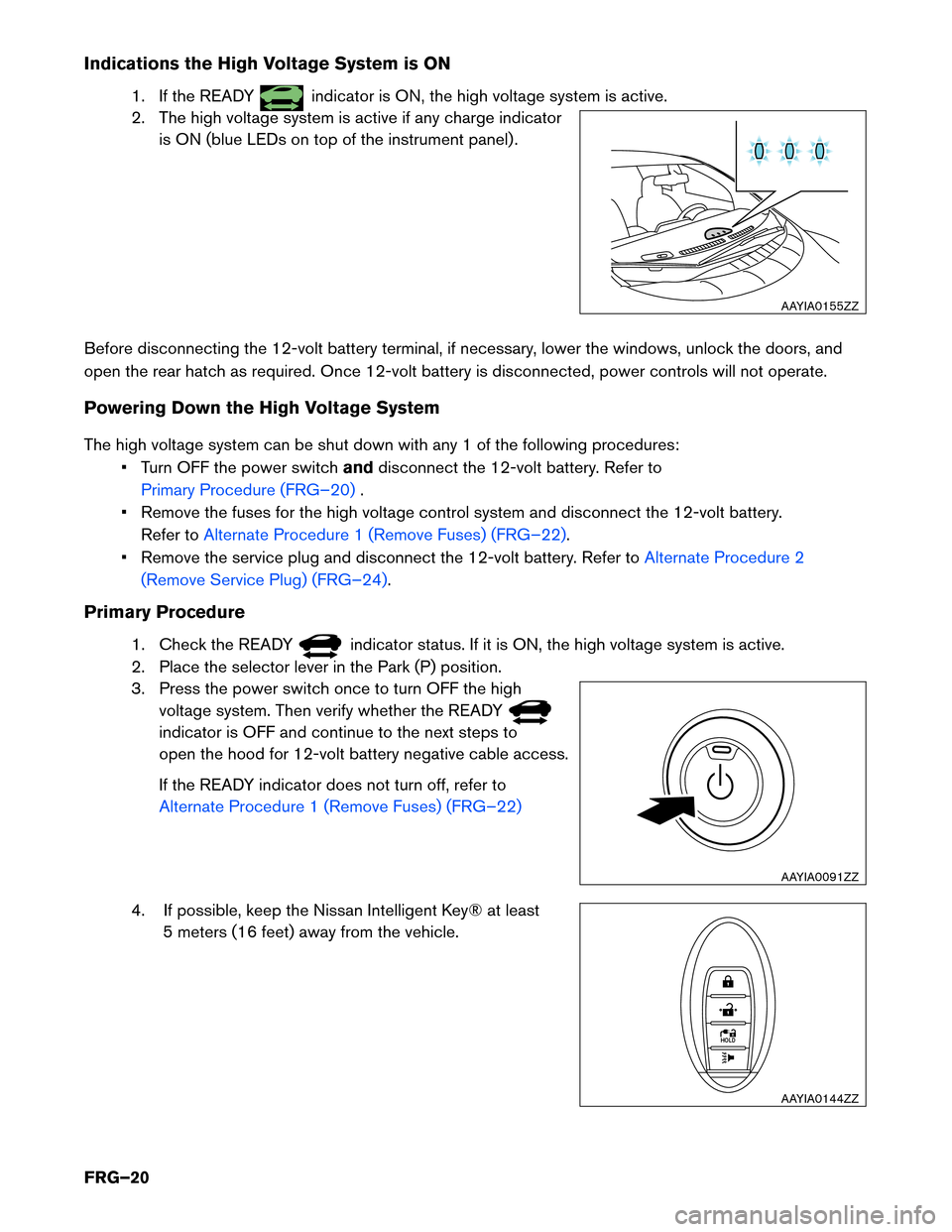
1. If the READY indicator is ON, the high voltage system is active.
2.
The high voltage system is active if any charge indicator
is ON (blue LEDs on top of the instrument panel) .
Before disconnecting the 12-volt battery terminal, if necessary, lower the windows, unlock the doors, and
open the rear hatch as required. Once 12-volt battery is disconnected, power controls will not operate.
Powering Down the High Voltage System
The high voltage system can be shut down with any 1 of the following procedures: • Turn OFF the power switch anddisconnect the 12-volt battery. Refer to
Primary Procedure (FRG–20) .
•
Remove the fuses for the high voltage control system and disconnect the 12-volt battery.
Refer to Alternate Procedure 1 (Remove Fuses) (FRG–22).
•
Remove the service plug and disconnect the 12-volt battery. Refer to Alternate Procedure 2
(Remove
Service Plug) (FRG–24) .
Primary
Procedure
1. Check the READY indicator status. If it is ON, the high voltage system is active.
2.
Place the selector lever in the Park (P) position.
3. Press the power switch once to turn OFF the high voltage system. Then verify whether the READY indicator is OFF and continue to the next steps to
open
the hood for 12-volt battery negative cable access.
If the READY indicator does not turn off, refer to
Alternate Procedure 1 (Remove Fuses) (FRG–22)
4. If possible, keep the Nissan Intelligent Key® at least 5
meters (16 feet) away from the vehicle. AAYIA0155ZZ
AAYIA0091ZZ
HOLD
AAYIA0144ZZ
FRG–20
Page 21 of 40
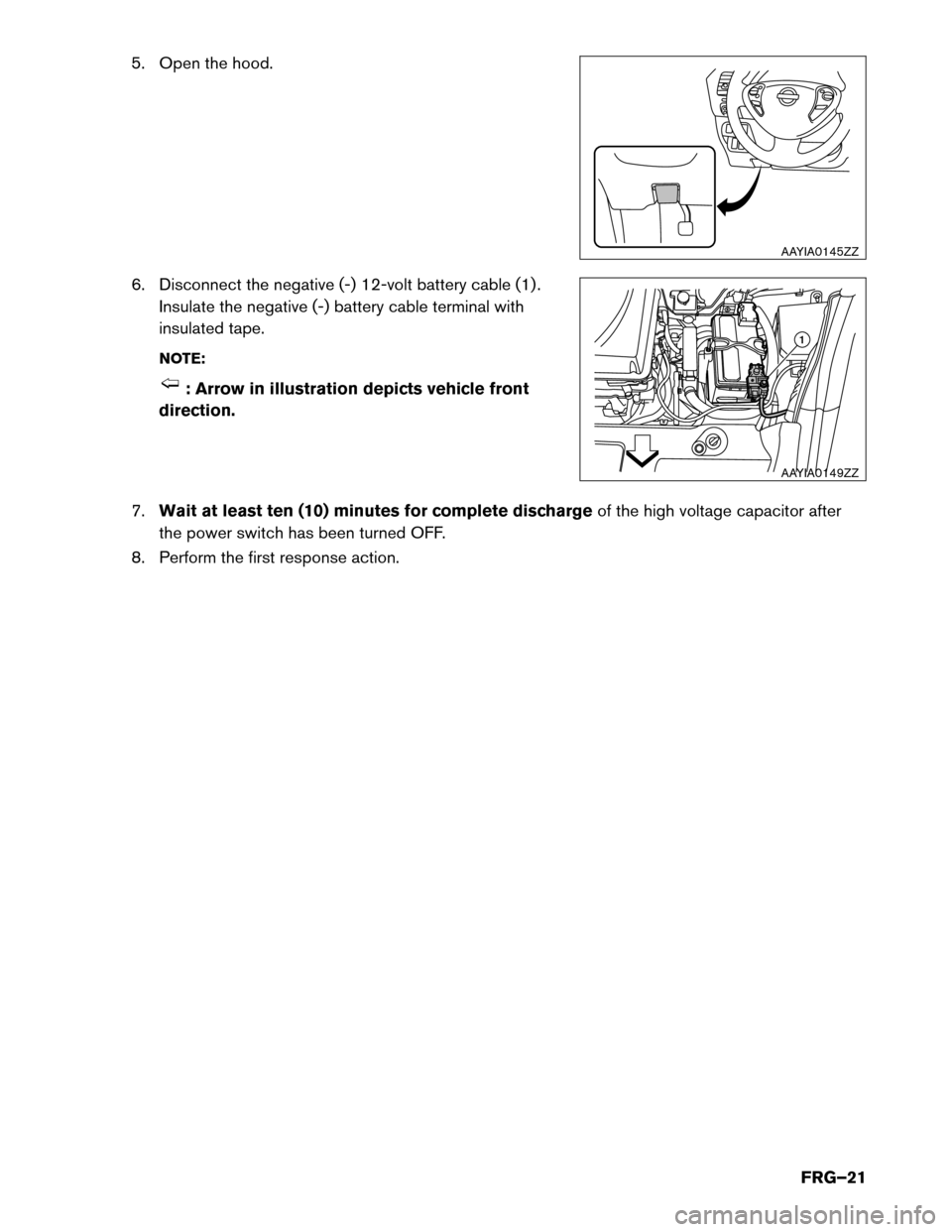
5. Open the hood.
6.
Disconnect the negative (-) 12-volt battery cable (1) .
Insulate the negative (-) battery cable terminal with
insulated tape.
NOTE: : Arrow in illustration depicts vehicle front
direction.
7. Wait
at least ten (10) minutes for complete discharge of the high voltage capacitor after
the power switch has been turned OFF.
8. Perform the first response action. AAYIA0145ZZ
1
AAYIA0149ZZ
FRG–21
Page 24 of 40
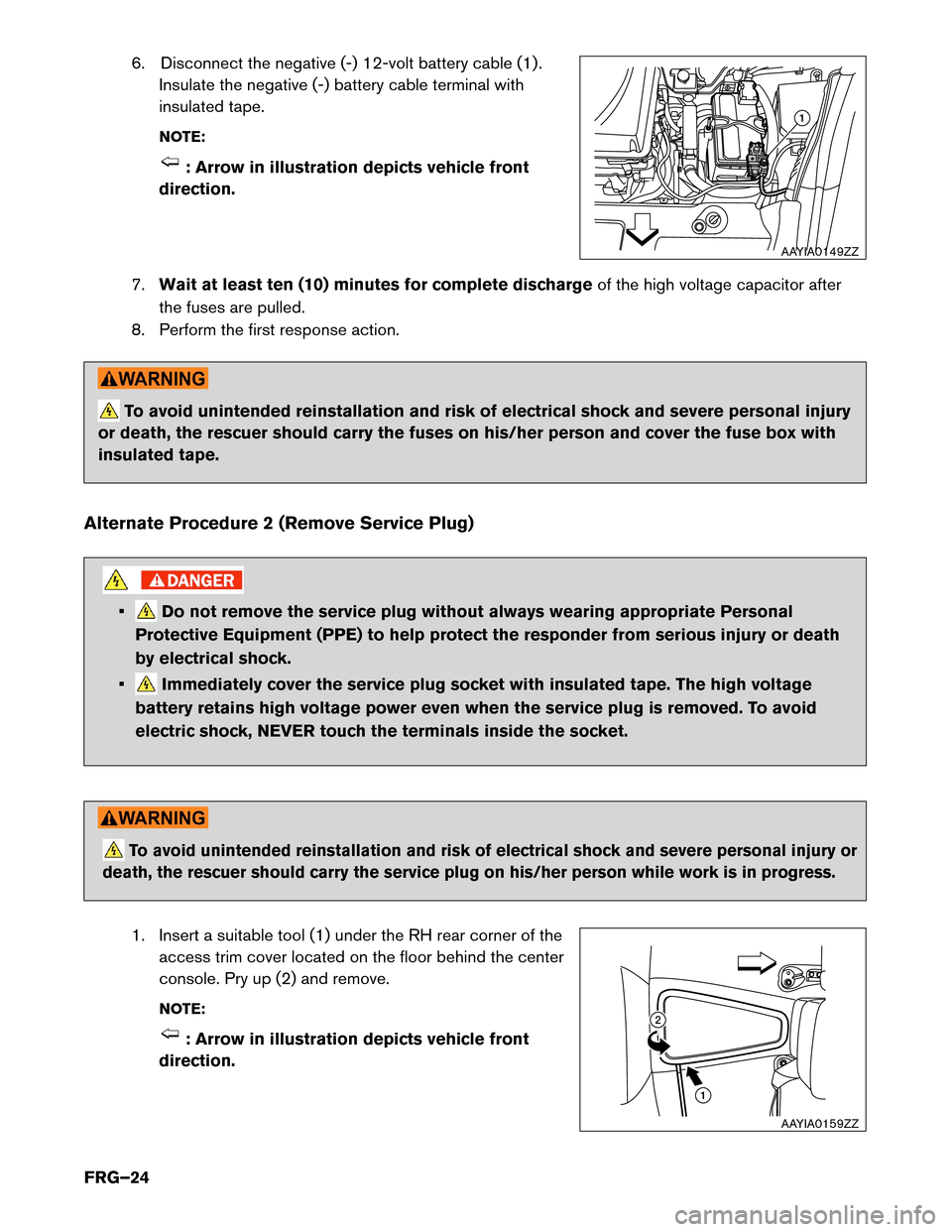
6. Disconnect the negative (-) 12-volt battery cable (1) .
Insulate the negative (-) battery cable terminal with
insulated tape.
NOTE: : Arrow in illustration depicts vehicle front
direction.
7. Wait
at least ten (10) minutes for complete discharge of the high voltage capacitor after
the fuses are pulled.
8. Perform the first response action. To avoid unintended reinstallation and risk of electrical shock and severe personal injury
or
death, the rescuer should carry the fuses on his/her person and cover the fuse box with
insulated tape.
Alternate Procedure 2 (Remove Service Plug) • Do not remove the service plug without always wearing appropriate Personal
Protective
Equipment (PPE) to help protect the responder from serious injury or death
by electrical shock.
• Immediately cover the service plug socket with insulated tape. The high voltage
battery
retains high voltage power even when the service plug is removed. To avoid
electric shock, NEVER touch the terminals inside the socket.
To avoid unintended reinstallation and risk of electrical shock and severe personal injury or
death, the rescuer should carry the service plug on his/her person while work is in progress.
1. Insert a suitable tool (1) under the RH rear corner of the access trim cover located on the floor behind the center
console. Pry up (2) and remove.
NOTE: : Arrow in illustration depicts vehicle front
direction. 1
AAYIA0149ZZ 12
AAYIA0159ZZ
FRG–24
Page 26 of 40
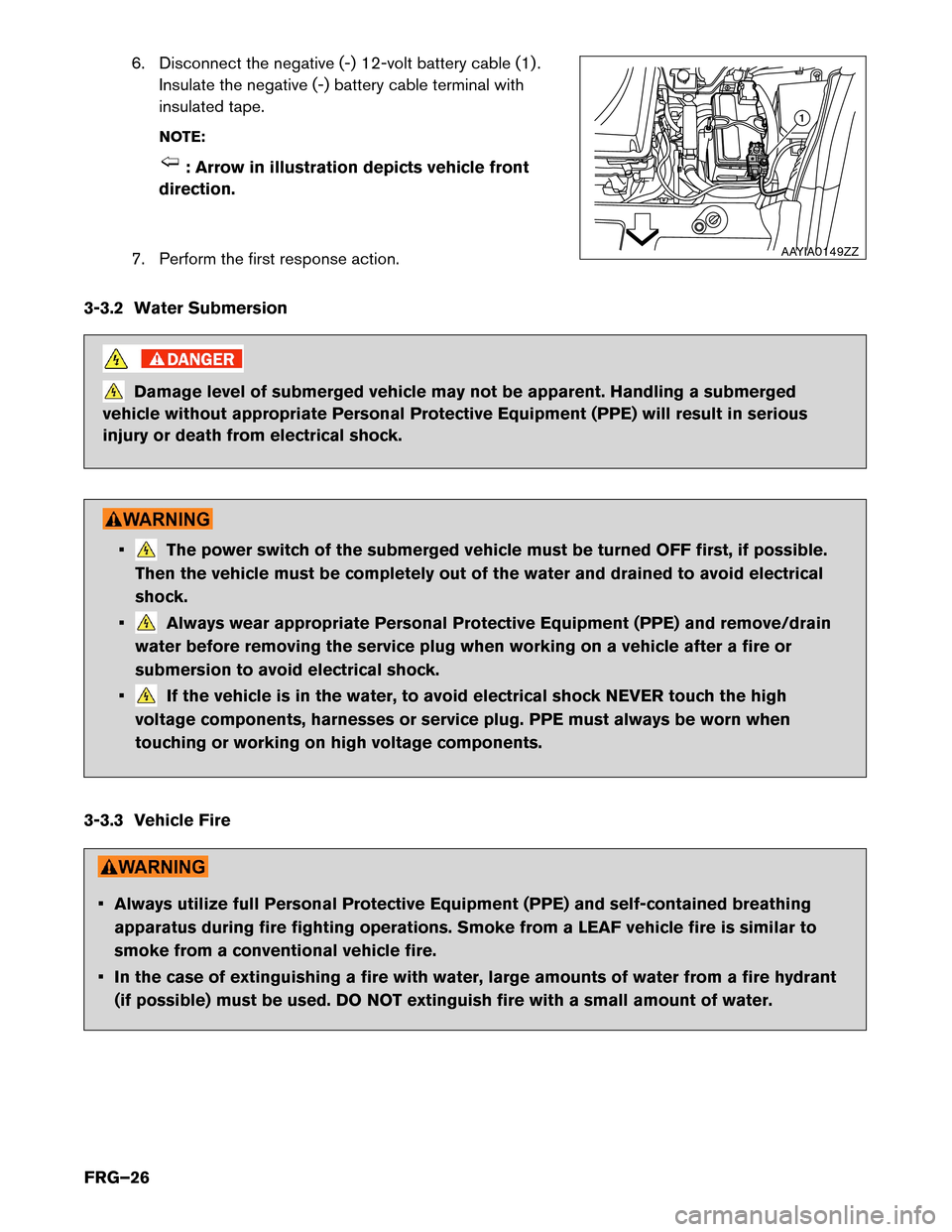
6. Disconnect the negative (-) 12-volt battery cable (1) .
Insulate the negative (-) battery cable terminal with
insulated tape.
NOTE: : Arrow in illustration depicts vehicle front
direction.
7.
Perform the first response action.
3-3.2 Water Submersion Damage level of submerged vehicle may not be apparent. Handling a submerged
vehicle
without appropriate Personal Protective Equipment (PPE) will result in serious
injury or death from electrical shock. • The power switch of the submerged vehicle must be turned OFF first, if possible.
Then
the vehicle must be completely out of the water and drained to avoid electrical
shock.
• Always wear appropriate Personal Protective Equipment (PPE) and remove/drain
water
before removing the service plug when working on a vehicle after a fire or
submersion to avoid electrical shock.
• If the vehicle is in the water, to avoid electrical shock NEVER touch the high
voltage
components, harnesses or service plug. PPE must always be worn when
touching or working on high voltage components.
3-3.3 Vehicle Fire • Always utilize full Personal Protective Equipment (PPE) and self-contained breathing
apparatus
during fire fighting operations. Smoke from a LEAF vehicle fire is similar to
smoke from a conventional vehicle fire.
• In the case of extinguishing a fire with water, large amounts of water from a fire hydrant (if possible) must be used. DO NOT extinguish fire with a small amount of water. 1
AAYIA0149ZZ
FRG–26
Page 27 of 40
In the event of a small fire, a Type ABC fire extinguisher may be used for an electrical fire
caused
by wiring harnesses, electrical components, etc. or oil fire.
Fire attack should follow standard fire fighting practices.
If you must walk away from the vehicle, notify an appropriate responder or a rescue person of the fact that
the vehicle is an electric car and contains a high voltage system and warn all others.
During overhaul operations (late stage fire suppression process to examine for remaining sources of heat) ,
make sure the battery is fully cooled to avoid fire re-ignition. The battery could reignite if it is placed near fire.
To avoid possible electrical shock and serious personal injury, do not breach the high voltage battery case.
3-3.4 Cutting the Vehicle Body • Do not cut into high voltage related areas to avoid severe personal injury or death.
• Do not cut into the high voltage battery to avoid severe personal injury or death.
• When removing parts, NEVER touch the high voltage parts or the insides of the
exposed
orange-colored high voltage cables to avoid severe personal injury or death.
Personal Protective Equipment (PPE) must always be worn when touching or
working on high voltage components. • Do not cut air bag parts to avoid unintended deployment of the air bags and the risk of
severe
personal injury or death.
If at least ten (10) minutes have passed since the rescuer shut down the high voltage system (refer to
3-3.1 High Voltage System Shut-Down Procedures (FRG–16)) , then the rescuer can cut the vehicle
except
for the high voltage battery. If the rescuer cannot wait the full ten (10) minutes or shut down the high voltage system,
absolute
care must be taken to avoid cutting HV parts and appropriate Personal Protective
Equipment (PPE) must always be worn.DO NOT cut the high voltage battery due to
possible electrocution risk and electrolyte solution leakage.
FRG–27