2016 NISSAN ALTIMA maintenance
[x] Cancel search: maintenancePage 445 of 491

●Periodically check spare tire inflation
pressure. Always keep the pressure of
the TEMPORARY USE ONLY spare tire
at 420 kPa, 4.2 bar (60 psi) .
● With the TEMPORARY USE ONLY spare
tire installed do not drive the vehicle at
speeds faster than 80 km/h (50 mph) .
● When driving on roads covered with
snow or ice, the TEMPORARY USE
ONLY spare tire should be used on the
rear wheels and the original tire used
on the front wheels (drive wheels) .
● Tire tread of the TEMPORARY USE
ONLY spare tire will wear at a faster rate
than the standard tire. Replace the
spare tire as soon as the tread wear
indicators appear.
● Do not use the spare tire on other
vehicles.
● Do not use more than one spare tire at
the same time.
● Do not tow a trailer when the TEMPO-
RARY USE ONLY spare tire is installed.CAUTION
● Do not use tire chains on a TEMPO-
RARY USE ONLY spare tire. Tire chains
will not fit properly and may cause dam-
age to the vehicle.
● Because the TEMPORARY USE ONLY
spare tire is smaller than the original
tire, ground clearance is reduced. To
avoid damage to the vehicle, do not
drive over obstacles. Also, do not drive
the vehicle through an automatic car
wash since it may get caught.
8-46Maintenance and do-it-yourself
Page 446 of 491

9 Technical and consumer information
Recommended fluids/lubricants and capacities.......9-2
Fuel recommendation ...........................9-4
Engine oil and oil filter recommendations ..........9-6
Air conditioner system refrigerant and oil
recommendations ..............................9-7
Specifications .....................................9-8
Engine ........................................9-8
Wheels and tires ...............................9-9
Dimensions and weights ........................9-9
When traveling or registering in another country ......9-10
Vehicle identification .............................. 9-10
Vehicle identification number (VIN) plate .........9-10
Vehicle identification number
(chassis number) .............................. 9-10
Engine serial number ........................... 9-11
F.M.V.S.S./C.M.V.S.S. certification label ..........9-11
Emission control information label ...............9-12Tire and loading information label
................9-12
Air conditioner specification label ................9-12
Installing front license plate ........................9-13
Vehicle loading information ........................9-13
Terms ........................................ 9-13
Vehicle load capacity .......................... 9-14
Loading tips .................................. 9-16
Measurement of weights .......................9-16
Towing a trailer ................................... 9-17
Flat towing .................................... 9-17
Uniform tire quality grading ........................9-17
Emission control system warranty ..................9-18
Reporting safety defects .......................... 9-19
Readiness for inspection/maintenance (I/M) test .....9-20
Event Data Recorders (EDR) .......................9-20
Owner’s Manual/Service Manual order information . . . 9-21
Page 447 of 491
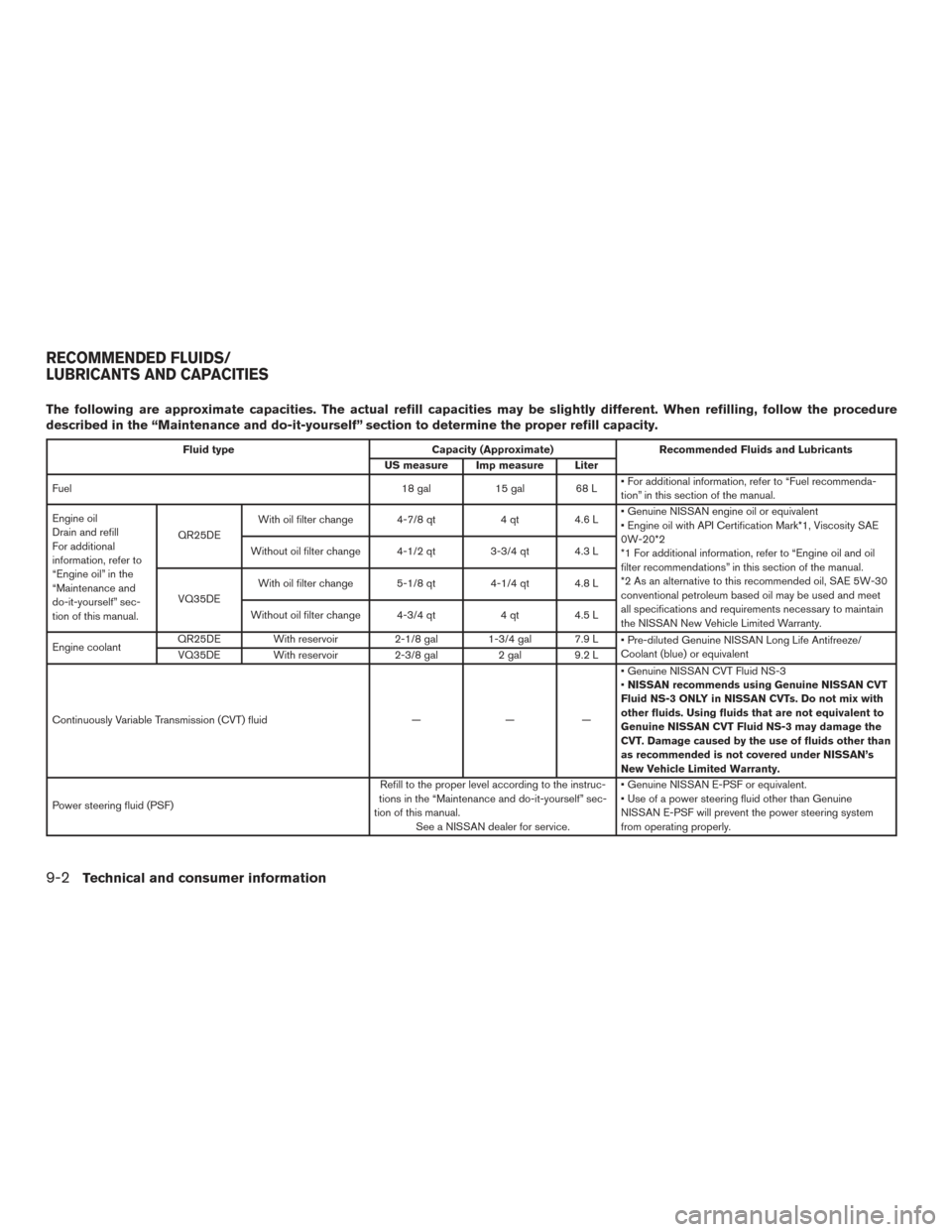
The following are approximate capacities. The actual refill capacities may be slightly different. When refilling, follow the procedure
described in the “Maintenance and do-it-yourself” section to determine the proper refill capacity.
Fluid typeCapacity (Approximate)Recommended Fluids and Lubricants
US measure Imp measure Liter
Fuel 18 gal15 gal 68 L • For additional information, refer to “Fuel recommenda-
tion” in this section of the manual.
Engine oil
Drain and refill
For additional
information, refer to
“Engine oil” in the
“Maintenance and
do-it-yourself” sec-
tion of this manual. QR25DE
With oil filter change 4-7/8 qt
4 qt4.6 L• Genuine NISSAN engine oil or equivalent
• Engine oil with API Certification Mark*1, Viscosity SAE
0W-20*2
*1 For additional information, refer to “Engine oil and oil
filter recommendations” in this section of the manual.
*2 As an alternative to this recommended oil, SAE 5W-30
conventional petroleum based oil may be used and meet
all specifications and requirements necessary to maintain
the NISSAN New Vehicle Limited Warranty.
Without oil filter change 4-1/2 qt
3-3/4 qt 4.3 L
VQ35DE With oil filter change 5-1/8 qt
4-1/4 qt 4.8 L
Without oil filter change 4-3/4 qt 4 qt4.5 L
Engine coolant QR25DE With reservoir
2-1/8 gal 1-3/4 gal 7.9 L
• Pre-diluted Genuine NISSAN Long Life Antifreeze/
Coolant (blue) or equivalent
VQ35DE With reservoir 2-3/8 gal2 gal 9.2 L
Continuously Variable Transmission (CVT) fluid ———• Genuine NISSAN CVT Fluid NS-3
•
NISSAN recommends using Genuine NISSAN CVT
Fluid NS-3 ONLY in NISSAN CVTs. Do not mix with
other fluids. Using fluids that are not equivalent to
Genuine NISSAN CVT Fluid NS-3 may damage the
CVT. Damage caused by the use of fluids other than
as recommended is not covered under NISSAN’s
New Vehicle Limited Warranty.
Power steering fluid (PSF) Refill to the proper level according to the instruc-
tions in the “Maintenance and do-it-yourself” sec-
tion of this manual. See a NISSAN dealer for service. • Genuine NISSAN E-PSF or equivalent.
• Use of a power steering fluid other than Genuine
NISSAN E-PSF will prevent the power steering system
from operating properly.
RECOMMENDED FLUIDS/
LUBRICANTS AND CAPACITIES
9-2Technical and consumer information
Page 448 of 491
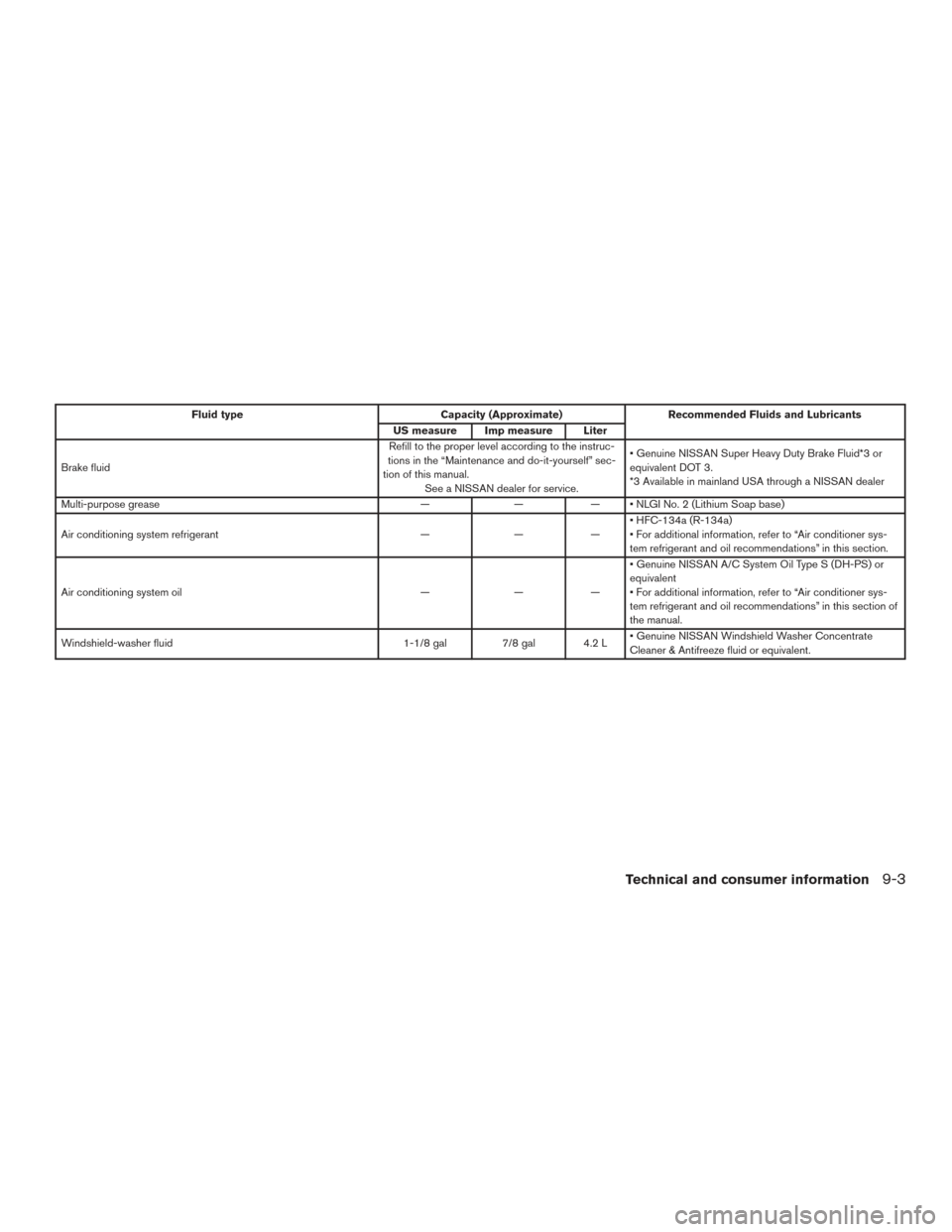
Fluid typeCapacity (Approximate)Recommended Fluids and Lubricants
US measure Imp measure Liter
Brake fluid Refill to the proper level according to the instruc-
tions in the “Maintenance and do-it-yourself” sec-
tion of this manual. See a NISSAN dealer for service. • Genuine NISSAN Super Heavy Duty Brake Fluid*3 or
equivalent DOT 3.
*3 Available in mainland USA through a NISSAN dealer
Multi-purpose grease ——— • NLGI No. 2 (Lithium Soap base)
Air conditioning system refrigerant ———• HFC-134a (R-134a)
• For additional information, refer to “Air conditioner sys-
tem refrigerant and oil recommendations” in this section.
Air conditioning system oil ———• Genuine NISSAN A/C System Oil Type S (DH-PS) or
equivalent
• For additional information, refer to “Air conditioner sys-
tem refrigerant and oil recommendations” in this section of
the manual.
Windshield-washer fluid 1-1/8 gal7/8 gal 4.2 L • Genuine NISSAN Windshield Washer Concentrate
Cleaner & Antifreeze fluid or equivalent.
Technical and consumer information9-3
Page 452 of 491
Oil viscosity
The engine oil viscosity or thickness changes
with temperature. Because of this, it is important
to select the engine oil viscosity based on the
temperatures at which the vehicle will be oper-
ated before the next oil change. Choosing an oil
viscosity other than that recommended could
cause serious engine damage.
Selecting the correct oil filter
Your new NISSAN vehicle is equipped with a
high-quality Genuine NISSAN oil filter. When
replacing, use a Genuine NISSAN oil filter or its
equivalent for the reason described in “Change
intervals.”
Change intervals
The oil and oil filter change intervals for your
engine are based on the use of the specified
quality oils and filters. Using engine oil and filters
that are not of the specified quality, or exceeding
recommended oil and filter change intervals
could reduce engine life. Damage to the engine
caused by improper maintenance or use of incor-
rect oil and filter quality and/or viscosity is not
covered by the NISSAN New Vehicle Limited
Warranty.Your engine was filled with a high-quality engine
oil when it was built. You do not have to change
the oil before the first recommended change
interval. Oil and filter change intervals depend
upon how you use your vehicle.
Operation under the following conditions may
require more frequent oil and filter changes:
● repeated short distance driving at cold out-
side temperatures
● driving in dusty conditions
● extensive idling
● towing a trailer
● stop and go commuting
For additional information, refer to “NISSAN Ser-
vice and Maintenance Guide” for the mainte-
nance schedule.
AIR CONDITIONER SYSTEM
REFRIGERANT AND OIL
RECOMMENDATIONS
The air conditioner system in your NISSAN
vehicle must be charged with the refriger-
ant HFC-134a (R-134a) and NISSAN A/C
system oil Type DH-PS or the exact equiva-
lents.
CAUTION
The use of any other refrigerant or oil will
cause severe damage to the air condition-
ing system and will require the replace-
ment of all air conditioner system
components.
The refrigerant HFC-134a (R-134a) in your
NISSAN vehicle does not harm the earth’s ozone
layer. Although this refrigerant does not affect the
earth’s atmosphere, certain government regula-
tions require the recovery and recycling of any
refrigerant during automotive air conditioner sys-
tem service. A NISSAN dealer has the trained
technicians and equipment needed to recover
and recycle your air conditioner system refriger-
ant.
It is recommended you visit a NISSAN dealer
when servicing your air conditioner system.
Technical and consumer information9-7
Page 465 of 491
Due to legal requirements in some states and
Canadian Provinces, your vehicle may be re-
quired to be in what is called the “ready condi-
tion” for an Inspection/Maintenance (I/M) test of
the emission control system.
The vehicle is set to the “ready condition” when it
is driven through certain driving patterns. Usually,
the ready condition can be obtained by ordinary
usage of the vehicle.
If a powertrain system component is repaired or
the battery is disconnected, the vehicle may be
reset to a “not ready” condition. Before taking the
I/M test, check the vehicle’s
inspection/maintenance test readiness condi-
tion. Place the ignition switch in the ON position
without starting the engine. If the Malfunction
Indicator Light (MIL) comes on steady for 20 sec-
onds and then blinks for 10 seconds , the I/M test
condition is “not ready”. If the MIL does not blink
after 20 seconds, the I/M test condition is
“ready”. Contact a NISSAN dealer to set the
“ready condition” or to prepare the vehicle for
testing.This vehicle is equipped with an EDR. The main
purpose of an EDR is to record, in certain colli-
sion or near collision-like situations, such as an
air bag deployment or hitting a road obstacle,
data that will assist in understanding how a vehi-
cle’s systems performed. The EDR is designed to
record data related to vehicle dynamics and
safety systems for a short period of time, typically
30 seconds or less. The EDR in this vehicle is
designed to record such data as:
● How various systems in your vehicle were
operating;
● Whether or not the driver and passenger
safety belts were buckled/fastened;
● How far (if at all) the driver was depressing
the accelerator and/or brake pedal; and,
● How fast the vehicle was traveling.
● Sounds are not recorded. These data can help provide a better understand-
ing of the circumstances in which collisions and
injuries occur. NOTE: EDR data are recorded by
your vehicle only if a nontrivial collision situation
occurs; no data are recorded by the EDR under
normal driving conditions and no personal data
(e.g. name, gender, age and collision location)
are recorded. However, other parties, such as
law enforcement, could combine the EDR data
with the type of personally identifying data rou-
tinely acquired during a collision investigation.
To read data recorded by an EDR, special equip-
ment is required and access to the vehicle or the
EDR is needed. In addition to the vehicle manu-
facturer and NISSAN dealer, other parties, such
as law enforcement, that have the special equip-
ment, can read the information if they have ac-
cess to the vehicle or the EDR. EDR data will only
be accessed with the consent of the vehicle
owner or lessee or as otherwise required or per-
mitted by law.
READINESS FOR INSPECTION/
MAINTENANCE (I/M) TEST
EVENT DATA RECORDERS (EDR)
9-20Technical and consumer information
Page 469 of 491
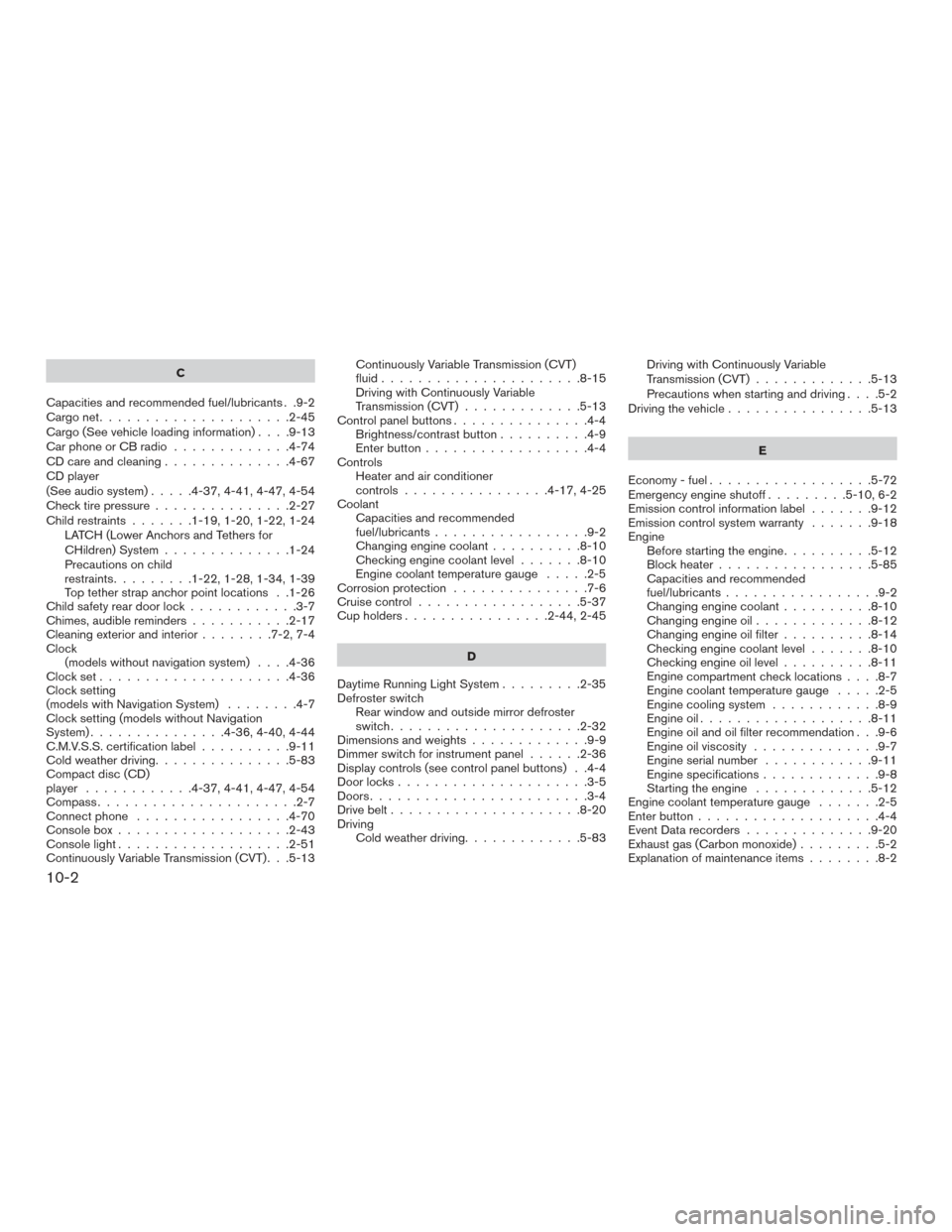
C
Capacities and recommended fuel/lubricants . .9-2
Cargonet.....................2-45
Cargo(Seevehicleloadinginformation)....9-13
Car phone or CB radio .............4-74
CD care and cleaning ..............4-67
CD player
(See audio system) .....4-37,4-41,4-47,4-54
Check tire pressure ...............2-27
Child restraints .......1-19,1-20,1-22,1-24
LATCH (Lower Anchors and Tethers for
CHildren) System ..............1-24
Precautions on child
restraints.........1-22,1-28,1-34,1-39
Top tether strap anchor point locations . .1-26
Child safety rear door lock ............3-7
Chimes, audible reminders ...........2-17
Cleaningexteriorandinterior........7-2,7-4
Clock (models without navigation system) ....4-36
Clockset.....................4-36
Clock setting
(models with Navigation System) ........4-7
Clock setting (models without Navigation
System) ...............4-36,4-40,4-44
C.M.V.S.S. certification label ..........9-11
Cold weather driving ...............5-83
Compact disc (CD)
player ............4-37,4-41,4-47,4-54
Compass ......................2-7
Connect phone .................4-70
Consolebox...................2-43
Consolelight...................2-51
Continuously Variable Transmission (CVT) . . .5-13 Continuously Variable Transmission (CVT)
fluid......................8-15
Driving with Continuously Variable
Transmission (CVT)
.............5-13
Control panel buttons ...............4-4
Brightness/contrast button ..........4-9
Enterbutton..................4-4
Controls Heater and air conditioner
controls................4-17,4-25
Coolant Capacities and recommended
fuel/lubricants .................9-2
Changingenginecoolant..........8-10
Checking engine coolant level .......8-10
Engine coolant temperature gauge .....2-5
Corrosion protection ...............7-6
Cruisecontrol..................5-37
Cupholders................2-44,2-45
D
Daytime Running Light System .........2-35
Defroster switch Rear window and outside mirror defroster
switch.....................2-32
Dimensionsandweights.............9-9
Dimmer switch for instrument panel ......2-36
Display controls (see control panel buttons) . .4-4
Door locks .....................3-5
Doors ........................3-4
Drive belt .....................8-20
Driving Cold weather driving .............5-83 Driving with Continuously Variable
Transmission (CVT)
.............5-13
Precautions when starting and driving ....5-2
Driving the vehicle ................5-13
E
Economy-fuel..................5-72
Emergency engine shutoff .........5-10,6-2
Emission control information label .......9-12
Emission control system warranty .......9-18
Engine Before starting the engine ..........5-12
Blockheater.................5-85
Capacities and recommended
fuel/lubricants.................9-2
Changing engine coolant ..........8-10
Changingengineoil.............8-12
Changing engine oil filter ..........8-14
Checking engine coolant level .......8-10
Checking engine oil level ..........8-11
Engine
compartment check locations ....8-7
Engine coolant temperature gauge .....2-5
Engine cooling system ............8-9
Engineoil...................8-11
Engine oil and oil filter recommendation . . .9-6
Engine oil viscosity ..............9-7
Engine serial number ............9-11
Engine specifications .............9-8
Starting the engine .............5-12
Engine coolant temperature gauge .......2-5
Enter button ....................4-4
Event Data recorders ..............9-20
Exhaust gas (Carbon monoxide) .........5-2
Explanation of maintenance items ........8-2
10-2
Page 470 of 491

Extendedstorageswitch ............2-41
Eyeglass case..................2-44
F
First aid kit .....................6-3
Flashers (See hazard warning flasher switch) . .6-2
Flat tire ....................6-3,6-4
Floor mat positioning aid .............7-6
Fluid Brake fluid ..................8-16
Capacities and recommended
fuel/lubricants .................9-2
Continuously Variable Transmission (CVT)
fluid......................8-15
Engine coolant .................8-9
Engine oil ...................8-11
Power steering fluid .............8-15
Windshield-washerfluid...........8-16
F.M.V.S.S. certification label ...........9-11
Foglightswitch .................2-37
Forward Emergency Braking (FEB) .......2-12
Front air bag system
(See supplemental restraint system) ......1-49
Front power seat adjustment ...........1-4
Frontseats.....................1-2
Fuel Capacities and recommended
fuel/lubricants .................9-2
Fuel economy ................5-72
Fuel-filler door and cap ...........3-33
Fuel-filler door lock opener lever ......3-32
Fuel gauge ...................2-6
Fuel octane rating ...............9-5
Fuel recommendation .............9-4 Loose fuel cap warning
...........2-28
Fuel Cell Vehicle (FCV) System Tirepressure.................8-34
Fuel-filler door ..................3-32
Fuelgauge.....................2-6
Fuses.......................8-25
Fusiblelinks ...................8-26
G
Garage door opener, HomeLink® Universal
Transceiver . .2-52, 2-53, 2-54, 2-55, 2-55, 2-56
Gascap .....................3-33
Gauge Engine coolant temperature gauge .....2-5
Fuel gauge ...................2-6
Odometer ...................2-4
Speedometer .................2-4
Tachometer ..................2-5
Trip odometer .................2-4
General maintenance ...............8-2
Glovebox.....................2-43
Gloveboxlock..................2-43
H
Hands-free phone system,
Bluetooth®............4-74,4-89,4-100
Hazard warning flasher switch ..........6-2
Headlight and turn signal switch ........2-33
Headlight control switch ............2-33
Headlights ....................8-29
Head restraints ..................1-7
Heated seats ...................2-37 Heated steering wheel
.............2-38
Heater Heater and air conditioner
controls ................4-17,4-25
Heater operation ...........4-18,4-26
HomeLink® Universal
Transceiver . .2-52, 2-53, 2-54, 2-55, 2-55, 2-56
Hood.......................3-29
Horn .......................2-37
I
Ignition Switch Push-Button Ignition Switch .........5-8
Immobilizer system ............2-30,5-11
Important vehicle information label .......9-11
In-cabin microfilter ................8-22
Increasing
fuel economy .............5-72
Indicator lights and audible reminders
(See warning/indicator lights and audible
reminders).................2-10,2-15
Inside automatic anti-glare mirror ........3-37
Instrument brightness control ..........2-36
Instrumentpanel...............0-6,2-2
Instrument panel dimmer switch ........2-36
Intelligent cruise control (ICC) system Brake assist .................5-39
Intelligent Key system Key operating range ..........3-9,3-21
Key operation ................3-10
Mechanical key ................3-3
Remote keyless entry operation . . .3-13, 3-21
Troubleshooting guide ........3-18,3-25
Warning signals ............3-18,3-25
Interior light ....................2-50
10-3