2016 MITSUBISHI SHOGUN lock
[x] Cancel search: lockPage 173 of 404

WARNING•If the rear differential lock is used by
mistake when driving on a paved road: With the rear differential lock on, thepower to drive the vehicle straight
ahead becomes very strong, which may
make it difficult to turn the steering
wheel.WARNINGl If the rear differential lock is used by mis-
take when turning a curve or making a
right or left turn at a crossing or the like:
The vehicle is unable to make a turn and may go straight ahead.WARNINGl If the rear differential lock is used by mis-
take except when making an emergencyescape on snow or frozen road: It be-
comes difficult to make a steady turn.
l In the case where the condition of the
road is different for the right tyre to drive from the left tyre (such as one tyre on a
paved road and the other on ice), direc- tion of the vehicle may change abruptly
when engine braking or accelerating.
Do not use the rear differential lock ex- cept when making an emergency escape
on a snow or frozen road, but drive with 4WD.4-wheel drive operation
E00606600627
By selecting 4-wheel drive, both axles of the
vehicle are rigidly connected with each other. This improves the traction characteristics. When turning sharp corners or moving for-
ward and backward repeatedly, however, the drive line is stressed, which is felt as a brak-
ing effect. A 4-wheel drive vehicle can accel-
erate more quickly and smoothly.
However, note that the braking distance is not shorter than that of a rear-wheel drive ve-hicle.
When using 4-wheel drive on rough roads
(snow, mud, sand, etc.), it is important to op- erate the vehicle correctly.
4-wheel drive operation
6-34OVWE16E1Starting and driving6
Page 174 of 404

NOTElThe driving posture should be more upright
and closer to the wheel than usual; adjust the
seat to a good position for easy steering and pedal operation. Be sure to wear the seatbelt.
l After driving on rough roads, check each
part of the vehicle and wash it thoroughlywith water. Refer to the “Vehicle care” sec-
tion and “Inspection and maintenance fol-
lowing rough road operation” on page 6-37.
Driving on dry paved road and
highway
Select the “2H” or “4H” position to drive on
the dry paved road. Especially on dry high- way, never select the “4HLc” or “4LLc” po-sition.
CAUTIONl Selecting the “4HLc” or “4LLc” position to
drive on dry paved road will increase the
fuel consumption with possible noise gener- ation and early tyre wear.
It may also increase the differential oil tem-
perature, resulting in possible damage to the driving system.
Further, the drive train will be subjected to
excessive loading, possibly leading to oil leakage, component seizure, or other serious faults.
Driving on snowy or icy roads
Set the transfer shift lever to the “4H” or
“4HLc” position in accordance with the road conditions, and then gradually depress the ac-
celerator pedal for a smooth start.
NOTEl The use of snow tyres and/or tyre chains is
recommended.
l In order to ensure that the anti-lock brake
system (ABS) will operate correctly in situa-tions where tyre chains have been fitted, drive in the “4H”, “4HLc” or “4LLc” posi-tion.
l Maintain a safe distance between vehicles,
avoid sudden braking, and use engine brak- ing (downshifting).CAUTIONl Avoid sudden braking, sudden acceleration,
and sharp turning; such operations could
cause skidding and spinouts.
Driving on sandy or muddy
roads
Set the transfer shift lever to the “4HLc” or “4LLc” position and then gradually depress
the accelerator pedal for a smooth start. Keep
the pressure on the accelerator pedal as con- stant as possible, and drive at low speed.
CAUTIONl Do not force the vehicle or drive recklessly
on sandy surfaces. In comparison with nor-
mal road surfaces, the engine and other
drive-system components are put under ex- cessive strain when driving on such a sur-
face, and this could lead to accidents.
l If any of following conditions occur while
the vehicle is being driven, immediately park your vehicle in a safe place and follow these procedures:
• The needle in the temperature gauge ap-
proaches the overheating zone.
Refer to “Engine overheating” on page
8-04.
4-wheel drive operation
6-35OVWE16E1Starting and driving6
Page 179 of 404

For details, refer to “Brake warning lamp” on
page 5-10.
Power brakes
The power brakes use brake fluid pressurized by the pump to power-assist the brake. If the brake system fails during driving, the brake
warning lamp comes on and a buzzer sounds continuously. In this case, the brake may not
work properly.
If this buzzer should continue to sound, park your vehicle in a safe place and have the sys-tem checked.
Refer to “Brake warning lamp” on page 5-10.
CAUTIONl Bring the vehicle to halt in a safe location by
applying the brakes gently. Applying the
brakes rapidly or driving at high speed may
make the vehicle unstable.NOTEl Depressing the brake pedal repeatedly may
turn on the brake warning lamp, ABS warn-ing lamp and brake warning buzzer. (The
ASTC indication lamp and Active Stability
Control function OFF indication lamp also
turn on.) It is normal if the lamp goes out and the buzzer stops sounding after a few
seconds.NOTEl In certain cases immediately after the engine
has been started or when the brake pedal is
depressed repeatedly, a noise generated by operation of brake devices may be heard coming from the engine compartment, or the
brake pedal vibration may be felt. This type
of noise or vibration is normal and there is
no need for concern. In fact, it indicates that
the corresponding devices are operating nor-
mal.WARNINGl Do not turn off the engine while your ve-
hicle is in motion. If you turn off the en-
gine while driving, the power assistance
for the braking system will stop working and your brakes will not work effectively.
l If the power assist is lost or if either brake
hydraulic system stops working properly,
have your vehicle checked immediately.
Warning lamp
l The brake warning lamp illuminates to
indicate a fault in the braking system.
Read “Brake warning lamp” on page
5-10.
l On vehicles with the rear differential
lock, the active stability & traction con-
trol (ASTC) and anti-lock brake system (ABS) functions are suspended while the
rear differential lock is activated. ASTC
indication lamp, Active Stability Control function OFF indication lamp, ABS warning lamp and brake warning lamp are illuminated while these functions are
suspended. It does not indicate a prob- lem. When the rear differential lock is
disengaged, these lamps go out and
function again.
Refer to “Brake warning lamp” on page
5-10 , “ABS warning lamp” on page
6-43 , “ASTC indication lamp” on page
6-45 , “Active stability control function
OFF indication lamp” on page 6-47.
When brakes are wet
Check the brake system while driving at a
low speed immediately after starting, espe- cially when the brakes are wet, to confirmthey work normally.
A film of water can be formed on the brake
discs and prevent normal braking after driv-
ing in heavy rain or through large puddles, or after the vehicle is washed. If this occurs, dry
the brakes out by driving slowly while lightly depressing the brake pedal.
Braking
6-40OVWE16E1Starting and driving6
Page 180 of 404

When driving downhill
It is important to take advantage of the en-
gine braking by shifting to a lower shift posi- tion while driving on steep downhill roads in
order to prevent the brakes from overheating.
WARNINGl Do not leave any objects near the brake
pedal or let a floor mat slide under it; do-
ing so could prevent the full pedal stroke that would be necessary in an emergency.Make sure that the pedal can be operated freely at all times. Make sure the floor mat is securely held in place.
Brake pads
l Avoid hard braking situations.
New brakes need to be broken-in by
moderate use for the first 200 km (125 miles).
l The disc brakes are provided with a
warning device which emits a shrieking
metallic sound while braking if the brake pads have reached their wear limit.
If you hear this sound, have the brake pads replaced immediately.
WARNINGl Driving with worn brake pads will make
it harder to stop, and can cause an acci-
dent.Brake assist system
E00627000376
The brake assist system is a device assistingdrivers who cannot depress the brake pedalfirmly when it is necessary to do so (such as
in emergency stop situations) and provides
greater braking force.
If the brake pedal is depressed suddenly, the brakes will be applied with more force thanusual.
CAUTIONl The brake assist system is not a device de-
signed to exercise braking force greater than its capacity. Make sure to always keep a suf-
ficient distance between vehicles in front of
you without relying too much on the brake
assist system.NOTEl Once the brake assist system is operational,
it maintains great braking force even if the
brake pedal is lightly released.
To stop its operation, completely remove
your foot from the brake pedal.
l When the brake assist system is in use while
driving, you may feel the brake pedal at-
tempt to resist, the pedal moves in small mo- tions in conjunction with the operation
noise, or the vehicle body and the steering wheel vibrate. This occurs when the brake
assist system is operating normally and does not indicate faulty operation. Continue to
firmly depress the brake pedal.
l When the anti-lock brake system warning
lamp is illuminated, the brake assist system is not functioning.Anti-lock brake system
(ABS) E00607101248
Environmental conditions can have an effect
on braking. During sudden braking when
there is snow, ice, oil, water etc. on the road
surface, a skid may occur. In this situation, steering control and braking effectiveness is
reduced and the stopping distance is in-
creased. The vehicle may also go into an un- controlled spin.
Brake assist system
6-41OVWE16E1Starting and driving6
Page 181 of 404

The ABS helps prevent the wheels from lock-
ing during braking, thus maintaining direc-
tional stability, ensuring controllability and
providing optimum braking force.
Driving hints
l Always maintain the same distance from
the vehicle in front of you as you would
for a vehicle not equipped with ABS.
Compared with vehicles not fitted with ABS, your vehicle may require a longer
stopping distance in the following cases: • Driving on gravel or snow-covered
roads.
• Driving with tyre chains installed.
• Driving on roads where the road sur-
face is pitted or has other differencesin surface height.
• Driving on bumpy roads or other poor
driving surfaces.
l In order to ensure that the ABS will op-
erate correctly in situations where tyre chains have been fitted, drive in the“4H”, “4HLc”, or “4LLc” position.
l Operation of ABS is not restricted to sit-
uations where brakes are applied sud- denly. This system may also operate to
prevent wheel lock when you are driving
over manholes, steel road-work plates, or the vehicle is driven over steps or lev-
el differences in the road, road markings,
or other surfaces which are difficult for the wheels to grip.
l When the ABS is activated, you may
feel the brake pedal pulsation and the vi- brations of the vehicle body and steering
wheel. You may also hear a characteris-
tic noise. At this time, you may feel as if
the pedal attempts to resist being de- pressed.
This is a normal result of the ABS oper- ation, and does not indicate a problem.
In this situation, to let the ABS work for you, just hold the brake pedal
down more firmly. Do not pump the brake. This will result in reduced
braking performance.
l When the engine starts and after starting
to drive, you might hear operation noise from the engine compartment or feel a shock from the brake pedal. This is nor-
mal. The ABS is performing self-check.
l The ABS will operate after the vehicle
has accelerated to a speed in excess ofapproximately 10 km/h (6 mph). It stops
operating when the vehicle decelerates
to a speed below about 5 km/h (3 mph).CAUTIONl Even the ABS cannot prevent the natural
laws of physics from acting on the vehicle. Itcannot for instance avoid accidents that may
result from excessive speed on bends or fol- lowing another vehicle too closely or aqua- planing. It should remain the driver’s task to
observe safety precautions to judge speeds and brake applications correctly in such con-
ditions.
l Be sure to use tyres of the same type and
size on 4 wheels.
If tyre types or sizes are mixed, ABS may not function normally.
l Never install a limited-slip differential,
which is not a MITSUBISHI MOTORS gen-
uine part, as the ABS may not function nor-
mally.
We recommend you to consult a MITSUBISHI MOTORS Authorized Serv-
ice Point.
Anti-lock brake system (ABS)
6-42OVWE16E1Starting and driving6
Page 182 of 404
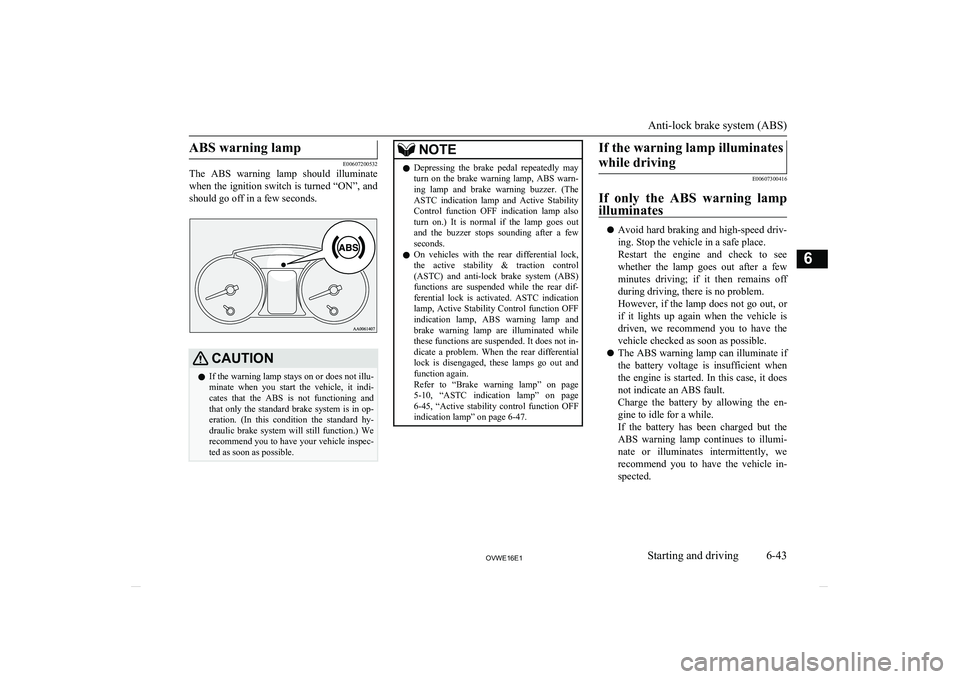
ABS warning lamp
E00607200532
The ABS warning lamp should illuminate
when the ignition switch is turned “ON”, and should go off in a few seconds.
CAUTIONl If the warning lamp stays on or does not illu-
minate when you start the vehicle, it indi-
cates that the ABS is not functioning and
that only the standard brake system is in op-
eration. (In this condition the standard hy- draulic brake system will still function.) We
recommend you to have your vehicle inspec- ted as soon as possible.NOTEl Depressing the brake pedal repeatedly may
turn on the brake warning lamp, ABS warn-ing lamp and brake warning buzzer. (The
ASTC indication lamp and Active Stability
Control function OFF indication lamp also
turn on.) It is normal if the lamp goes out and the buzzer stops sounding after a few
seconds.
l On vehicles with the rear differential lock,
the active stability & traction control
(ASTC) and anti-lock brake system (ABS)
functions are suspended while the rear dif- ferential lock is activated. ASTC indication
lamp, Active Stability Control function OFF indication lamp, ABS warning lamp and
brake warning lamp are illuminated while these functions are suspended. It does not in-
dicate a problem. When the rear differential lock is disengaged, these lamps go out and
function again.
Refer to “Brake warning lamp” on page
5-10 , “ASTC indication lamp” on page
6-45 , “Active stability control function OFF
indication lamp” on page 6-47.If the warning lamp illuminates
while driving
E00607300416
If only the ABS warning lamp illuminates
l Avoid hard braking and high-speed driv-
ing. Stop the vehicle in a safe place.
Restart the engine and check to see whether the lamp goes out after a few
minutes driving; if it then remains off during driving, there is no problem.
However, if the lamp does not go out, or if it lights up again when the vehicle is
driven, we recommend you to have the
vehicle checked as soon as possible.
l The ABS warning lamp can illuminate if
the battery voltage is insufficient when the engine is started. In this case, it doesnot indicate an ABS fault.
Charge the battery by allowing the en- gine to idle for a while.
If the battery has been charged but the
ABS warning lamp continues to illumi-
nate or illuminates intermittently, we recommend you to have the vehicle in-
spected.
Anti-lock brake system (ABS)
6-43OVWE16E1Starting and driving6
Page 183 of 404

If the ABS warning lamp and
brake warning lamp illuminate at the same time
l The ABS and brake force distribution
function will not work, so hard braking
could make the vehicle unstable.
Avoid hard braking and high-speed driv- ing. Stop the vehicle in a safe place and we recommend you to have it checked.
Inspection following snowy
road operation
E00618300012
After driving on snowy roads, remove any snow and ice which may have become ad-
hered to the wheel areas.
When doing this, be careful not to damage the wheel speed sensors (A) and cables loca-ted at each wheel on vehicles equipped with an ABS.
FrontRear
Power steering system
E00607400390
The power steering system operates while the
engine is running. It helps reduce the effort needed to turn the steering wheel.
The power steering system has mechanical
steering capability in case the power assist is lost. If the power assist is lost for some rea-
son, you will still be able to steer your vehi-
cle, but you will notice it takes much more effort to steer. If this happens, have your ve-
hicle inspected at an authorized MITSUBISHI MOTORS dealer.
WARNINGl Do not stop the engine while the vehicle is
moving. Stopping the engine would make the steering wheel extremely hard to turn,
possibly resulting in an accident.CAUTIONl Do not leave the steering wheel turned all
the way in one direction. This can causedamage to the power steering system.Active stability & traction
control (ASTC) E00613800230
The active stability & traction control(ASTC) takes overall control of the anti-lockbrake system, Active Stability Control func-
tion and active traction control function to
maintain the vehicle’s stability and traction. Please read this section in conjunction withthe pages on the anti-lock brake system, Ac-
tive Stability Control function and active
traction control function.
Anti-lock brake system (ABS) ® p. 6-41
Active stability control function ® p. 6-46
Active traction control function ® p. 6-47
CAUTIONl Do not over-rely on the ASTC. Even when
the ASTC is operating, there are limits to how far it can ensure vehicle stability; reck-
less driving may lead to accidents. Always
drive carefully, taking account of the road conditions.
Power steering system
6-44OVWE16E1Starting and driving6
Page 184 of 404

CAUTIONlBe sure to use the same specified type and
size of tyre on all 4 wheels. Otherwise, there
is a possibility that the ASTC will not work properly.NOTEl An operation noise may be emitted from the
engine compartment in the following situa-
tions. The sound is associated with checking the operations of the ASTC. At this time,
you may feel a shock from the brake pedal if
you depress it. These do not indicate a mal- function.
• When the ignition switch is set to the
“ON” position.
• When the vehicle is driven for a while af-
ter the engine is turned on.
l When the ASTC is activated, you may feel a
vibration in the vehicle body or hear a whin-ing sound from the engine compartment.
This indicates that the system is operating
normally. It does not indicate a malfunction.
l When the anti-lock brake system warning
lamp is illuminated, the ASTC is not active.NOTEl On vehicles with the rear differential lock,
the ASTC and ABS functions are suspended
while the rear differential lock is activated. ASTC indication lamp, Active Stability
Control function OFF indication lamp, ABS warning lamp and brake warning lamp are
illuminated while these functions are sus- pended. It does not indicate a problem.
When the rear differential lock is disengag- ed, these lamps go out and function again.
Refer to “Brake warning lamp” on page
5-10 , “ABS warning lamp” on page 6-43,
“Active stability control function OFF indi- cation lamp” on page 6-47.ASTC indication lamp
E00618000035
The ASTC indication lamp shows the operat-
ing status of the Active Stability Controlfunction and active traction control function.
For details, see these sections of this owner’s
manual:
Active stability control function indication
lamp ® p. 6-47
Active traction control function indication
lamp ® p. 6-48ASC OFF switch
E00620500095
The Active Stability Control function is auto-
matically activated when the ignition switchis turned to the “ON” position. You can deac-
tivate the system by pressing the ASC OFF switch when the vehicle is stationary.
Active stability & traction control (ASTC)
6-45OVWE16E1Starting and driving6