2016 MITSUBISHI OUTLANDER roof
[x] Cancel search: roofPage 379 of 464
Antenna
Comfort controls 7-51
7
N00734201494
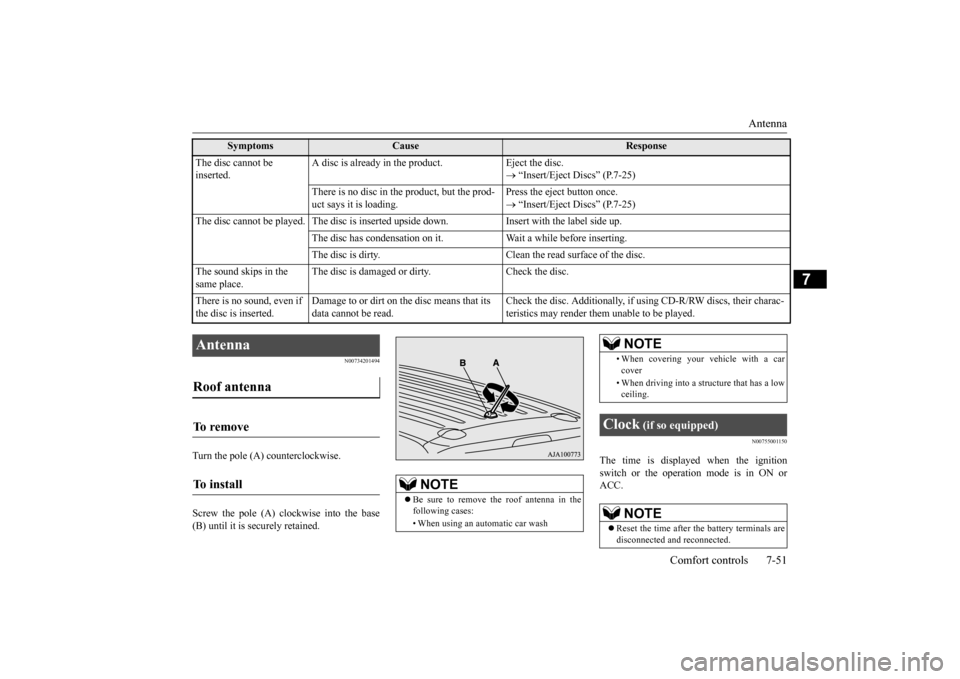
Turn the pole (A) counterclockwise. Screw the pole (A) clockwise into the base (B) until it is securely retained.
N00755001150
The time is displayed when the ignition switch or the operation mode is in ON orACC.
The disc cannot be inserted.
A disc is already in the product. Eject the disc.
“Insert/Eject Discs” (P.7-25)
There is no disc in
the product, but the prod-
uct says it is loading.
Press the eject button once. “Insert/Eject Discs” (P.7-25)
The disc cannot be played. The
disc is inserted up
side down. Insert with
the label side up.
The disc has condensation on it
. Wait a while before inserting.
The disc is dirty. Clean the
read surface of the disc.
The sound skips in the same place.
The disc is damaged or dirty. Check the disc.
There is no sound, even if the disc is inserted.
Damage to or dirt on the disc means that its data cannot be read.
Check the disc. Additionally, if using CD-R/RW discs, their charac- teristics may render them
unable to be played.
Symptoms
Cause
Response
Antenna Roof antenna To remove To install
NOTE
Be sure to remove the roof antenna in the following cases: • When using an automatic car wash
• When covering your ve
hicle with a car
cover • When driving into a structure that has a low ceiling.
Clock
(if so equipped)
NOTE
Reset the time after the battery terminals are disconnected an
d reconnected.
NOTE
BK0223400US.book 51 ページ 2015年2月13日 金曜日 午後12時15分
Page 424 of 464
Fuses 9-26 Vehicle care and maintenance
9
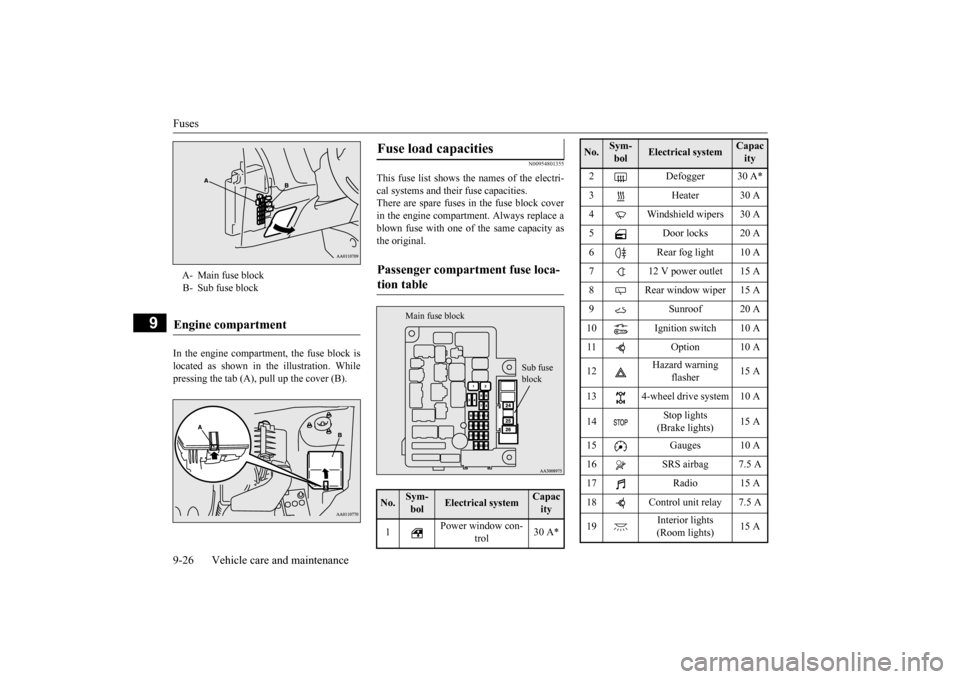
In the engine compartment, the fuse block is located as shown in the illustration. Whilepressing the tab (A), pull up the cover (B).
N00954801355
This fuse list shows the names of the electri- cal systems and their fuse capacities. There are spare fuses in the fuse block coverin the engine compartment. Always replace a blown fuse with one of the same capacity as the original.
A- Main fuse block B- Sub fuse blockEngine compartment
Fuse load capacities Passenger compartment fuse loca- tion table No.
Sym- bol
Electrical system
Capacity
1
Power window con-
trol
30 A*
Sub fuse block
Main fuse block
2 Defogger 30 A* 3 Heater 30 A 4 Windshield wipers 30 A 5 Door locks 20 A6 Rear fog light 10 A7 12 V power outlet 15 A8 Rear window wiper 15 A9 Sunroof 20 A 10 Ignition switch 10 A 11 Option 10 A 12
Hazard warning
flasher
15 A
13 4-wheel drive system 10 A 14
Stop lights (Brake lights)
15 A
15 Gauges 10 A 16 SRS airbag 7.5 A 17 Radio 15 A18 Control unit relay 7.5 A 19
Interior lights (Room lights)
15 A
No.
Sym- bol
Electrical system
Capacity
BK0223400US.book 26 ページ 2015年2月13日 金曜日 午後12時15分
Page 438 of 464
Cleaning the outside of your vehicle 9-40 Vehicle care and maintenance
9
N00945901637
Chemicals cont
ained in the dirt and dust
picked up from air, rain, snow, or road sur- faces can damage the paint and body of yourvehicle if left on. Frequent washing and wa
xing is the best way
to protect your vehicl
e from this damage.
Do not wash the vehicle in direct sunlight. Park the vehicle in the shade and spray it with water to remove dust.
Next, using plenty of
clean water and
a car washing mitt or sponge,
wash the vehicle from top to bottom.Use a mild car washing soap if necessary. Rinse thoroughly and wipe dry with a cham- ois or soft cloth. After washing the vehicle,carefully clean the joints and flanges of the doors, hood, etc., wher
e dirt is likely to
remain.
Salt and other chemical
s used on winter roads
in some geographical ar
eas can have a detri-
mental effect on the vehicle underbody. You should flush the underbody with a high pres- sure hose every time you wash the outside ofyour vehicle. Take special care to
remove mud or other
debris which could trap and hold salt andmoisture. After washing your vehicle, wipe off all waterdrops from the rubber parts around thedoors to prevent the doors from freezing.
Wa s h i n g
CAUTION When washing the underside of your vehicle or the wheels, wear a pair of gloves to pro- tect your hands. If your vehicle has rain
sensor wipers, place
the wiper switch lever in the “OFF” positionto deactivate the rain
sensor before washing
the vehicle. Otherwise,
the wipers will oper-
ate in the presence of water spray on thewindshield and may get
damaged as a result.
Never spray or splash
water on the electrical
parts in the engine compartment. This maydamage them. Be careful also when washingthe underbody to ensure that water does not enter the engine compartment. Avoid automatic car washers that use rotat- ing brushes. These brushes may scratch the paint surface and make it dull.Scratches are more not
iceable on darker col-
ored vehicles. Some hot water wash
ing equipment uses
high pressure and heat to clean your vehicle. Because hot water can da
mage plastics parts
and seep inside your ve
hicle, make sure you
do the following when using such equip- ment:• Keep the washing nozzle at least 28 inches(70 cm) away from the vehicle body.• When washing around the door glass, holdthe nozzle at a distance of more than 28inches (70 cm) and at a right angle to the glass surface.
Make sure to do the following when using an automatic car wash, with help from either this manual or the car wash operator, toavoid damaging your vehicle:• Fold the outside rearview mirrors.• Remove the antenna.• Tape or remove the rear wiper arm assem- bly.• If your vehicle is equi
pped with a roof rails,
check with the car wash operator before using the car wash.CAUTION
• If your vehicle is equipped with the rainsensor wipers, place th
e wiper switch lever
in the “OFF” position to deactivate the rainsensor.
During cold weather
NOTE
When the door is frozen, opening it by force may tear off or crack the rubber gasketinstalled around the door. Pour warm water to melt the ice. Be sure to thoroughly wipe off the water after opening the door. To pre-vent freezing of the we
atherstripping on the
doors, hood, etc., treat with silicone lubri- cant.CAUTION
BK0223400US.book 40 ページ 2015年2月13日 金曜日 午後12時15分
Page 439 of 464
Cleaning the outside of your vehicle Vehicle care and maintenance 9-41
9
N00946000205
Wax your vehicle once or twice a year, or when water does not
bead up on the paint.
Use a soft cloth to put a small amount of waxon the painted surfaces. After the wax has dried, polish with a dry soft cloth. Do not wax your vehicle
in direct sunlight.
You should wax when the painted surfaces are cool.
N00946100046
If painted surfaces have
been severely dam-
aged and lost their original luster and colortone, polish the surface
lightly with a fine
polishing compound. Avoid limiting your polishing to the damage
d surface only; polish
a somewhat wider area, moving the polishing cloth in one direction.
After polishing, flush
the compound from the surface and apply acoat of wax to regain a beautiful luster.
N00946201099
Small cracks and scratches in the paint coatshould be touched up as soon as possible with touch-up paint to prevent corrosion. Check body areas facing the road or the tirescarefully for damage to the paint caused by flying stones, etc. The paint code number for your vehicle can be found on the vehicle
information code plate located on the front passenger door sill.
N00946301221
Use a sponge or chamois to clean these parts.If the vehicle wax sticks to a gray or blackrough surface of the bumper, molding or lights, the surface may appear white in color. In this case, wipe it
off using lukewarm water
and a soft cloth or chamois.
Waxing
CAUTION Waxes containing high abrasive compounds should not be used. These waxes remove rust and stain effectively from the paintwork, butare harmful to the finish of the paint, because they also remove paint/clearcoat. They are also harmful to other glossy sur-faces such as the grille, trim, moldings, etc. Do not use gasoline, benzine, kerosene or paint thinners to remove road tar or other dirt from the vehicle surface. Do not put wax on the areas having black matte coating because
it can cause uneven
discoloration, patches, bl
urs, etc. If these get
wax on them, wipe the wax off right away with a soft clot
h and warm water.
On vehicles with sunr
oof, be careful not to
apply any wax on the
weatherstrip (black
rubber) when waxing the area around thesunroof opening. If stained with wax,
the weatherstrip cannot
maintain a weatherproof seal with the sun-roof.
Polishing Damaged paint
CAUTION
Cleaning plastic parts
CAUTION Do not use a scrubbing brush or other rough scrubber as these may
damage the plastic
surface. Do not use wax containing compounds (pol- ishing powder) which
may damage the plas-
tic surface. Do not let plastic parts
get soiled with gaso-
line, oil, brake fluids, engine oils, greases, paint thinner, and sulfuric acid (battery elec-trolyte), as such substa
nces will cause stains,
cracks, or discoloration. If any of these get on a plastic part, wipethem up with a soft cloth or chamois and a mild solution of soap and water. Then rinse them immediately with water.
BK0223400US.book 41 ページ 2015年2月13日 金曜日 午後12時15分
Page 440 of 464
Cleaning the outside of your vehicle 9-42 Vehicle care and maintenance
9
N00946400052
To prevent spots and corrosion of chrome parts, wash with water, dry thoroughly, and apply a nonabrasive automotive wax. If thechrome is severely da
maged or pitted, use a
commercially available chrome polish.
N00946500183
1. Remove dirt using a wet sponge. 2. Use a mild detergent on any dirt that can-not be removed ea
sily with water.
Rinse off the detergent after washing the wheel.3. Dry the wheel thoroughly using a chamois leather or a soft cloth.
N00946600054
The window glass can
usually be cleaned
using only a sponge and
water. Glass cleaner
can be used to remove wax, oil, grease, deadinsects, etc. After washing the glass, wipe it dry with a clean, dry, soft cloth.
N00946700068
Use a soft cloth and gl
ass cleaner to remove
grease, dead insects, etc., from the wiperblades. Replace the wiper blades when they no longer clean the windshield and rear window prop-erly.
N00946800069
Clean the inside of the sunroof with a soft cloth. Hard deposits
should be wiped away
with a cloth dipped in
warm, neutral deter-
gent solution. Wipe away the solution with a sponge dipped in fresh water.
N00947000071
Never spray or splash
water on the electrical
accessories in the engine compartment. This puts the engine at risk of being damaged.Do not bring the circum
ferential parts, the
plastic parts and so on
into contact with sulfu-
ric acid (battery electrolyte) which maycrack, stain or discolor them. If they are in contact, wipe off with soft cloth, chamois or the like and an aqueous solutionof neutral detergent th
en immediately rinse
the affected parts with plenty of water.
Chrome parts Aluminum wheels
(if so equipped)
CAUTION Do not use a brush or other hard implement on the wheels. Do not use any cleaner th
at contains an abra-
sive substance or is ac
idic or alkaline. Doing
so could cause the coating on the wheels to peel or become disc
olored or stained.
Do not directly apply
hot water using a steam
cleaner or by any other means. Contact with seawater or road salt used for de-icing can cause corro
sion. Rinse off such
substances as s
oon as possible.
Window glass Wiper blades Cleaning the sunroof (if so equipped)
NOTE
The surface treatment on the inside of the glass may be removed
if a hard cloth or
organic solvent is used.
Engine compartment
BK0223400US.book 42 ページ 2015年2月13日 金曜日 午後12時15分
Page 451 of 464
Vehicle weights
Specifications 11-5
11
N01147601927
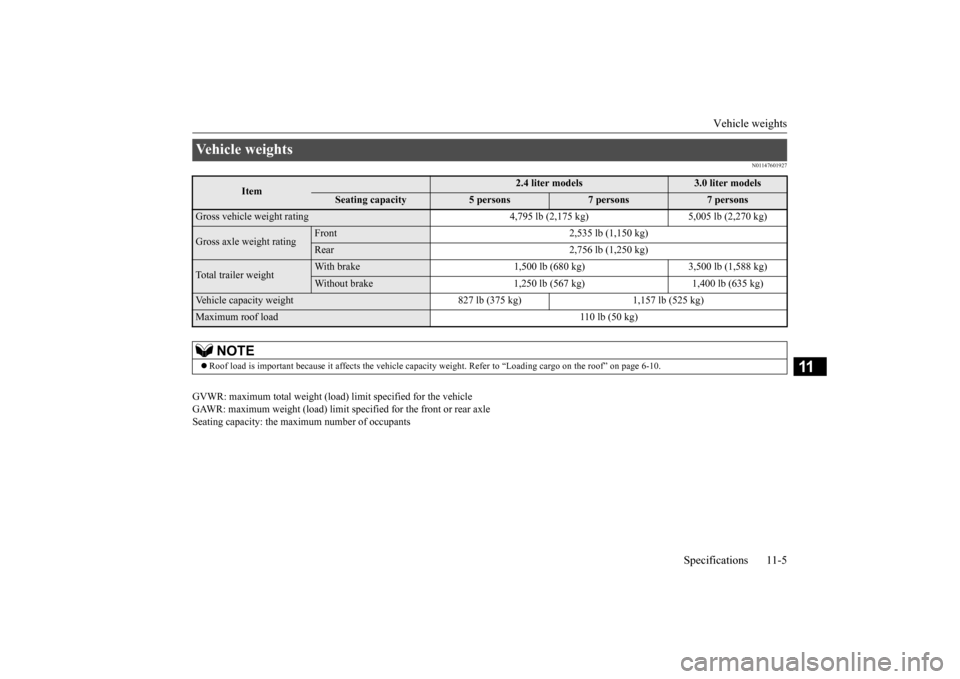
GVWR: maximum total weight (load) limit specified for the vehicle GAWR: maximum weight (load) limit specified for the front or rear axle Seating capacity: the maxi
mum number of occupants
Vehicle weights
Item
2.4 liter models
3.0 liter models
Seating capacity
5 persons
7 persons
7 persons
Gross vehicle weight
rating 4,795 lb (2,175 kg) 5,005 lb (2,270 kg)
Gross axle weight rating
Front 2,535 lb (1,150 kg)Rear 2,756 lb (1,250 kg)
Total trailer weight
With brake 1,500 lb (680 kg) 3,500 lb (1,588 kg)Without brake 1,250 lb (567 kg) 1,400 lb (635 kg)
Vehicle capacity weight 827 lb (375 kg) 1,157 lb (525 kg)Maximum roof load 110 lb (50 kg)
NOTE
Roof load is important becaus
e it affects the vehicle capacity weight. Refe
r to “Loading cargo on the roof” on page 6-10.
BK0223400US.book 5 ページ 2015年2月13日 金曜日 午後12時15分
Page 457 of 464
Alphabetical index
12-1
12
Numerics
12 V power outlets
............................
5-219
4-wheel drive operation
.......................
5-85
A
Accessory (installation)
.........................
3-6
Active stability control (ASC)
..............
5-94
Adaptive Cruise C
ontrol System (ACC)
.......
5-100 Air bag
..............................................
4-33
Air cleaner filter
...................................
9-9
Air conditioner
Automatic climate control air conditioner
.
7-5 Important air condi
tioning operating tips
..
7-14
Air purifier
.........................................
7-15
All-wheel drive operation
....................
5-85
Aluminum wheels
...............................
9-42
AM/FM radio
.....................................
7-15
Antenna
Roof antenna
..................................
7-51
Anti-lock braking system
.....................
5-91
Arm rest
...............................................
4-9
Assist grip
........................................
5-235
Audio
AM/FM radio
.................................
7-15
CD player
......................................
7-15
Troubleshooting
.............................
7-49
Automatic climate cont
rol air conditioner 7-5
Automatic transaxle
............................
5-64
Fluid
.....................................
9-11
, 11-7
Selector le
ver operation
..................
5-64
Selector lever positions
...................
5-68
Sports mode
...................................
5-68
B
Back-up light
Bulb capacity
.................................
9-30
Replacement
..................................
9-36
Ball joint, steering linka
ge seals, drive shaft
boots
...............................................
9-24
Battery
..............................................
9-13
Charging system warning light
.......
5-174
Checking battery
electrolyte level
....
9-13
Disconnection and connection
.........
9-14
During cold weather
.......................
9-13
Specification
..................................
11-6
Bluetooth® 2.0 interface
....................
5-192
Bottle holders
....................................
5-233
Brake
Fluid
.....................................
9-12
, 11-7
Brake assist
........................................
5-90
Braking
Anti-lock braking system
................
5-91
Braking
............................................
6-5
Hose
..............................................
9-24
Pad wear alarm
...............................
5-89
Parking brake
.................................
5-53
Pedal
.............................................
5-89
Pedal free play
................................
9-21
Power brakes
..................................
5-89
Service brake
..................................
5-89
Warning lights and buzzer
.............
5-173
Break-in recommendations
....................
5-3
Bulb capacity
......................................
9-30
C
California Perchl
orate Materials
Requirements
.....................................
3-7
Capacities
..........................................
11-7
Card holder
............................
5-219
, 5-229
Cargo area cover
...............................
5-233
Cargo loads
........................................
6-10
Cargo room light
...............................
5-227
Bulb capacity
.................................
9-32
Catalytic converter
................................
9-2
Cautions on the handling of all-wheel drive vehicles
............................................
5-88
CD player
...........................................
7-15
Certification label
...............................
11-3
Charging system warning light
...........
5-174
Child restraint systems
........................
4-26
BK0223400US.book 1 ページ 2015年2月13日 金曜日 午後12時15分
Page 460 of 464

Alphabetical index 12-4
12
M
MIVEC engine
..........................
5-25
, 5-64
Modification of your vehicle
..................
3-5
Multi information display - Type 1
.....
5-128
Multi information display - Type 2
.....
5-146
O
Octane rating
........................................
3-2
Oil
Engine oil
......................................
11-7
Rear axle oil
...................................
11-7
Transfer oil
....................................
11-7
Operation under adverse driving conditions
...
8-15 Outside rearview mirrors
.....................
5-57
Overheating
.........................................
8-4
P
Parking
................................................
6-6
Parking brake
.................................
5-53
Parking lights
Bulb capacity
.................................
9-30
Replacement
..................................
9-34
Polishing
............................................
9-41
Power brakes
......................................
5-89
Power liftgate
.....................................
5-38
Power outlet
.....................................
5-219
Power windows
...................................
5-49
Puncture (Tire changing)
.......................
8-6
R
Radiator cap
........................................
9-9
Radio
.................................................
7-15
General information
about your radio 7-52
Reading lights
Bulb capacity
..................................
9-32
Rear axle oil
..............................
9-12
, 11-7
Rear combination lights
Bulb capacity
..................................
9-30
Replacement
...................................
9-35
Rear side-marker lights
Bulb capacity
..................................
9-30
Rear turn signal light
Bulb capacity
..................................
9-30
Replacement
...................................
9-35
Rear-view camera
.............................
5-124
Rearview mirror
Inside rearview mirror
.....................
5-55
Outside rearview mirrors
.................
5-57
Replacement of light bulbs
...................
9-29
Replacing tires and wheels
...................
9-19
Reporting Safety Defects
.....................
10-2
Roof antenna
......................................
7-51
S
Safe driving techniques
.........................
6-4
S-AWC (Super-All Wheel Control)
......
5-81
Seat belt
Adjustable seat belt shoulder anchor
.4-23
Child restraint systems
....................
4-26
Front passenger seat belt warning light
.....
4-22Maintenance and inspection
.............
4-33
Seat belt extender
...........................
4-24
Seat belt force limitter
.....................
4-26
Seat belt pr
e-tensioners
...................
4-24
Seat belt use
during pregnancy
.........
4-24
Seat belts
...........................................
4-17
Seats
....................................................
4-2
Arm rest
..........................................
4-9
Front seats
.......................................
4-4
Head restraints
...............................
4-10
Heated seat
......................................
4-8
Making a cargo area
........................
4-12
Making a flat seat
...........................
4-16
Seat arrangement
..............................
4-3
Seats and restraint systems
................
4-4
Second row seats
..............................
4-8
Third row seats
...............................
4-10
Service brake
......................................
5-89
Service precautions
...............................
9-2
Side turn-signal light
Bulb capacity
.................................
9-30
BK0223400US.book 4 ページ 2015年2月13日 金曜日 午後12時15分